








BluEnt’s IT Security and Cybersecurity practice delivers five integrated sub-services: Cloud Security, Cybersecurity Compliance (SOC 2, HIPAA, GDPR, PCI DSS), Identity and Access Management, Risk Management (Vendor, Project, Application), and Business Continuity and Disaster Recovery.
Programs are mapped to NIST Cybersecurity Framework 2.0, NIST 800-53 Rev. 5, ISO 27001 Annex A, and CIS Controls v8. BluEnt engineers controls and prepares audit evidence; we do not provide threat detection, threat hunting, incident response, or forensic services.
BluEnt is an enterprise IT Security and Cybersecurity engineering partner for regulated industries. Our team designs the security program, engineers the controls into your platforms, authors the policy library, and prepares the evidence pack your auditors and customers expect.
Engagements are scoped to one or more of the five sub-services and to the regulatory profile of your environment. Most enterprises start with one entry point (compliance for a SOC 2 push, cloud security for a migration, BCP for a cyber insurance renewal) and expand from there.
Every engagement produces concrete artifacts: a current-state maturity assessment against NIST CSF 2.0; an engineered control set with named owners and automated evidence collection; a policy and procedure library version-controlled and refreshed quarterly; and an exercise calendar that proves controls actually work.
BluEnt is your engineering and readiness partner. We do not provide threat detection, threat hunting, incident response, or forensic services. Detection and containment remain with your SOC and IR partner; we design and engineer the controls and the recovery program their handoff activates.
Trusted By
Organizations That Trust BluEnt With Their Data

- Gift Card Management, Reporting, Data Integration, Analytics Solutions, Book Keeping NetSuite Reporting, NetSuite Records Maintenance, Income Statement, Audit Support

- Gift Card Management, Reporting, Data Integration, Analytics Solutions

- Invoicing, AP Reports, Sales Data Analytics

- MuleSoft Integration, Analytics & Dashboards - [Tableau, MS SQL Server, SSIS]

- ERP Onboarding and Implementation, Data Migration, Custom Report Building, Audit Support and Finalization, Draft Financials Statements, Bidding Website Development

- Data Analytics and Dashboards

- V-Bucks Gift Card Sales Analytics, Reconciliation, Financial Tracking and Reporting
- Web Asset Creation

- HubSpot Campaign Management, Workflow Automation, UX/UI Development, Mobile App Development, Application Development

- Data Analytics and Dashboards, Website Development, Website Maintenance, Application Development, HubSpot Automation and Integration, Asana Management

- SEO, Website UX/UI Development, Data Management, Third-Party Integration, Website Maintenance

- Shopify Website Development, Klaviyo Email Marketing, Email Campaign Setup, Third-Party Shopify App Integration
- Website and SEO Audit, Shopify Website Maintenance, SEO and Analytics

- Website Design and Development, Website Maintenance

- Website Design and Development, Website Maintenance

- Website Design and Development, Website Maintenance, SEO and Analytics
Is This Your Situation?
BluEnt is the right cybersecurity partner if any of the following describe your current state.
-
Your security controls live across cloud, identity, compliance, and continuity tools but no single team has a current map of how they fit together.
-
An external auditor, regulator, customer, or cyber insurer is asking for evidence of operating effectiveness across more than one framework, and your team is rebuilding the evidence each cycle.
-
A cloud migration, M&A integration, or new product line has expanded your attack surface faster than your security program has matured.
-
Your policy library was written years ago, your controls have evolved, and there is no continuous mechanism keeping the two aligned.
-
Procurement is asking for a single accountable partner across multiple security workstreams rather than juggling specialist vendors per domain.
-
Cyber insurance renewal is approaching and the questionnaire asks for evidence you cannot produce in the time available.
What Makes BluEnt Different
Enterprise cybersecurity vendors come in three shapes: big-firm consultancies that write strategy but rarely engineer controls, single-domain specialists that solve one problem but not the program, and SOC service providers that detect and respond after the fact. BluEnt occupies the engineering and governance space that connects them.
| Without an Engineering-Led Cybersecurity Partner | With BluEnt |
|---|---|
|
Strategy decks without engineered controls. |
Engineered controls in the platforms you run, with named owners and automated evidence. |
|
Specialist vendors per domain with no shared operating model. |
One integrated program across cloud, compliance, identity, risk, and continuity. |
|
Policies written once and shelved. |
Policy library version-controlled, refreshed quarterly, mapped to the audited framework. |
|
Evidence collected manually each audit cycle. |
Evidence collection automated into your GRC tool (Drata, Vanta, OneTrust, ServiceNow GRC). |
|
Annual security review divorced from engineering. |
Continuous control monitoring integrated with engineering ticketing and change management. |
For the integrated five-sub-service model, see Cloud Security Services and Cybersecurity Compliance Services.
The Five Sub-Services
BluEnt’s IT Security and Cybersecurity practice is delivered as five integrated sub-services. Each has its own dedicated page with the controls, methodology, and scoping detail a buyer needs.
Most engagements begin with one entry point and expand. The table below summarizes what each sub-service delivers; click through for depth.
| Control Family | Control IDs | What BluEnt Engineers | Tooling Examples |
|---|---|---|---|
| Cloud Security Services | AWS, Azure, Google Cloud | Zero Trust landing zones, Cloud Security Posture Management, CNAPP, Kubernetes hardening, DevSecOps integration. NIST 800-53, CIS Benchmarks, CSA CCM coverage. | See: Cloud Security Services page. |
| Cybersecurity Compliance | SOC 2, HIPAA, GDPR, PCI DSS | Framework-specific readiness, policy authoring, control engineering, evidence automation, mock audit. Dedicated pages per framework available. | See: Compliance hub, SOC 2, HIPAA, GDPR, PCI DSS pages. |
| Identity and Access Management | AC, IA, IAM, PAM, IGA, CIEM | Joiner-Mover-Leaver lifecycle, Zero Trust identity architecture, MFA enforcement, privileged access, identity governance, cloud entitlement management. | See: Identity and Access Management page. |
| Risk Management | TPRM, Project, Application | Vendor risk (TPRM), project risk, application risk. Risk register integrated with engineering and vendor lifecycle. GRC tool configuration. | See: Risk Management page. |
| Business Continuity and Disaster Recovery | BCP, DR, ISO 22301 | Business Impact Analysis, Business Continuity Plan, Disaster Recovery architecture (immutable backups, infrastructure-as-code failover), tabletop and full-scale exercise program. | See: Business Continuity and Disaster Recovery page. |
How to Choose a Cybersecurity Partner
Procurement teams at regulated enterprises ask the same questions when evaluating an integrated cybersecurity partner. The answers below are the criteria BluEnt is built to meet.

Engineering depth, not just strategy
Strategy decks do not protect data. The right partner engineers controls into the platforms you run, with code, runbooks, and named owners. Ask to see a sample Terraform module or policy-as-code rule before you sign.

Integrated across the five sub-services
Cloud, compliance, identity, risk, and continuity are not independent workstreams. Controls overlap. The right partner runs an integrated program where the same control evidence supports multiple frameworks and the same identity model feeds compliance, cloud, and risk.

Framework-agnostic mapping
NIST CSF 2.0, NIST 800-53, ISO 27001 Annex A, CIS Controls v8, and the framework you are audited against (SOC 2, HIPAA, GDPR, PCI DSS) all overlap. The right partner maps every recommendation to the catalogs you care about and the framework you are assessed against.

Continuous evidence, not annual heroics
An audit should be an export, not a fire drill. The right partner configures your GRC tool for continuous evidence collection so the next audit cycle is a renewal, not a rebuild.

Honest scope boundaries
An integrated partner that claims to do everything is rarely doing any of it well. BluEnt is explicit about what it does (engineering, readiness, governance) and what it does not (threat detection, threat hunting, incident response, forensic services). Those remain with your SOC and IR partner.
Where does your security program stand today?
Take the BluEnt Cybersecurity Maturity Assessment for a free, audit-defensible benchmark across the six security domains, with a target-state roadmap on the other side.
How We Deliver: A Five-Stage Methodology
Every BluEnt engagement follows the same five-stage methodology, applied within whichever sub-services are in scope.
Stage 1: Scoping and Maturity Assessment
We benchmark current controls against NIST CSF 2.0 across the six functions (Govern, Identify, Protect, Detect, Respond, Recover) and against the framework you are audited against. Output is a prioritized remediation backlog.
Stage 2: Operating Model and Architecture Design
We design the target operating model: control catalog, accountable owners, GRC tool configuration, policy library structure. Architecture covers cloud, identity, evidence flow, and recovery.
Stage 3: Control Engineering and Evidence Automation
We engineer controls as Infrastructure-as-Code where applicable: cloud guardrails, IAM and PAM rollouts, DLP and DSPM coverage, configuration management, change-management gates. Evidence collection is automated into the GRC tool.
Stage 4: Validation and Mock Audit
We run an internal validation that mirrors auditor procedures. Findings are remediated before any external assessor begins fieldwork. For frameworks like SOC 2 and PCI DSS, this is the formal pre-assessment.
Stage 5: Continuous Operations and Quarterly Refresh
BluEnt operates the control program, refreshes documentation quarterly, supports your external auditors, and integrates with engineering change management. Continuity exercises run on cadence.
For methodology applied to a specific sub-service, see Cloud Security Services or Cybersecurity Compliance Services.
Capabilities at a Glance
The five sub-services that frame the BluEnt cybersecurity practice. Each is delivered in-house by BluEnt engineers and consultants. None of the cards below cover threat detection, threat hunting, incident response, or forensics; those remain with your chosen SOC and IR partner.

Cloud Security Services
Zero Trust landing zones, CSPM, CNAPP, network segmentation, Kubernetes security across AWS, Azure, and Google Cloud. Built on two decades of enterprise cloud delivery.

Cybersecurity Compliance Services
SOC 2 Type II, HIPAA Security Rule, GDPR Article 32, PCI DSS v4.0 readiness. Policy library, control engineering, evidence automation, mock audit. Dedicated framework pages available.

Identity and Access Management
JML lifecycle, Zero Trust identity architecture, MFA, PAM, IGA, CIEM. Microsoft Entra ID, Okta, Ping, CyberArk, BeyondTrust integration.

Risk Management (Vendor, Project, Application)
Third-Party Risk Management, project risk, application risk. Integrated risk register in ServiceNow GRC, Archer, OneTrust, or Drata.

Business Continuity and Disaster Recovery
Business Impact Analysis, BCP, DR architecture with immutable backups (3-2-1-1-0), tabletop and full-scale exercise program aligned to ISO 22301 and APRA CPS 230.

Cybersecurity Maturity Assessment
Free benchmark across NIST CSF 2.0 six functions and the BluEnt six security domains. Target-state roadmap, prioritized remediation, audit-evidence baseline.
Industries We Serve
BluEnt delivers IT Security and Cybersecurity programs across four regulated verticals. Each vertical’s regulatory pressures and threat profile differ.

Architecture, Engineering, and Construction
AEC firms operate on project-bound timelines, with BIM platforms, design IP, and supplier-chain exposure. BluEnt scopes Cloud Security, IAM, and BCP first; Compliance follows when enterprise customers require SOC 2.

Healthcare and Life Sciences
Healthcare combines HIPAA Security Rule with SOC 2 for most digital-health SaaS. ePHI controls and BAA workflow anchor the program. BluEnt scopes Compliance and IAM in parallel given the heavy overlap.

E-Commerce and Retail
Retail combines PCI DSS v4.0 for payment flows with SOC 2 for B2B SaaS modules. Peak-season continuity is material. BluEnt typically scopes Compliance, BCP, and Cloud Security together.

Manufacturing and Industrial
Manufacturing introduces OT and ICS exposure alongside IT. NIS2 essential-entity status applies in the EU. BluEnt scopes the convergence of IT and OT security; OT-specific monitoring and operations are co-delivered with specialist partners.
Vertical-specific compliance programs are detailed on the Cybersecurity Compliance Services Hub. For vertical-specific recovery, see Business Continuity and Disaster Recovery.
Cybersecurity Services Across Six Markets
BluEnt delivers cybersecurity programs across six markets, each with its own regulatory expectations.

United States NIST CSF 2.0 (private sector reference), NIST 800-53 Rev. 5, HIPAA Security Rule, NY DFS 23 NYCRR 500 for in-scope financial firms, SEC cyber disclosure rules for public companies.
United Kingdom NCSC Cyber Assessment Framework, Cyber Essentials, ISO 27001, UK GDPR, Bank of England SS1/21 Operational Resilience for PRA-regulated firms.
Australia APRA CPS 234 Information Security, APRA CPS 230 Operational Risk Management, ASD Essential Eight, Australian Government ISM, Privacy Act 1988.
Canada OSFI Guideline B-13 technology and cyber risk, OSFI Guideline E-21 Operational Risk Management, PIPEDA, Quebec Law 25 provincial overlay.
Netherlands and EU NIS2 Directive, GDPR Article 32, DORA operational resilience for financial entities, ISO 27001.
Broader Europe NIS2 national transpositions, German BSI Act, French ANSSI sectoral guidance, EU Cyber Resilience Act for connected products.
For region-specific compliance evidence, see Cybersecurity Compliance Services. For region-specific continuity, see Business Continuity and Disaster Recovery.
An Integrated Cybersecurity Program, Engineered Into the Platforms You Run
Enterprise cybersecurity has matured beyond perimeter thinking, standalone tools, and annual audits. The organizations that handle it well run an integrated program: cloud, compliance, identity, risk, and continuity engineered together, with shared evidence, shared owners, and a single accountable partner.
BluEnt designs and engineers that program across five integrated sub-services. We are explicit about what we do (engineering, readiness, governance) and what we do not (threat detection, threat hunting, incident response, forensics). Detection and containment remain with your SOC and IR partner; BluEnt builds the controls and the recovery program their handoff activates.
Whether you are starting from a maturity assessment, consolidating fragmented vendors, preparing for a regulated audit, or scaling a program across regions, our team works alongside yours from day one.
Explore the IT Security and Cybersecurity Practice
Frequently Asked Questions
What services does BluEnt’s cybersecurity practice include?
Five integrated sub-services: Cloud Security; Cybersecurity Compliance (with dedicated SOC 2, HIPAA, GDPR, and PCI DSS pages); Identity and Access Management; Risk Management (Vendor, Project, Application); and Business Continuity and Disaster Recovery. Each has its own dedicated page. Most engagements start with one and expand.
What does BluEnt NOT provide?
BluEnt does not provide threat detection, threat hunting, incident response, security operations center (SOC) services, or digital forensics. These remain with your chosen SOC and IR partners. BluEnt designs and engineers the controls, the evidence collection, and the recovery program their handoff activates. We also do not act as your external compliance auditor; AICPA and PCI SSC independence rules require those roles to be separate.
How does BluEnt’s practice align with NIST CSF 2.0?
Programs map to all six NIST CSF 2.0 functions (Govern, Identify, Protect, Detect, Respond, Recover) at the design and engineering layer. Detect, Respond, and Recover are designed and engineered by BluEnt; the Detect and Respond operational functions are co-delivered with your chosen SOC and IR partner where applicable.
Can BluEnt run an enterprise cybersecurity program across multiple frameworks at once?
Yes. Because the underlying control catalog (NIST 800-53 Rev. 5, ISO 27001 Annex A, CIS Controls v8) is largely shared across SOC 2, HIPAA, GDPR, PCI DSS, and ISO 27001, BluEnt scopes a unified evidence program where multiple frameworks apply. The same control evidence supports multiple audits, reducing total work by approximately 40 to 60 percent compared to running each program in isolation.
What size of organization does BluEnt serve?
Enterprise organizations from approximately 200 employees up to 50,000+. The five sub-services scale up and down: a 250-person SaaS organization may engage BluEnt for SOC 2 and Cloud Security; a 5,000-person manufacturer may engage across all five sub-services with multi-region rollout.
How quickly can BluEnt start?
Typical kickoff is within two weeks of contract signature. A Stage 1 scoping and maturity assessment runs 1 to 4 weeks depending on environment complexity. Engineering work begins in parallel where the scope is clear.
View Our Projects
Dive into our portfolio and witness how BluEnt transforms bold ideas into powerful digital solutions.
From enterprise-grade applications to data-driven platforms, each project tells a story of innovation,
ROI, and long-lasting impact.

CRM, ERP & Business Apps | Case Study
Asana-HubSpot Integration
Discover how BluEnt help HFS in achieving task automation with real-time data synchronization and efficient ecosystem.

CMS & E-Commerce Platforms | Case Study
HFS Website Overhaul
Learn how BluEnt modernized the website to support heavy research content & deliver consistent UI/UX with better performance.
CMS & E-Commerce Platforms | Case Study
Author Dashboard Transformation
Explore how BluEnt developed a unified & comprehensive dashboard for better performance tracking and report collaboration.

CMS & E-Commerce Platforms | Case Study
Custom Elementor Widget
Learn how the custom elementor widget, developed by BluEnt, let HFS Research get off from its dependency over expensive…
CMS & E-Commerce Platforms | Case Study
Custom WordPress Videocast Plugin
Discover how BluEnt created a custom WordPress videocast plugin to improve loading time & performance of HFS Research podcast…

CMS & E-Commerce Platforms | Case Study
Report Analytic Dashboard
Discover how BluEnt designed & developed a comprehensive report analytic dashboard for HFS to generate accurate data.
Industry Trends & Innovation
Ideas That Drive Industries
Explore a 360° content hub featuring expert-written blogs, practical use cases, and FAQs,
all designed to spark innovation, solve challenges, and sharpen your competitive edge.
Whether you're shaping strategy or validating decisions, our insight-driven content
equips you with clarity, confidence, and the direction you need to stay ahead.
 Governing AI Tools in AEC: Copilot, Digital Twins, and Generative Design
 Data Governance for AI and Advanced Analytics: Building the Foundation That Works
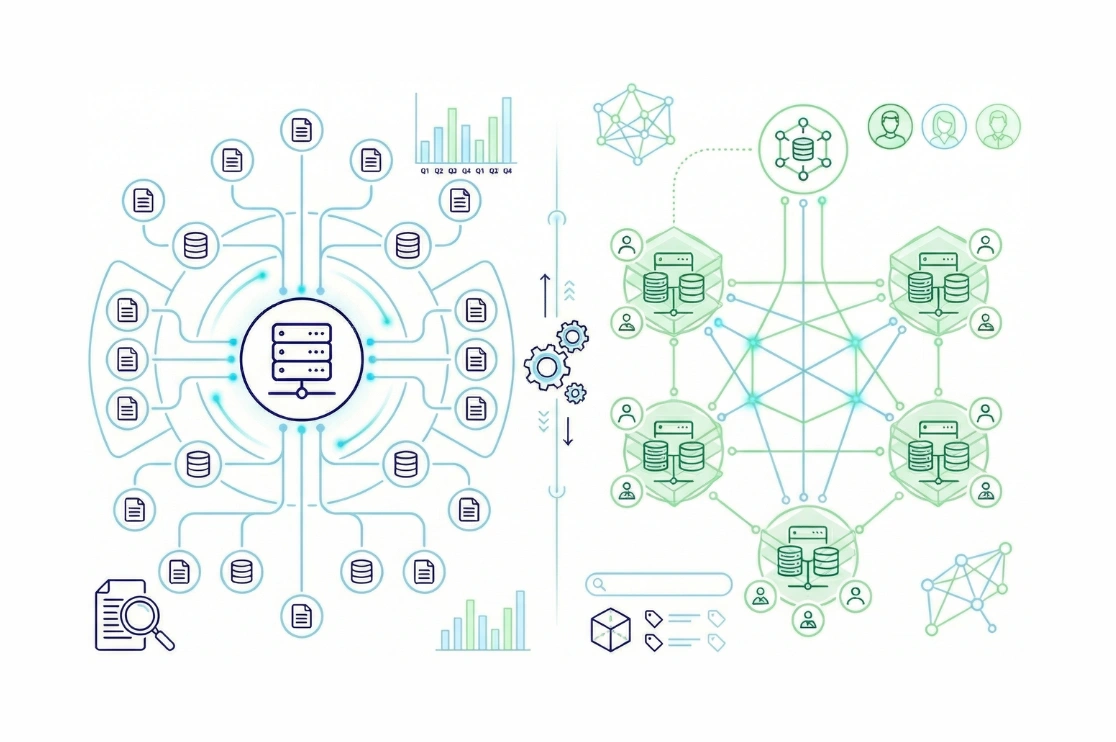 Centralized vs. Federated vs. Hybrid Data Governance: Which Model Fits Your Organization
 Data Governance Roles and Responsibilities in AEC Organizations