











Short answer
Zero Trust Data Security applies the seven NIST SP 800-207 Zero Trust tenets specifically to data assets: data is treated as a resource that must be verified before access regardless of network location; access is granted based on the sensitivity of the data, the identity and context of the requester, and the stated purpose of use; access is continuously monitored and anomalies trigger re-verification. Implementing Zero Trust at the data layer requires three governance prerequisites that most organizations have not completed before starting a Zero Trust initiative: a complete and current data classification scheme applied to all governed data assets, defined data ownership with formal accountability, and a data catalog that surfaces classification and ownership metadata to the access control policy engine. Without these foundations, Zero Trust access policies cannot be applied at the data level – only at the system level, which is the network-layer implementation that most Zero Trust deployments stop at.
Zero Trust security has moved from a concept to a mainstream enterprise initiative. Most large organizations have implemented Zero Trust in some form at the network and identity layers: micro-segmentation, multi-factor authentication, privileged access management, and continuous session verification. These are genuine improvements over perimeter-based security models. They are not, by themselves, Zero Trust for data.
Zero Trust at the network layer asks: is this user who they claim to be, and are they authorized to access this system? Zero Trust at the data layer asks a more precise question: is this user authorized to access this specific data asset, for this purpose, given its sensitivity level and their current context? The second question requires knowing what the data is – its classification, its owner, its sensitivity, its lineage – before any access decision can be made. That is a data governance requirement, not a security engineering requirement.
Organizations that deploy Zero Trust infrastructure without completing the data governance foundations find that their access control policies are written at the system level rather than the data level: they control who can access a database, not who can access the customer PII within it versus the non-personal product data it also contains. This is perimeter security with a new name, applied to the data warehouse rather than the corporate network.
Table of Contents:
Zero Trust at the Data Layer: What Changes from Network ZT How the NIST SP 800-207 tenets apply to data assets and what governance foundations they require
| 7 Tenets | NIST SP 800-207 defines seven tenets of Zero Trust Architecture. Tenet 1 states: “All data sources and computing services are considered resources.” Tenet 3 states: “Access to individual enterprise resources is granted on a per-session basis.” Applied to data, this means access decisions are made at the asset level, not the system level, and verified for each session based on current context. Source: NIST SP 800-207, Zero Trust Architecture, National Institute of Standards and Technology, August 2020 |
|---|
| ZT Tenet | Network-level meaning | Data-layer implementation | Governance prerequisite |
|---|---|---|---|
| All resources (Tenet 1) | Every device and service is treated as a resource that must be verified | Every data asset – table, file, API response, report – is a resource with defined sensitivity and ownership that determines access conditions | Data classification applied to all governed assets; data catalog with current classification metadata |
| No implicit trust (Tenet 2) | Network location does not grant trust; internal users are not trusted by default | Access to sensitive data is not granted by virtue of being inside the corporate network, having a valid login, or holding a role that previously had broad data access | Access policies defined at data sensitivity level, not at system level; ABAC policy engine consuming catalog metadata |
| Per-session access (Tenet 3) | Access is granted per session, evaluated against current posture and context | Data access is authorized based on current user context (location, device, time), data sensitivity, and stated purpose – re-evaluated for each access request, not granted permanently | Policy engine integrated with catalog classification; purpose-of-use logging for regulated data |
| Least privilege (Tenet 4) | Minimum access required to perform the task; no standing access to sensitive resources | Users access the minimum data sensitivity tier required for their current task; access to higher-sensitivity tiers requires explicit request and justification | Data classified by sensitivity tier; ABAC policies enforce tier-based access minimums; standing access reviews for sensitive tiers |
| Continuous monitoring (Tenet 6) | All traffic is monitored and logged; anomalous behavior triggers re-authentication | All data access is logged with user, asset, sensitivity, timestamp, and purpose; anomalous access patterns (bulk download, after-hours access to sensitive data, access by departing employees) trigger alerts | Data access audit logs linked to catalog asset records; anomaly detection rules defined per sensitivity tier |
The governance prerequisites column in the table above identifies what data governance work must be completed before Zero Trust data access policies can be enforced meaningfully. Classification, catalog currency, and ownership are not optional prerequisites that can be addressed later: without them, the policy engine has no data-level attributes to evaluate, and access decisions revert to system-level controls.
Assess Your Data Governance Security Maturity
Evaluate your governance maturity across data access, classification, ownership, security, and controls that support a Zero Trust data strategy.
Data Governance Maturity Assessment
A structured diagnostic for CDOs, CIOs, and Chief Compliance Officers. 18 questions across six governance dimensions. Receive a scored maturity profile and prioritised recommendations.
Your Details
Your Assessment Results
Overall Governance Maturity Level
Receive Your Full Report
A BluEnt governance consultant will prepare a personalised report with specific recommendations for your highest-priority gaps. Book a 60-minute discovery call to discuss your findings.
Data Classification as the Zero Trust Prerequisite Why classification must precede access policy, and how to design a scheme that supports dynamic enforcement
Why classification cannot be skipped
A Zero Trust access policy for data must answer the question: what level of verification is required before this specific data can be accessed? The answer depends on the data’s sensitivity. Accessing an internal product roadmap requires different verification than accessing customer payment data. Accessing aggregated, anonymized analytics requires different controls than accessing individual health records. Without classification, every data asset is treated as equivalent, which means either access is uniformly restrictive (protecting low-sensitivity data with controls appropriate for high-sensitivity data, creating friction without security value) or uniformly permissive (applying the minimum controls broadly and leaving sensitive data underprotected).
Classification is also the mechanism that makes Zero Trust data policies maintainable. When policies are written as “users with role X can access tables Y and Z,” every new table requires a policy update and every schema change may break the policy. When policies are written as “users with attribute A can access data classified at sensitivity tier 2 or below,” the policy applies automatically to all current and future data assets at that tier without requiring manual updates for each new asset.
A classification scheme designed for Zero Trust enforcement
A classification scheme designed for Zero Trust policy enforcement has four characteristics. It is exhaustive: every data asset in the governed estate has an assigned classification tier, with a default classification applied automatically at ingestion for assets that have not been explicitly reviewed. It is machine-readable: classification labels are stored as metadata attributes in the catalog and are accessible via API to the access control policy engine. It is stable: the tier structure changes infrequently and new tiers are added only when the existing tiers cannot accommodate a genuine new sensitivity category. And it is ownership-linked: each classification tier has defined ownership accountability, because the data owner is responsible for confirming that the tier assignment is accurate and for approving exceptions.
| Tier | Definition | Examples | Access default | Governance requirement |
|---|---|---|---|---|
| Public | No sensitivity; approved for unrestricted distribution | Marketing materials, published product documentation, public pricing | Open: no authentication required for read access | Classification confirmed by data owner; lineage documentation |
| Internal | Business-sensitive; not for external distribution but no regulatory restriction | Internal reports, non-regulated business data, internal communications | Authenticated: valid enterprise identity required; no purpose restriction | Named data owner; steward assigned; catalog entry complete |
| Confidential | Sensitive business data; access restricted to specific roles and purposes | Financial data, employee records, strategic plans, client data (non-personal) | Role + purpose: authenticated identity plus role authorization and stated purpose logged | Domain owner approval for access grants; access review quarterly; full lineage in catalog |
| Restricted | Regulated or highly sensitive; access requires explicit authorization per session | Personal data (GDPR/CCPA), health records (HIPAA), payment data (PCI DSS), model risk data (BCBS 239) | ABAC + approval: identity, role, device posture, purpose, and explicit domain owner authorization; logged and auditable | Domain owner approves every access grant; purpose documented and linked to processing register; full traceability chain required |
From the field
The most common classification implementation failure in Zero Trust programs is “classification theater” – organizations complete a classification exercise, assign tiers to data assets in a spreadsheet or catalog, and then do not connect the classification metadata to the access control policy engine. The access policies continue to run on system-level roles rather than data-level attributes, and the classification work produces a governance artifact without producing a security control. For classification to drive Zero Trust enforcement, the catalog API must be integrated with the identity provider and the access control policy engine so that every access request is evaluated against current classification metadata, not against a static list of roles.
Strengthen Security at the Data Layer
Build a data security strategy that applies Zero Trust principles to access, classification, governance, and protection of critical data.
From Static RBAC to Dynamic Attribute-Based Access Control Why role-based access is insufficient for Zero Trust data security and how ABAC enables data-level policy
The limits of static role-based access control
Role-Based Access Control (RBAC) assigns access permissions to roles, and users inherit permissions through role membership. RBAC is well-suited to system-level access control: the “Data Analyst” role has read access to the analytics database, the “Finance” role has access to financial reporting tables. In a static, well-defined data environment, RBAC is manageable. In a dynamic data environment with hundreds of tables at varying sensitivity levels, cross-domain data products, and purpose-based access requirements, RBAC produces two failure modes: role proliferation (organizations end up with hundreds of roles, each representing a slightly different combination of access requirements, which becomes unmaintainable) and over-permissioning (users are granted broad role-based access because creating a narrower role for their specific use case is administratively impractical, resulting in access grants that violate least privilege).
The deeper limitation of RBAC for Zero Trust is that it cannot encode data sensitivity. An RBAC policy grants access to a table; it does not grant access to the non-personal rows of a table while restricting access to the personal rows within it. It does not change access requirements based on the user’s current location, device posture, or stated purpose. These are data-level distinctions that require attribute-based evaluation rather than role-based assignment.
Attribute-Based Access Control for data: how it works
Attribute-Based Access Control (ABAC) evaluates access requests against a policy that combines attributes of the subject (user), the resource (data asset), and the environment (context of the request). NIST SP 800-162 defines ABAC as an access control method where subject requests to perform operations on objects are granted or denied based on assigned attributes of the subject, assigned attributes of the object, environment conditions, and a set of policies specifying allowable operations for a given combination of attributes.
Applied to data, an ABAC policy for a Restricted-tier dataset might state: grant read access if subject.clearance_level >= “confidential” AND resource.classification == “restricted” AND subject.purpose IN resource.approved_purposes AND environment.device_posture == “managed” AND environment.location != “untrusted_network”. Every attribute in this policy can be sourced dynamically: user clearance from the identity provider, data classification from the catalog, approved purposes from the domain owner’s access grant records, device posture from the endpoint management system, and network location from the network access control system.
Note: ABAC implementation requires that classification metadata in the catalog is kept current and is machine-readable via API. An access policy that references resource.classification will produce incorrect access decisions if the classification attribute in the catalog is stale – granting access to data that has been reclassified upward since the last steward review, or denying access to data that has been declassified. Stewardship workflows must include classification review triggers: any material change to a data asset (new columns added, data refresh from a new source, schema change) should trigger a classification re-confirmation by the data steward before the asset is served to the policy engine with its previous classification.
Recommended Reading:
Continuous Monitoring and Verification at the Data Layer What to monitor, what anomalies to act on, and how the audit trail serves both security and compliance
What continuous monitoring means for data access
NIST SP 800-207 Tenet 6 states that all assets are monitored for security posture and that this information is used to improve the security posture of assets. Applied to data, continuous monitoring means that every access to a Confidential or Restricted data asset generates a log entry capturing the user, the data asset, the classification tier, the access type (read, export, query), the stated purpose, and the timestamp. This log is the evidentiary record that supports both security incident response (did anyone access this data who should not have?) and regulatory compliance (can we demonstrate that personal data was accessed only for authorized purposes?).
Most data platforms generate access logs by default. The challenge is not generating logs but making them actionable. Raw access logs from a cloud data warehouse may contain millions of entries per day. What Zero Trust monitoring requires is anomaly detection applied to those logs: rules that identify access patterns that deviate from established norms and escalate them for review. The anomalies that matter most for data-layer Zero Trust are bulk access to Restricted-tier data by users whose role does not typically require it, access to sensitive data from unusual locations or device types, access volumes significantly above the user’s historical baseline, and access by users whose offboarding process has recently been initiated.
The five monitoring signals for Zero Trust data security
-
Classification tier anomaly: a user accesses a Restricted-tier asset but their established access pattern is primarily Internal or Confidential tier. May indicate a compromised credential, a misconfigured access grant, or legitimate but unusual work that should be verified.
-
Volume anomaly: access volume (rows read, files downloaded, query results returned) is significantly above the user’s 30-day baseline for a given data domain. May indicate data exfiltration, automation running under a personal credential, or a legitimate bulk export that was not logged through the normal data export approval process.
-
Purpose mismatch: the user’s stated purpose for accessing a Restricted asset is logged, but downstream analysis shows the data was queried in a pattern inconsistent with that purpose (e.g., purpose logged as “customer support case” but the query covered the entire customer table rather than a specific customer record).
-
Offboarding access: a user whose offboarding notice has been initiated (departure date set in HR systems) continues to access Confidential or Restricted data assets. Access by departing employees to sensitive data is a consistent source of data loss incidents and should trigger immediate access review.
-
Unusual timing or location: access to Restricted data from an unmanaged device, from a location outside the user’s normal access geography, or during hours significantly outside their normal activity pattern. In a Zero Trust architecture, these environmental context changes should trigger step-up authentication at minimum and may warrant blocking pending verification.
Connecting the audit trail to traceability and compliance
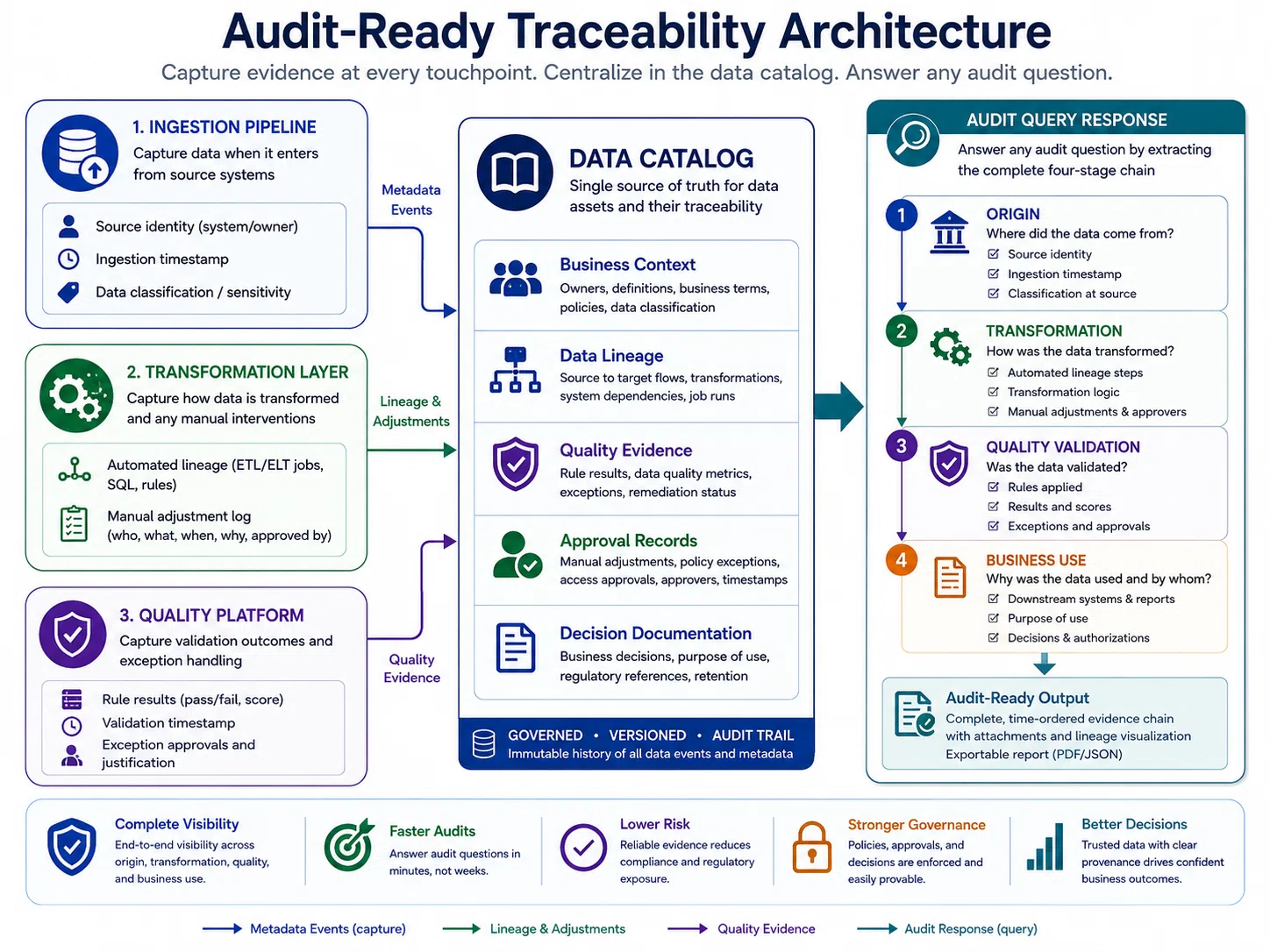
The data access audit log generated by Zero Trust monitoring is also the primary evidentiary record for regulatory compliance questions about data use. GDPR Article 25 (Data Protection by Design and by Default) requires that access to personal data be restricted to only what is necessary for the stated purpose. The Zero Trust access log, which captures user, asset, classification, purpose, and timestamp for every Restricted-tier access, is the evidence that this principle is being operationally enforced rather than merely stated in a policy.
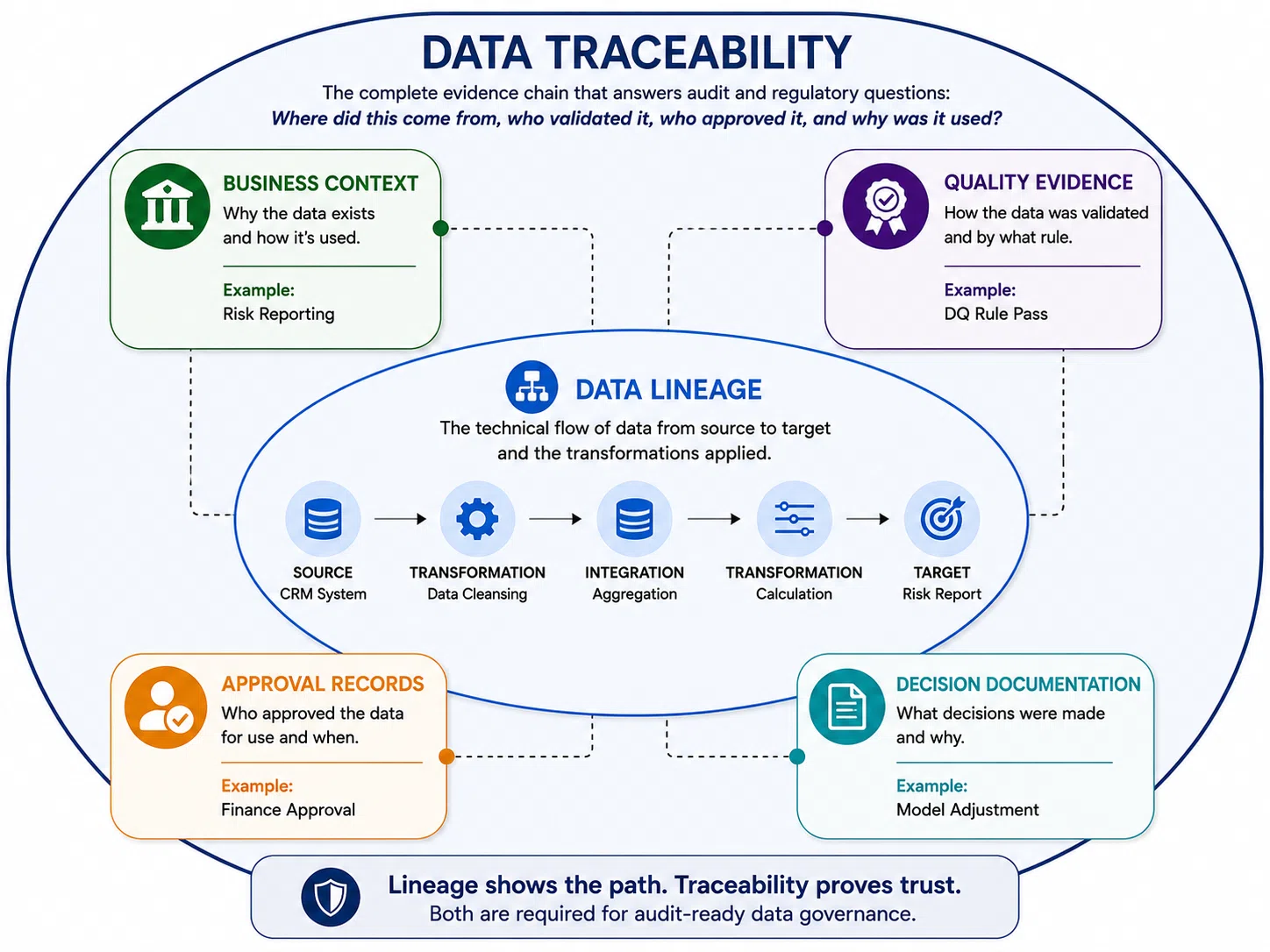
For this log to serve double duty as a security monitoring record and a compliance evidence record, it must be linked to the data catalog: the audit log entry should reference the catalog asset ID so that the access record can be retrieved as part of the traceability chain described in Blog 30 (Data Traceability for Audit and Compliance). An access log that records a database table name and user ID without catalog linkage is a security log. An access log that references a catalog asset with full classification, ownership, and lineage metadata is both a security log and a compliance record.
Note: GDPR Article 5(1)(b) establishes the purpose limitation principle: personal data shall be collected for specified, explicit, and legitimate purposes and not further processed in a manner incompatible with those purposes. In a Zero Trust data security program, purpose logging at the access control layer is the operational mechanism that enforces purpose limitation: it creates a record of what purpose was declared at the time of access, against which subsequent data use can be audited. Organizations that implement Zero Trust access logging without purpose capture are building a security control but not the compliance evidence that regulators require.
The bottom line
Zero Trust at the data layer is not an extension of network security. It is a data governance problem that security controls are built on top of. You cannot write a meaningful access policy for data you have not classified. You cannot enforce least privilege on data you have not inventoried. You cannot detect anomalous access to data whose normal access patterns you have not established.
-
Zero Trust data security requires classification applied to all governed assets as the foundational prerequisite
-
ABAC policies evaluate subject attributes + resource attributes + environment context dynamically, enabling data-level access decisions that static RBAC cannot make The data catalog is the source of truth for resource attributes; it must be current and API-accessible for ABAC to function correctly
-
Continuous monitoring produces the audit trail that serves both security incident response and regulatory compliance
-
Purpose logging at the access control layer operationalizes GDPR purpose limitation and is the evidence regulators look for in a data use audit
-
Data-layer Zero Trust is best implemented in the third phase of a Zero Trust program, after identity and network controls are established, but classification work must begin in parallel with the first phase
The organizations that get the most from their Zero Trust investment are the ones that treated classification and catalog as security infrastructure rather than governance overhead. When classification is complete and current, access policies write themselves. When the catalog is accurate, anomaly detection has a baseline. Zero Trust makes governance work visible as security value.
Design a Zero Trust data security program grounded in governance
BluEnt works with CISOs and CDOs to design data-layer Zero Trust programs: building the classification scheme, integrating catalog metadata with access control policy engines, implementing ABAC policies across multi-platform data estates, and establishing the audit logging architecture that serves both security monitoring and regulatory compliance.
Common Questions What CISOs and CDOs ask about implementing Zero Trust at the data layer
Where does Zero Trust for data fit in relation to a broader Zero Trust architecture program?In most Zero Trust architecture programs, the implementation sequence is: identity and access management first (MFA, privileged access management, conditional access policies for systems), then network segmentation (micro-segmentation, east-west traffic controls), then device posture management (endpoint detection, managed device policies), and finally data-layer controls. Data-layer Zero Trust typically comes last in the sequence because it depends on the identity infrastructure (for subject attribute evaluation in ABAC policies) and the device posture system (for environment attribute evaluation) built in earlier phases. However, data governance prerequisites – classification, catalog, ownership – should be started in parallel with the identity phase rather than deferred until data-layer implementation begins, because classification and catalog work takes 12-18 months for a large data estate and cannot be compressed into a single implementation sprint.
Can we implement Zero Trust for data without an ABAC policy engine?Yes, for a limited subset of Zero Trust data security controls. Row-level security (RLS) in data platforms like Snowflake, Databricks, BigQuery, and Azure Synapse can enforce data-level access controls based on user attributes without a dedicated ABAC policy engine. Column-level security (CLS) can mask or deny access to specific columns based on classification. These native platform controls implement attribute-based access at the data tier without requiring a separate policy engine. The limitation is that native platform controls are platform-specific and do not provide a unified policy across a multi-platform data estate. Organizations with data in multiple platforms need either a unified ABAC policy engine that integrates with all platforms, or consistent classification standards and policy logic implemented separately on each platform. A dedicated ABAC policy engine is most valuable when the organization has more than two or three data platforms, when cross-platform policy consistency is required for regulatory compliance, or when purpose-based access control is required beyond what native platform RLS/CLS supports.
How do we handle Zero Trust for data in legacy systems that do not support modern access control?Legacy systems that cannot implement column-level or row-level access controls present a genuine challenge for data-layer Zero Trust. Three mitigation approaches are used in practice. First, data virtualization: expose legacy system data through a governed data layer that does support modern access controls, rather than granting direct access to the legacy system. The virtualization layer applies ABAC policies before returning data to the requester. Second, classification-based network controls: where access to a legacy system cannot be controlled at the data level, treat the system as a Restricted resource at the network level – any access to the system triggers the full verification sequence appropriate for its most sensitive data, even if the system cannot enforce finer-grained controls internally. Third, compensating controls: implement enhanced monitoring and access logging at the network and system level for legacy systems, and require explicit justification and approval for all access grants. This is not true data-layer Zero Trust but provides a defensible control in the interim.
What is the relationship between Zero Trust data security and data loss prevention (DLP)?Zero Trust data security and Data Loss Prevention (DLP) are complementary controls that address different moments in the data protection lifecycle. Zero Trust controls access at the point of request: it determines whether a specific access request should be granted based on user attributes, data classification, and context. DLP controls data movement after access has been granted: it detects and prevents sensitive data from being exfiltrated through email, cloud storage, USB devices, or other channels. In a mature data security program, Zero Trust reduces the risk that sensitive data is accessed by unauthorized users, while DLP reduces the risk that authorized users move data to unauthorized destinations. Both require classification metadata to function: Zero Trust uses classification to evaluate access requests, DLP uses classification to identify what data should be protected in transit. The shared classification foundation is another reason why data classification must be completed before either control can be applied meaningfully.
How does Zero Trust data security interact with data sharing and third-party access?Third-party data access (external partners, vendors, customers, regulators) is one of the highest-risk categories for data security incidents and one of the most important use cases for Zero Trust data principles. In a Zero Trust model, third-party access to Restricted-tier data is authorized per session with explicit purpose documentation, time-bounded (access expires after the stated use period rather than being permanently granted), and monitored with the same anomaly detection applied to internal access. Third-party users access the minimum data required for their stated purpose, using a managed interface (a governed data sharing API or a certified data product) rather than direct database access. GDPR Article 28 (Processor obligations) and the data transfer provisions of Articles 46-49 establish specific requirements for personal data shared with third parties that a Zero Trust data sharing architecture directly supports: purpose limitation, access minimization, and contractual controls are all operationalized through the access control and audit logging infrastructure.

 Governing AI Tools in AEC: Copilot, Digital Twins, and Generative Design
  Data Governance for AI and Advanced Analytics: Building the Foundation That Works
  Centralized vs. Federated vs. Hybrid Data Governance: Which Model Fits Your Organization
  Data Governance Roles and Responsibilities in AEC Organizations