











Short answer
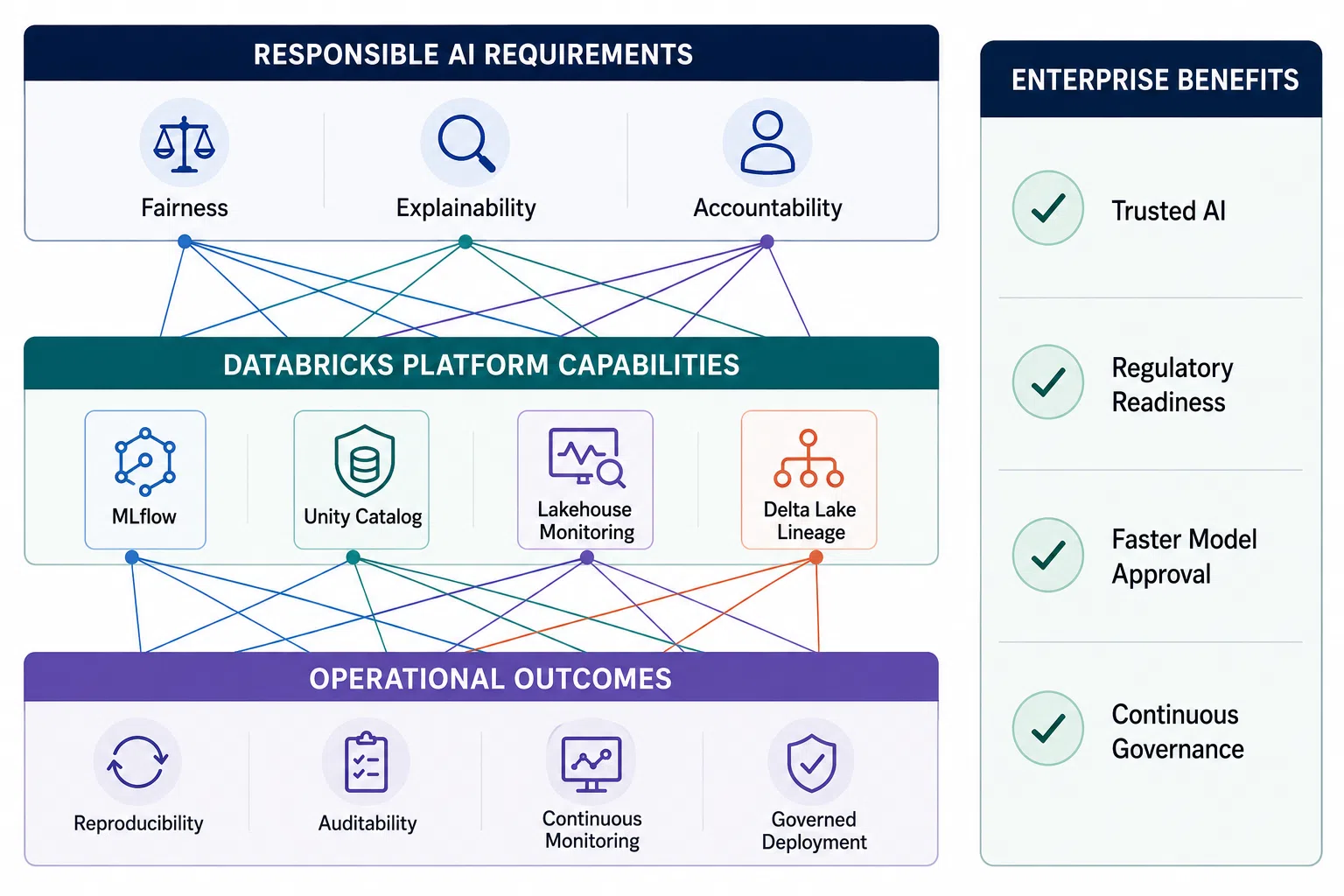
Responsible AI on Databricks is implemented through four platform capabilities working together: Unity Catalog for centralized model registration, access control, and lineage; MLflow for experiment tracking, model documentation, and reproducibility; Lakehouse Monitoring for post-deployment drift detection and fairness monitoring; and Delta Lake for training data lineage and audit trails. These capabilities address the three practical requirements of responsible AI: fairness (detecting and documenting bias in model outputs), explainability (providing interpretable rationale for model decisions), and accountability (creating the audit trail that connects every model decision to its training data, parameters, and validation record). The challenge is integrating these capabilities into a coherent governance workflow rather than using them independently.
Most organizations deploying AI on Databricks have a responsible AI policy. Many have an AI ethics charter. Fewer have answered the engineering question: what does responsible AI actually require us to build, and where does it live in our Databricks environment?
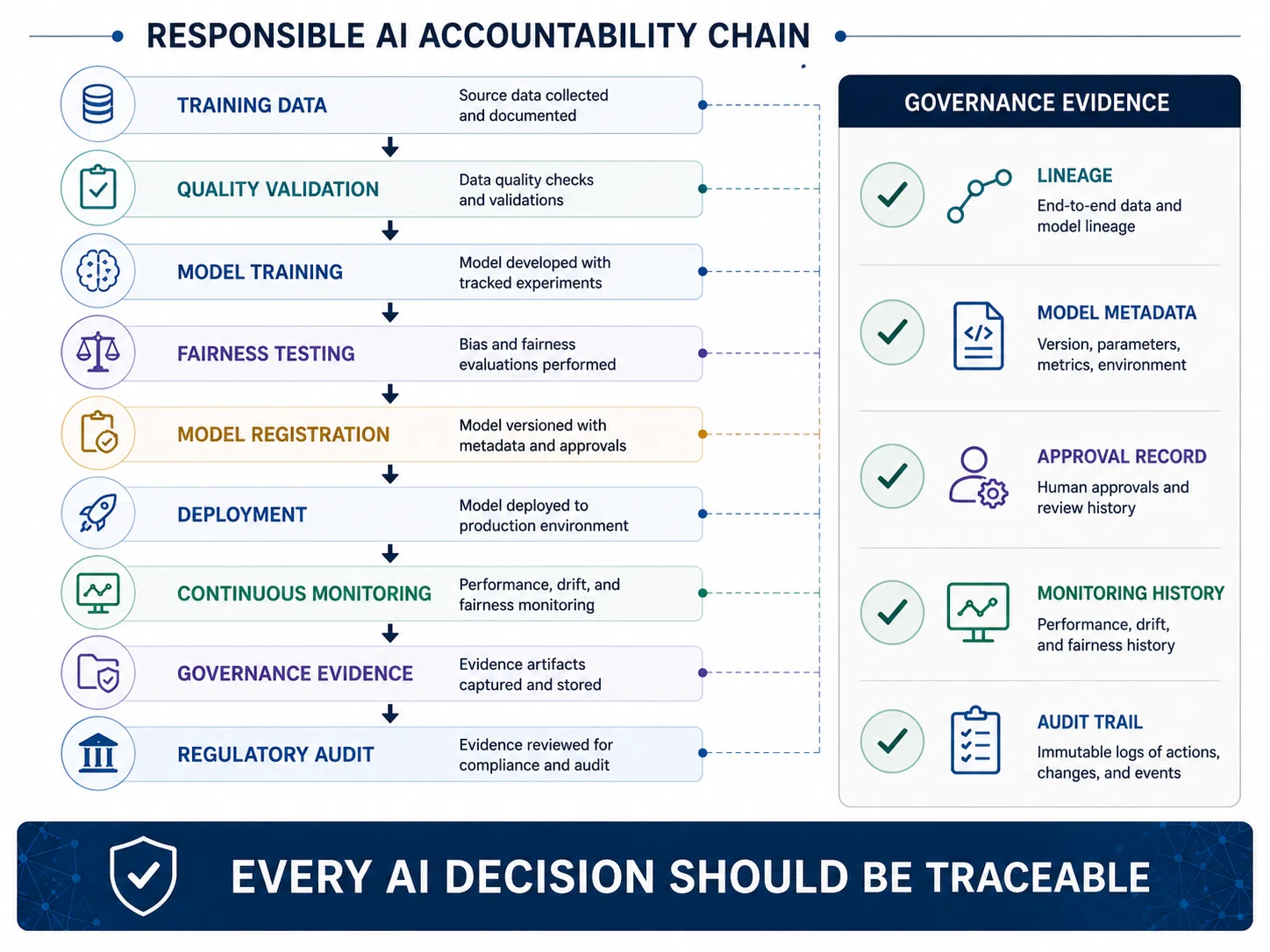
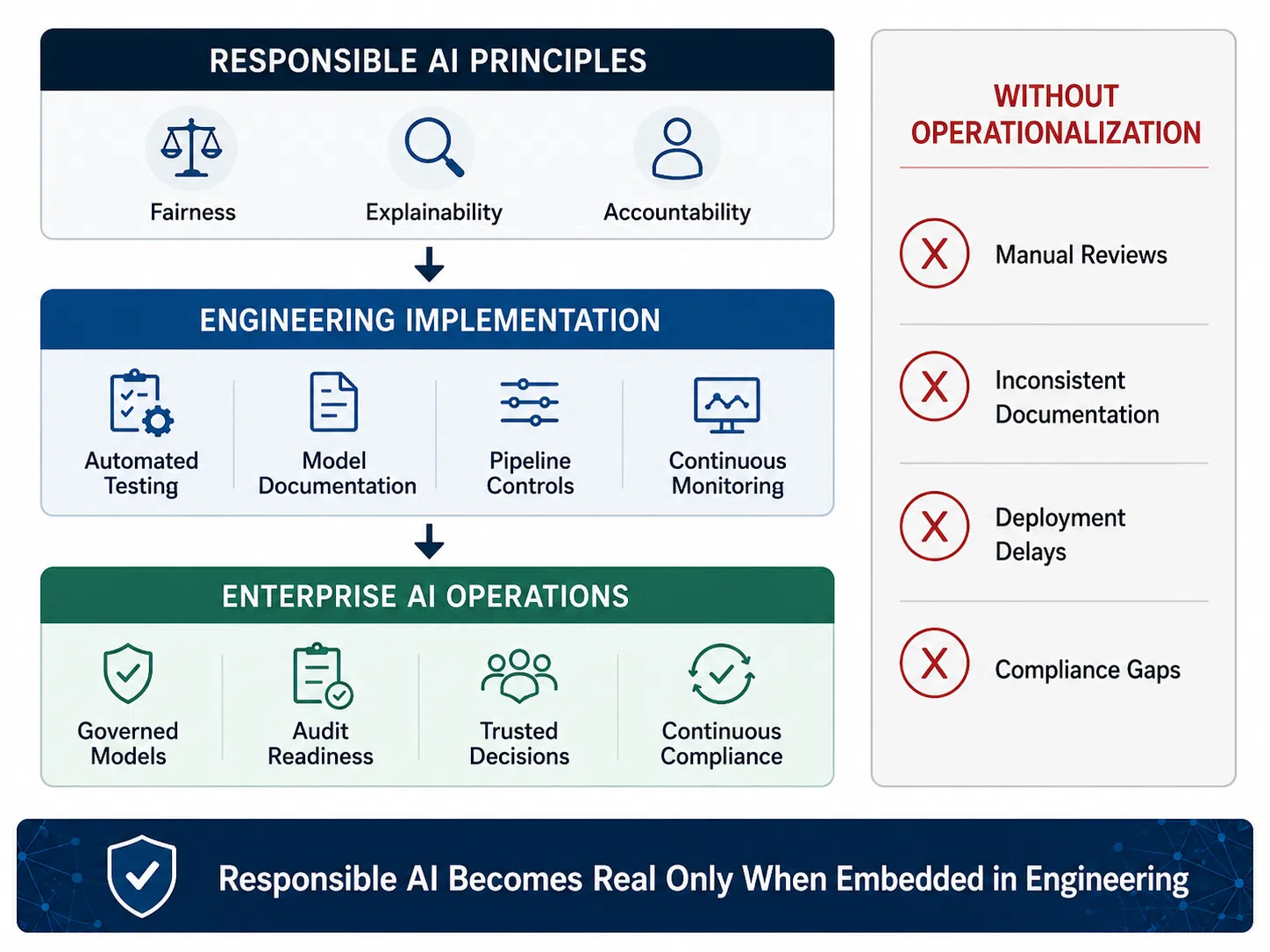
Responsible AI is not an ethics document problem. It is an engineering and governance problem. Fairness requires bias measurement tooling integrated into the model evaluation pipeline. Explainability requires model documentation, and interpretability outputs logged alongside model artifacts. Accountability requires a lineage trail connecting every production model decision to the training data it was built on, the parameters it was trained with, and the validation record that cleared it for deployment.
Databricks provides the platform capabilities to implement all three. Unity Catalog, MLflow, Lakehouse Monitoring, and Delta Lake lineage are the building blocks. The implementation challenge is connecting them into a coherent governance workflow rather than leaving them as independent tools the team uses selectively.
| Art. 13 | EU AI Act Article 13 requires that high-risk AI systems be designed and developed to ensure sufficient transparency for deployers and affected persons to interpret the system’s output and use it appropriately. This transparency requirement applies to AI used in hiring, credit scoring, critical infrastructure, education, healthcare, and law enforcement, and is enforceable from August 2026 for systems already in service. Source: EU AI Act (Regulation EU 2024/1689), Article 13 (Transparency and provision of information to deployers), Official Journal of the European Union, August 2024 |
|---|
Table of Contents:
What Responsible AI Requires in Practice The operational requirements that responsible AI principles create for ML and governance teams
Principles do not implement themselves
A responsible AI policy that says “our AI will be fair, transparent, and accountable” creates three engineering requirements. Fairness requires defining what fair means for each use case (demographic parity, equal opportunity, individual fairness, or a different metric), measuring the model’s actual performance against that definition across relevant population segments, and documenting the measurement methodology and results. Transparency requires producing and logging explanations of model outputs in a form that non-technical stakeholders can interpret, and that regulators can audit. Accountability requires an unbroken chain of documentation connecting each production model to its training data, development decisions, and validation of outcomes.
Each of these requirements has a specific technical implementation. None of them are satisfied by a policy statement. And all of them require effort from the engineering team that, without tooling support, competes with feature development and deployment velocity.
The regulatory context raises the stakes
The EU AI Act, effective August 2024 and with high-risk system compliance deadlines from August 2026, creates enforceable obligations for transparency, explainability, data governance, and human oversight for AI systems in regulated use cases. NIST AI RMF, while voluntary in the US, is increasingly referenced in government procurement and financial services for regulatory guidance. Financial services model risk management requirements (SR 11-7) apply to ML models used in credit and risk decisions.
These requirements make responsible AI implementation a compliance function for many organizations, not only an ethical best practice. The engineering investment in fairness testing, explainability logging, and accountability documentation is now partially driven by external requirements rather than solely by internal values statements.
The deployment velocity problem
The risk of treating responsible AI as a manual review process is that it becomes a bottleneck. If fairness assessment requires a separate manual analysis step before every model’s deployment, and explainability documentation requires a data scientist to write a separate interpretability report, the governance function slows deployment velocity. Teams begin treating these steps as overhead and finding ways around them.
The correct implementation embeds fairness measurement, explainability logging, and accountability documentation into the automated pipeline, so they happen as part of training and evaluation rather than as separate review steps. Databricks provide the tooling to make this possible. The design challenge is pipeline architecture, not tooling availability.
Is Your Data Governance Ready for Responsible AI?
Assess your data governance maturity to identify the capabilities needed for trusted, compliant, and scalable AI initiatives in Databricks.
Data Governance Maturity Assessment
A structured diagnostic for CDOs, CIOs, and Chief Compliance Officers. 18 questions across six governance dimensions. Receive a scored maturity profile and prioritised recommendations.
Your Details
Your Assessment Results
Overall Governance Maturity Level
Receive Your Full Report
A BluEnt governance consultant will prepare a personalised report with specific recommendations for your highest-priority gaps. Book a 60-minute discovery call to discuss your findings.
Databricks Capabilities for Responsible AI Unity Catalog, MLflow, Lakehouse Monitoring, and Delta Lake lineage mapped to RAI requirements
| Capability | What it provides | RAI pillar | Best used for |
|---|---|---|---|
| MLflow Tracking | Logs of experiment parameters, metrics, artifacts, and model signatures. Provides full reproducibility of model training runs. | Explainability, Accountability | Training run documentation, hyperparameter audit trail, model version comparison, experiment reproducibility |
| MLflow Model Registry | Centralized model versioning with stage transitions (Staging, Production, Archived). Enables approval workflows and model lineage. | Accountability | Model lifecycle management, deployment approval tracking, version rollback, champion/challenger management |
| Unity Catalog | Unified governance layer for data and AI assets. Registers models with lineage to training datasets, applies access policies, enables cross-workspace discovery. | Accountability, Fairness | Model-to-data lineage, access control for sensitive models, compliance-ready audit logs, model documentation tags |
| Lakehouse Monitoring | Automated post-deployment monitoring for data drift, model drift, and custom metric degradation with alerting. | Fairness, Accountability | Demographic parity drift detection, performance degradation alerts, ongoing fairness monitoring at scale |
| Delta Lake | ACID-compliant storage layer with built-in data versioning, time travel, and audit logging for training datasets. | Accountability, Fairness | Training data audit trail, point-in-time dataset reconstruction, data version pinning for model reproducibility |
| SHAP / LIME integration | Open source explainability libraries (SHAP, LIME) run natively on Databricks and can be logged as MLflow artifacts alongside model artifacts. | Explainability | Feature importance documentation, individual prediction explanation, regulatory explainability reports |
Note: Databricks rebrands and renames product capabilities periodically. Mosaic AI, previously Databricks Machine Learning, encompasses MLflow, the model of registry, and serving capabilities. Verify current product naming and API references at docs.databricks.com before publishing, as product names and some API paths have changed across major platform versions.
Implementing the Three Pillars on Databricks Practical guidance for fairness, explainability, and accountability in the Databricks pipeline
Fairness: define the metric, measure it in the pipeline, monitor it in production
Fairness implementation begins with a use-case-specific fairness metric definition. Demographic parity (equal positive prediction rates across groups) is appropriate for some use cases; equal opportunity (equal true positive rates) is more appropriate for others. The choice depends on the downstream impact of false positives versus false negatives for each population segment and the regulatory context. Document this decision in MLflow as a model parameter at training time.
Measure fairness during model evaluation using a fairness testing library such as Fairlearn or AIF360. Log the fairness metric results as MLflow metrics alongside accuracy and AUC. This makes fairness a first-class evaluation criterion that appears in the experiment’s comparison view alongside performance metrics and ensures the fairness measurement is logged in the model’s audit trail. The example below logs demographic parity difference as an MLflow metric:
# Log fairness metric alongside model performance metrics
# Verify MLflow API signatures at mlflow.org/docs before publishing
import mlflow
from fairlearn.metrics import demographic_parity_difference
dpd = demographic_parity_difference(
y_true=y_test,
y_pred=y_pred,
sensitive_features=sensitive_col
)
with mlflow.start_run():
mlflow.log_metric(“auc”, auc_score)
mlflow.log_metric(“demographic_parity_difference”, dpd)
mlflow.log_param(“fairness_metric”, “demographic_parity_difference”)
mlflow.log_param(“sensitive_feature”, “age_group”)
Post-deployment, configure Lakehouse Monitoring on the model’s inference table to track demographic parity across prediction cohorts over time. Drift in the fairness of metric signals that the model’s behavior relative to population segments is changing, which may indicate distributional shift in the input data, changes in the underlying population, or feedback loops from prior model decisions.
Explainability: log interpretability outputs as first-class MLflow artifacts
SHAP (SHapley Additive exPlanations) is the most widely used explainability method for tabular models and integrates directly with Databricks. SHAP values quantify the contribution of each feature to a model prediction for a specific instance, providing both global feature importance (averaged across the dataset) and local explanations (for individual predictions). Log SHAP summary plots and values as MLflow artifacts so that explainability outputs are version-controlled alongside the model.
# Generate and log SHAP explanation artifacts
# Verify MLflow artifact logging API at mlflow.org/docs before publishing
import shap
import mlflow
explainer = shap.TreeExplainer(model)
shap_values = explainer.shap_values(X_test)
with mlflow.start_run(run_id=active_run_id):
# Log SHAP values as artifact
shap.summary_plot(shap_values, X_test, show=False)
mlflow.log_artifact(“shap_summary.png”)
# Log feature importance as a metric for each feature
for i, feat in enumerate(X_test.columns):
mlflow.log_metric(f”shap_mean_{feat}”, abs(shap_values[:,i]).mean())
For high-risk AI use cases (credit scoring, hiring, healthcare) where individual-level explanation is a regulatory requirement, implement an explanation service alongside the prediction service: for every production prediction, generate and store the SHAP values for that prediction instance with the prediction record. This creates an auditable per-decision explanation trail.
Accountability: Unity Catalog as the governance record
Register all production models in Unity Catalog rather than only in the MLflow Model Registry. Unity Catalog provides the additional governance layer that MLflow Registry alone does not: access policies that control who can promote a model to production, lineage that connects the registered model to the Delta Lake tables used as training data, and audit logs that record every access and modification to the model asset.
Tag models in Unity Catalog with responsible AI metadata at registration time: the fairness metric and threshold used during evaluation, the explainability method employed, the regulatory tier of the use case, the data governance classification of the training data, and the approval status and approver identity. These tags make the responsible AI governance record discoverable from the catalog without requiring a separate documentation system.
From the field
The most effective Databricks responsible AI implementations we have seen treat MLflow and Unity Catalog as a single documentation system, not as separate tools. MLflow captures the training-time record: parameters, metrics, fairness results, SHAP artifacts. Unity Catalog captures the deployment-time record: which version was promoted, by whom, to which serving endpoint, with lineage to the training data. Together they provide the complete accountability trail that a compliance audit or regulatory review requires. Teams that use only MLflow have the training record but not the deployment of governance. Teams that use only Unity Catalog have the deployment record but not the training provenance.
Implement Responsible AI with Confidence
Our experts help organizations implement governance frameworks and Databricks capabilities that support trusted, transparent, and compliant AI.
Connecting Responsible AI to the Data Governance Program How Delta Lake lineage and Unity Catalog integrate with enterprise data governance
Training data lineage: the starting point for AI accountability
Delta Lake’s built-in lineage captures the provenance of training datasets: which source tables were read, which transformations were applied, and which version of the data was used (via Delta time travel). When a model is trained on a Delta Lake dataset registered in Unity Catalog, the lineage from training data to model artifact is automatically available in the Unity Catalog lineage graph.
This lineage is the foundation for training data audit trails. When a model produces a suspect output in production and an investigation begins, the first question is: what was in the training data? Unity Catalog lineage answers this by tracing the registered model back to the specific Delta table version used for training, which can then be queried using Delta time travel to reconstruct the exact dataset the model was trained on.
Data quality governance for training data
A model trained on data that has not been validated for quality inherits that data defects. The data governance program’s quality management function, applied to the datasets used as AI training data, is the primary upstream control for model fairness and reliability. If the training dataset contains a systematic null rate in a demographic feature, the model will learn from that gap. If the training dataset contains historical bias in outcomes for a population segment, the model will replicate that bias unless it is explicitly identified and addressed.
Integrate the quality SLAs for training datasets with the model deployment process: before a model is promoted to production in Unity Catalog, verify that the training dataset it was built on met its quality SLA at the time of training. Log the quality check result as a condition in the MLflow run and as a tag in Unity Catalog. Data stewards accountable for the governed training datasets become part of the responsible AI accountability chain.
Ongoing monitoring and the feedback loop
Responsible AI does not end with model deployment. Lakehouse Monitoring on the model’s inference table tracks input feature distributions, output score distributions, and custom fairness metrics over time. When drift is detected, the alert should trigger not only the MLOps team but also the data steward for the training dataset domain, because drift in model behavior is often a signal of drift in the underlying data.
A quality degradation in a training data domain that fed a production model should flow through the data governance incident process as well as the MLOps incident process. The two programs share a root cause when the issue originates in data. Connecting their monitoring and incident processes prevents the same root cause from being investigated twice independently with neither team aware of the other findings.
Note: Responsible AI is a shared responsibility between the ML engineering team and the data governance program. The ML team owns model fairness measurement, explainability, and MLOps monitoring. The data governance program owns training data quality, lineage documentation, and data stewardship. Neither team can fully discharge their responsible AI obligations without the other. The integration points are Unity Catalog (shared asset registry), Delta Lake lineage (shared provenance record), and the data quality SLA for training datasets (shared quality standard).
Recommended Reading:
The bottom line
Responsible AI on Databricks is an engineering and governance problem, not a policy problem. The Databricks platform provides the capabilities to implement fairness measurement, explainability, and accountability at scale. The implementation challenge is connecting those capabilities into a coherent pipeline that makes responsible AI a property of the development process rather than an external review gate.
-
Log fairness metrics as first-class MLflow metrics during model evaluation so they appear alongside accuracy and AUC in every experiment comparison
-
Log SHAP artifacts with every model artifact in MLflow so explainability outputs are version-controlled alongside the model
-
Register production models in Unity Catalog with responsible AI tags so the governance record is discoverable from the data catalog
-
Configure Lakehouse Monitoring on inference tables with custom fairness metrics so post-deployment drift is detected automatically
-
Integrate the training data quality SLA from the data governance program into the model deployment gate so model accountability starts with trusted data
If your Databricks ML team is building models faster than your governance program can assess them, the gap typically closes when responsible for AI tooling is embedded in the pipeline rather than managed as a separate review process.
Implement responsible AI practices across your Databricks environment
BluEnt’s data engineering and governance team helps enterprises embed fairness, explainability, and accountability into Databricks ML pipelines, connecting MLflow and Unity Catalog governance with the data governance program that ensures training data quality and lineage.
Common Questions What ML and data governance teams ask about responsible AI on Databricks
What is MLflow and how does it support a responsible AI?MLflow is an open-source platform for managing the machine learning lifecycle, developed by Databricks and deeply integrated into the Databricks platform. For responsible AI, MLflow provides three key capabilities: experiment tracking (logging all parameters, metrics, and artifacts from every training run, creating a reproducible record of how a model was built), model registry (versioning models with stage transitions and enabling governance workflows for model promotion), and artifact logging (storing explainability outputs such as SHAP plots alongside model artifacts so that interpretability evidence is version-controlled with the model). MLflow is available as open source at mlflow.org and as a managed service within Databricks.
What is Unity Catalog and how does it differ from the MLflow Model Registry?Unity Catalog is Databricks’ unified governance layer for all data and AI assets across a Databricks account. It extends beyond model governance to cover tables, files, volumes, and functions, and provides unified access control, audit logging, and lineage across all asset types. The MLflow Model Registry manages model versions, stage transitions, and experiment associations. Unity Catalog registers models as catalog assets with lineage connecting them to the Delta Lake tables they were trained on, access policies controlling who can access or promote the model and audit logs meeting compliance requirements. For responsible AI, Unity Catalog provides the deployment-time governance record that MLflow Registry alone does not, and the training data lineage that closes the accountability loop.
How does Lakehouse Monitoring support fairness monitoring in production?Databricks Lakehouse Monitoring automatically profiles the data in a table or the inference results of a model endpoint and detects statistical drift over time. For fairness monitoring, you can configure custom metrics that measure demographic parity, equal opportunity, or other fairness criteria across prediction cohorts, and set alert thresholds that notify the team when fairness metrics degrade beyond an acceptable level. This provides continuous post-deployment fairness assurance without requiring the team to manually compute fairness statistics. Verify current Lakehouse Monitoring API and configuration options at docs.databricks.com, as the feature has evolved significantly across recent Databricks releases.
What is SHAP and why is it the recommended explainability method for Databricks?SHAP (SHapley Additive exPlanations) is a model-agnostic explainability library based on game theory concepts that assigns each feature a contribution value for each individual prediction. It is widely used for regulatory explainability because it provides consistent, locally accurate explanations that can be audited and compared. On Databricks, SHAP integrates with tree-based models (XGBoost, LightGBM, scikit-learn decision trees) natively through TreeExplainer, which is computationally efficient on large datasets. SHAP values can be logged as MLflow artifacts, distributed across a Databricks cluster for batch explanation generation, and stored in Delta Lake for per-decision explanation archives. LIME is an alternative for models where SHAP is not applicable, with similar MLflow integration patterns.
How do we connect Databricks responsible AI to the EU AI Act compliance requirements?The EU AI Act creates specific technical requirements for high-risk AI systems that map directly to Databricks capabilities. Article 9 requires a risk management system throughout the lifecycle: MLflow experiment tracking and Lakehouse Monitoring provide the development and post-deployment record. Article 10 requires data governance and training data quality: Delta Lake lineage and the data governance program’s quality management provide this. Article 13 requires transparency and explainability: SHAP artifacts logged to MLflow and registered in Unity Catalog provide the explainability record. Article 14 requires human oversight mechanisms: Unity Catalog approval workflows for model promotion and stage gates to provide the oversight record. The Databricks platform does not automate EU AI Act compliance, but it provides the technical infrastructure that makes compliance demonstrable.
Does implementing responsible AI on Databricks slow down model development?It depends on how it is implemented. Responsible AI implemented as a separate manual review process adds overhead and creates a governance bottleneck. Responsible AI implemented as pipeline automation adds minimal overhead: fairness metrics are computed as part of the existing model evaluation step, SHAP values are logged as part of the existing MLflow run, and Unity Catalog registration replaces the existing model registry step. The marginal compute cost of computing SHAP values and fairness metrics during training is typically small relative to training time for most enterprise models. The up-front engineering investment to build the automated pipeline is real, but the ongoing overhead, once the pipeline is built, is low. Teams that treat responsible AI as a checklist imposed after model building pay a higher ongoing cost than teams that build it into the pipeline architecture from the start.

 Governing AI Tools in AEC: Copilot, Digital Twins, and Generative Design
  Data Governance for AI and Advanced Analytics: Building the Foundation That Works
  Centralized vs. Federated vs. Hybrid Data Governance: Which Model Fits Your Organization
  Data Governance Roles and Responsibilities in AEC Organizations