










Enterprise data strategy is no longer a technical initiative — it is a board-level growth lever.
Yet despite significant investments in cloud platforms, analytics tools, and AI initiatives, most enterprises still struggle to convert data into measurable business value. The issue is not data scarcity. It is fragmentation, governance complexity, duplicated infrastructure costs, and slow decision cycles.
For CXOs, the real risk is not having too little data — it is operating with inconsistent, delayed, or untrusted insights that impact revenue forecasting, operational efficiency, compliance exposure, and capital allocation.
Disconnected data lakes, siloed analytics teams, and overlapping tooling inflate costs while reducing agility. Meanwhile, competitive markets demand faster scenario modeling, real-time visibility, and measurable ROI from every technology investment.
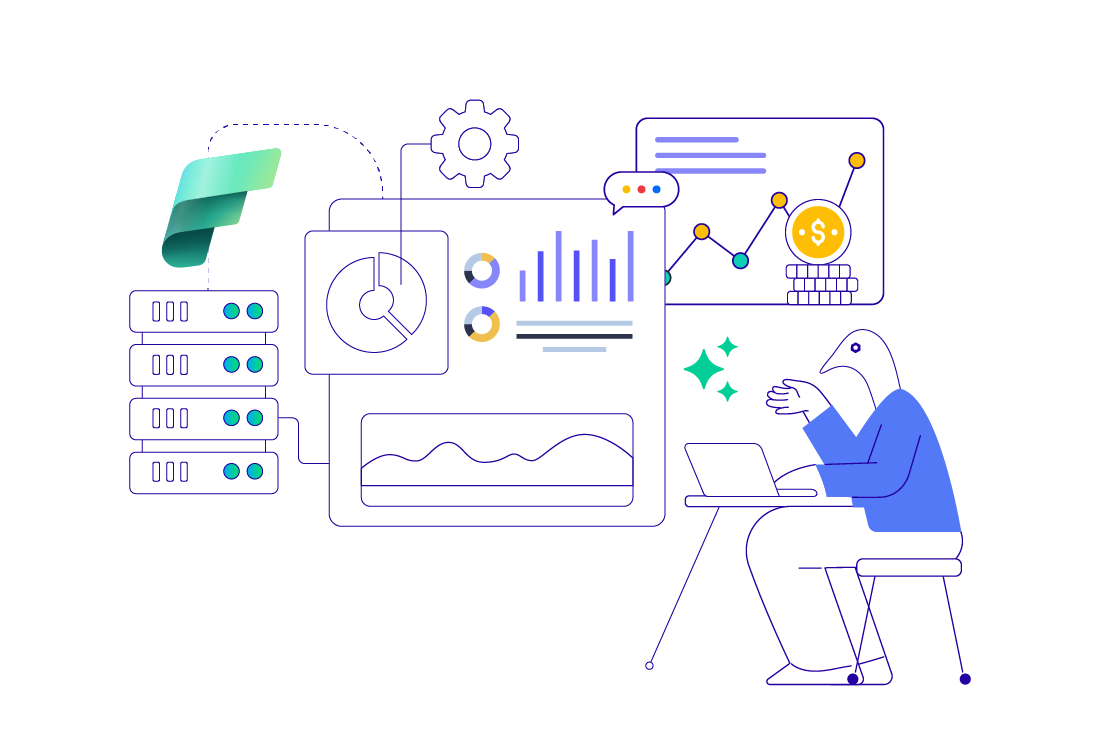
Microsoft Fabric was designed to address this exact executive challenge. By consolidating data engineering, warehousing, real-time analytics, governance, and business intelligence into a unified SaaS model, Fabric enables organizations to reduce architecture complexity, strengthen control, and accelerate time-to-insight — without multiplying infrastructure overhead.
The difference between a successful enterprise data strategy and an expensive modernization effort lies in alignment: aligning architecture to business objectives, governance to compliance mandates, and analytics to financial outcomes.
Data is often scattered across disparate systems and departments (CRM, sales, operations), making it nearly impossible to get a holistic view of the business or ensure consistency and accuracy. Organizations often use a patchwork of disconnected tools for data ingestion, processing, and analysis, leading to high operational costs, integration overhead, and the need for specialized expertise for each system.
Traditional Microsoft Fabric data strategy involves complex data movement and format conversions, causing significant latency between data collection and actionable insights.
But that’s not all. A lack of skilled professionals and general resistance to change among employees can hinder the adoption of new data tools and methodologies.
How Microsoft Fabric Fixes It?
Microsoft Fabric addresses common data strategy failures by providing a unified, AI-powered Software as a Service (SaaS) platform that eliminates data silos, reduces complexity, strengthens governance, and accelerates time-to-insight.
Fragmented Systems & Data Silos: Fabric provides a single, unified data platform with a central data lake called OneLake, which stores all organizational data in an open format (Delta Lake). This eliminates the need for data movement or duplication across different systems (like separate data lakes, data warehouses, and BI tools) and ensures a single source of truth.
Slow Time-to-Insight: Fabric streamlines the entire data lifecycle, from ingestion to visualization, within a single environment. Features like the Direct Lake mode allow Power BI to query data directly in OneLake without movement, enabling near real-time analytics and faster decision-making.
Complex Integrations & Operational Overhead: By unifying capabilities from Azure Data Factory, Synapse, Power BI, and more into a single Software-as-a-Service (SaaS) offering, Fabric eliminates the need for complex, manual integrations between disparate tools. This significantly reduces operational complexity and frees up IT resources.
Lack of Governance & Compliance: Fabric embeds Microsoft Purview for built-in, end-to-end data governance, lineage tracking, access control, and automatic compliance checks across all data assets. This ensures consistent security and policy enforcement, mitigating compliance risks.
Cost Management Challenges: Fabric uses a consumption-based, unified billing model (pay-as-you-go) that optimizes costs by automatically scaling resources based on demand. This helps avoid over-provisioning and the hidden costs associated with managing multiple vendor licenses.
When Should You Choose Microsoft Fabric Over Snowflake?
Choose Microsoft Fabric over Snowflake when your organization is already deeply invested in the Microsoft Azure ecosystem, heavily uses Power BI for visualization, or requires a unified, low-code SaaS platform with simplified, predictable cost modeling. It is ideal for teams needing an “all-in-one” solution for data engineering, lakehouse management, and analytics.
When to Choose Microsoft Fabric:
Deep Microsoft Integration
Your organization already uses Azure, Power BI, Office 365, or Data Factory.
Unified Experience
You want a single SaaS platform (OneLake) for data engineering, warehousing, data science, and real-time analytics, rather than connecting multiple separate tools.
Predictable Pricing
You prefer a fixed, predictable pricing model rather than a consumption-based pricing model.
Power BI Dominance
You need native, high-performance, and secure integration with Power BI without managing complex connectors.
Low-Code/No-Code Focus
Your team needs to enable data professionals and business analysts to work together without extensive, complex coding.
Simplified Governance
You require centralized security, data governance, and compliance customized to an Azure-centric environment.
How to Build a Data Strategy with Microsoft Fabric
For enterprises struggling with fragmented data platforms, Microsoft Fabric consolidates engineering, analytics, and governance into a single operational layer, reducing architecture complexity and cost duplication.
This Data strategy with Microsoft Fabric eliminates data silos and the need to manage disparate tools, streamlining the entire data lifecycle from ingestion to insight.
Let’s understand the key roles of Microsoft Fabric in modernizing data architecture.
Centralized Data Storage (OneLake)
At its core is OneLake, a single, unified data lake built on open Delta Lake formats, which acts as a single source of truth for all organizational data. This eliminates data duplication and movement, allowing different workloads to access the same data copy without complex integrations.
Enables Real-Time Analytics
Fabric includes real-time intelligence capabilities to ingest, process, and analyze high-velocity data streams from sources like IoT devices and application logs, enabling organizations to make timely, data-driven decisions.
Enhances Data Governance and Security
It provides a centralized governance framework using Microsoft Purview, which automatically applies security policies, tracks data lineage, and ensures compliance with regulations like GDPR and HIPAA across the entire data estate.
Simplifies Data Integration and Orchestration
Fabric offers a modern data integration experience with over 200 prebuilt connectors for various on-premises and cloud sources. It automates data pipelines and workflows, significantly reducing the manual effort and time traditionally spent on ETL/ELT processes.
Unifies Fragmented Systems
Fabric consolidates capabilities from tools like Azure Data Factory, Azure Synapse Analytics, and Power BI into a single platform, removing the complexity and operational overhead of managing multiple, disconnected systems.
KPIs That Matter to CXOs – Efficiency, Time to Insight, and ROI
For C-suite executives (CXOs), KPIs centered on Efficiency, Time to Insight, and ROI are crucial because they directly measure operational health, strategic responsiveness, and overall financial performance. The Microsoft Fabric implementation strategy metrics provide the data-driven foundation for high-level decision-making and sustainable growth.
Efficiency KPIs
Operational efficiency is about maximizing output while minimizing input, which directly impacts the bottom line.
-
Operational Expense Ratio (OER): Measures how much of the revenue is consumed by operational costs, helping identify cost savings opportunities and ensuring lean scaling.
-
Cycle Time / Order Fulfillment Time: Tracks the total time a process takes from start to finish (e.g., lead-to-close time, order completion). Faster cycles indicate streamlined operations and improved customer satisfaction.
-
Resource Utilization: Shows how effective resources (employees, equipment, capital) are being used. High utilization often correlates with increased revenue, while low rates may indicate wasted capacity.
-
Case Deflection & Self-Service Resolution Rate: In customer service, this metric tracks how many issues are resolved without a human agent, reducing support costs, and scaling the customer experience efficiently.
Time to Insight KPIs
In a fast-changing market, the speed at which data is converted into actionable intelligence is a competitive advantage.
-
Time-to-Value (TTV): Measures how quickly a new customer or an investment realizes its promised value. This is critical for driving adoption and demonstrating rapid impact.
-
Data Downtime & Issue Resolution Time: Tracks the time reports/dashboards are unavailable, or data errors are present. Shorter resolution times ensure continuous access to reliable data for decision-making.
-
Query Performance Time: The speed of dashboards or data queries, which impacts how quickly decision-makers can access the information they need.
-
Decision-Making Speed: While qualitative, some organizations track how quickly leadership can make and execute decisions based on available insights, an essential factor in adapting to market changes.
ROI (Return on Investment) KPIs
ROI metrics quantify the financial return of various initiatives, ensuring that capital is working effectively to scale the business.
-
Return on Investment (ROI): The quintessential metric, directly measuring the financial return of specific initiatives, projects, or hires to validate spending and guide future budget allocation.
-
Customer Lifetime Value (CLV) to Customer Acquisition Cost (CAC) Ratio (LTV: CAC): This ratio is the ultimate test for the profitability and scalability of a business model. A healthy ratio (typically at least 3:1) ensures the growth engine is profitable.
-
Net Profit Margin: The percentage of revenue remaining after all expenses is deducted, providing a true measure of overall business financial health.
-
Net Revenue Retention (NRR) / Gross Revenue Retention (GRR): Measures the recurring revenue from existing customers, factoring in expansion and churn. An NRR over 100% indicates the business can grow even without new customers, showing strong ROI on customer retention efforts.
-
Payback Period: Calculates the exact time it takes for an investment to pay for itself, helping prioritize initiatives that recoup their costs fastest.
Step By Step Implementation Roadmap
A step-by-step Microsoft Fabric implementation roadmap involves discovery and planning, governance and security setup, technical implementation, user training and adoption, and ongoing optimization and transformation.
The Microsoft Fabric architecture strategy process comprises 5 phases, starting from defining business objectives to continuously improving the solution. Let’s take a quick look at these five phases:
Phase 1 – Discovery and planning: Identify business goals, data gaps, and high-value use cases. Define the purpose, scope, success metrics, and modernization priorities for creating a clear execution blueprint.
Phase 2 – Governance and architecture: Set up data governance rules, security models, RBAC, and compliance frameworks. Design a united Fabric-ready architecture that aligns with enterprise standards.
Phase 3 – Technical implementation: Configure workspaces, pipelines, dataflows, lakehouse/warehouse structures, and integrations. Migrate essential data assets and automate workflows.
Phase 4 – Training and adoption: Enable teams via hands-on training, Fabric workspace familiarization, and self-service analytics adoption to ensure cross-department usage.
Phase 5 – Optimization and transformation: Continuously improve performance, fine-tune costs, scale use cases, and introduction of advanced analytics or AI to maximize long-term ROI and business impact.
Conclusion
Incorporating your enterprise’s data strategy with Microsoft Fabric architecture requires extensive experience and a well-prepared strategy so that the implementation process syncs with the data strategy and business objectives. Organizations like BluEnt specialize in catering professional Microsoft Fabric solutions to its clients wherein strategy and roadmap are prepared along with accurate implementation of the data platform and data mesh.
FAQs
How does Microsoft Fabric reduce the risk of data strategy failure?Microsoft Fabric unifies data engineering, data science, governance, and analytics in one platform, removing fragmentation which is the biggest cause of failed data strategies. It ensures consistency, compliance, interoperability, and quicker time-to-insight.
What ROI can CXOs expect after implementing Microsoft Fabric?Companies typically see reduced infrastructure costs, simplified governance, faster analytics delivery, and improved decision cycle times. The platform also reduces integration overheads and improves workforce productivity via automation and shared workspaces.
Is Microsoft Fabric suitable for organizations with legacy architectures?Yes. Microsoft Fabric architecture supports phased modernization – allowing enterprises to integrate existing data lakes, data warehouses, ETL tools, Power BI, and Azure services without disruption. It accelerates modernization while protecting previous tech investments.
What KPIs should enterprises track when adopting Microsoft Fabric?Enterprises need to monitor critical KPIs such as data processing proficiency, time-to-insight speed, data governance compliance, cost-to-value ratio, and adoption rate across business teams.

 Microsoft Fabric for Enterprise ESG and Sustainability Intelligence
  Microsoft Fabric 2.0: The Future of Unified Analytics in a Multi-Agent AI World
  Why Traditional Data Migration Falls Short and How AI Is Changing the Approach
  How CFOs and CIOs Actually Evaluate Cloud Data Strategy: Cost, Risk, and ROI