










In today’s volatility-driven markets, decision latency is a competitive risk. Microsoft Fabric compresses the time between signal and strategy.
It centralizes all data services, eliminating the complexity and delays caused by fragmented tools and data silos, and making insights accessible to more users.
How does MS Fabric accelerate decision-making?
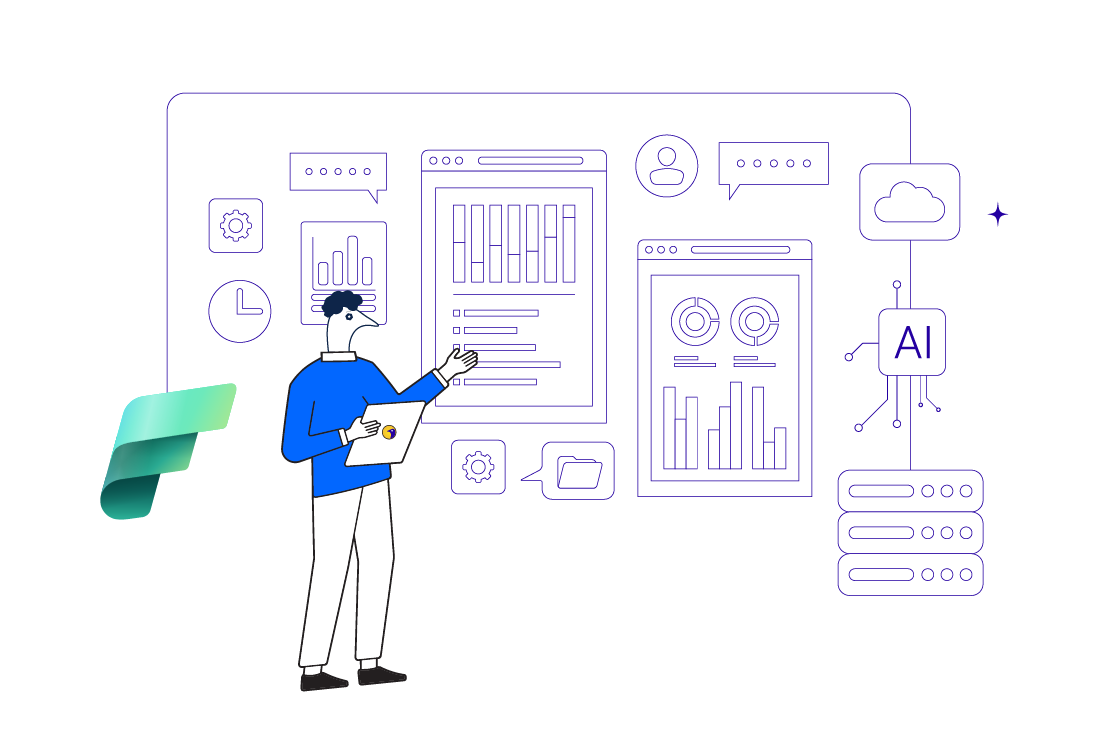
The platform’s unified architecture and AI capabilities allow businesses to transform raw data into actionable insights with speed and agility.
Fabric’s core is OneLake, a single, centralized storage location for all organizational data.
By eliminating data duplication and providing one single source of truth, OneLake ensures all teams and workloads are working from the same consistent, up-to-date information.
- Introduction: Decision Speed = Market Advantage
- Why Legacy Systems Slow CXOs Down
- Fabric’s Real-Time Capabilities
- Business Outcomes: Faster Forecasts, Customer Insights, Risk Responses
- CXO KPIs for Real-Time Analytics
- When Should Enterprises Choose Microsoft Fabric for Real-Time Intelligence?
- Conclusion
- FAQs
Microsoft positions Fabric as its SaaS data analytics platform, consolidating capabilities previously distributed across Synapse, Data Factory, and Power BI.
It gets easily integrated with tools like Power BI, offering low-code/no-code interfaces that allow business analysts and other non-technical users to independently explore data and build reports.
This reduces the traditional bottleneck of relying on specialized data teams, empowering a wider audience to make data-driven decisions.
With its Real-Time Intelligence component, Fabric can ingest, analyze, and visualize streaming data instantly from various sources like IoT devices, application logs, and websites.
This allows businesses to react and make decisions based on fresh data, giving them a critical edge in fast-paced markets.
Microsoft has infused AI throughout the Fabric platform with its Copilot assistant. This allows users to generate code, create reports, and build machine learning models using simple, conversational language.
AI integration automates manual tasks and uncovers hidden patterns in data, freeing up teams to focus on strategic thinking.
By consolidating all data services into a single Software-as-a-Service (SaaS) platform, Fabric simplifies the entire data journey.
It creates a collaborative workspace where data engineers, data scientists, and business users can work together more efficiently, from data ingestion to reporting.
Why Legacy Systems Slow CXOs Down?
Legacy systems were built for outdated business models and often use monolithic architectures that are difficult to update.
Fragmented data prevents CXOs from getting a single, comprehensive view of the business, leading to delayed or inaccurate decision-making.
Maintaining legacy systems can be incredibly expensive due to reliance on outdated, unsupported technology and the need for specialized IT staff.
As legacy systems are no longer supported with modern security patches, they become vulnerable to cyberattacks and data breaches.
For CXOs, legacy systems become a major liability that risks sensitive company and customer data, damaging the company’s reputation and potentially leading to regulatory penalties.
How does Microsoft Fabric help CXOs overcome these issues?
By bringing all enterprise data into a centralized, logical data lake called OneLake, Fabric provides a single source of truth that is accessible to all business units.
Fabric’s native support for data processing and analytics helps companies move beyond slow, batch-processed data models.
Fabric has AI capabilities, including Microsoft Copilot, built into its core. This allows business users to interact with data conversationally and generate insights with less reliance on technical teams, speeding up time-to-insight for CXOs.
The data governance in Microsoft Fabric includes lineage tracking and unified policy enforcement, which helps CXOs ensure that their organization stays compliant with evolving regulations while protecting sensitive data.
Fabric’s Real-Time Capabilities
Microsoft Fabric, a real-time enterprise data platform, provides an end-to-end platform to ingest, process, analyze, visualize, and act on live data processing.
Key components of this enterprise AI analytics solution include the Real-Time hub for managing Microsoft Fabric streaming analytics, Eventstream for capturing and transforming event data, Eventhouse for scalable event storage and querying, and Real-Time Dashboard for live visualization.
What is Eventstream & Eventhouse in Microsoft Fabric? – a quick question that might pop up in the reader’s mind.
Well, Eventstream and Eventhouse are the two major components in Microsoft Fabric’s Real-time Intelligence. They are developed for high-volume data ingestion and analysis. Eventstream captures, changes, and redirects real-time data while the Fabric Eventhouse architecture stores, indexes, and queries the data via KQL, which acts like a Kusto database.
Key capabilities:
-
Real-Time Data Ingestion
-
Data Processing and Transformation
-
Scalable Event Storage
-
Real-Time Analysis
-
Live Visualization
-
Automated Actions and Alerts
-
AI-Powered Insights
-
Unified Management
All these capabilities assist CXOs to gain immediate insights from data in motion, set alerts, and automate actions using no-code tools and AI assistance.
Microsoft Fabric vs Traditional Streaming Architecture
Microsoft Fabric is a combined SaaS-based platform that merges Lakehouse storage, real-time analytics, and data engineering into a single environment. Unlike the traditional streaming architecture, Fabric facilitates continuous, low-latency streaming ingestion, and prevents data duplication.
The major difference between MS Fabric and the Traditional Streaming Architecture lies in the following 5 areas:
-
Data storage
-
Scalability
-
AI integration
-
Latency & processing
-
Architecture structure
Business Outcomes: Faster Forecasts, Customer Insights, Risk Responses
Enterprise real-time analytics drive business outcomes like faster forecasts, richer customer insights, and quicker risk responses by providing an end-to-end platform for processing and acting on high-volume, live-streaming data.
By centralizing data and applying machine learning in live data processing, Fabric can accelerate enterprise AI-powered analytics and provide more accurate predictions.
Microsoft Fabric provides a holistic, 360-degree view of the customer by unifying operational and behavioral data in real time.
Enterprises, incorporating Microsoft Fabric’s unified data architecture, have experienced reduction in their insight latency by 40–60%.
Micro Case Teaser: A US-based retail enterprise incorporated Microsoft Fabric’s Eventhouse architecture and decreased its reporting latency by 52% within 90 days.
Also, Fabric’s Real-Time Intelligence workload allows organizations to move from reactive to proactive risk management by immediately detecting and responding to threats.
CXO KPIs for Real-Time Analytics
In Microsoft Fabric, CXO KPIs measure decision speed and business resilience—live revenue visibility, customer sentiment, operational efficiency, predictive reliability, and fraud prevention effectiveness.
Microsoft Fabric, as an enterprise real-time analytics platform, brings together data ingestion, transformation, and analysis into a single platform, providing a holistic view of data in motion. Fabric’s AI capabilities help users transform raw data into actionable insights and can be used for tasks like predictive modeling and anomaly detection, directly supporting KPI tracking.
When Should Enterprises Choose Microsoft Fabric for Real-Time Intelligence?
Enterprises should opt for Microsoft Fabric for live data processing when they require unified scattered data streams, speeding up time-to-insight, and AI-driven automated actions. Basically, enterprises who are planning to replace complex, multi-vendor streaming architecture with a cohesive, SaaS-based platform.
Here are some quick key scenarios/indicators for choosing MS Fabric for Real-Time Intelligence:
-
Need for a single “OneLake” Architecture.
-
Speeding Analytics and AI
-
Event-driven architecture
-
Multi-cloud integration
-
Governance needs
-
AI-assisted modeling
-
Increase in technical and operational efficiency
-
High-velocity data and instant action requirements
However, just to stay on the safe side, if your enterprise needs deep-infrastructure-level, OS-level customization, specific and granular control over GPU workloads, and a restrict platform-centric approach, then Microsoft Fabric might not be the right choice for you.
Quick Mini Case Study
Real-Time Fraud Detection for a Regional Bank: A US-based regional bank with over 2M customers faced increasing digital payment fraud and delayed fraud detection due to batch-based monitoring systems. Fraud alerts were generated 6–8 hours after suspicious transactions occurred.
The challenges faced by the bank were batch-driven fraud analytics, disconnected transaction and customer behavior data, and a high rate of false-positive hampering overall customer experience.
BluEnt, offered their expertise in Microsoft Fabric Consultation services to the bank to unify transaction streams and behavioral analytics. Real-time anomaly detection models were deployed, an executive risk dashboard was created in Power BI, and automated fraud alerts & transaction holds were created.
As a result, the bank experienced a 65% reduction in fraud detection time, 30% decrease in losses due to fraudulent activities, and 37% improvement in the overall speed of fraud team response; all within 5 months.
Conclusion: The CXO Advantage with Microsoft Fabric
For CXOs, decision speed defines competitive advantage. Microsoft Fabric transforms how leaders access, interpret, and act on data by providing a unified, AI-infused analytics platform that enables real-time intelligence at scale.
Organizations partnering with certified Microsoft Fabric specialists like BluEnt typically accelerate implementation timelines by 30–40%. With their best Microsoft Fabric solutions, BluEnt deliver enterprises with agility and confidence, turning every data point into a strategic opportunity for growth, resilience, and innovation.
FAQs
How does Microsoft Fabric improve decision speed for business leaders?Microsoft Fabric accelerates decision-making by unifying data from across the organization into a centralized data lake called OneLake. This eliminates data silos and ensures a single source of truth, enabling CXOs and teams to access and act on AI-driven insights in real time.
What makes Fabric’s Real-Time Intelligence different from traditional analytics?Unlike traditional batch-processing analytics, Fabric’s streaming intelligence continuously ingests, processes, and visualizes live data streams from multiple sources. This allows businesses to detect trends, respond to risks, and act on opportunities the moment they occur.
Can non-technical teams use Microsoft Fabric effectively?Yes. Fabric integrates with intuitive tools like Power BI and incorporates Microsoft Copilot to provide low-code/no-code interfaces. This empowers business analysts and other non-technical users to explore data, build reports, and generate insights without waiting for technical teams.
How does Microsoft Fabric enhance data security and compliance?Fabric includes built-in governance and security features such as data lineage tracking, unified policy enforcement, and modern security protocols. This ensures sensitive data remains protected while meeting evolving regulatory requirements.
What measurable outcomes can organizations expect from adopting Fabric?Organizations can expect faster forecasting, richer customer insights, improved operational efficiency, and more accurate risk detection. CXOs can track KPIs such as streaming intelligence, revenue growth, supply chain latency, predictive maintenance success rates, and fraud detection accuracy.

 Microsoft Fabric for Enterprise ESG and Sustainability Intelligence
  Microsoft Fabric 2.0: The Future of Unified Analytics in a Multi-Agent AI World
  Why Traditional Data Migration Falls Short and How AI Is Changing the Approach
  How CFOs and CIOs Actually Evaluate Cloud Data Strategy: Cost, Risk, and ROI