











What Does It Mean to Operationalize Data Governance?
Operationalizing data governance means embedding governance policies, ownership structures, and quality standards into the daily workflows, platform controls, and performance expectations of an organization, so that governance happens as a consequence of normal operations, not as a separate compliance exercise. A governance program is operationalized when data owners resolve issues as part of their job; quality standards are enforced by platform automation, and leadership receives governance metrics alongside operational performance data as a matter of course.
The strategy is written. The framework is approved. The executive sponsor gave a compelling presentation at all hands.
Six months later, the data governance program exists in a SharePoint folder that nobody opens. The data quality issues it was designed to fix are still there. The stewardship roles that were assigned have not produced a single resolved data issue. The metrics dashboard was built but is not being reviewed.
This is not a strategy failure. It is an execution failure, and it is the most common outcome for enterprise data governance programs that are designed well but implemented without the operational mechanics to make them stick.
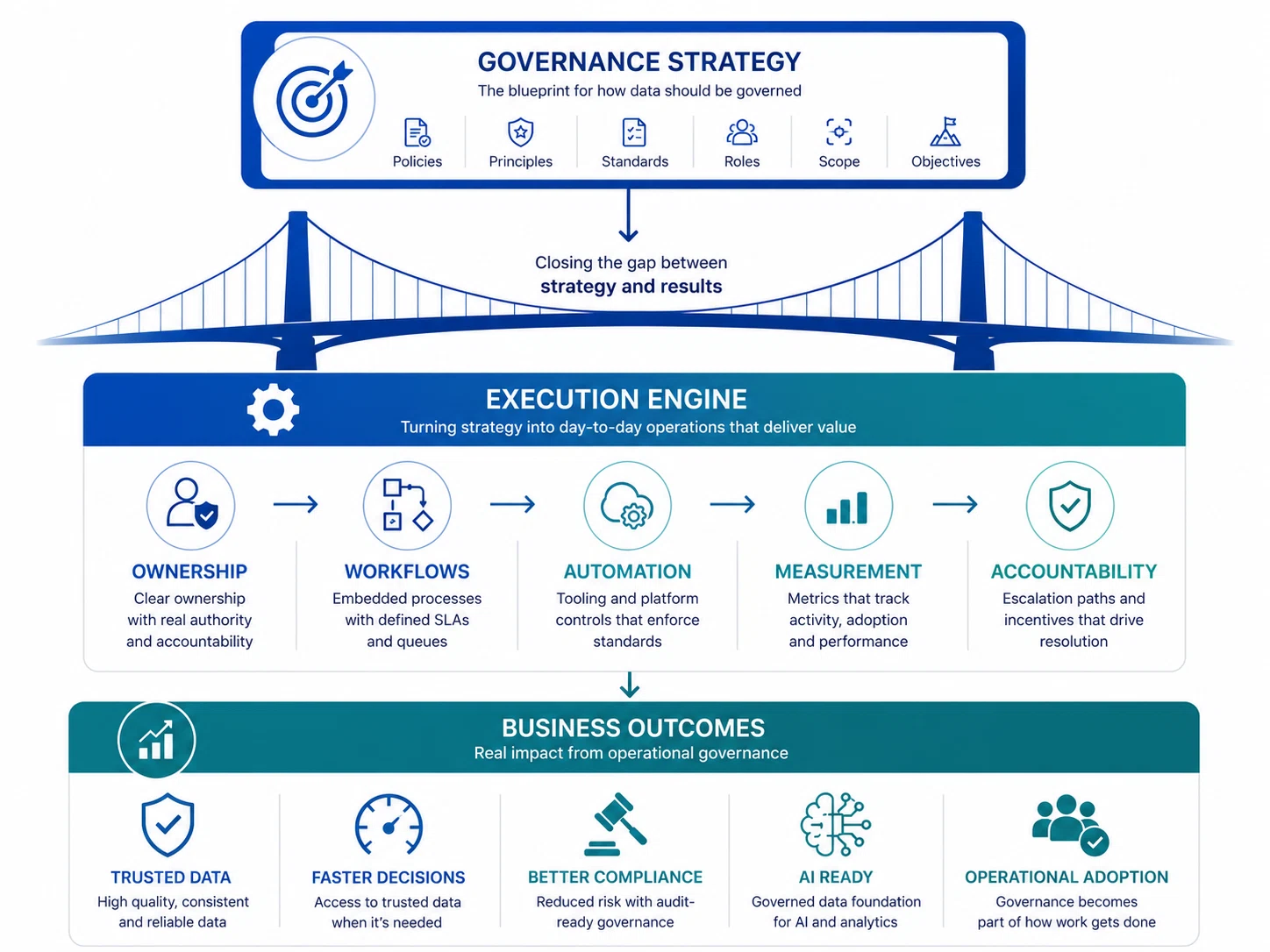
Operationalizing data governance means closing the distance between what a governance framework says should happen and what people actually do every day. That distance is where most programs die.
Table of Contents:
- What Does It Mean to Operationalize Data Governance?
- Why Governance Programs Stall Between Strategy and Execution
- The Five Execution Gaps That Kill Governance Programs
- A Proven Operationalization Framework
- BluEnt in Practice: 10 Weeks from Framework to Operations
- How to Start: A 5-Step Execution Sequence
- Frequently Asked Questions
What Does It Mean to Operationalize Data Governance?
The distinction matters because most governance programs are designed as policy frameworks and deployed as documentation exercises. Policies get written. Roles are assigned. The steering committee meets quarterly.
None of that is operationalization. Operationalization happens when a data steward in the finance team has a queue of data quality issues to resolve by Friday, when a CDE publishing workflow rejects a document that does not meet naming standards, and when the CDO reviews a governance scorecard in the same meeting where project delivery performance is reviewed.
Gartner research has consistently found that fewer than 50% of enterprise data governance programs produce measurable value in their first two years. The primary reason is not poor design; it is failure to translate governance design into operational practice at the team level.
Why Governance Programs Stall Between Strategy and Execution
The gap between governance strategy and governance execution is predictable. The same failure patterns appear across industries, organization sizes, and technology stacks. Understanding them is the first step to avoiding them.
The framework becomes the deliverable
In many organizations, the data governance framework document is treated as the outcome of the program rather than the starting point for it. The CDO or consulting team delivers a governance framework; the document is approved by leadership, and the program is considered ‘done.’
A governance framework is a set of instructions. It has no value until the instructions are followed. When the framework is deliverable, execution never begins.
Ownership is assigned without authority
Data ownership roles are created on paper. Job descriptions are updated. But the data owners are not given the authority to reject non-compliant data, mandate source system corrections, or escalate unresolved quality issues to leadership.
Ownership without authority produces accountability of theater. People are named responsible for data quality outcomes they cannot actually control.
Technology is selected before governance design is complete
Organizations purchase Collibra, Alation, or Microsoft Purview before they have defined their data ownership model, quality standards, or stewardship workflows. The platform is configured to match the existing governance gaps rather than the desired governance state.
Tools accelerate governance. They do not create it. Selecting the tool first means the tool shapes the program rather than the program shaping the tool.
Your governance strategy is only as good as its execution plan.
BluEnt’s Data Governance Maturity Assessment identifies precisely where your organization is stalling between strategy and operations, across 18 dimensions in 15 minutes.
Data Governance Maturity Assessment
A structured diagnostic for CDOs, CIOs, and Chief Compliance Officers. 18 questions across six governance dimensions. Receive a scored maturity profile and prioritised recommendations.
Your Details
Your Assessment Results
Overall Governance Maturity Level
Receive Your Full Report
A BluEnt governance consultant will prepare a personalised report with specific recommendations for your highest-priority gaps. Book a 60-minute discovery call to discuss your findings.
The Five Execution Gaps That Kill Governance Programs
Not all data is master data. Master data describes the core entities that appear across multiple systems and business processes. Here are the six domains that most enterprises need to govern as a priority.
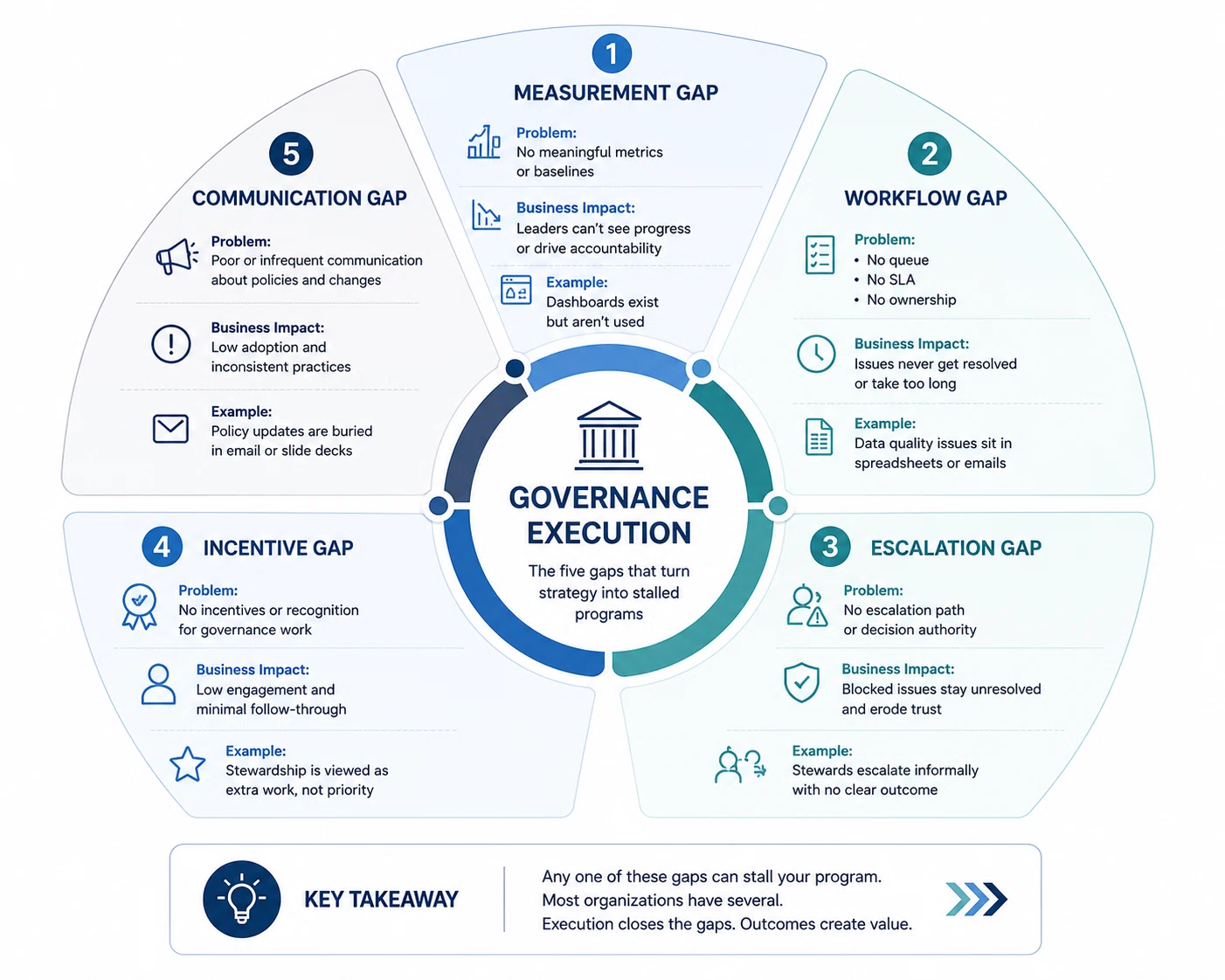
Most governance execution failures can be traced to one or more of five specific gaps. Identifying which gaps exist in your program is the most direct path to fixing them.
| Gap | What It Looks Like |
|---|---|
| The Measurement Gap | Governance activities are not measured. Data quality scores, issue resolution rates, and stewardship adoption of metrics do not exist or are not reviewed by leadership. Without measurement, governance programs have no feedback loop and no accountability mechanism. |
| The Workflow Gap | Governance tasks, resolving data quality issues, reviewing access requests, and approving data definitions, are not integrated into existing work management platforms. Stewards have no queue, no ticketing system, no SLA. Issues get raised but not systematically resolved. |
| The Escalation Gap | When data quality issues are identified, there is no clear escalation path. Stewards do not know when to escalate, to whom, or what authority the escalation path has. Issues that stewards cannot resolve alone sit unresolved indefinitely. |
| The Incentive Gap | Governance responsibilities are added to data owners and stewards without being reflected in performance objectives, workload allocation, or recognition. People optimize what they are measured on. Governance activities that are not measured disappear under the pressure of other priorities. |
| The Communication Gap | The governance program does not report its outcomes to the business in business terms. Data quality scores and policy compliance rates do not connect to revenue, risk, or operational performance. Leadership cannot see why governance matters, so it does not defend it when resources are squeezed. |
A Proven Operationalization Framework
Closing the execution gaps requires building four operational capabilities that turn governance policy into daily practice.
An Operating Model with Real Authority Ownership that comes with enforcement power
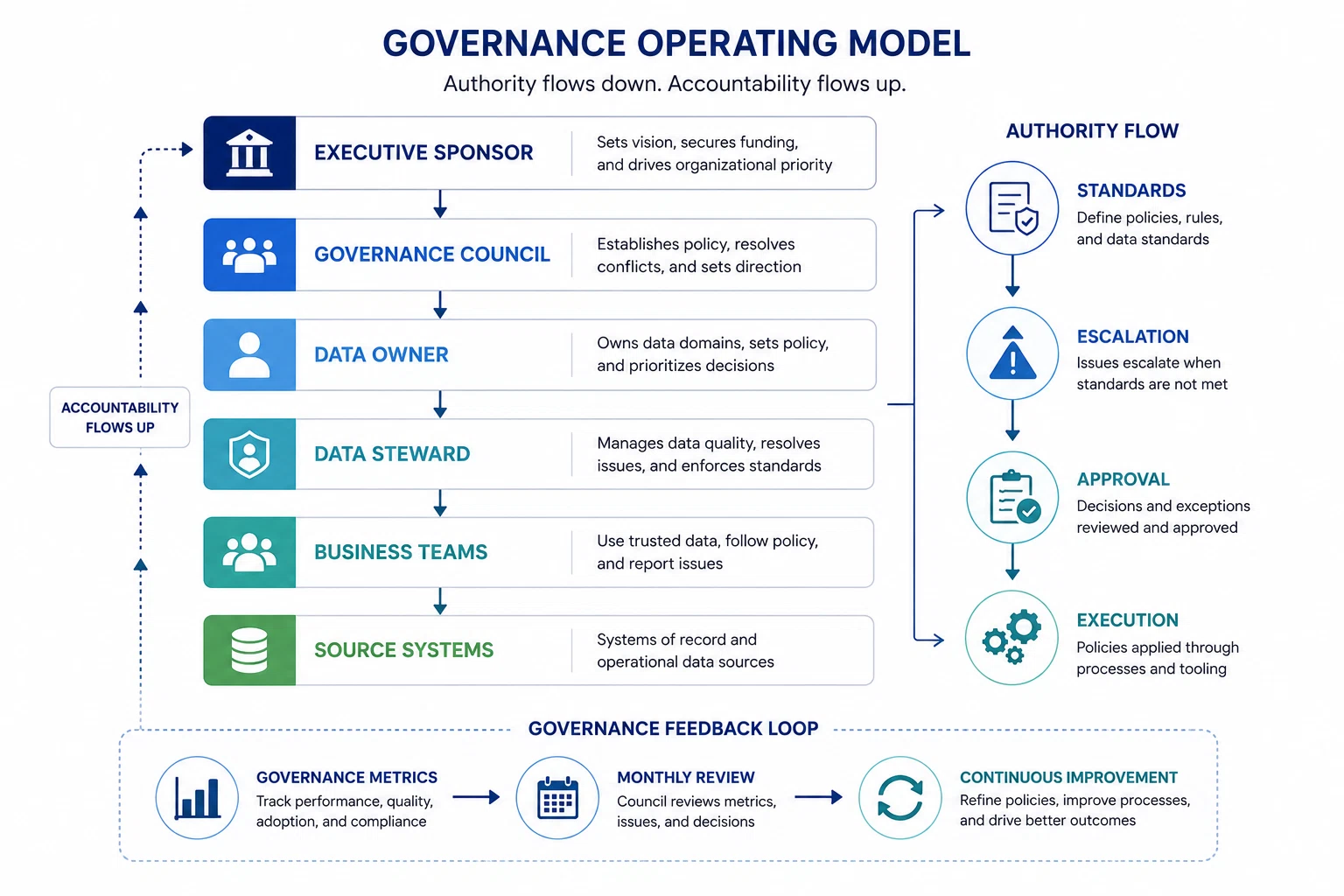
Every data domain needs a named owner with defined scope and genuine authority: the right to reject non-compliant data, mandate corrections in source systems, and escalate to the data governance council when issues are not resolved within SLA.
Stewardship roles sit below ownership in the operating model. Stewards handle day-to-day governance activities: resolving quality issues, managing access requests, and maintaining data catalog entries. The distinction between owner (accountable for outcomes) and steward (responsible for activities) matters for escalation and performance management.
Integrated Tooling That Creates Governance Workflows Make governance work visible and trackable
Governance activities should live in the same work management environment as operational work. ServiceNow, Jira, or Microsoft Planner can host data quality issue queues. Collibra and Alation provide native workflow capabilities for data issue management, access requests, and policy approvals.
When governance work has a ticket, an owner, an SLA, and a resolution record, it becomes manageable and measurable. When it lives in email threads and meeting notes, it does not.
A Measurement System Connected to Business Outcomes Report governance in the language of leadership
The governance scorecard should report three tiers of metrics: operational metrics (issue resolution rate, data quality scores, stewardship activity completion), program metrics (policy adoption rate, domain coverage, catalog completeness), and business impact metrics (reduction in manual reconciliation hours, decrease in data-related audit findings, improvement in reporting turnaround time).
Business impact metrics are the ones that protect the governance budget. If leadership can see that governed data reduced quarterly close reconciliation from 40 hours to 8 hours, governance has a business case that survives the next budget cycle.
Governance Embedded in Platform Controls, Not Just Policy Documents Automation that enforces standards without depending on memory
The most durable governance controls are the ones that are enforced by the platform, not by people remembering to follow a policy. Microsoft Purview sensitivity labels that prevent documents from being shared outside approved groups. Collibra approval of workflows that require data quality sign-off before a dataset is published to the catalog. CDE publishing rules that reject documents that do not meet naming convention standards.
Policy-only governance degrades as soon as attention shifts. Platform-enforced governance persists.
Governance programs that stall in execution need more than a better framework.
BluEnt’s data governance consulting team specializes in the execution layer, designing the operating models, workflows, and measurement systems that make governance programs work in practice. Request a scoped proposal.
BluEnt in Practice: 10 Weeks from Framework to Operations
A US-based enterprise engaged BluEnt after a previous governance initiative had produced a comprehensive framework of documents that was never operationalized. The organization had data ownership roles defined on paper, but no enforcement mechanism, no stewardship workflows, and no governance metrics.
The core problem was structural: governance activities had been designed as a parallel process rather than integrated into existing operational workflows. Data owners had responsibilities but no tooling to act on them. Issues were identified but had nowhere to go.
BluEnt’s 10-week engagement was structured to close the execution gaps directly. Ownership roles were redefined with explicit enforcement authority and escalation paths. Stewardship workflows were built into the client’s existing ServiceNow environment, creating ticketed queues for data quality issues with defined SLAs and ownership accountability.
A governance scorecard was designed and presented to the CDO in the same monthly business review where operational KPIs were reported, making governance performance visible alongside delivery performance for the first time. By week 10, the governance program had measurable activity, resolved issues, and a reporting cadence that sustained leadership attention beyond the initial launch.
How to Start: A 5-Step Execution Sequence
If your governance program has a framework but not an execution engine, here is the sequence that closes the gap fastest.
Audit the Current Execution State Find out which gaps exist before adding more governance infrastructure
Before redesigning anything, map the current state: which roles are assigned but not active, which policies exist but are not enforced, which tools are deployed but not generating workflow. This audit takes one to two weeks and produces a precise list of execution gaps rather than a general sense that ‘governance is not working.
Pick One Domain and Build the Full Execution Stack Depth before breadth
Choose the highest-priority domain and build the complete execution capability for it: ownership with authority, stewardship with a workflow queue, quality standards with automated measurement, and an escalation path that reaches the governance council. Prove the execution model works in one domain before replicating it across others.
Integrate Governance Work into Existing Tools No separate governance portal
Resist the urge to build a dedicated governance portal. Route governance works into the tools your teams already use: ServiceNow for issue queues, Jira for stewardship tasks, Microsoft Teams for escalation notifications. The lower the friction of governance work, the higher the adoption rate.
Report to Leadership Monthly from Month One Establish the reporting cadence before you have impressive results
Start reporting governance metrics to the CDO and leadership team from the first month, even if the early metrics are baseline measurements rather than improvements. The reporting cadence is the mechanism that keeps governance visible and protected from budget pressure. A program that does not report does not sustain.
Connect Governance Performance to Performance Management Make governance someone’s job, not someone’s extra task
Work with HR and functional leaders to include governance responsibilities in the performance objectives of data owners and stewards. Even a single governance metric in a performance review changes the priority calculus for everyone in that role. Governance that is not measured in performance management gets deprioritized as soon as operational pressure increases.
Ready to move your governance program from strategy to execution?
BluEnt’s data governance consulting team has operationalized governance programs for enterprises across 14 business units and 6 global markets. Book a strategy session to scope the execution gaps in your current program.
Frequently Asked Questions
How long does it take to operationalize a data governance program?Establishing operational governance in a single priority data domain, with active ownership, a stewardship workflow, quality measurement, and a reporting cadence, typically takes 60 to 90 days. Expanding operational governance across multiple domains and business units takes 6 to 18 months depending on organizational complexity. The most important variable is not the breadth of the program but the depth of execution in the first domain. A fully operationalized single domain delivers more value than a partially operationalized enterprise-wide framework.
What is the difference between a data governance framework and an operationalized governance program?A data governance framework defines the policies, roles, standards, and structures for how data should be managed. An operationalized governance program is one where those policies are actively enforced; those roles are actively exercised, quality standards are regularly measured, and governance outcomes are regularly reported. The framework is the design. Operationalization is the implementation. Many organizations have frameworks. Fewer have operationalized programs.
What tools support data governance operationalization?Data catalog and governance platforms, Collibra, Alation, Microsoft Purview, Informatica Axon, provide native workflow capabilities for data issue management, policy approval, and stewardship task management. Work management platforms, ServiceNow, Jira, Microsoft Planner, can host governance workflows within environments teams already use. BI platforms, Power BI, Tableau, support governance, scorecard development, and leadership reporting. The right toolset depends on your existing infrastructure and where your teams already work.
Why do data governance programs fail in execution?The most common execution failures are ownership roles assigned without enforcement authority; governance activities not integrated into existing workflows (no queue, no SLA, no tracking); absence of measurement that connects governance performance to business outcomes; technology selected before governance design is complete; and governance responsibilities not reflected in performance management. Most programs fail to do so because of one or more of these five gaps, not because of poor framework design.
How do you measure the success of a data governance program?Effective governance measurement operates at three levels. Operational metrics track the activity of the program: data quality scores by domain, issue resolution rates, stewardship task completion, and policy adoption rates. Program metrics track the coverage and maturity of governance across the organization: number of governed domains, catalog completeness, ownership assignment coverage. Business impact metrics connect governance to organizational outcomes: reduction in manual data reconciliation time, decrease in data-related audit findings, improvement in reporting reliability, and cycle time. All three levels are needed; business impact metrics are the ones that protect governance investment at budget time.
Should we hire a data governance consultant or build the capability internally?Most organizations benefit from both. External data governance consultants provide frameworks, domain expertise, and implementation acceleration that would take years to develop internally. Internal capability provides institutional knowledge, organizational relationships, and continuity that external consultants cannot sustain past the engagement. The most effective pattern is to use external consultants to design and launch the governance program and stand up the operational infrastructure, while building internal data owners, stewards, and governance leadership who own the program’s ongoing execution. BluEnt’s data governance implementation engagements are structured with knowledge transfer built in from the first week.

 Governing AI Tools in AEC: Copilot, Digital Twins, and Generative Design
  Data Governance for AI and Advanced Analytics: Building the Foundation That Works
 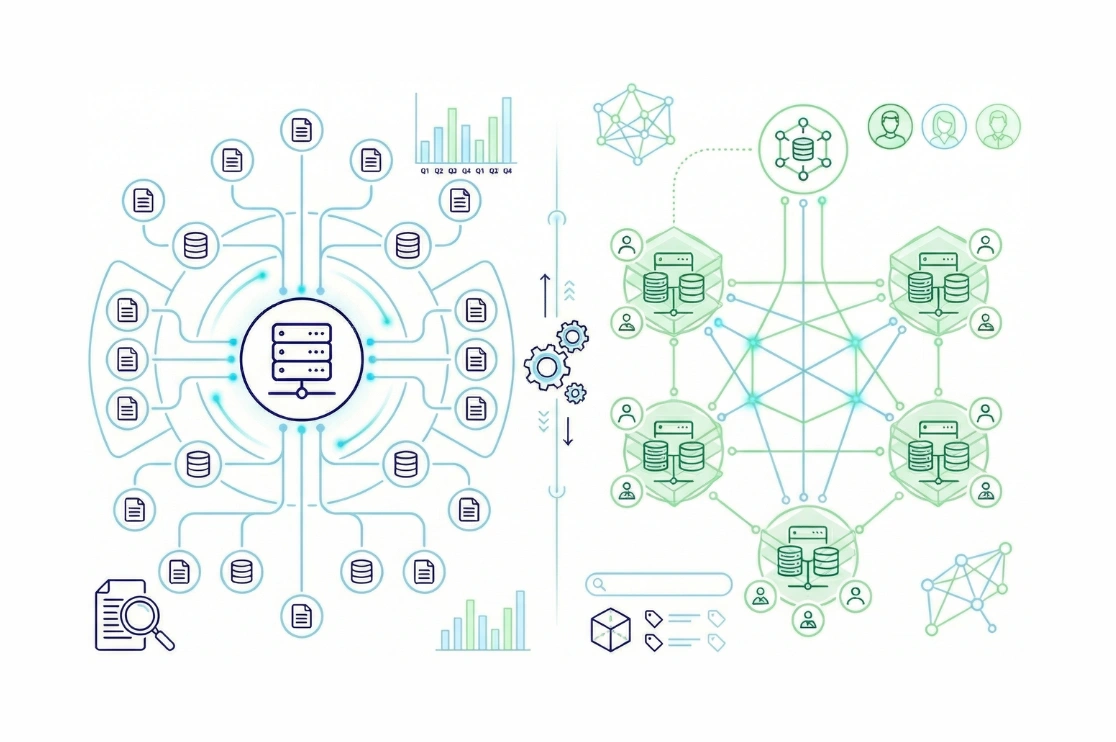 Centralized vs. Federated Data Governance: Which Model Fits Your Organization
  Data Governance Roles and Responsibilities in AEC Organizations