








Most data governance programs fail not because the framework was wrong, but because the starting point was misunderstood. Organizations invest in cataloging, stewardship, and platform configuration without an accurate picture of what already exists, what is missing, and what to fix first. A BluEnt maturity assessment gives you that picture before the investment begins.
BluEnt delivers consultant-led data governance maturity assessments for enterprise organizations across five industry verticals and six global markets. Our assessment is not a questionnaire or a vendor-provided scoring tool. It is a structured diagnostic engagement conducted by a senior governance consultant, producing findings that your leadership team can act on and your board can trust.
Data Governance Maturity Assessment
A structured diagnostic for CDOs, CIOs, and Chief Compliance Officers. 18 questions across six governance dimensions. Receive a scored maturity profile and prioritised recommendations.
Your Details
Your Assessment Results
Overall Governance Maturity Level
Receive Your Full Report
A BluEnt governance consultant will prepare a personalised report with specific recommendations for your highest-priority gaps. Book a 60-minute discovery call to discuss your findings.
Trusted By
Organizations That Trust BluEnt With Their Data

- Gift Card Management, Reporting, Data Integration, Analytics Solutions, Book Keeping NetSuite Reporting, NetSuite Records Maintenance, Income Statement, Audit Support

- Gift Card Management, Reporting, Data Integration, Analytics Solutions

- Invoicing, AP Reports, Sales Data Analytics
- MuleSoft Integration, Analytics & Dashboards - [Tableau, MS SQL Server, SSIS]

- ERP Onboarding and Implementation, Data Migration, Custom Report Building, Audit Support and Finalization, Draft Financials Statements, Bidding Website Development
- Data Analytics and Dashboards

- V-Bucks Gift Card Sales Analytics, Reconciliation, Financial Tracking and Reporting
- Web Asset Creation

- HubSpot Campaign Management, Workflow Automation, UX/UI Development, Mobile App Development, Application Development

- Data Analytics and Dashboards, Website Development, Website Maintenance, Application Development, HubSpot Automation and Integration, Asana Management
- SEO, Website UX/UI Development, Data Management, Third-Party Integration, Website Maintenance

- Shopify Website Development, Klaviyo Email Marketing, Email Campaign Setup, Third-Party Shopify App Integration

- Website and SEO Audit, Shopify Website Maintenance, SEO and Analytics
- Website Design and Development, Website Maintenance
- Website Design and Development, Website Maintenance

- Website Design and Development, Website Maintenance, SEO and Analytics
Is This Your Situation?
This page is written for the CDO, CIO, Chief Compliance Officer, or governance program director who needs an independent, consultant-led view of where their organization stands on data governance. If any of the following apply, a BluEnt maturity assessment is the right starting point.
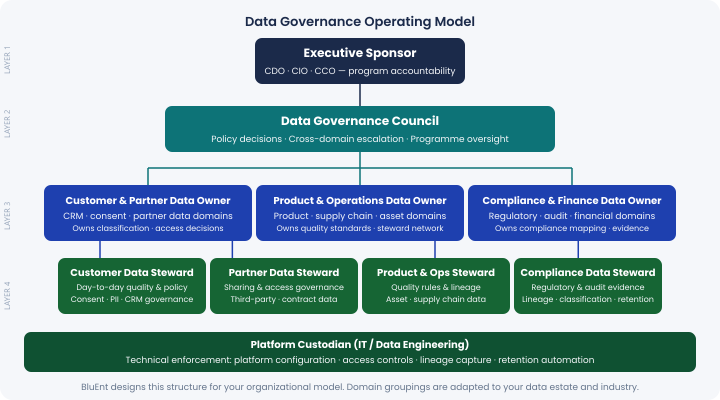
-
You are preparing to invest in a data governance program and need an accurate baseline before committing to scope, timeline, and budget.
-
Your governance program has been running for 12 to 24 months but outcomes are unclear. You are not certain what is working, what has stalled, and what to prioritize next.
-
A regulator, internal auditor, or board committee has requested evidence of your organization’s data governance maturity and you need an independent assessment to support that response.
-
You are evaluating data governance consulting firms and want a bounded, lower-risk engagement before committing to a full implementation program.
-
You have completed a self-assessment or vendor-provided maturity model and want an independent consultant to validate the findings against your actual policies, platform configuration, and stewardship activity.
-
You are in a post-merger or post-acquisition context and need to assess the governance maturity of two organizations before designing a combined governance framework.
Why a Consultant-Led Assessment Produces Different Results Than a Self-Assessment
Self-assessment tools, including our own free online maturity diagnostic, serve an important purpose: they help organizations identify approximate maturity levels quickly and at no cost. They are valuable for initial positioning, internal awareness, and prioritization conversations.
A consultant-led assessment produces a different category of output. The difference is not speed or depth alone. It is the nature of what is being measured.
| Self-Assessment or Free Online Tool | BluEnt Consultant-Led Maturity Assessment |
|---|---|
|
|
BluEnt assessors bring active delivery experience in the industries and platforms they evaluate. An assessor reviewing a financial services organization’s regulatory compliance readiness will have hands-on experience with DORA, BCBS 239, GLBA, or APRA CPS 234, not a generic checklist applied to every sector equally.
The Six Dimensions BluEnt Evaluates
BluEnt’s maturity assessment framework evaluates governance capability across six dimensions. Each dimension is independently scored on a one-to-five scale and weighted by its relative importance to overall governance maturity. The weighted composite score produces the organization’s overall maturity level.
| Code | Dimension | Weight | What BluEnt Evaluates |
|---|---|---|---|
| D1 | Data Ownership and Stewardship | 20% | Are data owners formally assigned and accountable? Is the steward network active, trained, and operating with a defined mandate? How are governance decisions escalated and resolved? |
| D2 | Policy, Standards, and Classification | 18% | Are governance policies documented, current, and enforced? Does a classification framework exist and drive platform controls? Is the business glossary active and referenced as the authoritative source? |
| D3 | Regulatory and Compliance Readiness | 20% | Can the organization produce audit evidence on demand? Are regulatory obligations formally mapped to governance controls? How are cross-border data flows identified and governed? |
| D4 | Data Quality and Trust | 17% | Do business leaders trust the data used in decisions? Are quality issues caught at source or discovered downstream? Is master data governed through a formal program? |
| D5 | Technology and Platform Governance | 12% | Is the data catalog deployed and adopted across engineering and business teams? Are platform governance controls configured and enforced natively? Is access monitoring automated? |
| D6 | AI and Analytics Data Readiness | 13% | Is the governance foundation ready to support AI and machine learning programs? Are model inputs documented and governed? Is the organization prepared for evolving AI regulation? |
Each dimension produces an independent finding with a dimension score, a gap summary, and recommended next steps. Organizations frequently score at different maturity levels across dimensions.
A Level 4 score on technology and platform governance does not indicate Level 4 performance on stewardship or regulatory readiness, and vice versa.
The Five Maturity Levels
BluEnt uses a five-level maturity model calibrated to real governance outcomes, not theoretical ideals. Each level reflects an observable, assessable state of governance capability rather than a point on a conceptual scale.
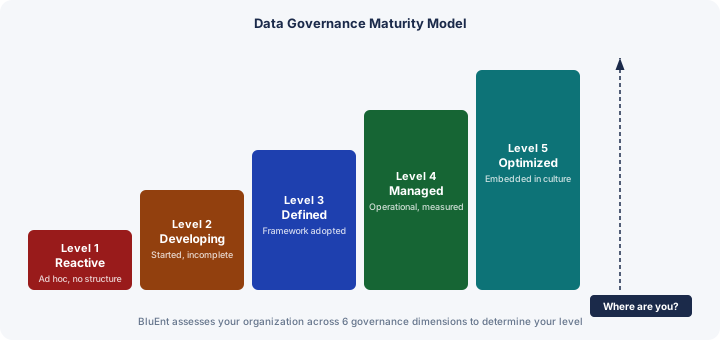
| Level 1: Reactive | Governance is absent or entirely ad hoc. Data quality problems, compliance gaps, and access control failures are discovered after they cause damage. No defined ownership structure, no active stewardship, no enforced policy framework. |
| Level 2: Developing | Governance has started but is incomplete. Some policies, roles, and tools exist but coverage is inconsistent, adoption is low, and the program lacks executive accountability or a formal operating model. |
| Level 3: Defined | A governance framework exists and is largely adopted across most critical data domains. Known gaps are identified and being addressed. Platform controls are partially configured. Stewardship is active in most domains. |
| Level 4: Managed | Governance is operational, measured, and continuously maintained. Platform controls enforce policy natively. Stewardship is active and accountable across all critical domains. Compliance posture is maintained on an ongoing basis. |
| Level 5: Optimized | Governance is embedded in organizational culture and technology. The program evolves proactively with regulatory change, platform growth, and business expansion. Governance capability is a competitive and regulatory advantage. |
What You Receive at the End of a BluEnt Maturity Assessment
Every BluEnt maturity assessment engagement produces a defined set of deliverables. These are not internal working documents. They are structured outputs designed to be presented to executive leadership, used in board-level governance conversations, and submitted as evidence to regulators and auditors where applicable.

Governance Maturity Scorecard
A scored assessment across all six governance dimensions with dimension-level findings, supporting evidence, and confidence ratings. Presented as both a detailed report and an executive summary.

Gap Analysis Report
A structured gap analysis per dimension identifying specific control failures, policy gaps, and stewardship failures. Each gap is rated by severity and regulatory risk, and prioritized by impact on the organization’s governance program.

Prioritized Implementation Roadmap
A sequenced 12-to-24-month action plan aligned to the organization’s budget constraints, regulatory deadlines, and governance risk priorities. The roadmap is structured in phases with defined outcomes per phase.

Regulatory Compliance Map
The organization’s regulatory obligations mapped to current governance controls and identified gaps. Jurisdiction-specific and industry-specific. Structured to support both internal compliance reporting and regulator engagement.

Executive Presentation
A board-ready summary of assessment findings, maturity scores, and recommended investment priorities. Formatted for presentation to executive leadership without requiring prior familiarity with governance frameworks.

Assessment Debrief Session
A 90-minute facilitated session with the organization’s leadership team to present findings, discuss the roadmap, answer questions, and agree on immediate next steps. Conducted by the lead assessor who performed the engagement.
Book Your Governance Assessment Scoping Call. No Preparation Required.
We bring the assessment framework, the interview guide, the platform review checklist, and the industry-specific regulatory knowledge. You provide access to your team and your documentation.
How BluEnt Conducts a Data Governance Maturity Assessment
Every BluEnt maturity assessment follows a five-stage methodology designed to produce accurate, validated findings. The assessment is structured to minimize disruption to the organization’s operations while ensuring that findings reflect the actual state of governance, not the intended state.
A single senior consultant leads the engagement from scoping through to the debrief. You will not be handed between team members or required to re-explain your environment at each stage.

Stage 1: Scoping and Stakeholder Planning (Weeks 1 to 2)
BluEnt works with the engagement sponsor to define assessment scope: which business units, data domains, platforms, and regulatory frameworks will be covered. Stakeholders are identified for interview scheduling: typically eight to twelve individuals across data ownership, stewardship, compliance, IT leadership, and business data consumers. A documentation request list is issued.
Deliverable: Assessment Scope Document, Stakeholder Interview Schedule, Documentation Request List.

Stage 2: Documentation and Platform Review (Weeks 2 to 4)
The assessor reviews all submitted documentation against the six-dimension framework: governance policies, data standards, classification frameworks, stewardship charters, regulatory compliance mapping, platform configuration records, and data catalog adoption evidence. Platform configuration is reviewed directly where access is granted, or via screen-share review sessions with the technical team.
Deliverable: Documentation Review Summary, Platform Configuration Assessment, Initial Maturity Indicators per Dimension.

Stage 3: Stakeholder Interviews (Weeks 3 to 5)
Structured interviews are conducted with each identified stakeholder using a standardized interview guide tailored to their role. Data owners and stewards are asked about accountability structures, escalation processes, and operational workflows. Compliance officers are asked about regulatory mapping, audit readiness, and evidence management. Platform leads are asked about catalog adoption, control configuration, and access monitoring. Business data consumers are asked about data trust, reporting discrepancies, and the operational impact of governance gaps.
Deliverable: Interview Transcripts, Stakeholder Findings Summary, Gap Validation Notes.

Stage 4: Scoring, Analysis, and Report Preparation (Weeks 5 to 7)
Dimension scores are calculated using the weighted maturity model, with scores calibrated against the documentation review and interview findings rather than self-reported answers alone. The gap analysis is structured by dimension and by severity. The implementation roadmap is sequenced based on the organization’s regulatory risk exposure, platform readiness, and organizational capacity for change.
Deliverable: Draft Maturity Scorecard, Gap Analysis Report, Prioritized Implementation Roadmap, Regulatory Compliance Map, Executive Presentation.

Stage 5: Findings Presentation and Roadmap Alignment (Week 7 to 8)
The lead assessor presents findings to the engagement sponsor and relevant leadership stakeholders. The 90-minute debrief session covers the dimension scores, the highest-priority gaps, the recommended roadmap, and the immediate next steps. Organizations that choose to proceed to a BluEnt implementation engagement transition directly from this session to scoping the first implementation phase.
Deliverable: Finalized Deliverable Package, Assessment Debrief Session, Optional: Implementation Scoping Proposal.
Proof Point: Governance Assessment That Became the Foundation for a 14-Unit Program
BluEnt delivered a data governance maturity assessment for a confidential client in the architecture, engineering, and construction sector operating across 14 business units in three countries. The assessment preceded a full governance program implementation.
The Situation
The organization had invested in a data catalog and appointed nominal data owners across business units, but business leadership had low confidence in governance progress and could not determine whether the investment was producing results. An internal audit had flagged gaps in access controls and lineage documentation without providing a clear remediation path. The organization needed an independent baseline before committing further budget to governance infrastructure.
What BluEnt Assessed
Governance posture across all six dimensions. Stakeholder interviews with 11 participants including the CDO, four data owners, three stewards, two platform leads, and one compliance officer. Documentation review of 18 policy documents, the catalog configuration, and the stewardship charter. Platform review of the data catalog adoption metrics and access control configuration.
Assessment Findings
Overall maturity: Level 2 (Developing). Highest-scoring dimension: Technology and Platform Governance (Level 3). Lowest-scoring dimension: Regulatory and Compliance Readiness (Level 1). Seven critical gaps identified including absence of documented lineage for any regulated dataset and no formal obligation mapping for two of the three operating jurisdictions.
Outcome
The assessment findings and roadmap were presented to the board and used to secure investment for a 12-month implementation program. BluEnt delivered the implementation in three phases, with the organization reaching Level 4 overall maturity within 14 months of the assessment completion. The assessment deliverables were also submitted to the organization’s external auditors as evidence of governance intent and structured remediation planning.
Data Governance Maturity Assessments Across Your Industry
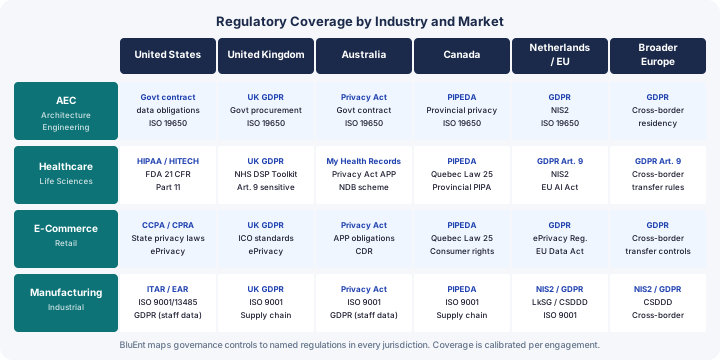
Governance maturity means different things in different industries. The dimensions that carry the highest risk, the regulatory frameworks that define compliance obligations, and the stewardship structures that are practical to implement all vary significantly by sector. BluEnt calibrates every assessment to the industry it is assessing.
Architecture, Engineering, and Construction (AEC)
AEC enterprises manage some of the most fragmented data environments of any sector. Project data, BIM models, asset registers, contract documentation, and supply chain records are spread across dozens of entities and jurisdictions, with governance accountability structures that rarely survive project handoff.
BluEnt’s AEC assessments focus on data ownership across project and entity boundaries, classification of project and asset data against government contract obligations, and stewardship structures that function in a project-based organizational model.
Regulatory context assessed: government contract data obligations (US, UK, Australia), ISO 19650 BIM data management standards, procurement compliance frameworks.
Healthcare and Life Sciences
No other sector produces a wider gap between stated governance maturity and actual audit readiness than healthcare. When BluEnt assesses a healthcare organization, the most common finding is that HIPAA technical safeguard requirements are partially addressed in documentation but not enforced through platform controls. Patient data, clinical trial records, and operational health data each carry distinct regulatory obligations that must be independently validated during the assessment.
BluEnt evaluates platform control configuration against healthcare-specific requirements, stewardship structures for sensitive health data domains, and the organization’s ability to produce audit evidence on demand. Regulatory context assessed: HIPAA and HITECH (US), NHS Data Security and Protection Toolkit (UK), My Health Records Act (Australia), GDPR Article 9 sensitive data obligations (EU), FDA 21 CFR Part 11 (clinical trials).
E-Commerce and Retail
Retail enterprises are managing the regulatory pressure that accompanies first-party data growth while navigating the collapse of third-party data ecosystems. Customer data assets are expanding rapidly and governance frameworks are not keeping pace.
BluEnt’s retail assessments focus on classification and purpose-binding governance for customer and behavioral data, cross-border transfer governance for international retail operations, and the data quality and stewardship structures required to make customer data trustworthy for both analytics and regulatory compliance. Regulatory context assessed: GDPR (EU), UK GDPR, CCPA and CPRA (US), PIPEDA (Canada), Australian Privacy Act, ePrivacy Regulation.
Manufacturing and Industrial Enterprises
Manufacturing enterprises are managing the convergence of operational technology data from IoT sensors, SCADA systems, and production lines with ERP, MES, and supply chain platforms in shared data environments. Governance programs must address both OT-derived and IT-derived data domains under frameworks that were not designed for operational technology data.
BluEnt’s manufacturing assessments evaluate classification standards across OT and IT data domains, access controls that reflect production facility and supplier relationship structures, and lineage configurations that support product traceability and quality management audit requirements.
Regulatory context assessed: NIS2 Directive for critical infrastructure operators (EU), German Supply Chain Due Diligence Act (LkSG), EU CSDDD, ITAR and EAR export controls (US), ISO 9001 and ISO 13485 quality data obligations, GDPR and UK GDPR.
For full regulatory framework coverage by jurisdiction and implementation blueprints by industry, see our dedicated service pages.
Data Governance Maturity Assessments Across Six Markets
Regulatory obligations, audit expectations, and governance standards differ materially between jurisdictions. A maturity assessment that evaluates compliance readiness against the wrong regulatory framework produces findings that cannot be acted on. BluEnt maintains active regulatory knowledge across all six markets we operate in.

United States: HIPAA, HITECH, GLBA, SOX, CCPA and CPRA, plus state privacy laws including the Virginia Consumer Data Protection Act, Colorado Privacy Act, Connecticut Data Privacy Act, and Texas Data Privacy and Security Act.
United Kingdom: UK GDPR, Data Protection Act 2018, ICO enforcement standards, FCA operational resilience expectations, NHS Data Security and Protection Toolkit for healthcare clients.
Australia: Privacy Act 1988, Australian Privacy Principles (APP), Notifiable Data Breaches scheme, APRA CPS 234 for information security in financial services, APRA CPS 230 for operational risk, Consumer Data Right (CDR).
Canada: Federal privacy obligations under PIPEDA, supplemented by province-level legislation: Quebec Law 25, British Columbia PIPA, and Alberta PIPA. Organizations in federally regulated industries are also subject to OSFI guideline B-13 on technology and cyber risk management.
Netherlands and EU: GDPR, Digital Operational Resilience Act (DORA) for financial entities, NIS2 Directive for critical infrastructure operators, EU Data Act, and Autoriteit Persoonsgegevens (AP) guidance for Dutch entities.
Broader Europe: DORA implementation across EU member states, cross-border data residency controls, and sector-specific regulatory frameworks for financial services, healthcare, and critical infrastructure operators.
An Accurate Starting Point Is the Most Valuable Investment a Governance Program Can Make
The most expensive governance mistakes happen when organizations invest in frameworks, tools, and stewardship structures without an accurate baseline. Cataloging data that has not been classified. Configuring platform controls that are not enforced because the policy framework they should reference does not exist. Activating stewards who have no mandate because ownership has not been defined.
A BluEnt maturity assessment identifies those misalignments before they compound. The findings give your leadership team the evidence they need to invest confidently, the roadmap they need to act on that investment, and the independent validation they need to satisfy auditors, boards, and regulators.
Not ready for either yet? Explore our governance service portfolio:
- Enterprise Data Governance Services: our hub page covering the full governance service portfolio
- Data Governance Consulting Services: specialist advisory, operating model design, and stewardship activation
- Enterprise Data Governance Solutions: full industry breakdowns, capability coverage, and regulatory frameworks by jurisdiction
- Data Governance for Snowflake and Databricks: platform-native governance implementation for lakehouse environments
Data Governance Maturity Assessment
A structured diagnostic for CDOs, CIOs, and Chief Compliance Officers. 18 questions across six governance dimensions. Receive a scored maturity profile and prioritised recommendations.
Your Details
Your Assessment Results
Overall Governance Maturity Level
Receive Your Full Report
A BluEnt governance consultant will prepare a personalised report with specific recommendations for your highest-priority gaps. Book a 60-minute discovery call to discuss your findings.
Frequently Asked Questions
What is a data governance maturity assessment?
A data governance maturity assessment is a structured diagnostic engagement that evaluates an organization’s current governance capabilities across defined dimensions and produces a scored baseline, a gap analysis, and a prioritized improvement roadmap. A consultant-led assessment validates findings against actual platform configuration, governance documentation, and stakeholder interviews rather than relying solely on self-reported answers. The output is used to guide governance investment decisions, respond to regulatory inquiries, and establish a measurable foundation for program improvement.
How is a consultant-led assessment different from a self-assessment tool?
A self-assessment tool produces scores based on self-reported answers, typically from a single respondent or small internal group. There is no validation against actual policies, platform configuration, or stewardship activity. A consultant-led assessment validates every finding against evidence: policy documents are reviewed for currency and completeness, platform controls are assessed directly, and structured interviews with data owners, compliance officers, and business stakeholders surface the operational reality behind the documented framework. The result is a finding that can be presented to regulators, auditors, and boards as independent evidence rather than internal self-evaluation.
How long does a BluEnt data governance maturity assessment take?
A standard BluEnt maturity assessment covering all six governance dimensions takes six to eight weeks from scoping to final deliverable delivery. The timeline depends on the number of business units and data domains in scope, stakeholder availability for interviews, and the volume and accessibility of governance documentation to be reviewed. Organizations with complex multi-jurisdiction or multi-entity environments may require eight to ten weeks. Expedited assessments covering a single dimension or specific regulatory readiness area can be completed in three to four weeks.
What does a data governance maturity assessment cost?
Assessment cost depends on the scope of the engagement: the number of dimensions assessed, the number of business units and platforms included, the number of stakeholder interviews conducted, and the markets covered. BluEnt provides a fixed-fee proposal for every engagement following a complimentary 60-minute scoping call. There are no variable billing surprises. Organizations that proceed from assessment to implementation with BluEnt receive a credit against their assessment fee on their first implementation phase.
What deliverables do we receive at the end of the assessment?
Every BluEnt maturity assessment produces six deliverables: a Governance Maturity Scorecard scored across all six dimensions, a Gap Analysis Report with severity and regulatory risk ratings per gap, a Prioritized Implementation Roadmap covering 12 to 24 months, a Regulatory Compliance Map linking obligations to current controls and gaps, a board-ready Executive Presentation, and a 90-minute Assessment Debrief Session with the lead assessor. All deliverables are provided in editable formats suitable for internal distribution and board presentation.
Do we need to have an existing governance program to benefit from an assessment?
No. Organizations at every stage of governance maturity benefit from an independent assessment. Organizations with no formal governance program use the assessment to establish a credible starting point and build an investment case. Organizations with established programs use the assessment to validate progress, identify gaps they have become blind to, and recalibrate priorities. Organizations in regulatory response situations use the assessment to produce independent evidence of governance posture and a structured remediation plan.
Can the assessment output serve as evidence in a regulatory audit or board review?
Yes. BluEnt assessment deliverables are structured specifically for use in regulatory and board contexts. The Governance Maturity Scorecard and Gap Analysis Report provide an independent, third-party view of governance posture with validated evidence supporting each finding. The Regulatory Compliance Map documents obligations mapped to current controls and identified gaps. These documents have been used by BluEnt clients to respond to regulatory inquiries, satisfy internal audit requirements, and support board-level governance investment decisions.
How does the assessment connect to a full governance implementation?
The assessment is designed to serve as the first phase of a governance implementation engagement. The Prioritized Implementation Roadmap produced in the assessment directly informs the scope, sequencing, and investment structure of a follow-on implementation program. Organizations that proceed to a BluEnt implementation engagement transition directly from the assessment debrief into scoping the first implementation phase, with no re-baselining or re-discovery required. The assessment findings also serve as the baseline against which implementation progress is measured.
What is the difference between a maturity assessment and a gap analysis?
A maturity assessment is broader than a gap analysis. A maturity assessment evaluates governance capability across defined dimensions, produces a scored baseline, and situates the organization within a maturity model. A gap analysis is typically a component of a maturity assessment: it identifies specific control failures, policy gaps, and stewardship failures against a defined standard. In a BluEnt engagement, the gap analysis is one of six deliverables produced from the broader maturity assessment, structured by dimension and rated by severity and regulatory risk.
Which industries and regulatory frameworks does BluEnt have assessment experience in?
BluEnt has delivered governance maturity assessments across four industry verticals: architecture, engineering, and construction; healthcare and life sciences; e-commerce and retail; and manufacturing and industrial enterprises. Assessment regulatory coverage includes HIPAA and HITECH (US), UK GDPR and the Data Protection Act 2018, GDPR (EU), DORA and NIS2 (EU and Netherlands), APRA CPS 234 (Australia), CCPA and CPRA (US), PIPEDA and provincial privacy legislation (Canada), and ISO 9001 and 13485 (manufacturing).
How do we start a BluEnt data governance maturity assessment?
The process begins with a 60-minute complimentary scoping call. In that call, BluEnt and the engagement sponsor agree on assessment scope, confirm stakeholder availability, discuss the documentation to be reviewed, and agree on a timeline and fixed fee. There is no preparation required before the scoping call. BluEnt brings the framework, the interview guide, the platform review checklist, and the industry-specific regulatory knowledge. Organizations proceed at their own pace from the scoping call to formal engagement.
View Our Projects
Dive into our portfolio and witness how BluEnt transforms bold ideas into powerful digital solutions.
From enterprise-grade applications to data-driven platforms, each project tells a story of innovation,
ROI, and long-lasting impact.

CRM, ERP & Business Apps | Case Study
Asana-HubSpot Integration
Discover how BluEnt help HFS in achieving task automation with real-time data synchronization and efficient ecosystem.

CMS & E-Commerce Platforms | Case Study
HFS Website Overhaul
Learn how BluEnt modernized the website to support heavy research content & deliver consistent UI/UX with better performance.
CMS & E-Commerce Platforms | Case Study
Author Dashboard Transformation
Explore how BluEnt developed a unified & comprehensive dashboard for better performance tracking and report collaboration.

CMS & E-Commerce Platforms | Case Study
Custom Elementor Widget
Learn how the custom elementor widget, developed by BluEnt, let HFS Research get off from its dependency over expensive…
CMS & E-Commerce Platforms | Case Study
Custom WordPress Videocast Plugin
Discover how BluEnt created a custom WordPress videocast plugin to improve loading time & performance of HFS Research podcast…

CMS & E-Commerce Platforms | Case Study
Report Analytic Dashboard
Discover how BluEnt designed & developed a comprehensive report analytic dashboard for HFS to generate accurate data.
Industry Trends & Innovation
Ideas That Drive Industries
Explore a 360° content hub featuring expert-written blogs, practical use cases, and FAQs,
all designed to spark innovation, solve challenges, and sharpen your competitive edge.
Whether you're shaping strategy or validating decisions, our insight-driven content
equips you with clarity, confidence, and the direction you need to stay ahead.
 Governing AI Tools in AEC: Copilot, Digital Twins, and Generative Design
 Data Governance for AI and Advanced Analytics: Building the Foundation That Works
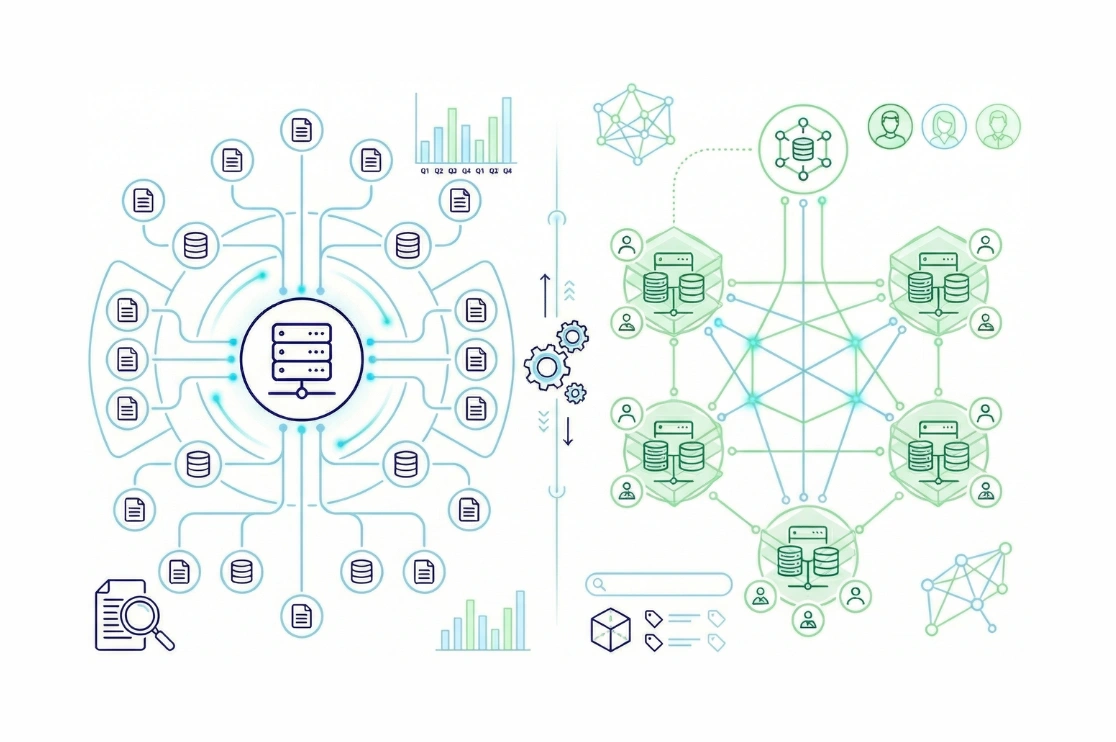 Centralized vs. Federated vs. Hybrid Data Governance: Which Model Fits Your Organization
 Data Governance Roles and Responsibilities in AEC Organizations