










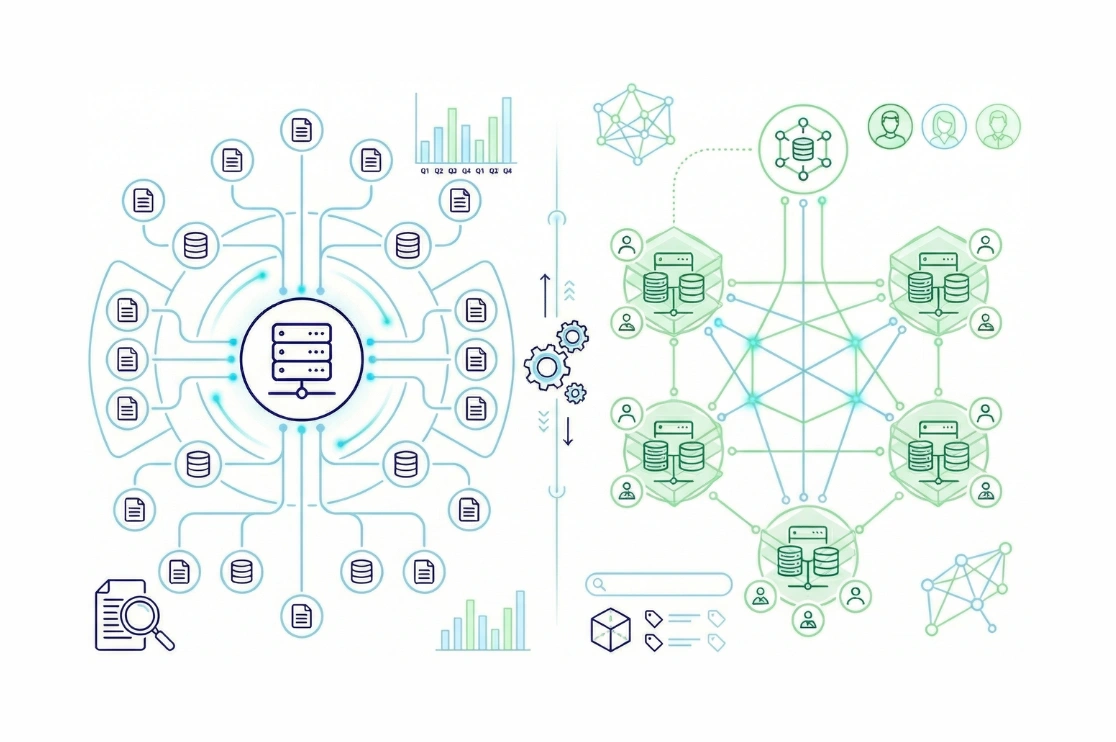
A centralized data governance model concentrates policy authority, stewardship accountability, and standards enforcement in a single enterprise-wide governance function. A federated data governance model distributes that authority to domain-level teams while maintaining common enterprise standards through a central coordination layer. A hybrid model combines both: centralized standards and minimum viable policy, with federated execution and domain-level ownership. Most large enterprises use a hybrid in practice, even when they describe their approach as purely centralized or purely federated.
Before you select a governance technology platform, before you hire a Chief Data Officer, before you write a data policy or assign a data steward, you need to answer one foundational question: where will authority over data decisions live in your organization?
That is the governance model question. Get it wrong and every program component you build on top of it will be misaligned with how your organization actually operates. Governance policies that require central enforcement in a highly decentralized enterprise will be ignored. Federated ownership in a heavily regulated industry without sufficient central control will create compliance gaps. The model determines whether the program can hold.
The governance model decision is also not permanent. Organizations evolve, merge, expand geographically, enter new regulatory jurisdictions, and acquire new data capabilities. A model that was appropriate for a 2,000-person organization in one country may need significant redesign at 20,000 people across six markets. Understanding the trade-offs between centralized, federated, and hybrid models is essential not just for initial design but for ongoing governance evolution.
This article maps the three models in precise terms, compares them against the dimensions that matter most for enterprise governance programs, shows how each of the four major industry verticals typically approaches the choice, and provides a decision framework for organizations evaluating or redesigning their governance operating model.
Table of Contents:
- Why Your Governance Model Is the Most Consequential Design Decision You Will Make
- What Is Centralized Data Governance?
- What Is Federated Data Governance?
- What Is a Hybrid Governance Model?
- Centralized vs. Federated vs. Hybrid: Direct Comparison
- How Each Industry Chooses Its Governance Model
- Data Mesh: The Architectural Context for Federated Governance
- Professional Standards on Governance Operating Models
- Five Governance Model Mistakes That Derail Enterprise Programs
- Frequently Asked Questions
What Is Centralized Data Governance?
A centralized data governance model places authority, policy-making, and stewardship accountability in a single enterprise governance function, typically led by a Chief Data Officer or Head of Data Governance. That central function defines standards that apply across all business units, geographies, and data domains. Domain teams operate within those standards but do not set them independently.
Centralized governance is not the same as centralized data storage. Data can be physically distributed across many systems while still being governed under a unified policy and ownership model. The centralization is organizational, not architectural.
Strengths of Centralized Governance
-
Consistency: a single standard applies across all domains, geographies, and systems, making enterprise reporting and cross-domain analytics reliable
-
Compliance control: a central function can enforce regulatory requirements uniformly, which is critical in heavily audited environments
-
Clear accountability: one function owns governance outcomes, making escalation paths short and decision-making clear
-
Faster policy enforcement: changes to standards or policies propagate from one point rather than requiring negotiation across multiple domain owners
Weaknesses of Centralized Governance
-
Scalability limits: a central function serving many domains and business units becomes a bottleneck as the organization grows or as data volumes increase
-
Domain knowledge gaps: central governance teams often lack deep knowledge of specific business domain data, leading to standards that are technically correct but operationally unworkable
-
Adoption resistance: business units that feel governance is imposed on them rather than designed with them tend to comply minimally and enforce passively
-
Speed mismatch: centralized approval processes can slow data initiatives in fast-moving business units where domain agility is a competitive requirement
What Is Federated Data Governance?
A federated data governance model distributes governance authority to domain-level teams, each of which owns policies, standards, and stewardship accountability for their data domain. A central coordinating layer sets minimum enterprise standards, manages cross-domain interoperability, and provides common infrastructure, but does not own governance execution in each domain.
The domain teams in a federated model are accountable for their data as a product: they define quality standards, manage access, maintain lineage, and report governance outcomes up to the enterprise layer. The central function serves as a standards body and arbitrator, not as an operational governance team.
Strengths of Federated Governance
-
Domain expertise: governance standards are designed and enforced by people who understand the data deeply, producing policies that are technically accurate and operationally practical
-
Scalability: governance capacity grows naturally with the organization because each new domain brings its own governance function rather than placing additional load on a central team
-
Adoption: domain teams that own their governance are more likely to invest in it, maintain it, and enforce it, because it serves their operational interests, not just a central compliance requirement
-
Innovation agility: domains can move at their own pace on data initiatives while maintaining compliance with enterprise minimum standards
Weaknesses of Federated Governance
-
Consistency risk: without strong central standards, domain-level governance can diverge in ways that break cross-domain analytics, enterprise reporting, and regulatory compliance
-
Coordination overhead: aligning multiple domain governance teams on shared standards, interoperability requirements, and enterprise data catalogue maintenance requires significant cross-functional effort
-
Uneven maturity: domain teams develop governance capability at different rates, creating maturity gaps that produce compliance risk in lower-maturity domains
-
Accountability diffusion: when governance authority is distributed, it can be unclear who is accountable for enterprise-level governance outcomes, particularly when cross-domain data issues arise
Not Sure Which Model Fits Your Organization?
BluEnt’s Governance Operating Model Assessment evaluates your organizational structure, regulatory obligations, and data maturity to recommend the right governance model, and design the operating architecture to implement it. Available for enterprises across all six of our primary markets.
Data Governance Maturity Assessment
A structured diagnostic for CDOs, CIOs, and Chief Compliance Officers. 18 questions across six governance dimensions. Receive a scored maturity profile and prioritised recommendations.
Your Details
Your Assessment Results
Overall Governance Maturity Level
Receive Your Full Report
A BluEnt governance consultant will prepare a personalised report with specific recommendations for your highest-priority gaps. Book a 60-minute discovery call to discuss your findings.
What Is a Hybrid Governance Model?
A hybrid data governance model combines centralized authority over enterprise-critical standards with federated execution at the domain level. It is the most common model in large, multi-business-unit organizations, and in practice, it is what most organizations that describe themselves as either ‘centralized’ or ‘federated’ are actually running, whether intentionally or not.
In a well-designed hybrid model, the central governance function owns: enterprise data policy, the data catalogue and metadata standards, cross-domain data quality thresholds, regulatory compliance frameworks, and the governance council structure. Domain teams own: domain-specific quality standards and stewardship, data product definitions within their domain, access control management for domain data, and governance metrics reporting for their domain.
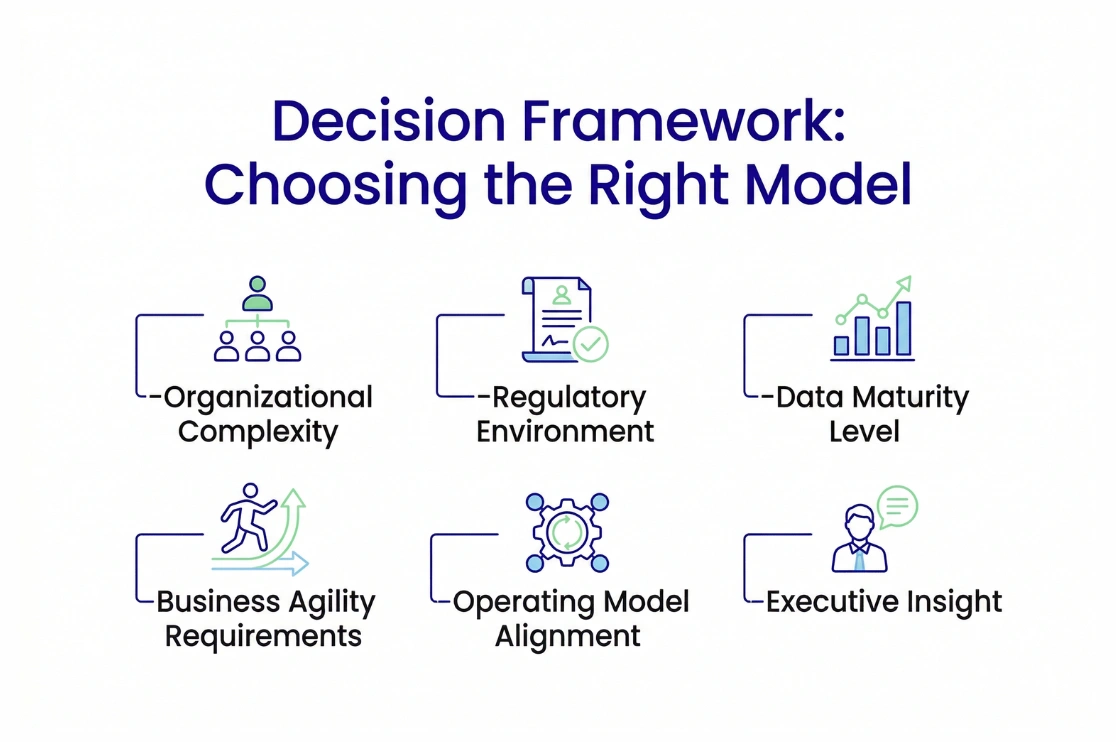
The critical design question in a hybrid model is where to draw the line between central and federated authority. That line is not fixed, it should be calibrated to the regulatory environment, the maturity of domain teams, the degree of cross-domain data dependency in the organization, and the pace of change in each domain. Organizations that set the centralization line too high create the bottlenecks of pure centralization. Those that set it too low create the consistency risks of pure federation.
A hybrid model requires a governance operating model document that explicitly defines which decisions are made centrally and which are made at domain level. Without that document, the hybrid defaults to ambiguity, and ambiguity in governance produces the worst outcomes of both models.
Centralized vs. Federated vs. Hybrid: Direct Comparison
The following comparison maps the three models across the dimensions that matter most for enterprise governance program design. Use this as a starting framework for evaluating which model aligns with your organization’s structure, scale, and regulatory context.
| Dimension | Centralized | Federated |
|---|---|---|
| Authority location | Single enterprise governance function | Domain teams, coordinated centrally |
| Policy ownership | Central team owns all policies | Domains own domain policies; central sets minimums |
| Stewardship model | Central stewards or centrally-assigned domain stewards | Domain-embedded stewards accountable to domain leads |
| Best fit: org structure | Single-business, heavily regulated, compliance-critical | Multi-business, decentralized, domain-autonomous |
| Scalability | Limited, central team is the constraint | High, governance scales with domain growth |
| Consistency | High, one standard across all domains | Variable, depends on central minimum standard strength |
| Adoption likelihood | Lower, perceived as compliance imposition | Higher, domains own what they govern |
| Regulatory compliance | Strongest, central enforcement of all requirements | Risk if central minimums are not sufficiently defined |
| Cross-domain analytics | Strong, consistent standards enable reliable joins | Weaker without strong interoperability standards centrally |
| Time to implement | Faster initial design; slower adoption | Slower initial design; faster adoption per domain |
| Enterprise reporting | Reliable from day one | Requires strong central master data management layer |
| Hybrid variant | Central standards, federated execution, most practical | Federated by default with central coordination layer |
There is no universally correct governance model. The right model is the one that your organization can actually operate sustainably, given its structure, culture, regulatory obligations, and data maturity. A well-run federated model outperforms a poorly-run centralized one in every dimension.
How Each Industry Chooses Its Governance Model
The governance model decision is heavily influenced by industry context: the regulatory environment, the organizational structure, the nature of the data, and the consequences of governance failure. The following covers how each of the four major industry verticals approaches the choice.
Healthcare and Life Sciences
Healthcare organizations face a governance model tension that is structurally built into the industry. On one side, regulatory requirements, HIPAA in the US, UK GDPR and NHS data security standards in the UK, Australian Privacy Principles under the Privacy Act 1988 in Australia, demand consistent, auditable data governance across the entire organization. On the other side, clinical operations are highly domain-specific: radiology data, pharmacy data, patient administration data, and clinical trial data each require domain expertise to govern effectively.
The result is that healthcare organizations almost universally operate hybrid governance models, even when they do not call it that. A central privacy and compliance function owns PHI governance policy and audit requirements. Clinical and operational domain teams own domain-specific standards for their data. The governance tension in healthcare is less about which model to choose and more about where to draw the centralization line on PHI access controls versus domain operational data.
Large health systems in the US operating under value-based care contracts have an additional governance driver: cross-domain analytics that require patient, clinical, financial, and operational data to join reliably. This creates a strong enterprise MDM requirement as a precondition for the federated model to produce usable cross-domain outputs.
Financial Services and Banking
Financial services organizations have had governance model requirements written into regulatory frameworks for longer than most industries. The Basel Committee on Banking Supervision’s BCBS 239 Principles for Effective Risk Data Aggregation and Reporting, published in January 2013, establish explicit requirements for data governance that apply to systemically important banks: a firm-wide data governance framework, clear data ownership, defined data quality standards, and documented lineage for risk data.
BCBS 239 does not prescribe a governance model architecture, but its requirement for firm-wide consistency, particularly for risk data aggregation and regulatory reporting, creates a strong pull toward centralized or hybrid models for risk and finance data domains. Investment banks and universal banks with highly autonomous trading desks and business lines typically run federated governance for product and client data, with centralized governance for risk, finance, and regulatory reporting data.
In the UK, the FCA’s Senior Managers and Certification Regime (SMCR) creates individual accountability for governance failures, which strengthens the business case for centralized accountability structures in governance-critical data domains. In Australia, APRA’s CPS 234 Information Security standard and associated data governance expectations reinforce similar centralization pressures on regulated entities.
Manufacturing and Supply Chain
Manufacturing organizations face a governance model challenge driven by the intersection of operational technology and information technology data. Production systems, quality management systems, ERP platforms, supply chain management tools, and warehouse management systems each generate data that is owned by different operational functions with different governance maturity levels and different tolerance for central policy.
Large manufacturers operating across multiple plants and geographies typically run federated governance by plant or by production domain, with central governance for financial data, supplier master data, and product master data. The critical governance boundary in manufacturing is between OT data (generated by sensors, SCADA systems, and production control equipment) and IT data (processed in ERP and business intelligence systems). Central governance of OT-to-IT data flows is a common gap that creates quality failures in production analytics and predictive maintenance programs.
Organizations implementing digital twin programs or Industry 4.0 analytics capabilities are discovering that their existing governance models were not designed to handle real-time OT data streams. Extending the governance model to cover OT data governance is a specific design requirement that many manufacturing governance programs have not yet addressed. New Zealand and Australian manufacturers in the food and beverage, dairy, and natural resources sectors face additional traceability governance requirements under product safety and biosecurity legislation that reinforce the need for enterprise-level governance of supply chain data.
Architecture, Engineering, and Construction
AEC organizations face a governance model challenge that is structurally unlike other industries: their primary operational unit is the project, not the business unit or the product line. Projects are temporary, multi-party, and governed by contracts that impose information management requirements specific to each engagement. Enterprise governance must coexist with project-level governance without either overriding the other.
The result is typically a three-tier governance model in sophisticated AEC organizations: an enterprise layer that owns master data standards (client master, asset master, project code structures), a project layer that owns information management standards for each active engagement (often aligned to ISO 19650), and a domain layer for cross-cutting data domains like finance, HR, and supply chain. The enterprise and project layers operate under different governance rhythms and authorities, which is a coordination challenge that most AEC governance frameworks do not explicitly address.
ISO 19650, the international standard for information management using BIM, defines information management roles and requirements at the project level. AEC organizations that implement ISO 19650 rigorously are operating structured project-level governance. Elevating that to enterprise governance requires a central layer that aggregates project data into enterprise-governed repositories with consistent standards, something ISO 19650 specifies at the project level but not at the enterprise level.
Design a Governance Operating Model That Fits How You Work
BluEnt’s governance operating model engagements are calibrated to your industry, organizational structure, and regulatory obligations. We design hybrid models that are neither too centralized to adopt nor too federated to control.
Recommended Reading:
Data Mesh: The Architectural Context for Federated Governance
Any discussion of federated data governance must address data mesh, the architectural and organizational framework that has become the most influential articulation of the federated governance model in enterprise data programs.
Data mesh was introduced by Zhamak Dehghani in a 2019 article published on martinfowler.com, titled ‘How to Move Beyond a Monolithic Data Lake to a Distributed Data Mesh.’ The concept was developed further in Dehghani’s 2022 book ‘Data Mesh: Delivering Data-Driven Value at Scale,’ published by O’Reilly Media. Data mesh proposes four principles: domain ownership of data, data as a product, self-serve data infrastructure as a platform, and federated computational governance.
The fourth principle, federated computational governance, is directly relevant to this discussion. Data mesh explicitly defines governance as federated: domain teams own governance of their data products, with a central governance function setting interoperability standards, compliance requirements, and enterprise data policies. The governance model is hybrid by design, not by compromise.
Zhamak Dehghani, Data Mesh (O’Reilly, 2022)
Federated computational governance in a data mesh ‘enables domain autonomy while maintaining global interoperability and compliance.’ The governance function defines the policies that all domain data products must meet, security, privacy, quality, interoperability, and embeds those policies into the self-serve platform so that compliance is automated rather than manually enforced. Domain teams govern execution; the central platform governs the rules.
Data mesh is not the right organizational model for every enterprise. It requires significant platform maturity, domain team capability, and governance clarity to implement effectively. Organizations that adopt data mesh architecture without the federated governance design to support it often find that domain autonomy produces data inconsistency at scale. The governance design is not optional in data mesh, it is the mechanism that makes federated ownership sustainable.
Professional Standards on Governance Operating Models
DAMA International: DMBoK 2
DAMA International’s Data Management Body of Knowledge, Second Edition (DMBoK 2), addresses governance operating models in the context of data governance organizational design. DMBoK 2 identifies three primary governance operating model types, centralized, replicated, and federated, and notes that most organizations use a hybrid of centralized and federated in practice. The standard identifies the governance council as the coordinating mechanism in all three models: the body that resolves cross-domain issues, enforces enterprise standards, and provides the escalation path that makes distributed governance accountable.
DMBoK 2 also distinguishes between governance operating model design (the structural question) and governance program maturity (the capability question). An organization can have the right structural design but insufficient maturity to execute it, or sufficient maturity but a structural design misaligned with its organizational reality. Both dimensions must be assessed before a governance model is selected.
ISO/IEC 38505-1: Governance of Data
ISO/IEC 38505-1:2017, the international standard for governance of data, defines the governance model question in terms of the Evaluate-Direct-Monitor framework: how does an organization’s leadership evaluate data governance options, direct governance activities, and monitor governance performance? The standard is agnostic on governance model architecture but requires that the chosen model provide clear accountability for data governance outcomes at the organizational level, whether centralized or federated, accountability for governance results must be defined and monitored.
Recommended Reading:
Five Governance Model Mistakes That Derail Enterprise Programs
Mistake 1: Choosing the Model That Sounds Right Rather Than the One That Fits
Data mesh and federated governance are intellectually compelling frameworks. They are also organizationally demanding. Organizations that adopt federated governance because it is the current best practice rather than because their domain teams have the capability to execute it end up with distributed accountability and no one actually accountable. The governance model must fit the organization’s current capability and structure, not an aspiration.
Mistake 2: Designing the Model Without Defining the Central-Federated Boundary
Hybrid models fail when the boundary between central and federated authority is left implicit. Every governance design decision becomes a negotiation between the central team and domain owners, with no documented basis for resolution. The governance operating model document must explicitly state which decisions are made centrally and which are made at domain level, with no ambiguity and no overlap.
Mistake 3: Treating the Governance Model as a Fixed Design
Governance models should evolve as organizational maturity, scale, and regulatory context change. An organization that implemented centralized governance five years ago may need to federate as it has grown and domain teams have developed capability. An organization that federated too early may need to recentralize specific domains after discovering consistency failures. Building a regular governance model review into the annual governance program cycle prevents model drift from becoming model failure.
Mistake 4: Federating Without Enterprise MDM
Federated governance distributes policy authority to domains. It does not distribute the management of shared entity data. Client master, project master, supplier master, and product master data span multiple domains and must be governed centrally or through a coordinated MDM program. Organizations that federate governance without resolving master data management find that each domain governs its own version of the same entity, and cross-domain analytics fail because the entities do not match.
Mistake 5: Measuring the Model Rather Than the Outcomes
Governance programs report on model compliance: governance councils are meeting, stewards are assigned, policies are documented. What they do not always report on is whether governance is producing better data quality, faster analytics delivery, or lower compliance risk. The governance model is not the objective, it is the mechanism. Measuring model activity rather than data outcomes allows underperforming governance programs to persist indefinitely under the appearance of compliance.
Turn Governance into a Strategic Business Advantage
BluEnt designs governance operating models for enterprises across Healthcare, Financial Services, Manufacturing, and AEC in the US, UK, Canada, Australia, New Zealand, and the Netherlands. Whether you are starting from scratch or redesigning a model that is not holding, our team delivers a governance architecture built for your organization.
Frequently Asked Questions
What is the difference between centralized and federated data governance?Centralized data governance places policy authority and stewardship accountability in a single enterprise function that sets and enforces standards across all business units and domains. Federated data governance distributes that authority to domain-level teams, with a central function setting minimum enterprise standards and managing interoperability. Most large organizations use a hybrid of both in practice: centralized standards with federated execution.
Which governance model is best for a large enterprise?There is no universally best model for large enterprises. The right choice depends on organizational structure, regulatory obligations, domain team maturity, and the degree of cross-domain data dependency. Organizations with heavy regulatory requirements, financial services under BCBS 239, healthcare under HIPAA, manufacturers under product safety traceability requirements, typically need stronger central governance for regulated data domains while federating operational and domain-specific data. BluEnt’s governance operating model assessment maps these factors and recommends the appropriate design.
What is data mesh and how does it relate to federated governance?Data mesh is an organizational and architectural framework introduced by Zhamak Dehghani in 2019 that proposes four principles: domain ownership of data, data as a product, self-serve data infrastructure, and federated computational governance. The governance principle in data mesh is explicitly federated: domain teams own their data products and govern them, while a central function sets interoperability standards and compliance requirements that all domains must meet. Data mesh is a specific implementation architecture for federated governance, not a synonym for it.
How do I transition from centralized to federated governance without losing consistency?Transition from centralized to federated governance by strengthening enterprise minimum standards before distributing authority. Define the non-negotiable central requirements, regulatory compliance, interoperability standards, master data governance, cross-domain quality thresholds, and embed them in a formal governance policy. Then federate execution domain by domain, starting with the highest-maturity domains. Run both central and domain governance in parallel for the first two quarters to identify consistency gaps before fully distributing authority. BluEnt designs and manages these governance model transitions across all four major industry verticals.
How long does it take to implement a governance operating model?A governance operating model design, including the central-federated boundary definition, council structure, stewardship framework, and policy architecture, typically takes six to ten weeks to design and document. Deployment across an enterprise, including steward onboarding, council activation, and domain team briefing, typically takes an additional three to six months depending on organizational scale and the number of domains in scope. Organizations that start with a pilot in two or three domains and expand progressively achieve sustainable deployment faster than those that attempt full enterprise rollout from day one.

 Governing AI Tools in AEC: Copilot, Digital Twins, and Generative Design
  Data Governance for AI and Advanced Analytics: Building the Foundation That Works
  Data Governance Roles and Responsibilities in AEC Organizations
  Data Governance vs. Data Management vs. MDM: What AEC Leaders Need to Know