












The Core Relationship
Advanced analytics and artificial intelligence programs are entirely dependent on the quality, consistency, and governance of the data they operate on. Data governance for AI and advanced analytics is the set of organizational policies, roles, processes, and controls that ensure data used in AI models, machine learning pipelines, and enterprise analytics platforms is accurate, traceable, appropriately permissioned, and managed to defined quality standards. Without this foundation, AI programs produce unreliable outputs, accumulate technical debt in data preparation, and create regulatory exposure when model decisions cannot be audited.
Data Governance Maturity Assessment
A structured diagnostic for CDOs, CIOs, and Chief Compliance Officers. 18 questions across six governance dimensions. Receive a scored maturity profile and prioritised recommendations.
Your Details
Your Assessment Results
Overall Governance Maturity Level
Receive Your Full Report
A BluEnt governance consultant will prepare a personalised report with specific recommendations for your highest-priority gaps. Book a 60-minute discovery call to discuss your findings.
The most consistent finding across enterprise AI and analytics programs in every industry is that the majority of program effort is spent not on modeling, insight generation, or decision automation, but on data preparation: finding the right data, cleaning it, reconciling inconsistencies across systems, resolving missing values, and building pipelines that break the next time an upstream system changes something.
This is not a data engineering problem. Data engineering can build the pipelines. What it cannot do is fix the underlying cause: data that is ungoverned at its source. When data has no defined owner, no quality standard, no lineage documentation, and no consistency requirement across systems, every analytics pipeline that depends on it is built on a foundation that will fail repeatedly. The engineering effort is spent compensating for governance failures rather than delivering analytical value.
The consequence is that analytics programs that should be delivering competitive advantage are consuming most of their capacity on infrastructure remediation. Data scientists and ML engineers spend the majority of their time on data wrangling rather than model development. Dashboards are rebuilt every quarter because the data they depend on has changed structure without notice. AI models are retrained constantly because the training data quality degrades between cycles.
Data governance for AI and advanced analytics addresses this at the source. It does not make data engineering unnecessary. It makes data engineering productive by ensuring the data flowing into analytics pipelines is consistent, quality-controlled, well-documented, and stable enough to build on.
Table of Contents:
- Why Advanced Analytics Programs Stall at the Data Preparation Stage
- The Dependency: What AI and Analytics Require from Data Governance
- Six Data Governance Requirements for AI-Ready Organizations
- Industry Applications: Governing Data for AI Across Four Verticals
- The Regulatory Dimension: AI Data Governance and Compliance
- Professional Standards for AI Data Governance
- Five Signs Your Data Governance Is Not AI-Ready
- Frequently Asked Questions
The Dependency: What AI and Analytics Require from Data Governance
AI and advanced analytics programs have governance requirements that are more demanding than those of traditional reporting and business intelligence programs. The difference is not just scale. It is the nature of how AI systems use data and the consequences when that data is wrong.
Traditional reporting systems display data to a human who evaluates it and makes a decision. If the data is wrong, the human may catch it. AI systems use data to make or support decisions automatically, at scale, often without a human in the loop for every individual output. If the data is wrong or biased, the AI amplifies and systematizes the error across every decision it influences. The governance requirements for AI data are therefore higher, not lower, than those for reporting data.
Training Data Governance
Machine learning models are trained on historical data. The quality, representativeness, and bias profile of that training data determine the model’s behavior in production. If the training data overrepresents certain populations, time periods, or operational conditions, the model will perform poorly on underrepresented cases.
Governance of training data requires: documented provenance of all data sources used in training, bias assessment for demographic and operational representativeness, quality validation against defined thresholds before training begins, and version control so that model retraining can reference the same data version.
Feature Data Governance
Features are the specific data variables that an AI model uses to generate predictions or recommendations. Feature governance defines which data elements are approved for use as features in production models, what quality thresholds each feature must meet, how features are calculated and transformed, and who is accountable for maintaining feature quality over time.
Without feature governance, data scientists create feature engineering pipelines that are undocumented, inconsistently maintained, and impossible to audit when a model produces an unexpected output.
Inference Data Governance
When a trained model runs in production, it processes new data, called inference data, to generate outputs. Inference data must meet the same quality standards as training data for the model’s outputs to be reliable.
Inference data governance ensures that data flowing into production AI models is validated against quality rules before it reaches the model, that anomalies in inference data are detected and flagged, and that model performance is monitored for degradation as inference data distributions shift over time.
Data Governance Maturity Assessment
A structured diagnostic for CDOs, CIOs, and Chief Compliance Officers. 18 questions across six governance dimensions. Receive a scored maturity profile and prioritised recommendations.
Your Details
Your Assessment Results
Overall Governance Maturity Level
Receive Your Full Report
A BluEnt governance consultant will prepare a personalised report with specific recommendations for your highest-priority gaps. Book a 60-minute discovery call to discuss your findings.
Six Data Governance Requirements for AI-Ready Organizations
AI readiness is not a technology state. It is a governance state. The following six requirements must be met for an organization’s data to support production AI and advanced analytics programs reliably.
Requirement 1: Defined Data Ownership for All AI-Relevant Domains
Every data domain that an AI or analytics program will draw on must have a defined data owner: an accountable individual or role for data quality, access policy, and standard compliance in that domain. Without ownership, there is no accountability for the governance failures that will surface when AI programs begin consuming the data. Data ownership is not a governance aspiration; for AI programs, it is a prerequisite for reliable model performance.
Requirement 2: Documented Data Quality Standards with Quantified Thresholds
Quality standards for AI data must be quantified, not qualitative. A standard that says ‘customer records should be accurate’ is not actionable. A standard that says ‘customer records must have a non-null value in the primary identifier field in 100% of cases, and in the address fields in no less than 95% of cases, with monthly stewardship validation’ is actionable.
AI models need specific thresholds to assess whether the data they are trained on and operating against meets the quality bar required for reliable performance.
Requirement 3: End-to-End Data Lineage for Model Auditability
Data lineage, the documented path from a data element’s source through all transformations to its use in a model output, is essential for AI auditability. When a model produces an output that is challenged by a regulator, an internal audit, or a business stakeholder, the organization must be able to trace the data that produced that output back to its source, identify any transformations that were applied, and confirm that the data met quality standards at each stage.
Organizations that cannot provide this traceability face regulatory exposure under the EU AI Act, GDPR, and equivalent data protection laws in every jurisdiction BluEnt operates in.
Requirement 4: Access Controls and Data Minimization for Model Training
AI models should only be trained on data that has been explicitly approved for that use case. This is both a governance requirement and a regulatory one. GDPR Article 5 requires that personal data be used only for specified, explicit, and legitimate purposes, a principle that applies directly to the use of personal data in AI training.
Australian Privacy Principle 3 under the Privacy Act 1988 imposes similar constraints. Privacy Act 2020 obligations in New Zealand align with these requirements. Governance of data access for AI training requires a documented approval process that confirms the legal basis for using each data source in a given model, and access controls that restrict model training pipelines to approved data.
Requirement 5: Metadata Management for Feature Discovery and Reuse
In large organizations, the same data elements are used as features in multiple models by different teams. Without a governed metadata layer, each team re-engineers the same features independently, producing inconsistently calculated variables that diverge over time.
A governed feature store or data catalogue with standardized feature definitions, calculation methodologies, and quality metadata enables feature reuse across models, reduces engineering duplication, and ensures that models referencing the same feature are using the same calculation. This is a data governance deliverable that directly reduces AI development cost and model inconsistency.
Requirement 6: Data Change Management for Production Model Stability
Data governance programs must include a change management process that notifies AI and analytics teams when upstream data sources change in ways that could affect model performance.
Schema changes, new null rates in previously reliable fields, shifts in data volume, changes to data collection processes, and system migrations are all events that can silently degrade model performance without triggering any alert in the AI system itself. A governed data change management process builds the notification bridge between the data governance program and the model operations team.
Assess Your Organization’s AI Data Governance Readiness
BluEnt’s AI Data Governance Assessment maps your current governance against all six AI readiness requirements and produces a prioritized remediation plan. Available for enterprises in the US, UK, Canada, Australia, New Zealand, and the Netherlands.
Industry Applications: Governing Data for AI Across Four Verticals
The six governance requirements apply across all industries, but the specific AI use cases, the data types involved, and the regulatory constraints shaping each requirement differ significantly by vertical. The following covers the most consequential AI and analytics governance challenges in Healthcare, Financial Services, Manufacturing, and AEC.
Healthcare: Clinical AI and Diagnostic Model Governance
Healthcare organizations are deploying AI across clinical decision support, diagnostic imaging, patient risk stratification, and operational efficiency programs. Each use case carries distinct governance requirements.
Clinical decision support AI, including tools that recommend treatment options, flag medication interactions, or predict patient deterioration, operates on clinical data that is governed under HIPAA in the US, NHS Data Security Standards in the UK, and the Australian Privacy Principles in Australia. Training data for clinical AI must be de-identified or covered by appropriate patient consent frameworks.
Model performance must be validated against the specific clinical population the model will serve, not just a global benchmark dataset. The FDA’s framework for AI and machine learning-based Software as a Medical Device establishes pre-deployment validation and post-market monitoring requirements for clinical AI in the US.
Diagnostic imaging AI, including computer vision models that assist radiologists with image interpretation, requires governance of the imaging datasets used for training, including documented source institutions, acquisition parameters, and demographic composition.
A model trained primarily on imaging data from one demographic or one imaging equipment manufacturer will perform differently on images from other populations or equipment. Data governance for imaging AI must address training data representativeness explicitly, not assume it.
Patient risk stratification models, which predict readmission risk, deterioration risk, or chronic disease progression, use electronic health record data that aggregates across multiple clinical systems.
EHR data governance is typically the weakest governance layer in health systems: data entry is inconsistent, field definitions vary across facilities, and historical data contains coding changes that affect model training. Governing EHR data quality to the standard required for AI training is a major pre-program investment that most health systems have not fully made.
Financial Services: Credit, Risk, and Fraud AI Governance
Financial services organizations have deployed AI extensively in credit decisioning, fraud detection, anti-money laundering, and algorithmic trading. Each has specific data governance requirements shaped by regulatory expectations.
Credit decisioning AI, which includes models that determine loan approval, credit limits, or pricing, is subject to fair lending laws in the US (Equal Credit Opportunity Act, Fair Housing Act) and equivalent legislation in the UK, Australia, and the EU.
These laws prohibit discriminatory credit decisions and require that AI models used in credit decisions can be explained to applicants. Data governance for credit AI must include bias testing of training data and model outputs, documentation of feature selection rationale, and explainability requirements that allow individual decision explanations to be generated for regulatory purposes.
BCBS 239, the Basel Committee’s Principles for Effective Risk Data Aggregation and Reporting, imposes governance requirements on risk data that are directly applicable to AI models used in risk management.
Principle 6 requires that risk data be accurate and complete; Principle 7 requires that data be timely. Both apply to data used in AI-based risk models. Banks that deploy AI in regulatory capital calculation or stress testing without meeting BCBS 239 data quality standards face supervisory scrutiny.
Fraud detection AI operates on transaction data that changes character rapidly as fraud patterns evolve. Model drift, the degradation of model performance as transaction patterns shift away from the training distribution, is a persistent challenge.
Data governance for fraud AI requires a model monitoring program that tracks inference data distributions against the training baseline and triggers retraining when drift exceeds defined thresholds. This is a governance-engineering integration requirement that goes beyond standard data quality management.
Manufacturing: Predictive Maintenance and Quality AI Governance
Manufacturing AI programs are concentrated in predictive maintenance, quality inspection automation, supply chain optimization, and demand forecasting. The data governance requirements for each differ from those in knowledge-work industries because much of the data originates in operational technology systems, not enterprise IT systems.
Predictive maintenance AI uses sensor data, equipment logs, and maintenance records to predict equipment failure before it occurs. The data governance challenge is that OT sensor data is typically not managed under enterprise data governance frameworks: sensors are calibrated inconsistently, time-stamping across systems is often misaligned, and maintenance records are entered by field technicians with varying data entry discipline.
Governing OT data for predictive maintenance AI requires extending the data governance program into the plant environment, establishing OT data quality standards, and building validation into the OT-to-IT data pipeline before data reaches the AI model.
Quality inspection AI uses computer vision to detect defects in products or components. Training data for quality AI is the historical record of defects classified by human inspectors. If human classification has been inconsistent.
If one inspector classified a defect as category A and another as category B, the model will learn from inconsistent labels and produce inconsistent classifications. Data governance for quality AI must include a label quality assessment before training begins, and a process for resolving historical label inconsistencies in the training dataset.
In Australia and New Zealand, manufacturers in the food and beverage, agricultural processing, and natural resource sectors operate under traceability requirements that create additional data governance obligations.
Australian food safety traceability requirements under the Australia New Zealand Food Standards Code, and New Zealand’s food safety legislation under the Food Act 2014, require documented supply chain data that AI-based traceability systems must be able to audit. Governance of supply chain data for these markets must address traceability standards as a functional requirement.
Architecture, Engineering, and Construction: BIM Analytics and Project Intelligence Governance
AEC organizations are investing in AI and analytics programs that process BIM model data, project performance data, cost data, and asset operational data to generate project risk scores, automated clash detection outputs, generative design recommendations, and predictive asset maintenance plans.
The fundamental governance challenge in AEC AI is that the data these programs depend on is project-specific and temporary: it exists within the lifecycle of a project and is not always retained and structured in ways that support enterprise analytics.
A predictive project risk model trained on historical project data requires that historical project data is consistent in structure, comparable across projects, and available at the enterprise level. Most AEC organizations do not have this: project data lives in project-specific CDE instances, with varying naming conventions, data completeness levels, and retention practices.
ISO 19650’s Exchange Information Requirements define what information must be delivered at each project stage, by whom, and to what standard. AEC organizations that implement ISO 19650 rigorously are creating structured, consistent project data as a byproduct of compliant delivery.
That data, governed to ISO 19650 standards, is the foundation for enterprise analytics. Organizations that have not implemented ISO 19650 governance at the project level do not have the structured historical data that enterprise AI programs require.
For asset owners such as infrastructure operators, real estate portfolio managers, and government asset managers, AI programs for predictive asset maintenance require consistent asset master data across the portfolio and reliable operational data feeds from building management and monitoring systems.
The governance requirement is an asset data standard that applies across the entire portfolio, not just individual assets, and an operational data governance program that validates sensor and monitoring data before it feeds analytics models.
Build the Data Foundation Your AI Program Needs
BluEnt’s enterprise data governance programs are designed for AI readiness from the ground up. We work with Healthcare, Financial Services, Manufacturing, and AEC organizations to establish the six governance requirements that make AI programs produce reliable results.
The Regulatory Dimension: AI Data Governance and Compliance
Every major jurisdiction in which BluEnt operates has enacted or is developing regulatory requirements that directly impose data governance obligations on organizations deploying AI. Understanding these obligations is essential for building a governance program that is both AI-enabling and compliant.
EU AI Act and Data Governance Requirements for High-Risk AI
The EU AI Act (Regulation 2024/1689), which entered into force on 1 August 2024, imposes explicit data governance requirements on high-risk AI systems.
Article 10 of the Act requires that training, validation, and testing datasets for high-risk AI systems be subject to data governance and management practices covering: the design choices in data collection, data preparation, annotation, labelling, and cleaning; examination for possible biases; identification of relevant data gaps; and assessment of fitness for purpose. These are data governance requirements written into binding legislation.
For organizations in the Netherlands and those deploying high-risk AI systems in EU markets from the UK, Canada, or Australia, compliance with Article 10 requires a data governance program for AI that is documented, auditable, and proportionate to the risk level of the AI system. The obligation begins applying in full from 2 August 2026 for most high-risk AI categories.
GDPR and UK GDPR: Data Minimization and Purpose Limitation for AI
GDPR Article 5 establishes data minimization and purpose limitation principles that apply directly to AI training data: personal data may only be collected for specified, explicit, and legitimate purposes and may not be processed in a manner incompatible with those purposes.
Using personal data collected for one purpose (such as customer service interactions) to train an AI model for a different purpose requires a fresh legal basis assessment. UK GDPR, which mirrors GDPR in most respects post-Brexit, applies the same constraints.
The ICO in the UK has published specific guidance on AI and data protection that addresses purpose limitation for AI training, lawful basis for automated decision-making, and transparency obligations when AI is used in decisions that affect individuals. Organizations deploying AI in the UK should treat ICO guidance as a live compliance document, not a static reference.
Australia and New Zealand: Privacy Obligations for AI Data
The Australian Privacy Act 1988, including the Australian Privacy Principles, requires that organizations using personal information do so only for the primary purpose for which it was collected, or for secondary purposes that meet specific conditions.
The use of personal data in AI model training is a secondary use that requires either consent or a finding that it falls within an exception. The Office of the Australian Information Commissioner has indicated that AI use of personal data is an area of active regulatory interest.
New Zealand’s Privacy Act 2020 aligns closely with GDPR principles and imposes purpose limitation and data minimization obligations that apply to AI training data. The Office of the Privacy Commissioner in New Zealand has indicated that automated decision-making using personal data will be a regulatory priority in coming years.
AEC and manufacturing organizations with operations in Australia and New Zealand should build AI training data governance to meet these requirements now, rather than retrofitting after regulatory action.
Professional Standards for AI Data Governance
NIST AI Risk Management Framework (AI RMF 1.0) | January 2023
The NIST AI RMF’s Map function requires organizations to identify ‘context established for the AI system to be developed, deployed, or used,’ including the data characteristics relevant to the system’s risk profile. The Measure function requires organizations to analyze ‘AI risk and uncertainty, and evaluate the approach taken.’ Both functions have direct data governance implications: the AI system’s risk profile is determined in part by the governance state of the data it uses, and measuring AI risk requires measuring data quality and governance conformance.
ISO/IEC 42001:2023 | AI Management Systems
ISO/IEC 42001 Section 8.4 addresses AI system impact assessment and requires organizations to assess the data used in AI systems as part of their risk management process. The standard requires that organizations identify data sources, assess data quality relative to the intended AI use, and document data governance controls as part of the AI management system. Organizations pursuing ISO/IEC 42001 certification are required to demonstrate data governance for AI systems as an auditable management system control.
Recommended Reading:
Five Signs Your Data Governance Is Not AI-Ready
Data Scientists Spend Most of Their Time on Data Preparation
When data science teams report that 60 to 80 percent of their time is spent on data cleaning, reconciliation, and pipeline maintenance rather than modeling, it is a direct indicator that the underlying data is ungoverned. Data governance does not replace data engineering; it gives data engineering stable, quality-controlled inputs to work with. If the preparation burden is not decreasing, the governance foundation has not been established.
You Cannot Identify the Owner of a Data Element Used in an AI Model
If a data element is used in a production AI model and the organization cannot identify who owns that element and is accountable for its quality, the model’s reliability depends on informal maintenance of an ungoverned data source. When that source inevitably changes, the model’s performance will degrade without warning and without accountability. Data ownership for AI-relevant data domains is a prerequisite, not a nice-to-have.
You Cannot Trace a Model Output Back to Its Source Data
The ability to trace an AI model’s output to the data that produced it is a regulatory requirement in some jurisdictions and a governance standard in all. If an AI credit decision, a clinical recommendation, or a project risk score cannot be traced back through the feature pipeline to the source data, the organization cannot audit the model’s behavior, cannot explain decisions to regulators or affected parties, and cannot identify root causes when model performance degrades.
AI Model Performance Degrades Unexpectedly After Launch
Unexplained model performance degradation after launch is almost always a data governance failure. The training data and inference data distributions have diverged because an upstream source changed without notification, data quality in a key feature domain declined below the model’s operating threshold, or a data pipeline was modified without a model impact assessment. A data change management process for AI-relevant domains is the governance control that prevents silent model degradation.
Different Teams Are Getting Different Results from the Same AI Tool
When different teams using the same AI platform are getting inconsistent outputs from nominally identical queries, the most common cause is that they are accessing different versions of the same data with different quality profiles. This is because data is not governed to a consistent standard across the organization. This is a governance consistency problem that manifests as an AI reliability problem. It cannot be solved by changing the AI tool.
Make Your Data AI-Ready Before Your Next Model Launch
BluEnt’s AI data governance programs establish the six readiness requirements that production AI demands. We work with Healthcare, Financial Services, Manufacturing, and AEC organizations across the US, UK, Canada, Australia, New Zealand, and Netherlands to build governance that makes AI programs reliable, auditable, and compliant.
Frequently Asked Questions
What is data governance for AI and why does it matter?Data governance for AI is the set of policies, roles, and controls that ensure data used in AI and machine learning programs is accurate, consistently structured, traceable, and appropriately permissioned. It matters because AI systems amplify the quality and bias characteristics of the data they train on. Ungoverned data produces unreliable AI outputs at scale. In regulated industries, poor AI data governance also creates direct compliance exposure under the EU AI Act, GDPR, HIPAA, BCBS 239, and equivalent regulations in Australia and New Zealand.
How does data governance relate to AI model performance?Data governance directly determines AI model performance by controlling the quality, consistency, and completeness of the data that models train on and operate against. Models trained on well-governed data with documented quality thresholds, defined ownership, and stable structures perform more reliably in production and degrade more predictably. Models trained on ungoverned data require constant remediation, produce unpredictable outputs, and are difficult to audit. Data governance is not a prerequisite for building a model. It is a prerequisite for the model producing reliable results in production.
What data governance requirements does the EU AI Act impose?Article 10 of the EU AI Act (Regulation 2024/1689) requires that providers of high-risk AI systems implement data governance and management practices covering training, validation, and testing datasets. These practices must address data collection design, data preparation, annotation and labelling, bias examination, identification of data gaps, and assessment of data fitness for purpose. These obligations apply to organizations placing high-risk AI systems on the EU market or using them within the EU, including organizations based outside the EU. Full application for most high-risk AI categories begins from 2 August 2026.
How do we govern data for AI training without violating GDPR?Governing data for AI training under GDPR requires establishing the lawful basis for the specific use of personal data in model training, conducting a data protection impact assessment for high-risk AI processing, applying data minimization so models are trained only on data elements necessary for the intended purpose, implementing appropriate pseudonymization or anonymization where personal data can be protected without compromising model utility, and documenting the governance controls applied to training data for regulatory accountability. BluEnt’s AI data governance engagements address GDPR compliance as an integrated component of the governance design.
How long does it take to get data governance AI-ready?The timeline depends on the current governance maturity, the complexity of the data environment, and the specific AI use cases in scope. An organization with established data ownership and quality standards in the relevant domains can typically meet AI readiness requirements for a specific use case in eight to twelve weeks. An organization starting governance from scratch should expect an initial governance foundation to take four to six months before the first AI programs can be reliably deployed. BluEnt recommends beginning with the highest-value AI use case as the governance driver, which focuses the program on the domains that matter most rather than attempting to govern everything simultaneously.

 Governing AI Tools in AEC: Copilot, Digital Twins, and Generative Design
 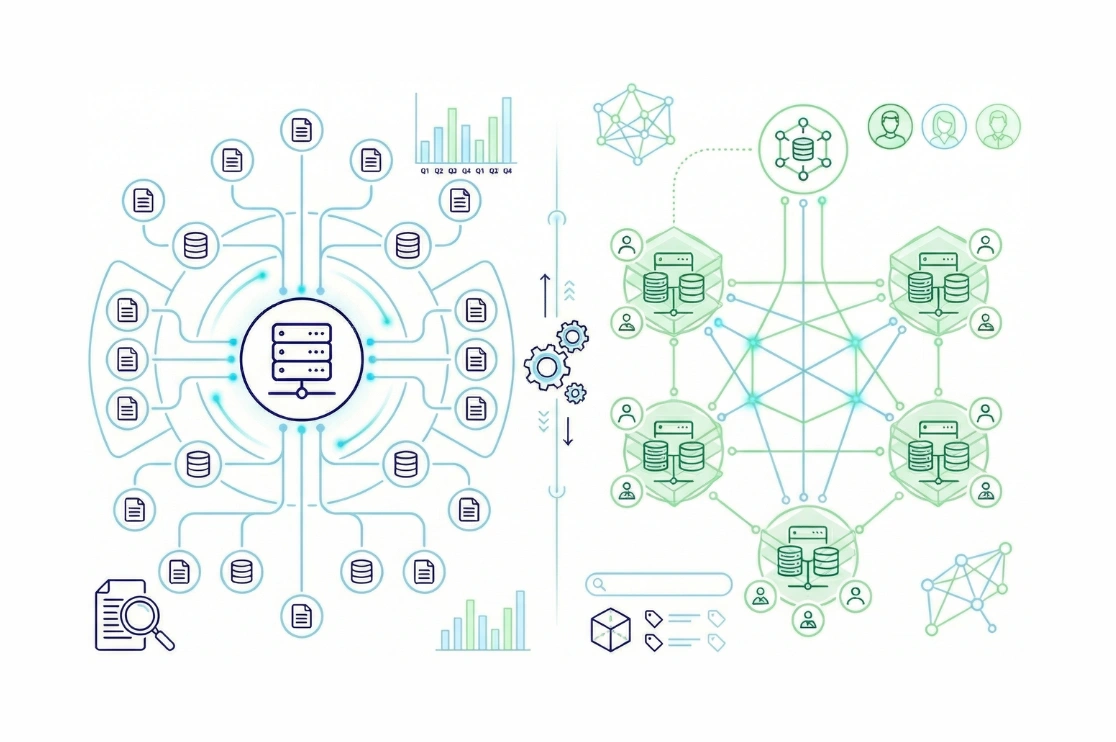 Centralized vs. Federated vs. Hybrid Data Governance: Which Model Fits Your Organization
 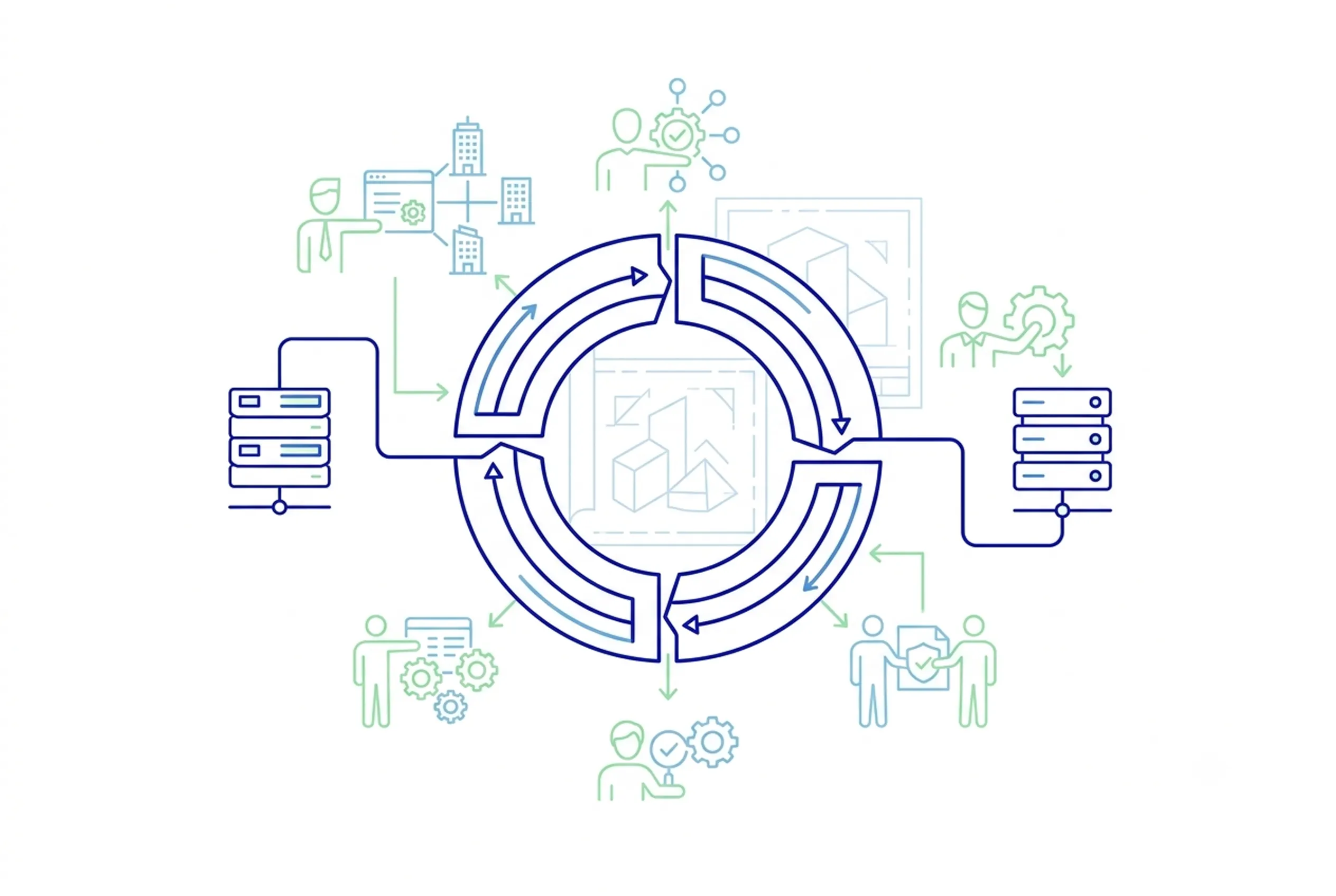 Data Governance Roles and Responsibilities in AEC Organizations
  Data Governance vs. Data Management vs. MDM: What AEC Leaders Need to Know