











An AI governance framework is the set of policies, roles, processes, and controls that an organization uses to ensure its artificial intelligence systems are deployed responsibly, operate reliably, and comply with applicable laws and contractual obligations. For AEC organizations, this means governing how AI tools, including Microsoft Copilot, generative design platforms, digital twin analytics engines, and predictive risk models, access data, make recommendations, and integrate into project delivery and asset management workflows.
Data Governance Maturity Assessment
A structured diagnostic for CDOs, CIOs, and Chief Compliance Officers. 18 questions across six governance dimensions. Receive a scored maturity profile and prioritised recommendations.
Your Details
Your Assessment Results
Overall Governance Maturity Level
Receive Your Full Report
A BluEnt governance consultant will prepare a personalised report with specific recommendations for your highest-priority gaps. Book a 60-minute discovery call to discuss your findings.
AI is no longer a future capability for AEC firms. It is operating in your business right now – in the Microsoft 365 Copilot licence your project managers activated last quarter, in the generative design tools your architects are running in Autodesk, in the clash detection and quantity takeoff automation embedded in your BIM workflows, in the predictive analytics your commercial team is using to forecast project risk.
What is not operating in most AEC businesses is a framework to govern how those tools work. Without governance, AI tools in AEC create four categories of exposure that are already materializing for early adopters in the sector.
The first is data exposure. Copilot and similar large language model tools generate responses by accessing whatever data the user has permission to reach. If your SharePoint and CDE permissions are inconsistent – if a junior estimator technically has read access to confidential client contract data because folder permissions were never reviewed – Copilot will surface that data in response to a query. The AI does not evaluate the appropriateness of what it retrieves. Governance of data access permissions is a prerequisite for safe AI deployment.
The second is model reliability. Generative design tools produce design options based on parameters you define. Predictive risk models generate scores based on historical project data. If the underlying data is inconsistent, incomplete, or biased – if your historical project data captures cost overruns for certain project types but not others – the AI outputs will reflect and amplify those patterns without flagging the limitation. AI governance includes defining what data quality thresholds are required before a model is trusted in a decision.
The third is accountability gaps. When an AI tool recommends a structural configuration, flags a project as low risk, or surfaces a specification version that turns out to be superseded, who is accountable? The answer in most AEC firms today is ‘the person who ran the query’ – but that person had no mechanism to audit the AI’s reasoning, verify its data sources, or escalate a concern about the output. AI governance defines the accountability structure that makes those answers available.
The fourth is regulatory exposure. The European Union AI Act – which entered into force in August 2024 – classifies certain AI systems as high risk and imposes conformity assessment, transparency, and human oversight requirements on their use. AEC firms with operations in the Netherlands, or those delivering projects for EU public sector clients from any geography, are within the Act’s scope. The UK has published its own AI regulatory framework. Canada is developing AI-specific legislation. Building an AI governance program is no longer a best-practice exercise; for some AEC organizations, it is a legal requirement.
Table of Contents:
- Why AI Governance Has Become an AEC Leadership Issue
- What Is an AI Governance Framework?
- Six Core Components of an AI Governance Framework
- AEC AI Use Cases and Their Governance Implications
- The Regulatory Landscape for AI in AEC
- Professional Standards: NIST AI RMF and ISO/IEC 42001
- How Other Industries Are Governing AI
- Five Governance Failures That Derail AEC AI Programs
- Frequently Asked Questions
What Is an AI Governance Framework?
An AI governance framework is the organizational capability that ensures AI systems in your business operate within defined boundaries: boundaries of data access, decision authority, quality standards, risk tolerance, and legal compliance.
It is not a technology tool. You cannot buy AI governance from a software vendor, though vendors can support specific components of it. It is an organizational program, analogous to data governance, that requires policies, defined roles, monitoring processes, and leadership accountability to function.
The relationship between AI governance and data governance is foundational and direct. AI systems operate on data. The quality of AI outputs is determined by the quality, consistency, and governance of the data those systems access. An AI governance framework without a functioning data governance program underneath it is governance over a broken foundation. Organizations that try to govern AI before governing their data spend most of their program effort managing data quality failures that surface through AI outputs, rather than governing AI decision-making itself.
AI governance addresses a set of questions that data governance does not: Is this AI system appropriate for this use case? Has it been tested against the data it will operate on in production? Who reviews AI outputs before they are acted on? What is the escalation path when an AI recommendation is incorrect or inappropriate? What are the disclosure obligations to clients, regulators, or employees when AI is used in a decision that affects them? These are the questions an AI governance framework is designed to answer.
Six Core Components of an AI Governance Framework
A practical AI governance framework for an AEC organization covers six components. These are aligned with the NIST AI Risk Management Framework (AI RMF 1.0) and the requirements of ISO/IEC 42001:2023, both addressed in detail in Section 6.
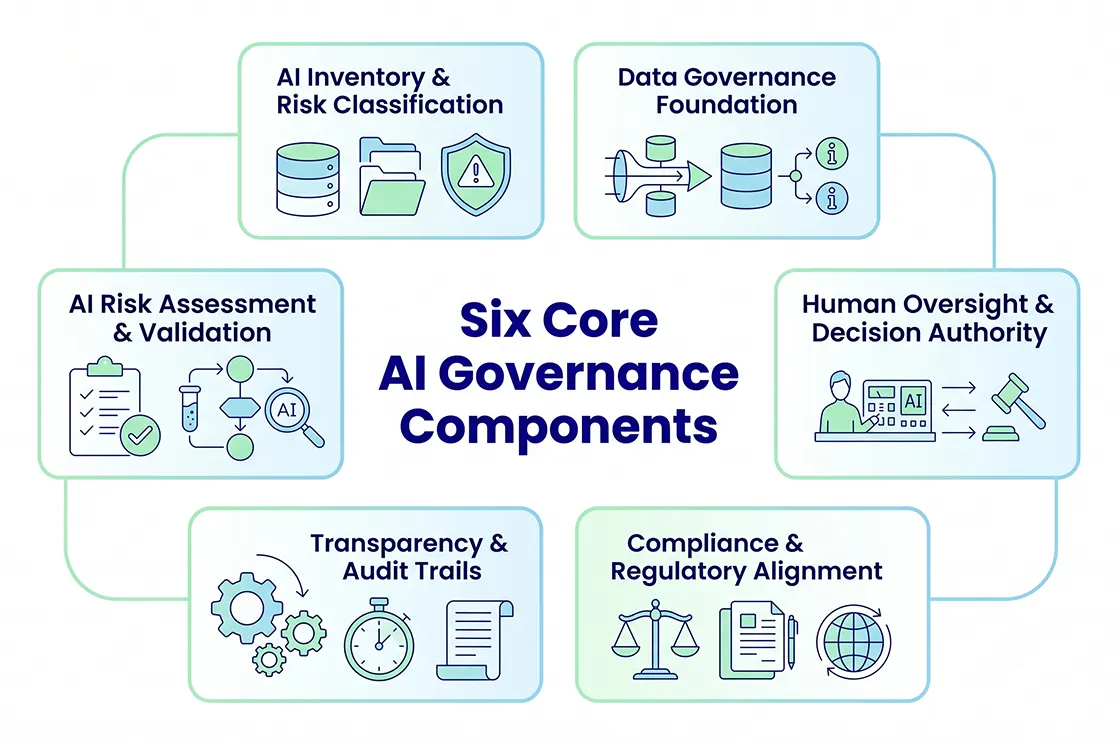
Component 1: AI Inventory and Risk Classification
You cannot govern what you have not catalogued. The first step in any AI governance program is a complete inventory of AI tools in use across the organization, including tools embedded in existing platforms, AI features activated within licensed software, and ad-hoc AI use by individuals or teams. For most AEC firms, this inventory reveals a significantly larger and more varied AI deployment than leadership is aware of.
Each inventoried AI system must be classified by risk level. The EU AI Act provides a four-tier classification, unacceptable risk, high risk, limited risk, and minimal risk, that offers a useful starting taxonomy. For internal purposes, AEC governance programs typically use a simplified two- or three-tier model: high-risk AI (systems where outputs directly influence safety-critical decisions, contractual obligations, or regulatory compliance), medium-risk AI (systems where outputs inform but do not automatically execute decisions), and low-risk AI (tools that assist with communications, search, or administrative tasks with human review).
The classification determines the governance requirements applied to each system: the level of testing required before deployment, the human oversight mechanisms in place, the data access controls enforced, and the audit trail maintained.
Component 2: Data Governance as AI Foundation
Every AI governance program depends on data governance to be effective. The data quality, access control, and lineage tracking requirements that AI systems demand are data governance deliverables. Before an AI system is deployed in a production AEC workflow, the governance program should confirm: that the data the system will access is complete and accurate to defined quality thresholds; that access permissions to that data are reviewed and appropriate; that the provenance of training data (for custom models) is documented; and that data lineage is sufficient to audit the AI’s outputs.
In practice, this means the AI governance program works in tandem with the data governance operating model. The Data Owner for a given domain is responsible for confirming data quality before AI tools are granted access to that domain. The Data Steward is responsible for ongoing quality monitoring once the AI system is live. AI governance adds a layer of oversight; it does not replace the data governance accountability structure beneath it.
Component 3: AI Risk Assessment and Model Validation
Before any AI system is deployed in a consequential AEC workflow, it should undergo a structured risk assessment that addresses: what decisions or recommendations the AI will influence; what failure modes exist and what their consequences would be; what data biases might be present in the training or operational data; how the AI’s outputs will be reviewed before they are acted on; and what the threshold is for human intervention or override.
Model validation – testing a model’s performance against representative data before deployment, and periodically in production – is a core AI governance control. For AEC organizations using commercially licensed AI tools (as opposed to custom-built models), validation focuses on confirming that the tool performs as expected on your specific data and use case, not on validating the underlying model’s architecture. A predictive risk model trained on global project data may perform well on average but poorly on your firm’s project mix if your geographic markets, contract types, or delivery models are underrepresented in the training data.
Component 4: Human Oversight and Decision Authority
AI governance defines where human judgment is required in workflows that include AI recommendations. This is the human-in-the-loop design question: which AI decisions can be executed automatically, which require human review before action, and which must be escalated to a senior decision-maker before the AI’s recommendation is accepted?
In AEC contexts, the default position for any AI recommendation that affects structural safety, contractual commitments, or regulatory compliance should be human review and approval. This is not about distrust of AI capability; it is about legal accountability. A structural engineer, not an AI system, is licensed to certify a structural design. A contract manager, not an AI tool, is accountable for a variation recommendation. Human oversight is not an optional governance layer – it is the accountability structure that makes AI deployment defensible.
Component 5: Transparency, Explainability, and Audit Trails
AEC clients, regulators, and counterparties have a legitimate interest in understanding when AI was used in a decision that affects them. Transparency governance defines which AI uses require disclosure, what form that disclosure takes, and how disclosure obligations are met in contracts and project delivery processes.
Explainability is the related technical question: can you explain why an AI system produced a particular output? For some AI architectures, full explainability is not possible. For those systems, the governance requirement is compensatory: if you cannot explain the AI’s reasoning, the human review requirement before acting on its output must be proportionally stricter. Audit trails – logs of AI queries, outputs, and the human decisions made in response – are essential for post-incident review, regulatory response, and quality improvement.
Component 6: Compliance Monitoring and Regulatory Alignment
The regulatory landscape for AI is changing rapidly and unevenly across BluEnt’s primary markets. The EU AI Act creates binding obligations for firms operating in the Netherlands or delivering services to EU public sector clients. UK AI regulation is currently principles-based but is evolving. Canada’s Artificial Intelligence and Data Act (AIDA), part of the broader Bill C-27 digital charter legislation, is advancing through Parliament. The US has no comprehensive federal AI law but has sector-specific AI guidance from federal agencies and a growing body of state-level AI legislation.
A compliance monitoring component of the AI governance framework ensures that the organization tracks regulatory developments in its operating jurisdictions, assesses the applicability of new requirements to its AI inventory, and updates governance policies and controls accordingly. This is not a one-time exercise, it is an ongoing program management function.
Assess Your AI Governance Readiness
BluEnt’s AI Governance Readiness Assessment maps your current AI deployment against the six governance components, identifies the highest-risk gaps, and builds a prioritized remediation plan. Available for AEC firms in the US, UK, Canada, and Netherlands.
AEC AI Use Cases and Their Governance Implications
Different AI use cases in AEC carry different governance requirements. The following covers the most widely deployed AI capabilities in the sector and the specific governance controls each one demands.
Microsoft Copilot: Data Access Governance
Microsoft 365 Copilot is the most widely deployed AI tool in AEC organizations that run Microsoft environments. It operates across Teams, Outlook, SharePoint, and the Office suite, generating responses and summaries by accessing the data the querying user has permission to reach within the Microsoft 365 tenant.
The core governance challenge is that Copilot surfaces information at a speed and scale that makes informal access control gaps consequential. A user who technically has read access to a SharePoint folder containing confidential client pricing, because that folder was never expressly excluded from their permissions, will receive Copilot responses that include that data in context. Permission sprawl – accumulated excess access rights across years of project setups, becomes an immediate AI risk.
Governance requirements for Copilot deployment include: a permissions audit of all SharePoint sites and CDE folders that Copilot will access; a data classification exercise that identifies confidential, commercially sensitive, and personally identifiable data and ensures it is appropriately restricted; and an ongoing access review process that prevents permission sprawl from reasserting itself. These are data governance deliverables that AI governance requires. Copilot deployment without this foundation is not recommended.
Microsoft has published its Responsible AI Standard, which defines six principles – fairness, reliability and safety, privacy and security, inclusiveness, transparency, and accountability – governing how Microsoft builds and deploys its AI systems. AEC firms using Copilot should familiarize themselves with these principles and assess how their own governance complements Microsoft’s platform-level controls.
Generative Design: IP Ownership and Design Approval
Generative design tools – including Autodesk Forma, Spacemaker, and similar platforms – use AI to generate and evaluate multiple design options against performance parameters defined by the designer. They are increasingly used in early-stage design, urban planning, and site optimization work.
The governance questions for generative design center on three areas. First, intellectual property: who owns the design outputs generated by an AI tool? Under UK copyright law, computer-generated works have a defined protection period, but the legal status of AI-generated designs, particularly in collaborative or client-commissioned contexts – is not fully settled. AEC contracts should explicitly address IP ownership for AI-generated design work before tools are deployed on client projects.
Second, professional accountability: design decisions, especially those affecting structural performance, building regulations compliance, or planning permission, must be reviewed and certified by a licensed professional. Generative design outputs are design proposals, not certified designs. The governance control is clear: AI-generated design options require professional engineering or architectural review and approval before they are submitted to clients, regulators, or contractors.
Third, parameter governance: generative design tools produce outputs that are only as good as the parameters they are given. If the optimization parameters are poorly defined – if ‘cost efficiency’ is defined in a way that does not account for lifecycle maintenance costs, for example – the AI will optimize for the wrong objective. Governance of how optimization parameters are set, reviewed, and approved before a generative design run is a process governance requirement.
Digital Twin Analytics: Real-Time Data Governance
Digital twins – dynamic virtual representations of physical assets that are continuously updated with real-time operational data – are becoming central to large infrastructure asset management programs. AI analytics layers applied to digital twins generate predictive maintenance recommendations, anomaly detection alerts, and performance optimization suggestions.
Digital twin AI governance requires addressing data quality in real time, not just at the point of model setup. Sensor data streams, IoT feeds, and operational data inputs need to be validated for accuracy before they influence AI recommendations. A predictive maintenance alert generated from a faulty sensor reading can trigger unnecessary maintenance interventions, which in critical infrastructure has both cost and operational consequences.
The governance model for digital twin AI also needs to address the asset data lifecycle: what happens to the AI model when the physical asset undergoes a significant configuration change, a major maintenance intervention, or a partial decommissioning? The model’s operating parameters may need to be updated or revalidated. Asset data governance – including clear accountability for maintaining the accuracy of the digital twin’s physical representation – is a prerequisite.
Predictive Project Risk Analytics: Model Validation and Decision Authority
Predictive project risk tools use historical project data to generate risk scores, flag potential delays, or estimate cost overrun probability. They are increasingly embedded in project management platforms and portfolio reporting tools.
The primary governance risk with predictive analytics in AEC is overconfidence in model outputs. A project risk score presented as a percentage (87% probability of cost overrun) carries an implied precision that the underlying model may not support. If the model was trained on project data that does not reflect your firm’s current project mix, geographic markets, or delivery approach, the score may be systematically off. Governance requires that the model’s training data, validation results, and known limitations be disclosed to the people using its outputs in decisions.
Decision authority governance for project risk AI defines which decisions can be informed by a risk score and which require human review. A red flag from a predictive risk tool should trigger a structured risk review, not an automatic contract variation or scope reduction. The AI surfaces the signal; a qualified project director or commercial manager evaluates it and decides the response.
Document AI: Specification Review and Contract Analysis
AI tools that analyze technical specifications, contract documents, and RFI history to surface relevant clauses, flag inconsistencies, or suggest responses are increasingly in use in AEC procurement and delivery teams. These tools offer significant productivity benefits in high-volume document environments.
The governance risks are specific. AI-generated contract analysis may miss jurisdiction-specific legal nuances, fail to flag a clause that contradicts project-specific conditions, or produce a summary that omits a commercially critical obligation. The summary may look complete and coherent while being materially incomplete. Governance requires that AI-generated document analysis is clearly labelled as AI-assisted, that it identifies the documents and sections reviewed, and that a qualified reviewer verifies any AI summary before it is relied on in a commercial or legal decision.
Data Governance Maturity Assessment
A structured diagnostic for CDOs, CIOs, and Chief Compliance Officers. 18 questions across six governance dimensions. Receive a scored maturity profile and prioritised recommendations.
Your Details
Your Assessment Results
Overall Governance Maturity Level
Receive Your Full Report
A BluEnt governance consultant will prepare a personalised report with specific recommendations for your highest-priority gaps. Book a 60-minute discovery call to discuss your findings.
The Regulatory Landscape for AI in AEC
The regulatory environment for AI is evolving at different speeds across BluEnt’s primary operating markets. AEC firms with international operations cannot apply a single-jurisdiction compliance model. The following summarizes the current regulatory position in the US, UK, Netherlands (EU), and Canada.
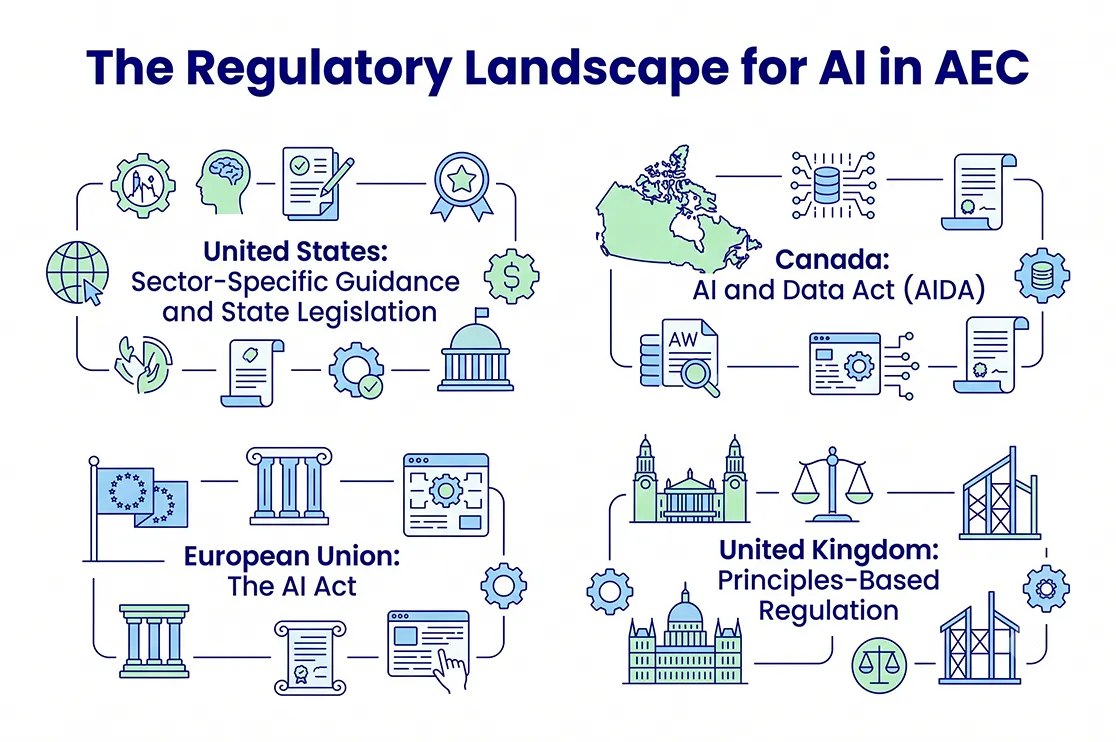
European Union: The AI Act
The EU AI Act – Regulation (EU) 2024/1689 – entered into force on 1 August 2024. It is the world’s first comprehensive binding horizontal legislation governing AI systems. The Act classifies AI systems into four risk tiers: unacceptable risk (prohibited, including AI used for social scoring and certain biometric surveillance applications), high risk, limited risk, and minimal risk.
High-risk AI systems under the Act include those used as safety components of products covered by EU product safety legislation, and those used in employment and worker management contexts including recruitment, performance monitoring, and work allocation. For AEC firms, AI tools used in structural analysis that affects the safety of buildings or infrastructure, and AI tools used in workforce scheduling or performance management, are potentially within the high-risk category.
High-risk AI systems must meet conformity assessment requirements before being placed on the EU market. These include establishing a risk management system, ensuring data governance practices appropriate to the system’s training and operation, providing technical documentation, enabling logging and traceability, ensuring transparency to users, and ensuring human oversight is possible. The obligations for high-risk AI systems begin applying in full from 2 August 2026.
For AEC firms operating from the Netherlands or delivering projects to EU public sector clients from the UK, Canada, or US: if you are placing a high-risk AI system into use within the EU – including using an AI tool on an EU project – the Act’s requirements apply to you. This is not a risk that can be managed by choosing a non-EU service provider.
United Kingdom: Principles-Based Regulation
The UK’s approach to AI regulation, set out in its AI Regulation White Paper (March 2023) and the subsequent AI Opportunities Action Plan (January 2025), is deliberately non-prescriptive compared to the EU’s horizontal legislation. The UK framework establishes five cross-sectoral principles – safety and security, appropriate transparency and explainability, fairness, accountability and governance, and contestability and redress – and applies these through existing sector regulators rather than creating new AI-specific regulation.
For AEC firms in the UK, this means that AI governance obligations are currently defined by sector-specific regulators (the Health and Safety Executive for construction site AI, the Financial Conduct Authority for any AI used in project finance or investment decisions) rather than a single AI regulator. The UK government has indicated that this approach will be reviewed as AI deployment matures, and sector-specific AI guidance is expected from several regulators in the 2025-2026 period.
The practical implication for UK AEC firms is to build an AI governance program against the five principles now, and monitor sector regulator guidance for construction, infrastructure, and related professional services. Firms that have a functioning AI governance program aligned to the principles will be well-positioned for any subsequent statutory requirements.
Canada: AI and Data Act (AIDA)
Canada’s Artificial Intelligence and Data Act – part of Bill C-27, the Digital Charter Implementation Act – proposes the first federal AI-specific legislation in Canada. As of mid-2026, the legislation was still progressing through Parliament, and its final form may differ from early drafts. The Act as proposed applies to high-impact AI systems, requiring impact assessments, transparency measures, and human oversight controls broadly analogous to the EU AI Act’s high-risk tier requirements.
AEC firms with significant Canadian operations should monitor the Act’s progress and prepare governance programs that would meet its requirements if enacted. Given the alignment between AIDA’s proposed requirements and the NIST AI RMF and ISO/IEC 42001 frameworks, organizations that build governance to those standards will be well-positioned for Canadian compliance regardless of the Act’s final form.
United States: Sector-Specific Guidance and State Legislation
The US does not yet have a comprehensive federal AI law. The National Institute of Standards and Technology’s AI Risk Management Framework (AI RMF 1.0), published in January 2023, is a voluntary framework but has been widely adopted across industries and referenced in federal agency AI policies. The AI RMF is addressed in detail in Section 6.
Federal sector agencies – including the Department of Transportation for infrastructure AI, the Environmental Protection Agency for environmental assessment AI, and the General Services Administration for AI used in federal procurement – are developing sector-specific AI guidance under the Executive Order on Safe, Secure, and Trustworthy AI (October 2023). AEC firms delivering federal projects in the US should track agency-specific AI requirements for their relevant project categories.
At the state level, AI legislation is advancing unevenly. Colorado, Illinois, and several other states have enacted or proposed AI-specific laws that may affect AEC firms operating in those jurisdictions, particularly around employment AI (recruitment and performance management tools) and automated decision-making in consequential contexts. State-level compliance is a growing component of US AI governance for firms with multi-state operations.
Recommended Reading:
Professional Standards: NIST AI RMF and ISO/IEC 42001
Two professional frameworks provide the most widely adopted and practically useful foundations for building an AEC AI governance program. Both are verifiable, actively maintained, and internationally recognized.
NIST AI Risk Management Framework (AI RMF 1.0)
The National Institute of Standards and Technology published the AI Risk Management Framework (AI RMF 1.0) in January 2023. It is a voluntary framework designed to help organizations manage AI-related risks across the full AI lifecycle. It is organized around four core functions: Govern, Map, Measure, and Manage.
| NIST AI RMF Function | What It Covers | AEC Application |
|---|---|---|
| Govern | Establishes the organizational policies, accountability structures, and culture of AI risk management. Includes AI risk tolerance definition, roles and responsibilities, and governance oversight mechanisms. | Designate an AI governance owner (CDO, CTO, or AI Ethics Lead). Define AI risk tolerance for different use cases. Establish governance committee with project delivery and legal representation. |
| Map | Identifies and classifies AI risks in context. Covers categorization of AI systems, stakeholder impact assessment, and identification of potential harms and benefits for each deployment. | Catalogue all AI tools in use. Classify each by risk tier (high/medium/low). Map data flows from CDE, SharePoint, and project systems that each AI tool accesses. |
| Measure | Defines and applies metrics for AI risk assessment, testing, and ongoing monitoring. Includes model performance evaluation, bias testing, and continuous monitoring protocols. | Set data quality thresholds required before AI deployment in each domain. Define performance metrics for predictive models. Establish regular validation cadences for live AI systems. |
| Manage | Implements risk responses, accept, avoid, mitigate, or transfer AI risks. Covers incident response, model updates, decommissioning, and communication of residual risks. | Define human review requirements by AI risk tier. Build incident escalation paths for AI failures. Document residual risks in project risk registers where AI tools are in use. |
The NIST AI RMF is applicable regardless of jurisdiction and is referenced by US federal agencies, international standards bodies, and an increasing number of enterprise procurement frameworks. AEC firms building governance programs aligned to the AI RMF are building to a globally recognized standard.
ISO/IEC 42001:2023, AI Management Systems
ISO/IEC 42001:2023, published by the International Organization for Standardization in December 2023, is the first international standard specifically addressing AI management systems. It specifies requirements for establishing, implementing, maintaining, and continually improving an AI management system, the organizational infrastructure for governing AI responsibly.
ISO/IEC 42001 follows the same high-level structure as ISO 9001 (Quality Management) and ISO/IEC 27001 (Information Security Management), making it integrable with existing management systems in organizations that already hold certifications in those standards. For AEC firms with ISO 9001 certification, ISO/IEC 42001 is a structured extension of an existing management system framework, not an entirely new program.
The standard covers: organizational context and AI policy, leadership and governance roles, planning and AI risk assessment, support (resources, competence, awareness, documentation), operational controls (AI impact assessment, data governance for AI), performance evaluation (monitoring, audit, management review), and improvement processes. Its clause structure maps closely to the six governance components described in Section 3 of this article.
ISO/IEC 42001 certification is emerging as a procurement differentiator for AEC firms bidding on large public sector infrastructure projects, particularly in the EU and UK where public sector procurers are beginning to include AI governance requirements in tender documentation. Building toward the standard now positions AEC organizations ahead of a requirement that is likely to become common in enterprise and public sector contracts within the next two to three years.
NIST AI RMF 1.0 – January 2023
The NIST AI RMF defines ‘trustworthy AI’ as AI that is valid and reliable, safe, secure and resilient, explainable and interpretable, privacy-enhanced, fair with managed harmful bias, and accountable and transparent. These seven properties provide a comprehensive checklist for evaluating any AI system deployed in an AEC context.
Data Governance Maturity Assessment
A structured diagnostic for CDOs, CIOs, and Chief Compliance Officers. 18 questions across six governance dimensions. Receive a scored maturity profile and prioritised recommendations.
Your Details
Your Assessment Results
Overall Governance Maturity Level
Receive Your Full Report
A BluEnt governance consultant will prepare a personalised report with specific recommendations for your highest-priority gaps. Book a 60-minute discovery call to discuss your findings.
How Other Industries Are Governing AI
Healthcare, financial services, and manufacturing have been working with consequential AI deployments for longer than most AEC organizations. Their governance approaches offer practical precedent.
Healthcare: Regulatory Framework for AI as Medical Software
In the US, the Food and Drug Administration (FDA) has developed a framework for AI and machine learning-based Software as a Medical Device (SaMD). The FDA’s January 2021 action plan established a risk-based approach to AI/ML-based SaMD that parallels the EU AI Act’s risk classification model: the higher the clinical consequence of the AI’s output, the more rigorous the pre-deployment validation and post-market monitoring required.
The key governance concept that healthcare AI regulation has established – and that AEC AI governance should adopt, is the requirement for a ‘predetermined change control plan.’ When an AI system’s model is updated, retrained, or significantly modified, the change must be assessed against defined criteria before it is deployed in a live clinical environment. For AEC, the equivalent is a change control process for AI model updates: a generative design tool or predictive risk model that has been updated or retrained should be revalidated before it is used in an active project delivery workflow.
Financial Services: AI Governance Under Supervisory Scrutiny
The Basel Committee on Banking Supervision’s BCBS 239 Principles – which established data governance as a regulatory requirement for systemically important banks, have been complemented by AI-specific supervisory guidance from national financial regulators. The UK’s Financial Conduct Authority (FCA) and the European Banking Authority (EBA) have both published guidance on AI and algorithmic decision-making that includes requirements for model risk management, explainability to customers, and governance accountability for automated decisions.
The most transferable governance practice from financial services to AEC is model risk management: the structured practice of evaluating AI model performance before deployment, monitoring it in production, and triggering a formal review when model performance degrades. In financial services, model risk management is a regulatory requirement with defined escalation paths. In AEC, it is currently a governance best practice. It will not remain voluntary in AEC jurisdictions indefinitely.
Manufacturing: AI in Operational Technology Environments
Large manufacturers, particularly in process industries, automotive, and aerospace, have deployed AI in operational technology environments where output failures have direct physical consequences: quality defects, production shutdowns, or safety incidents. Their AI governance approach reflects this: human override capability is a hard requirement, not an optional feature, for AI systems operating in physical production environments.
The ‘human override as a hard requirement’ principle is directly applicable to AEC. Any AI system deployed in a workflow with structural, safety, or contractual consequences, automated quantity takeoff, structural analysis AI, automated site safety monitoring, must have a defined and accessible human override mechanism. Governance frameworks that treat human override as an optional escalation path rather than a mandatory design requirement are underspecifying the governance control.
Recommended Reading:
Five Governance Failures That Derail AEC AI Programs
AEC organizations that have deployed AI without governance frameworks have encountered these five failures repeatedly. Each is predictable and preventable with governance design.
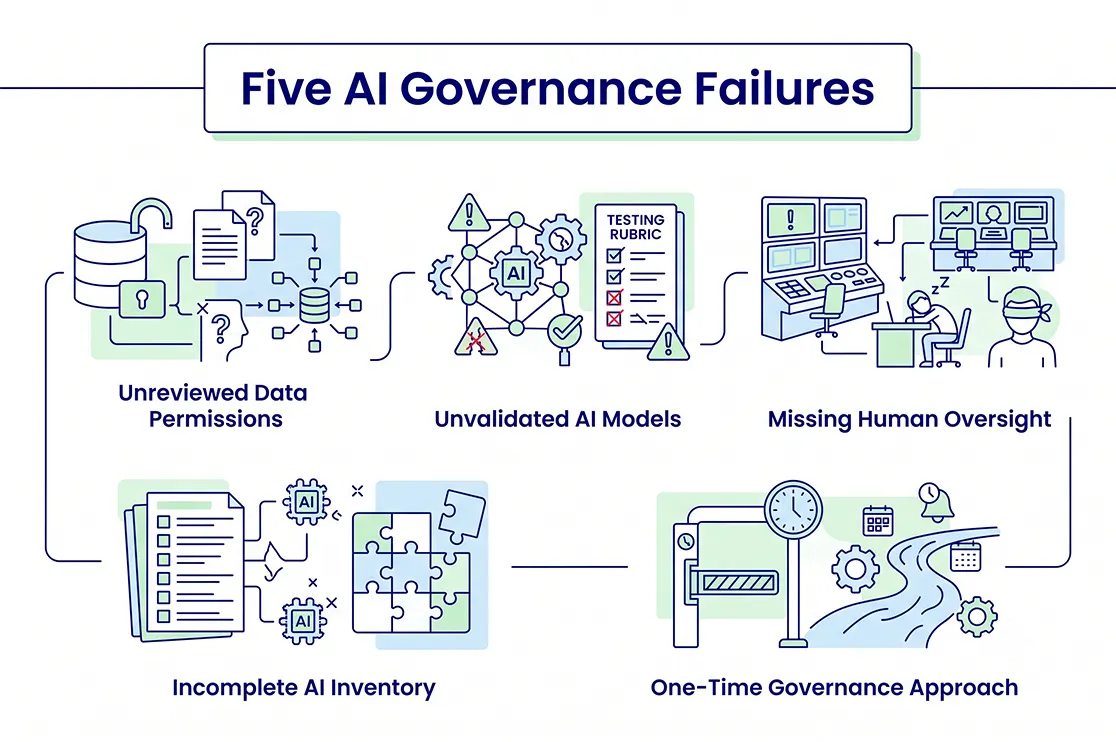
Failure 1: Deploying Copilot Before Fixing Permissions
The single most common AI governance failure in AEC is activating Microsoft Copilot on a Microsoft 365 tenant with unreviewed SharePoint and CDE permissions. Within weeks, project teams discover that Copilot is surfacing commercially sensitive data, client pricing, internal margin information, personnel records, in response to queries from users who should not have access to that information but technically did because permissions were never cleaned up. The remediation is not a Copilot problem; it is a permissions audit that should have been done before the AI was activated. The cost is not just data exposure, it is the reputational damage of having to explain to clients or employees why their confidential data was accessible to unauthorized colleagues through an AI query.
Failure 2: Using Predictive Models Without Validating Them on Your Data
AEC firms that adopt predictive project risk tools from vendors frequently do not validate model performance on their own historical project data before using outputs in live decisions. The vendor’s benchmark performance numbers are typically generated on a broad dataset. If your firm’s project mix is concentrated in a narrow geography, sector, or contract type, the model’s performance on your data may be significantly lower than the benchmark. Governance requires validation on representative local data before deployment, not after the first project where the model’s score turned out to be wrong.
Failure 3: No Human Review Requirement for High-Stakes Outputs
AI tools that generate design recommendations, risk scores, or specification summaries can be configured to deliver outputs directly into project workflows without a defined review step. In time-pressured project environments, teams default to acting on AI outputs without the review that governance requires. This is a governance design failure, the review requirement was not built into the workflow. Effective AI governance does not rely on individual discipline; it encodes the review requirement into the process so that acting on an AI output without review is structurally prevented, not just discouraged.
Failure 4: No AI Inventory, So No Governance Coverage
AI governance programs that start from the top, defining policy, establishing roles, building frameworks, without first completing an AI inventory frequently discover, after six months of program work, that significant AI deployments in operational teams are ungoverned because they were never catalogued. A BIM team running a third-party AI clash detection tool, a commercial team using an AI contract analysis platform, an HR function using an AI screening tool for project resourcing, these are real AI deployments with real governance implications that a top-down program without an inventory will miss. Start with the catalogue.
Failure 5: Treating AI Governance as a One-Time Project
AI governance is not a project with a completion date. The AI tools an AEC firm deploys today will change. New tools will be introduced. Existing tools will be updated, retrained, or expanded in scope. The regulatory environment will evolve. The data the AI accesses will change as projects begin and end. AI governance is a continuous operational program, analogous to data governance, that requires ongoing stewardship, periodic review, and active adaptation. Organizations that treat it as a one-time compliance exercise find themselves ungoverned again within eighteen months.
Build Your AEC AI Governance Program
BluEnt designs and implements AI governance frameworks for AEC organizations in the US, UK, Canada, and Netherlands. From AI inventory and risk classification to NIST AI RMF alignment and ISO/IEC 42001 readiness, we build governance that holds as your AI deployment scales.
Frequently Asked Questions
What is an AI governance framework and why does an AEC firm need one?An AI governance framework is the set of policies, roles, and controls that ensure AI systems in your organization operate within defined boundaries of data access, decision authority, quality standards, and legal compliance. AEC firms need one because AI tools are already operational in most businesses, in Copilot, generative design platforms, predictive analytics, and document AI, and without governance, those tools create data exposure, accountability gaps, model reliability failures, and regulatory risk. The question is not whether to govern AI; it is whether your governance keeps pace with your AI deployment.
Does the EU AI Act apply to AEC firms outside the European Union?Yes, in relevant circumstances. The EU AI Act applies to providers who place AI systems on the EU market and to deployers who use AI systems within the EU, regardless of where they are established. An AEC firm based in the UK, Canada, or US that uses a high-risk AI system, such as an AI tool used in structural safety analysis or workforce management, on an EU project, or that provides AI-enabled services to an EU client, is within the Act’s scope for those activities. AEC firms with operations or projects in the Netherlands, or delivering to EU public sector clients, should assess their AI inventory against the Act’s risk classification.
How does AI governance relate to data governance?AI governance depends on data governance as its foundation. AI systems operate on data, and the quality, access controls, and lineage of that data determine the reliability and safety of AI outputs. Before an AI tool is deployed in a consequential AEC workflow, data governance must confirm that the data the tool will access is accurate, appropriately restricted, and traceable. An AI governance framework defines additional requirements on top of data governance: risk classification for AI systems, human oversight requirements, explainability standards, and regulatory compliance. Neither discipline can substitute for the other; both are necessary.
What is ISO/IEC 42001 and is it relevant to AEC firms?ISO/IEC 42001:2023 is the international standard for AI management systems. It specifies requirements for establishing and maintaining an organizational AI governance capability, following the same high-level structure as ISO 9001 and ISO/IEC 27001. For AEC firms with existing ISO 9001 certification, ISO/IEC 42001 is an integrable extension of a familiar management system framework. It is relevant to AEC organizations that are building AI governance programs, particularly those bidding on large public sector or enterprise contracts where AI governance requirements are beginning to appear in tender documentation.
Where should an AEC firm start with AI governance?Start with an AI inventory. You cannot govern what you have not catalogued, and most AEC organizations discover significantly more AI deployment than leadership is aware of when they conduct a thorough inventory across all business units. From the inventory, classify each tool by risk level, identify the highest-risk gaps between current deployment and governance controls, and build the governance program from the highest-risk items first. BluEnt’s AI Governance Readiness Assessment completes this process in three to four weeks and produces a prioritized action plan.
Ready to Govern Your AI Deployment?
BluEnt’s AI governance team works with AEC firms across the US, UK, Canada, and Netherlands to build governance programs that are practical, defensible, and designed to scale. If your AI tools are already running, the time to govern them is now.

 Data Governance for AI and Advanced Analytics: Building the Foundation That Works
  Centralized vs. Federated vs. Hybrid Data Governance: Which Model Fits Your Organization
  Data Governance Roles and Responsibilities in AEC Organizations
  Data Governance vs. Data Management vs. MDM: What AEC Leaders Need to Know