










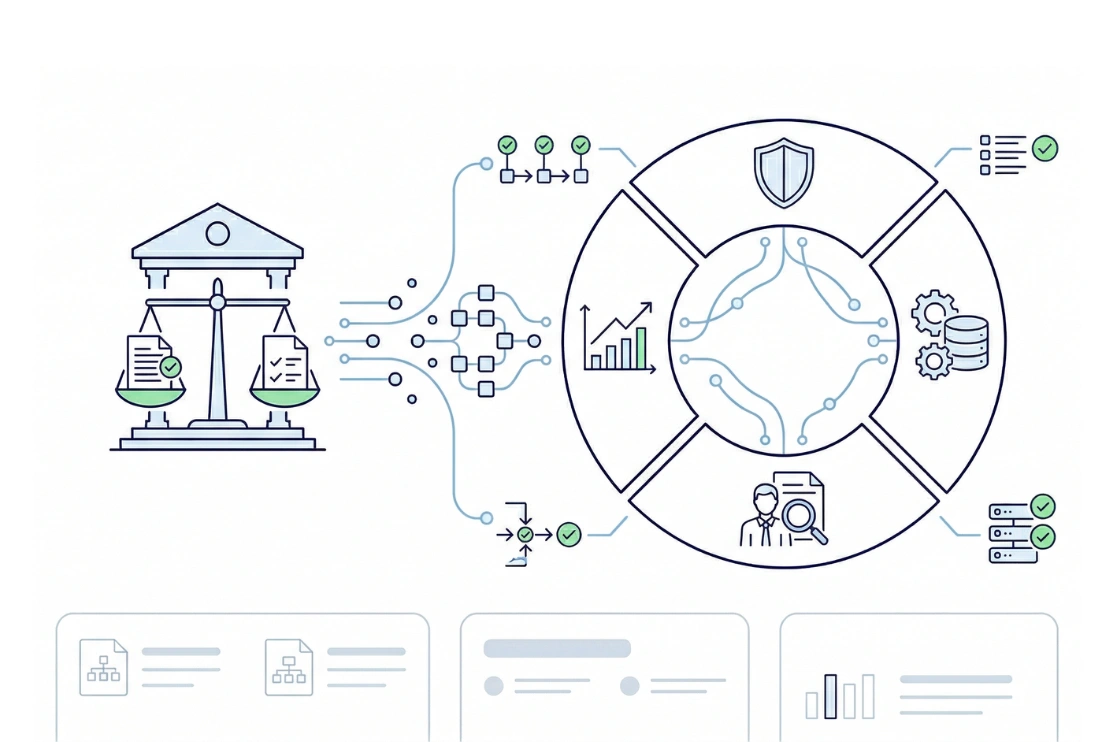
Data governance enables regulatory compliance by improving data visibility, audit readiness, and risk control, helping enterprises reduce compliance costs while building trusted, AI-ready data ecosystems.
Key Takeaways
-
Data governance is the foundation for achieving scalable and audit-ready regulatory compliance.
-
Strong governance improves data visibility, lineage, and accountability across the enterprise.
-
Regulatory pressure is accelerating the need for structured data governance programs.
-
Automation and AI are transforming compliance from reactive to real-time monitoring.
-
Organizations with mature governance gain better risk control, data trust, and faster AI adoption.
Currently, 71% of countries enforce data privacy laws, and thecost of non-compliance is 2.7 times higher than the cost of maintaining compliance (Gitnux).
For business leaders, this marks a major change. Compliance is no longer only about following rules; it is now about having control over your data. As oversight grows to cover personal data, financial transactions, AI models, and cross-border data flows, organizations without strong data governance find it hard to track where data comes from, manage consent, and stay ready for audits.
This blog examines how data governance for regulatory compliance enables organizations to transition from reactive compliance to a proactive, structured, and audit-ready data strategy, thereby reducing risk and fostering long-term data trust.
Table of Contents:
- Introduction
- Understanding the Relationship Between Data Governance and Regulatory Compliance
- The Role of Regulatory Pressure in Advancing Enterprise Data Governance Programs
- Key Components of a Data Governance Compliance Framework
- How Data Governance Enables Regulatory Compliance
- Data Governance Best Practices for Compliance Leaders
- Challenges Organizations Face in Implementing Data Governance for Compliance
- The Future of Data Governance in a Highly Regulated Digital Economy
- How Data Governance Consulting Services Help Organizations Achieve Compliance
- Bottom Line
- FAQs
Understanding the Relationship Between Data Governance and Regulatory Compliance
Data governance and regulatory compliance are not independent initiatives; rather, they are directly interconnected.
Data governance establishes the structures, including policies, roles, and processes, necessary to ensure that data remains secure, trustworthy, and accessible. Regulatory compliance is the resulting outcome, requiring organizations to adhere to laws such as the General Data Protection Regulation (GDPR), California Consumer Privacy Act (CCPA), Health Insurance Portability and Accountability Act (HIPAA), Digital Personal Data Protection (DPDP) Act, and the European Union Artificial Intelligence (EU AI) Act.
For most enterprises, the primary challenge lies not in understanding regulations but in demonstrating how data is collected, utilized, and protected. In the absence of effective governance, these processes become fragmented and require extensive auditing.
That’s why governance is no longer optional. In fact, 60% of organizations with mature data governance achieve better compliance outcomes.
The Role of Regulatory Pressure in Advancing Enterprise Data Governance Programs
Regulatory pressure is accelerating, compelling organizations to reconsider their approaches to large-scale data management.
Compliance expectations, including those related to global data protection laws, cross-border data flows, and AI governance requirements, are expanding more rapidly than most legacy systems can accommodate. Increased regulatory scrutiny and the escalating costs associated with data breaches have elevated data governance to a board-level priority rather than solely an IT concern.
In fact, the financial implications are substantial. The average cost of a data breach has reached $4.45 million, and 80% of organizations anticipate increased regulatory oversight of their data practices. Concurrently, the data governance market is projected to reach $15.86 billion by 2032, primarily driven by compliance requirements.
For business leaders, regulatory pressure not only increases risk but also accelerates the necessity for structured, enterprise-wide data governance programs.
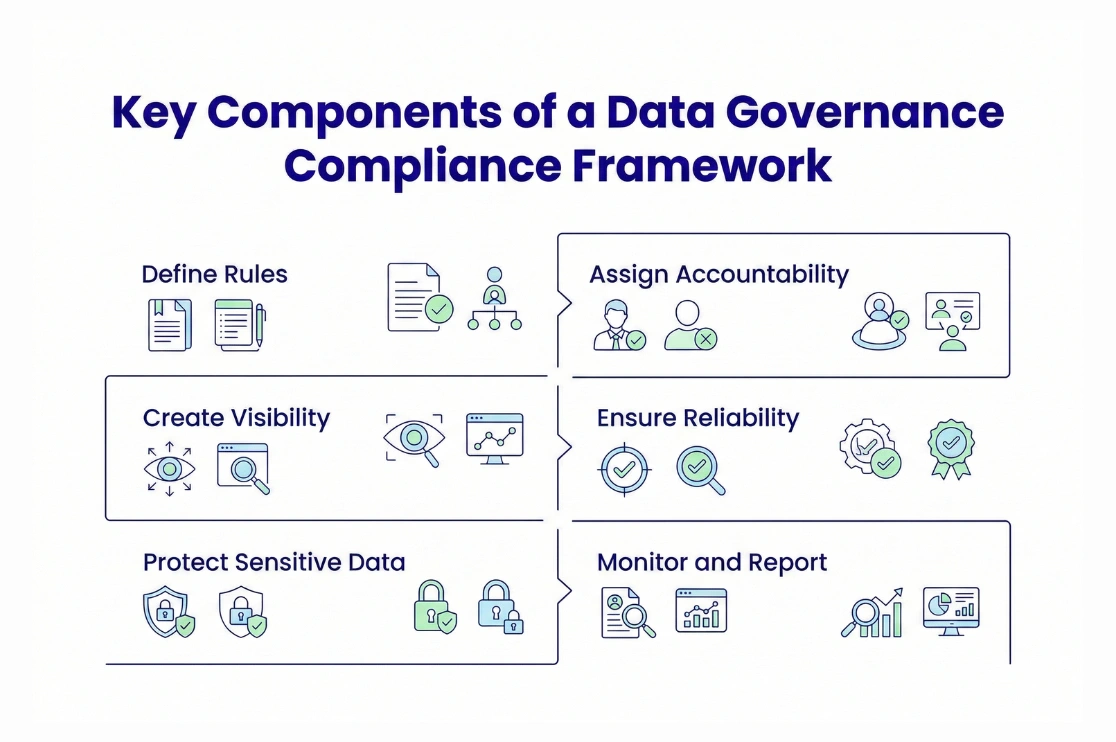
Key Components of a Data Governance Compliance Framework
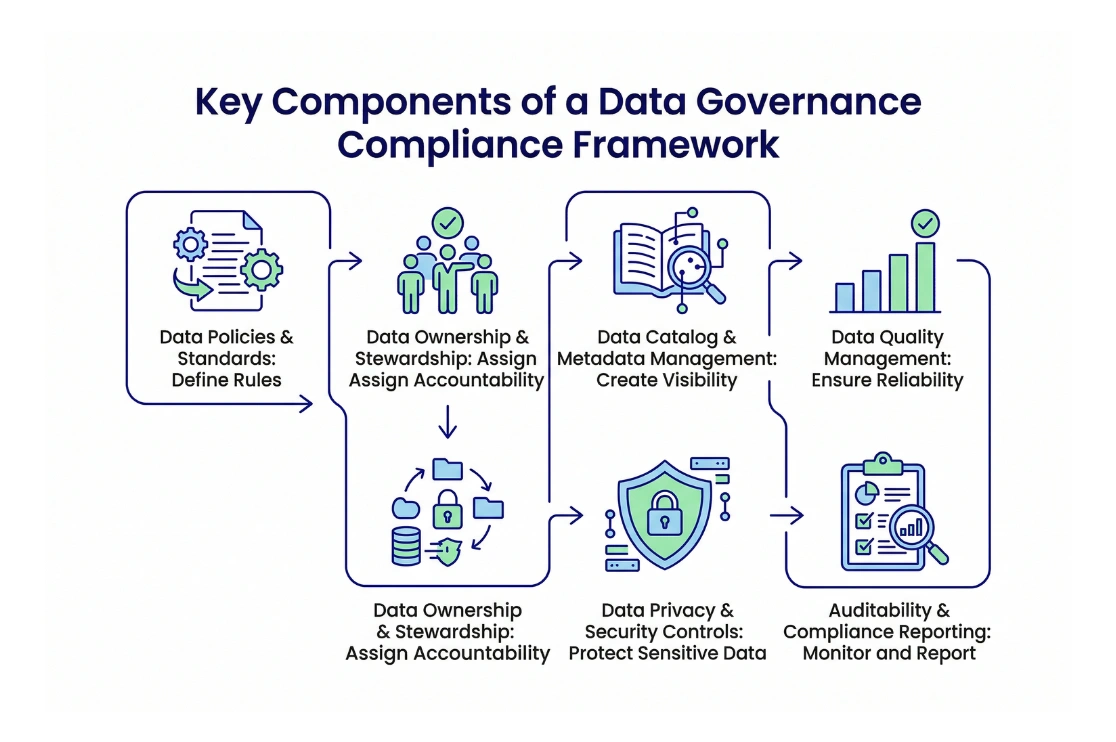
A strong data governance framework transforms compliance from a reactive task into a structured, repeatable process. Successful organizations focus on several critical components:
-
Data Policies & Standards – Define clear rules for data usage, retention, and classification to ensure consistency across the enterprise.
-
Data Ownership & Stewardship – Assign accountability through defined roles like data owners and stewards to eliminate ambiguity.
-
Data Catalog & Metadata Management – Create visibility into data assets, enabling lineage tracking and impact analysis.
-
Data Quality Management – Ensure data is accurate, complete, and reliable—critical for both reporting and regulatory trust.
-
Data Privacy & Security Controls – Implement encryption, access controls, masking, and tokenization to protect sensitive data.
-
Auditability & Compliance Reporting – Maintain audit trails and enable real-time compliance monitoring and reporting.
How Data Governance Enables Regulatory Compliance
Data governance solutions changes compliance from a manual, reactive task into a process that is controlled and measurable.
-
Ensures Data Lineage & Traceability – Provides clear visibility into where data originates, how it moves, and how it’s used, which is critical for regulatory audits.
-
Strengthens Data Privacy & Security – Enforces classification, access controls, and monitoring to protect sensitive data and meet privacy requirements.
-
Improves Audit Readiness – Enables continuous compliance with real-time visibility, reducing last-minute audit pressure.
-
Supports Regulatory Reporting – Automates reporting across financial, privacy, and risk regulations, improving accuracy and speed.
The impact is clear. Organizations that use governance frameworks have reduced data security incidents by 57.8%, showing their direct role in compliance and risk reduction.
Is your data governance failing audits?
See how top enterprises are turning compliance into a competitive edge.
Data Governance Best Practices for Compliance Leaders
For compliance leaders, the primary challenge is not initiating governance but rather ensuring it is scalable and actionable throughout the enterprise. Leading organizations prioritize several high-impact practices:
-
Establish an Enterprise Data Governance Strategy – Align governance with risk management, compliance objectives, and business strategy to ensure it delivers measurable value.
-
Implement Data Classification & Cataloging – Identify sensitive, regulated, and operational data to prioritize protection and compliance efforts.
-
Embed Governance into Data Workflows – Integrate governance directly into data pipelines, analytics, and AI models to avoid manual enforcement.
-
Leverage Automation & AI for Monitoring – Use AI to detect anomalies, track data usage, and enforce policies in real time.
Challenges Organizations Face in Implementing Data Governance for Compliance
While data governance is critical for compliance, most organizations struggle with execution at scale.
-
Data Silos Across Systems – Fragmented data across departments limits visibility, making it difficult to enforce consistent governance.
-
Lack of Data Ownership – Without clearly defined owners and stewards, accountability breaks down and governance initiatives stall.
-
Complex Regulatory Landscape – Managing multiple regulations across regions creates confusion and increases compliance risk.
-
Cultural Resistance – Governance requires new processes, roles, and accountability, often facing resistance from business teams.
These challenges don’t just impact compliance, they also slow innovation. In fact, data governance is now a key barrier to AI adoption, primarily due to concerns around data trust and regulatory compliance.
The Future of Data Governance in a Highly Regulated Digital Economy
Data governance is rapidly evolving from a control function to a strategic enabler of compliance, AI, and digital growth.
-
AI-Driven Data Governance: Organizations increasingly utilize AI to automate data classification, monitor compliance, and detect anomalies in real time, thereby reducing manual effort and operational risk.
-
Real-Time Compliance Monitoring: Contemporary platforms are shifting from periodic audits to continuous compliance visibility, which enables more rapid responses to regulatory changes.
-
Data Fabric and Data Mesh Governance: As data becomes increasingly decentralized, governance frameworks must adapt to maintain control while supporting ongoing innovation.
-
Strengthening Global Privacy Regulations: Evolving legislation, such as the EU AI Act, India’s Digital Personal Data Protection (DPDP) Act, and various United States state regulations, is compelling organizations to adopt more transparent and accountable data practices.
For business leaders, the imperative is clear: data governance must become proactive, intelligent, and integrated within the data ecosystem. This approach is essential not only for regulatory compliance but also for sustaining long-term digital trust.
Competitors are already leveraging governance to accelerate AI and reduce risk.
Don’t get left behind & transform your data into a compliance powerhouse.
How Data Governance Consulting Services Help Organizations Achieve Compliance
Many organizations know what needs to be done but struggle with putting it into practice. Data governance consulting services help bridge this gap and provide real value right away.
-
Governance maturity assessments help you find gaps and risks and see how ready your current data setup is.
-
Framework design focuses on creating a data governance system that can grow with your business and meet regulatory requirements.
-
A compliance data strategy outlines how your data can support audits, protect privacy, and make regulatory reporting easier.
-
Implementing a data catalog gives you better visibility, tracks where your data comes from, and helps you control your data assets.
-
A governance operating model sets clear roles and responsibilities, making sure everyone knows what they are accountable for across teams.
-
Regulatory reporting frameworks help make compliance reporting faster and more automated.
With these steps, you can put governance in place faster, be better prepared for regulations, and build more trust in your data. This turns compliance from a risk into a real advantage for your business.
Bottom Line
Data governance now extends beyond regulatory compliance to encompass the development of resilient, data-driven enterprises. Organizations that approach governance as a strategic capability achieve enhanced risk management, regulatory resilience, reliable data ecosystems, and accelerated adoption of artificial intelligence.
A significant shift for business leaders is evident: compliance should no longer be reactive but must be integrated into data strategies from the outset.
By collaborating with experienced partners like BluEnt, organizations can transition from fragmented initiatives to the implementation of scalable, enterprise-grade data governance frameworks, thereby transforming compliance into a sustainable competitive advantage.
Collaborate with a trusted leader in enterprise data governance.
Leverage BluEnt’s expertise to implement scalable, audit-ready frameworks that turn compliance into a strategic advantage.
FAQs
How does data governance reduce regulatory risk in large enterprises?Data Governance creates structured control over data usage, access, and movement, ensuring compliance gaps are identified early and addressed proactively.
What is the difference between data governance and compliance management?Data governance focuses on managing data quality, ownership, and policies. While compliance ensures adherence to regulatory requirements, governance enables compliance.
Why do compliance initiatives fail without data governance?Without governance, organizations lack visibility, accountability, and consistency in data handling, making it difficult to meet audit and regulatory requirements.
How can organizations measure the success of data governance for compliance?Success is measured through improved audit readiness, reduced compliance incidents, faster reporting, and better data accuracy across systems.
When should an organization invest in data governance consulting services?When compliance risks increase, data complexity grows, or internal teams lack the expertise to implement scalable governance frameworks effectively.

 Governing AI Tools in AEC: Copilot, Digital Twins, and Generative Design
  Data Governance for AI and Advanced Analytics: Building the Foundation That Works
  Centralized vs. Federated vs. Hybrid Data Governance: Which Model Fits Your Organization
  Data Governance Roles and Responsibilities in AEC Organizations