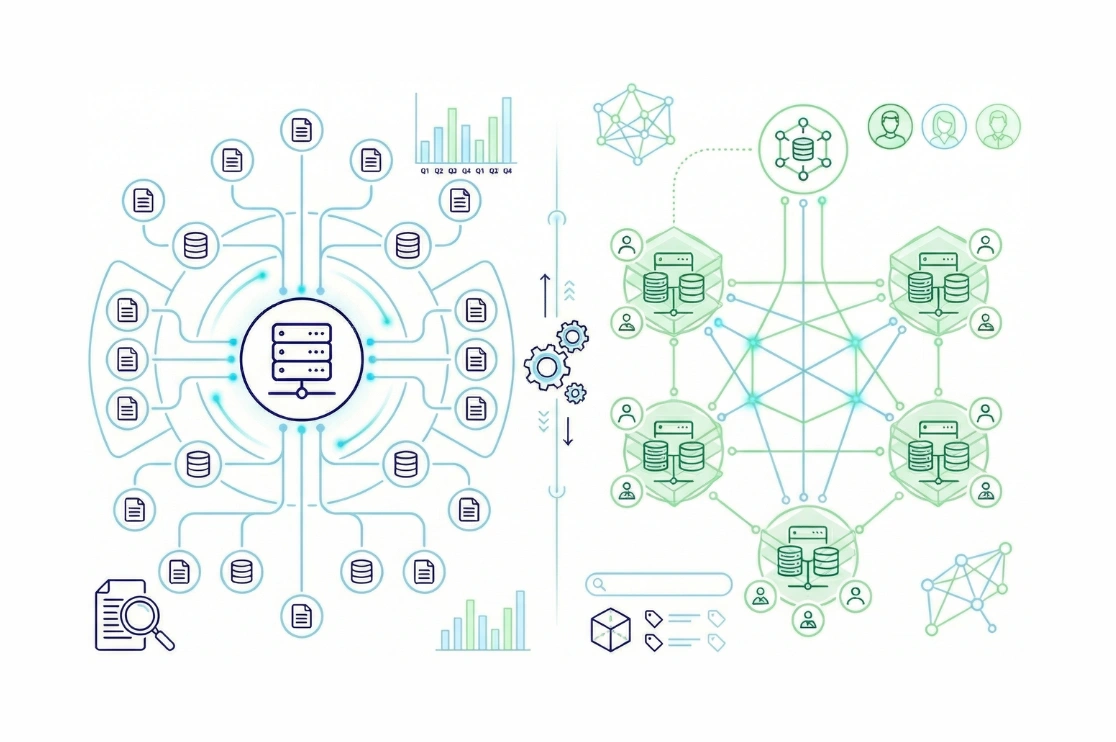









Your enterprise generates more data than ever before. Without governance, that data does not stay neutral; it compounds risk, contradicts itself across business units, and erodes the trust your analysts, executives, and regulators need to act on it.
BluEnt designs, implements, and operationalises enterprise data governance programmes for complex, multi-entity organisations – building the frameworks, policies, and operational structures that transform data from a liability into a reliably governed asset.

Years enterprise delivery

Global markets

Vendor alignment
100% Vendor-Neutral Platform Recommendations
Data Governance Maturity Assessment
A structured diagnostic for CDOs, CIOs, and Chief Compliance Officers. 18 questions across six governance dimensions. Receive a scored maturity profile and prioritised recommendations.
Your Details
Your Assessment Results
Overall Governance Maturity Level
Receive Your Full Report
A BluEnt governance consultant will prepare a personalised report with specific recommendations for your highest-priority gaps. Book a 60-minute discovery call to discuss your findings.
Trusted By
Organizations That Trust BluEnt With Their Data
- Gift Card Management, Reporting, Data Integration, Analytics Solutions, Book Keeping NetSuite Reporting, NetSuite Records Maintenance, Income Statement, Audit Support

- Gift Card Management, Reporting, Data Integration, Analytics Solutions
- Invoicing, AP Reports, Sales Data Analytics
- MuleSoft Integration, Analytics & Dashboards - [Tableau, MS SQL Server, SSIS]

- ERP Onboarding and Implementation, Data Migration, Custom Report Building, Audit Support and Finalization, Draft Financials Statements, Bidding Website Development

- Data Analytics and Dashboards

- V-Bucks Gift Card Sales Analytics, Reconciliation, Financial Tracking and Reporting
- Web Asset Creation

- HubSpot Campaign Management, Workflow Automation, UX/UI Development, Mobile App Development, Application Development

- Data Analytics and Dashboards, Website Development, Website Maintenance, Application Development, HubSpot Automation and Integration, Asana Management
- SEO, Website UX/UI Development, Data Management, Third-Party Integration, Website Maintenance

- Shopify Website Development, Klaviyo Email Marketing, Email Campaign Setup, Third-Party Shopify App Integration
- Website and SEO Audit, Shopify Website Maintenance, SEO and Analytics
- Website Design and Development, Website Maintenance
- Website Design and Development, Website Maintenance

- Website Design and Development, Website Maintenance, SEO and Analytics
Six Signs Your Enterprise Has Outgrown Its Current Approach to Data
Each of the following patterns has a clear governance root cause. If more than two are recognisable in your organisation, the case for action is established. The question is no longer whether to invest in governance, but where to start.

Your Compliance Team Is
Preparing for Audits Manually
Audit readiness that depends on people tracking down documentation is not a process problem. It is a governance gap. GDPR, HIPAA, DORA, and APRA CPS 234 require traceable, current compliance records. When your team is assembling evidence manually every cycle, the cost compounds and the risk does not go away between audits.

Different Teams Are
Reporting Different Numbers
Finance, sales, and operations each report a different revenue figure for the same quarter. When leadership cannot agree on a number, trust in data collapses across every function that depends on it. The problem is not the reporting tool. It is the absence of governed definitions, ownership, and quality standards underneath it.

Your AI Programme Is Delivering Less Than
Its Business Case Promised
If your data science team spends more time questioning data quality than generating insight, the problem is upstream. AI models are bounded by the data they are trained on. Unresolved quality issues, undocumented lineage, and inconsistent definitions do not disappear when you deploy a model. They become embedded in the outputs your organisation acts on.

Every Acquisition Takes Longer to
Integrate Than Expected
Post-merger data integration without a governance standard means reconciling incompatible definitions, ownership structures, and quality baselines from scratch. Each acquired entity brings its own version of the same data. The expected synergies take years longer to realise because there is no common foundation to integrate into.

Data Problems Are Compounding Faster
Than Your Team Can Resolve Them
Deferred governance decisions accumulate. Inconsistent master data grows harder to reconcile with every new system added. Undocumented lineage makes platform migrations more expensive than the platforms themselves. The team that could be solving business problems is instead managing data cleanup that should have been prevented at source.

Nobody in the Organisation Owns the
Data Quality Problem
Without defined ownership, every data quality problem becomes everyone’s problem and no one’s responsibility. As data volumes grow, the absence of accountable stewardship means quality issues are discovered downstream, in reports, in customer-facing systems, in audit findings, rather than prevented at source. The cost of fixing problems downstream is typically five to ten times the cost of preventing them.
If any of these patterns are visible in your organisation, the cost of continued inaction is measurable and growing. The right starting point is understanding exactly where you stand.
How BluEnt Builds Enterprise Data Governance
BluEnt takes an outcomes-first approach to enterprise data governance. We do not arrive with a rigid off-the-shelf framework. We start with your organisation’s specific data landscape, compliance obligations, and strategic goals and design a governance programme across three interconnected layers that must work together for governance to be sustainable.
Layer 1: Governance Strategy
The strategic foundation of your governance programme. Covers governance operating model design, data ownership and stewardship structures, council and committee charters, policy architecture, and regulatory compliance mapping across your operating jurisdictions.
Without a clear strategy, governance tooling produces catalogues that nobody uses and policies that nobody enforces.
Layer 2: Governance Operations
The operational infrastructure that makes governance a daily practice rather than a project. Covers data quality management workflows, stewardship activation and training, governance council operations, issue escalation processes, and the change management that drives adoption across business units.
Without operational infrastructure, governance frameworks sit in repositories rather than shaping how your organisation works with data.
Layer 3: Governance Technology
The tooling and integration layer that scales governance across your enterprise data environment. Covers data catalogue implementation, metadata management, lineage mapping, quality rule enforcement, and integration with your existing data platforms such as Snowflake, Databricks, Microsoft Fabric, Azure Purview, Collibra, Alation, and AWS Glue.
Without the right technology, governance is manual and cannot scale. With technology alone and no strategy or operations, adoption fails.
All three layers are required. The most common reason enterprise governance programmes fail is that organisations invest in one or two layers, usually technology and a strategy document, without building the operational infrastructure that makes governance a sustainable practice.
The Business Case for Governed Data
A well-designed governance programme delivers returns across compliance, operations, and strategy. The following are the outcomes organisations achieve when governance is built correctly from the start, not retrofitted after problems surface.

Compliance Costs That Go Down, Not Up
Automated lineage, classification, and retention governance replace manual documentation cycles. Each audit costs less than the last. Regulatory findings related to data management decline because the framework is maintained continuously, not assembled in preparation for review.

Leadership Teams That Work From the Same Numbers
Governed data definitions, ownership, and quality standards eliminate the internal disputes that slow down every decision. When finance, operations, and sales pull from the same governed definitions, board reporting becomes faster and executive alignment becomes the default, not the exception.

AI Investments That Justify Their Business Case
Governed, quality-scored, and well-classified data produces models that perform as projected and are trusted enough to act on. Analytics teams spend their time generating insight rather than tracing data quality issues. The gap between what AI was expected to deliver and what it actually delivers closes significantly.

Acquisitions That Become Productive Assets Faster
When your enterprise has a governance standard, new entities map to it. Integration timelines shorten, data from acquired organisations becomes analytically useful within months, and the projected synergies from the acquisition start arriving on schedule rather than years later.

A Regulatory Posture That Absorbs Change Without Rebuilding
Governance frameworks designed for multi-jurisdiction compliance adapt when regulations evolve. New obligations become a mapping exercise against an existing structure rather than a rebuild. As regulatory requirements change across the US, UK, EU, and Australia, your posture adjusts without starting from scratch.

A Data Foundation Built for What Comes Next
New markets, new platforms, new data domains, new regulatory obligations. A governance programme designed with scalability as a first principle grows with your organisation rather than becoming a constraint on it. BluEnt builds frameworks intended to be in use in ten years, not replaced in three.
Enterprise Data Governance Capabilities

Enterprise Governance Operating Model
Design of the ownership structures, stewardship networks, governance councils, and accountability frameworks that make enterprise-scale governance function across business units, geographies, and entity types. Includes role definition, RACI mapping, and council charter development.

Master Data Management Governance
Governance of your critical master data domains – customer, product, supplier, asset, and financial data – including domain ownership, definition standards, quality thresholds, and change control processes. The foundation for a reliable single source of truth across your enterprise.

AI and Analytics Data Readiness
Assessment and remediation of data governance gaps that prevent reliable AI and analytics outcomes. Covers data quality scoring, lineage documentation, classification completeness, and domain-level readiness ratings that tell your data science teams exactly which data assets can be used for which use cases.

Enterprise Data Catalogue and Metadata Management
Implementation and operationalisation of an enterprise data catalogue across priority domains – including metadata standards, business glossary development, lineage mapping, and integration with your existing data infrastructure. Configured to serve both technical and business users.

Multi-Jurisdiction Regulatory Compliance Governance
Structured governance architecture designed to meet overlapping regulatory obligations across the jurisdictions in which your enterprise operates. Covers GDPR, UK GDPR, HIPAA, DORA, APRA CPS 234, BCBS 239, CCPA, PIPEDA, and sector-specific frameworks – with traceability from policy to technical control.

Data Quality at Enterprise Scale
Enterprise-wide data quality programme design and implementation, including domain-level quality scoring, automated quality rule enforcement, remediation workflow design, and executive-level quality dashboards. Produces a measurable, improving quality baseline rather than a point-in-time assessment.

Post-Merger Data Governance Integration
Structured governance integration programmes for newly acquired entities, covering data standard harmonisation, ownership model extension, policy onboarding, and platform integration. Reduces M&A data integration cost and timelines by providing a defined governance standard for each entity to map to.

Governance Programme Management and Measurement
Ongoing governance programme management including stewardship performance tracking, data quality KPI dashboards, council effectiveness reviews, regulatory posture monitoring, and roadmap maintenance. Ensures your governance programme continues to evolve as your enterprise grows and regulatory requirements change.
Data Governance Expertise Across High-Stakes Industries
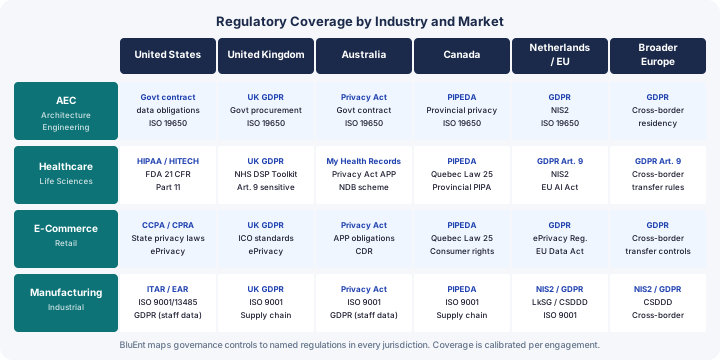
Enterprise governance requirements differ significantly by industry. The regulatory frameworks, data types, stewardship obligations, and operational risks that define governance in healthcare have almost nothing in common with those in manufacturing or financial services. BluEnt brings deep, sector-specific knowledge — not a generic governance model applied without modification.
Architecture, Engineering and Construction (AEC)
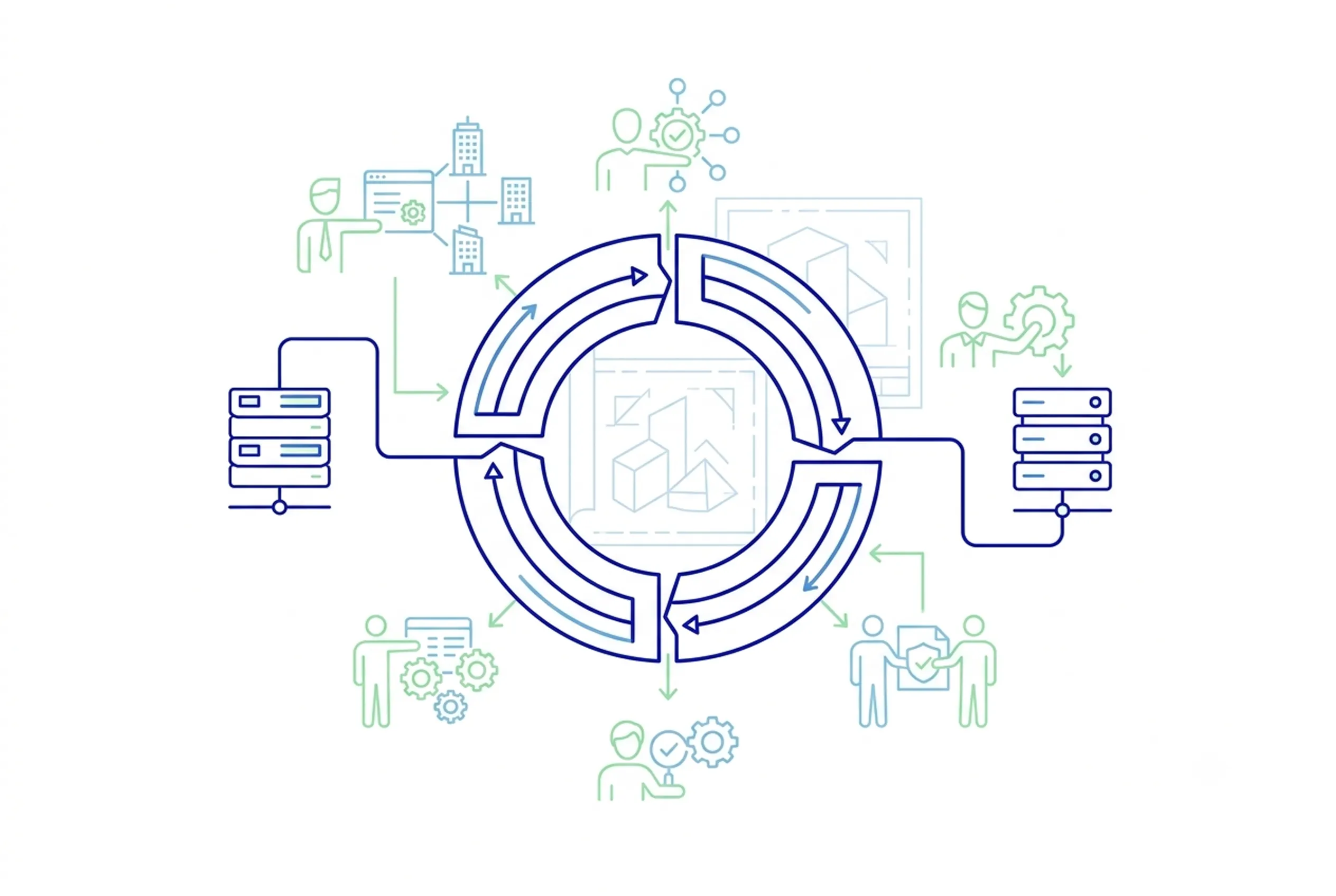
AEC enterprises operate some of the most fragmented data environments of any industry — project data, BIM models, asset registers, contract documentation, compliance records, and supply chain data spread across dozens of entities, contractors, geographies, and delivery platforms. The governance challenge is not just quality — it is consistency, interoperability, and accountability across a distributed data landscape that changes with every project.
BluEnt’s AEC governance work addresses four specific challenges: establishing consistent data standards and definitions across all project delivery entities; governing BIM and digital twin data throughout the asset lifecycle; meeting the data management obligations on public and government contracts (increasingly a formal requirement); and enabling the data interoperability that modern integrated project delivery demands across tools like Autodesk Construction Cloud, Bentley, and Microsoft Fabric.
Regulatory context: Government contract data obligations (UK, Australia, US), ISO 19650 BIM data management, procurement compliance frameworks.
Healthcare and Life Sciences
Healthcare organisations face the most demanding data governance environment of any industry BluEnt serves. Patient data protection requirements under HIPAA in the US, NHS data standards in the UK, and the Australian My Health Records Act impose specific, non-negotiable obligations on data classification, access control, retention, and audit traceability. Clinical trial data integrity, cross-border data residency, and the governance of AI-assisted clinical decision tools add further layers of complexity.
BluEnt helps healthcare organisations build governance frameworks that are genuinely compliant — not just documented — and that support the operational goal of enabling safe, appropriate data sharing between clinical, administrative, and research functions. We work with healthcare CIOs, CDOs, and compliance teams who need a governance partner with real understanding of clinical data environments, not just generic data protection expertise.
Regulatory context: HIPAA (US), NHS Data Security and Protection Toolkit (UK), My Health Records Act (Australia), GDPR Article 9 sensitive data obligations (EU), FDA 21 CFR Part 11 (clinical trials).
E-Commerce and Retail
Retail and e-commerce organisations are navigating three simultaneous governance pressures that have no precedent: the collapse of third-party cookie-based data ecosystems, forcing first-party data to carry the entire weight of personalisation and audience targeting; the global expansion of consumer privacy regulation, creating compliance obligations across dozens of jurisdictions simultaneously; and the growing complexity of supplier and logistics data ecosystems, where data quality issues in the supply chain translate directly to customer experience failures and margin erosion.
BluEnt helps retail organisations build first-party data assets that are compliant, trusted, and analytically powerful. This means governing how customer data is collected, classified, and used; implementing consent management and data subject rights workflows; governing supplier and inventory data across multi-tier supply chains; and building the data infrastructure that enables reliable personalisation, demand forecasting, and supply chain optimisation.
Regulatory context: GDPR (EU), UK GDPR, CCPA and US state privacy laws, PIPEDA (Canada), Australian Privacy Act, ePrivacy Regulation.
Manufacturing and Supply Chain
Manufacturers are managing a convergence of governance challenges that did not exist a decade ago: the integration of operational technology (OT) data from production systems with IT data from ERP and planning platforms; the governance of ESG and sustainability reporting data, which is moving from voluntary to mandatory under CSRD in the EU and SEC climate rules in the US; and the data quality obligations of digital transformation programmes such as IoT, digital twins, and predictive maintenance systems, that depend entirely on the quality of the data they consume.
BluEnt supports manufacturing clients across the US, UK, Netherlands, and Australia with governance frameworks that address all three challenges simultaneously, ensuring that production data, supply chain data, ESG reporting data, and digital transformation data assets meet the quality and governance standards that operational and regulatory requirements demand.
Regulatory context: CSRD (EU), SEC climate disclosure rules (US), ISO 9001 quality management, IATF 16949 (automotive), REACH and RoHS (product compliance data).
Client Case Study: Multi-Country AEC Enterprise
The Challenge
A construction and engineering group operating across 14 business units in three countries had reached a governance crisis point. Project data existed in incompatible formats across entities, making cross-entity reporting unreliable. Compliance documentation for government contracts was prepared manually before each audit cycle, consuming significant internal resources. A major public sector contract – representing a material portion of projected revenue – required demonstrable data governance maturity within 90 days as a condition of award.
The BluEnt Approach
BluEnt delivered a phased governance programme across three stages. Stage 1 completed a governance maturity assessment across all 14 business units and produced a prioritised framework design within five weeks, meeting the 90-day contract requirement. Stage 2 implemented a data catalogue across the client’s core project data domains and established consistent data quality standards across all entities, integrated with their existing Autodesk Construction Cloud and Microsoft Fabric environment. Stage 3 operationalised the stewardship network across all business units, embedded governance workflows into project delivery processes, and trained domain stewards and the governance council.
Results Delivered
-
Governance framework delivered within 90 days – contract awarded
-
Data catalogue live across 14 business units within 6 months
-
Compliance documentation automated: 80% reduction in manual effort
-
Cross-entity reporting discrepancies eliminated in priority data domains
-
Stewardship network of 34 domain owners operational at programme close
-
Autodesk + Microsoft Fabric integration completed without platform migration
-
Governance programme transitioned to internal ownership within 18 months
From First Conversation to Full Implementation
Enterprise data governance programmes have a reputation for long procurement cycles, slow starts, and years before any meaningful outcome is visible. BluEnt designs engagements to invert this pattern, delivering quick wins early, building progressively toward full maturity, and maintaining a single senior point of accountability throughout.
| Week 1–2 | Discovery and scoping call. No preparation required. BluEnt brings the agenda, the questions, and a sector-specific pre-read on your likely governance landscape. Output: scoped engagement proposal with phased investment breakdown. |
| Week 3–5 | Governance maturity assessment. Structured evaluation of your current data governance posture across all in-scope data domains, business units, and regulatory obligations. Output: maturity report and prioritised governance roadmap. |
| Week 6–12 | Framework design and policy development. Operating model design, data ownership structure, policy and standards library, regulatory compliance mapping. Output: complete governance framework document ready for council review and adoption. |
| Month 3–6 | Technology integration and data catalogue implementation. Platform configuration, metadata standards implementation, lineage mapping, quality rule deployment. Output: live data catalogue across priority domains, integrated with your data infrastructure. |
| Month 4–8 | Stewardship operationalisation and change management. Stewardship network activation, council launch, role-based training, governance workflow embedding. Output: active, functioning stewardship network with measurable engagement metrics. |
| Month 6+ | Measurement, optimisation, and scale. Governance KPI dashboards, quality trending, regulatory posture monitoring, domain expansion planning. Output: self-sustaining governance programme with progressive capability transfer to your internal team. |
Enterprise Data Governance Is the Foundation Your AI Strategy Depends On

Every significant AI and machine learning investment your enterprise makes depends on data that can be trusted. The quality of your models is bounded by the quality of your data. The speed of your AI delivery is bounded by how quickly your data teams can certify that a given dataset is fit for training. The adoption of your AI tools by the business is bounded by whether the outputs are trusted; and trust in AI outputs is ultimately trust in the underlying data.
BluEnt has seen organisations invest millions in AI and analytics platforms, then fail to realise the expected returns because the underlying data governance foundation was not in place. The models exist. The tools exist. The data teams exist. But the data is not trusted, and the models cannot be validated, and the dashboards contradict each other, and the business units revert to spreadsheets.
Data governance is not a prerequisite that slows down your AI programme. It is the investment that makes your AI programme work. A governed data environment with documented lineage, defined quality standards, and active stewardship accelerates AI delivery by an order of magnitude compared to an ungoverned one because data scientists spend their time building models, not hunting for reliable data.
Evaluating consulting partners as part of your governance programme planning?
Your Data Is One of Your Enterprise’s Most Strategic Assets. Govern It Accordingly.
Ungoverned data does not stay static. It compounds risk, erodes trust in your analytics and AI investments, and makes every platform migration, regulatory audit, and acquisition integration harder than it needs to be. The organisations winning with data today invested in governance before it became a crisis.
BluEnt is ready to help your enterprise build a governance programme that is practical, compliant, and built to scale – starting with a structured understanding of exactly where you stand today.
Data Governance Maturity Assessment
A structured diagnostic for CDOs, CIOs, and Chief Compliance Officers. 18 questions across six governance dimensions. Receive a scored maturity profile and prioritised recommendations.
Your Details
Your Assessment Results
Overall Governance Maturity Level
Receive Your Full Report
A BluEnt governance consultant will prepare a personalised report with specific recommendations for your highest-priority gaps. Book a 60-minute discovery call to discuss your findings.
Frequently Asked Questions
What is enterprise data governance and why does it matter now?
Enterprise data governance is the system of policies, ownership structures, processes, and standards that ensure your organisation’s data is accurate, consistent, secure, and compliant across all business units, systems, and geographies. It matters now more than at any previous point because three forces are converging simultaneously: regulatory scrutiny of data management is at an all-time high across all major jurisdictions; AI and analytics investments are producing below-expected returns in ungoverned data environments; and the volume and complexity of enterprise data is growing faster than most organisations’ ability to manage it informally. The organisations that govern their data well have a compounding competitive advantage over those that do not.
How is enterprise data governance different from data governance at a smaller scale?
Scale introduces complexity that does not exist in smaller environments: multiple business units with different data definitions for the same concept; acquisitions with incompatible data standards; simultaneous regulatory obligations across multiple jurisdictions; legacy systems that cannot be easily replaced but must be governed; and stewardship networks that span hundreds of data owners rather than dozens. Enterprise governance requires an operating model, not just a policy. It requires a stewardship network that functions across organisational boundaries, change management that works at scale, and technology that can catalogue and govern enterprise-wide data volumes. BluEnt designs governance programmes specifically for these conditions.
How does data governance support our AI and machine learning programme?
AI and machine learning depend on data that is traceable, classified, and quality-certified. Governance delivers this in three specific ways. First, lineage documentation tells your data scientists where data originated and how it has been transformed, which is required for model validation and regulatory explainability. Second, data quality standards and scoring tell your teams which datasets meet the threshold for training use and which require remediation before they can be used. Third, a data catalogue with a business glossary ensures that the features your models are trained on have consistent, agreed definitions, eliminating the ambiguity that produces unreliable models. A governed data environment typically reduces the time data scientists spend on data preparation by 30 to 50 percent.
What regulations does BluEnt’s enterprise governance work address?
BluEnt’s enterprise governance frameworks are designed to address the regulatory requirements applicable to your industry and the jurisdictions in which you operate. This includes: GDPR and UK GDPR, CCPA and US state privacy laws, HIPAA and HITECH (US healthcare), DORA (EU financial services), BCBS 239 and Basel III (banking), APRA CPS 234 (Australian financial institutions), the Australian Privacy Act, PIPEDA and Bill C-27 (Canada), ISO 19650 (AEC BIM data), CSRD (EU ESG reporting), and sector-specific standards across manufacturing, healthcare, and financial services. Our regulatory mapping is maintained and updated as frameworks evolve.
How does BluEnt manage governance across multiple business units and geographies?
BluEnt designs federated governance operating models that balance enterprise-level consistency with business-unit-level operational reality. This means defining a core set of enterprise governance standards, policies, and ownership principles that apply across all entities, then implementing them in a way that accommodates the differences in data types, systems, regulatory obligations, and operational maturity across each unit. Stewardship networks are designed to span organisational boundaries, with clear escalation paths to a central governance council. Technology implementations integrate across your entire data infrastructure rather than being confined to a single business unit’s environment.
What is the difference between a data governance framework and a data governance programme?
A data governance framework is the documented architecture: the policies, standards, ownership model, and process definitions that describe how data should be governed. A governance programme is the living implementation: the active stewardship network, the functioning governance council, the embedded workflows, the quality metrics being tracked, and the ongoing management activities that make governance a daily operational reality rather than a document. Most governance failures are framework failures that never became programme successes. BluEnt delivers both the framework and the programme implementation, with specific change management and operationalisation stages designed to ensure the framework is actually adopted.
How do you ensure governance is adopted by business stakeholders, not just the data team?
Governance adoption is a change management challenge, not a technology challenge. BluEnt’s Stage 4 operationalisation work specifically addresses adoption through three mechanisms: role-specific training that shows business stakeholders how governance makes their work easier rather than adding compliance overhead; stewardship network design that places data ownership in business functions rather than in a central data team; and governance workflow embedding that integrates governance practices into existing business processes rather than requiring separate governance activities. We measure adoption through stewardship engagement metrics and data quality improvement trends, not document sign-offs.
View Our Projects
Dive into our portfolio and witness how BluEnt transforms bold ideas into powerful digital solutions.
From enterprise-grade applications to data-driven platforms, each project tells a story of innovation,
ROI, and long-lasting impact.

HubSpot | Case Study
Asana-HubSpot Integration
Discover how BluEnt help HFS in achieving task automation with real-time data synchronization and efficient ecosystem.

Wordpress | Case Study
HFS Website Overhaul
Learn how BluEnt modernized the website to support heavy research content & deliver consistent UI/UX with better performance.
Wordpress | Case Study
Author Dashboard Transformation
Explore how BluEnt developed a unified & comprehensive dashboard for better performance tracking and report collaboration.

Wordpress | Case Study
Custom Elementor Widget
Learn how the custom elementor widget, developed by BluEnt, let HFS Research get off from its dependency over expensive…
Wordpress | Case Study
Custom WordPress Videocast Plugin
Discover how BluEnt created a custom WordPress videocast plugin to improve loading time & performance of HFS Research podcast…

Wordpress | Case Study
Report Analytic Dashboard
Discover how BluEnt designed & developed a comprehensive report analytic dashboard for HFS to generate accurate data.
Industry Trends & Innovation
Ideas That Drive Industries
Explore a 360° content hub featuring expert-written blogs, practical use cases, and FAQs,
all designed to spark innovation, solve challenges, and sharpen your competitive edge.
Whether you're shaping strategy or validating decisions, our insight-driven content
equips you with clarity, confidence, and the direction you need to stay ahead.