











In today’s data economy, collaboration is no longer optional. It is a competition necessity. Marketing teams need to provide insights on audiences with partners.
There should be cooperation among financial institutions in detecting fraud. Healthcare organizations should open the doors to research without revealing sensitive information of patients.
Meanwhile, the privacy laws are becoming stricter. Cyber risks are rising. Stronger governance is being required by boards. It is at this point that data clean rooms come into the picture.
For data platform owners and security leaders, it is no longer a choice of whether to implement a clean room or not, but a question of how it can be done safely, effectively, and at large scale.
The choice often comes down to two leading platforms: Databricks and Snowflake.
This article will break down the strategic differences between a Databricks clean room and a Snowflake clean room, and what it implies to your business. If you are evaluating data clean room implementation services, this guide will enable you to make an informed decision.
- Introduction
- About Data Clean Room
- Why clean rooms matter to decision-makers
- Understanding the Databricks clean room
- Understanding the Snowflake clean room
- Databricks vs Snowflake: strategic comparison
- When Databricks is the strategic choice
- When Snowflake makes sense
- Key use cases explained
- Implementation considerations for leaders
- Midway check: is your organization ready?
- Short case study: before and after
- Why expert-led implementation matters
- Why BluEnt for Snowflake + Databricks clean rooms
- Final decision framework
- Conclusion
About Data Clean Room
A data clean room is an autonomous location in which numerous users have the opportunity to examine combined datasets without the necessity of sharing raw data. Sensitive data is secured, encrypted and controlled.
For CXOs, the value is straightforward:
-
Facilitate revenue generating partnerships.
-
Reduce compliance risk
-
Have complete ownership of data.
A clean room is not a technology solution anyway. It is a system of trust which makes collaboration safe.
Why clean rooms matter to decision-makers
Boardroom views on clean rooms have three essential outputs:
Risk reduction
The fines of data leakage and non-compliance are costly. Clean rooms impose very strict control and exposure.
Revenue acceleration
Secure collaboration enables joint analytics with partners, advertisers, and suppliers. This has a direct effect on growth.
Strategic data control
Companies maintain a direct dominance over the manner in which data is accessed, processed, and monetized. However, the complexity of implementation can derail value.
Scalability, cost predictability and long-term ROI are determined by platform choice. That is why evaluating data clean room implementation services carefully is essential.
Understanding the Databricks clean room
Databricks clean room is constructed on the Lakehouse architecture. It integrates machine learning, analytics, data engineering and data governance into one platform. The global data collaboration market is projected to exceed USD 20 billion by 2030, driven by privacy regulations and the need for secure cross-organization analytics.
What makes Databricks different?
Databricks enables organizations to:
-
Share data securely without copying it
-
Enforce granular access controls through Unity Catalog
-
Apply privacy-preserving transformations
-
Run advanced AI and ML models inside the clean room
For security leaders, this integrated architecture reduces fragmentation. For platform owners, it eradicates duplication of data between systems.
Business impact
Problem: The existence of siloed systems raises the cost and governance risk.
How Databricks helps: Reduced tool sprawl with Unified Lakehouse.
Result: Reduced cost of infrastructure, greater control, accelerated insights.
Unlike traditional warehouse-centric models, Databricks clean room settings have the ability to handle both structured and unstructured data. This creates them as perfect to use in AI-based collaboration cases.
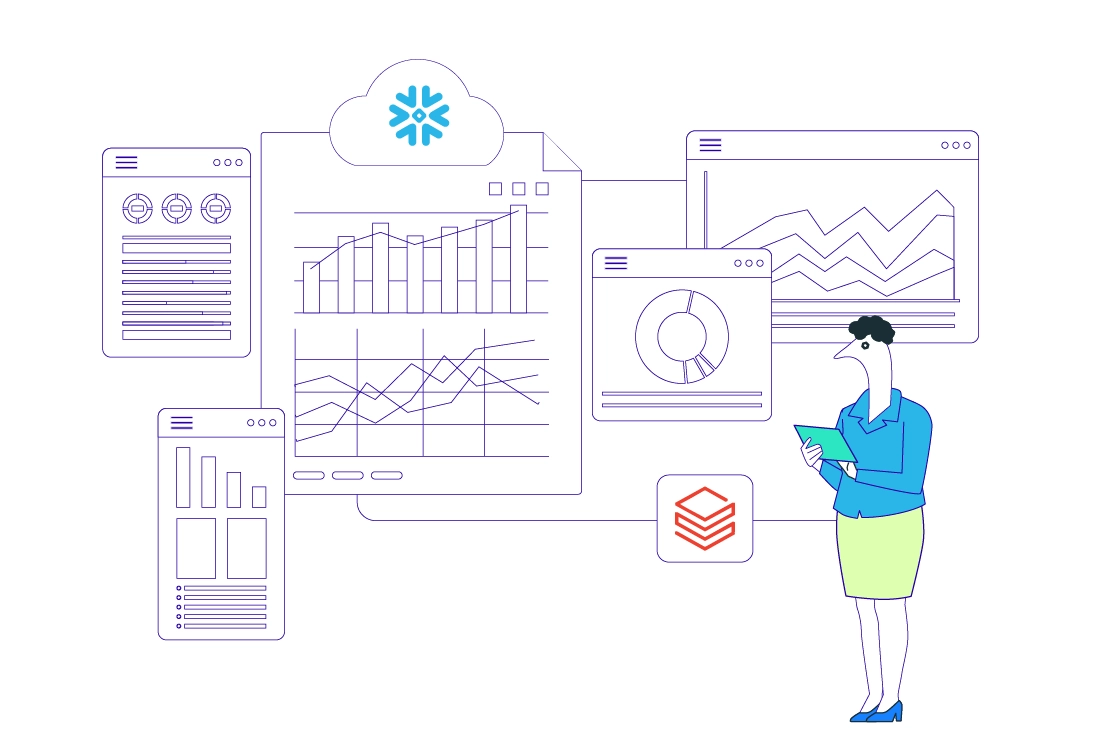
Understanding the Snowflake clean room
A Snowflake clean room is constructed on Snowflake Data Cloud. It uses SQL based analytics and native secure data sharing capabilities.
What makes Snowflake strong?
Snowflake is known for:
-
Seamless data sharing
-
Strong SQL performance
-
Built-in governance controls
-
Rapid partner onboarding
In the case of organizations that are already in operation in Snowflake, implementation can be easy.
Business impact
Problem: Secure partner collaboration requires tight governance.
How Snowflake helps: Native secure data sharing brings less friction to the operations.
Result: Faster partner activation and reduced setup time.
Marketing analytics and advertiser collaboration are areas where Snowflake clean rooms are especially attractive.
Databricks vs Snowflake: strategic comparison
For CXOs, the question is not feature comparison. It is aligned with business strategy.
| Decision Factor | Databricks Clean Room | Snowflake Clean Room |
|---|---|---|
| Architecture | Lakehouse (Unified Data + AI) | Cloud Data Warehouse |
| AI/ML Capability | Native and advanced | Strong but warehouse-centric |
| Data Types | Structured + Unstructured | Primarily structured |
| Governance | Unity Catalog | Native RBAC & policies |
When Databricks is the strategic choice
Choose Databricks if:
-
AI and advanced analytics are central to your roadmap
-
You work with different types of data.
-
You desire a single and cohesive data and ML ecosystem.
-
You seek to eliminate platform fragmentation.
When Snowflake makes sense
Choose Snowflake if:
-
Your company has a strong commitment to Snowflake.
-
Use cases are primarily SQL-based
-
Partner collaboration needs are structured and defined
The proper platform relies on the long-term data strategy, rather than the short-term convenience.
Key use cases explained
Let us look at practical scenarios.
Marketing attribution across partners
Problem: Privacy laws do not allow brands and agencies to share user-level data.
Solution: Clean room aggregates and anonymizes datasets securely.
Business result: Better campaign ROI and correct attribution.
This is supported by both Snowflake clean room and Databricks clean room. However, Databricks helps to facilitate more advanced ML modeling within the environment.
Financial fraud detection collaboration
Problem: Banks should identify fraud trends across organizations without disclosing the information of customers.
Solution: Secure data clean room with encrypted processing.
Business Result: Reduced fraud losses and stronger compliance posture.
Databricks is more flexible as far as ML-based anomaly detection is concerned.
Retail and supply chain optimization
Problem: The retailers and suppliers cannot coordinate inventory data safely.
Solution: Shared analytics environment without the exchange of raw data.
Business result: Reduced inventory expenses and enhanced forecast.
Snowflake can be used with structured inventory data. Databricks is more effective in the context of the IoT and real-time signals.
Implementation considerations for leaders
Choosing a platform is only half the battle. Execution defines ROI.
Governance design
Security architecture must be defined before deployment. The access control, encryption policy, and audit logging should be in accordance with the regulatory standards.
Cost management
Warehouse-based models have the ability to raise compute costs when collaboration is intense. Lakehouse models can save on duplication costs.
Integration strategy
The clean rooms should integrate with your existing data platform, identity management, and compliance tools. At this point, specialized data clean room implementation services, in particular, would be essential. Internal teams often underestimate integration complexity.
Midway check: is your organization ready?
Before deciding which company to select between Databricks and Snowflake, consider:
-
Is governance centralized?
-
Do we possess clear collaboration use cases?
-
Is AI central to our roadmap?
-
Are we aware of long-term computer expenses?
If these questions feel unclear, it may be time for a structured readiness review.
Short case study: before and after
Industry: Financial Services
Before:
-
Partner data interchange manually.
-
High compliance risk
-
Delayed fraud insights
After implementing a Databricks clean room:
-
The secure collaboration is automated.
-
30% faster fraud identification
-
Minimized compliance exposure.
It was not only about picking Databricks but it is about the governance being designed correctly in the first place.
Why expert-led implementation matters
Clean rooms are sensitive environments. An ill-defined system may even cause compliance risk as opposed to reducing it.
Professional data clean room implementation services ensure:
-
Architecture aligned to business goals
-
Secure partner onboarding
-
Audit-ready controls
For platform owners, this saves deployment time. For security leaders, it instills confidence.
Why BluEnt for Snowflake + Databricks clean rooms
BluEnt possesses extensive knowledge in Snowflake and Databricks ecosystems.
What differentiates BluEnt:
-
Strategic alignment with business KPIs.
Rather than pressurizing a single platform, BluEnt analyses your roadmap, collaboration model and risk. It is not about tools – but about quantifiable business outcomes.
Whether you need a Databricks clean room for AI-driven collaboration or a Snowflake clean room for structured partner analytics, BluEnt ensures secure, scalable implementation. The global data analytics market is undergoing an unprecedented expansion, valued at $82.2 billion in 2025, it is projected to soar to $402.7 billion by 2032, growing at a CAGR of 25.5%.
Close to an AI-oriented collaboration with Databricks clean room, or structured partner analytics with Snowflake clean room, BluEnt will ensure secure, scalable implementation.
Final decision framework
In case AI, machine learning, and centralized approach to data are the core of your long-term strategy, then Databricks offers stronger strategic alignment. If your collaboration needs are SQL-driven and you are already embedded in Snowflake, a Snowflake clean room may offer faster deployment.
Anyhow, clean rooms are no longer a luxury. They are becoming the basis of securing data monetization and compliance resilience.
Final decision framework
The next top decade will be characterized by data collaboration as a competitive advantage. The organizations that win will be those that combine privacy, governance, and analytics seamlessly.
A decision between Databricks and Snowflake is not a technical debate. It is a tactical move concerning how the organization will innovate securely.
The appropriate architecture supported by strong data clean room implementation services ensures:
-
Improved partner trust
-
Faster innovation cycles
-
Measurable ROI
When assessing the secure collaboration strategies, it is time to act and not to discuss.

 Microsoft Fabric for Enterprise ESG and Sustainability Intelligence
  Microsoft Fabric 2.0: The Future of Unified Analytics in a Multi-Agent AI World
  Why Traditional Data Migration Falls Short and How AI Is Changing the Approach
  How CFOs and CIOs Actually Evaluate Cloud Data Strategy: Cost, Risk, and ROI