











Short answer
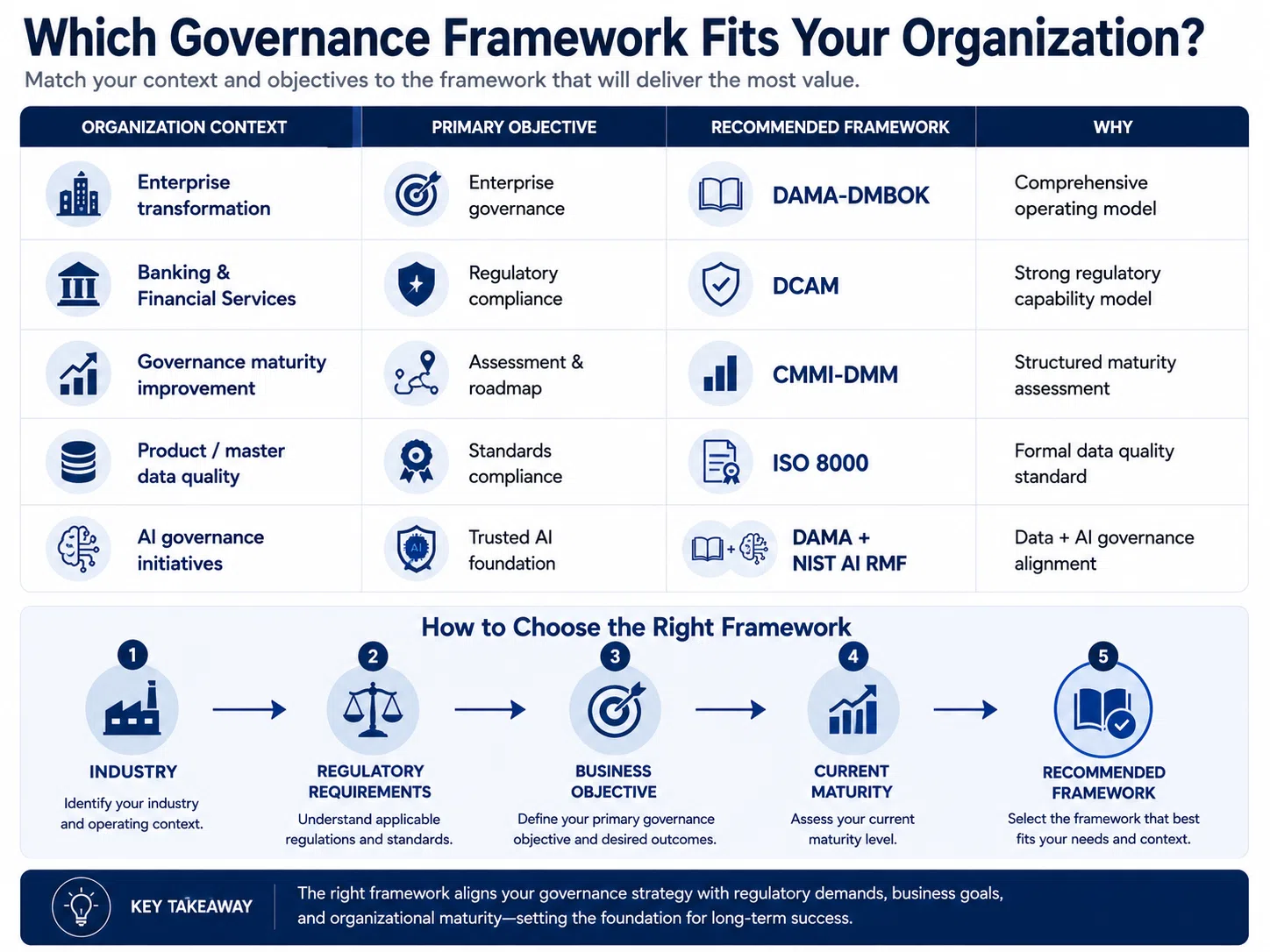
The four primary data governance frameworks are DAMA-DMBOK (broad data management, most widely adopted), DCAM (financial services and regulated industries, compliance-oriented), CMMI-DMM (maturity assessment and improvement roadmap focus), and ISO 8000 (data quality and master data, standards-compliance context). Framework selection should be driven by three factors: the regulatory environment the organization operates in, the primary governance objective (quality improvement, compliance, analytics enablement, or AI readiness), and the current maturity level. Tool selection follows framework choice: the framework determines what capabilities are required (catalog, quality, lineage, policy management), and technology evaluation should be conducted against those requirements. Organizations that reverse this sequence – tool first, framework second – frequently find that the tool they selected does not support the governance operating model they need.
The phrase “data governance framework” is used loosely in vendor marketing, analyst reports, and job descriptions, often to mean anything from a set of policies to a specific software platform. This imprecision creates real problems when organizations try to evaluate governance approaches: they compare things that are not comparable, select tools before they have defined what the tools need to do, and adopt frameworks that were designed for a different regulatory context or maturity level than their own.
Getting framework selection right is a sequencing problem before it is a content problem. The correct sequence is defining the governance objective, selecting the framework that matches that objective and context, derive the capability requirements from the framework, and then evaluating technology against those requirements. Most organizations encounter governance approaches in reverse order: a vendor demonstrates a platform; the platform capabilities shape the requirements, and the requirements are fitted to a framework after the fact.
This article provides the content for each step in the correct sequence: what the major frameworks are and when each is appropriate, how framework choice translates into technology requirements, and how to move from framework selection to an operating program.
Table of Contents:
What a Data Governance Framework Is (and What It Is Not) Defining the term, distinguishing frameworks from methodologies, and understanding what a framework gives you
Framework vs methodology vs platform
A data governance framework is a structured set of principles, knowledge areas, roles, and processes that define what data governance should accomplish, and how governance activities relate to each other. A framework is descriptive and prescriptive: it describes what good governance looks like and prescribes the components that need to be in place. DAMA-DMBOK, DCAM, CMMI-DMM, and ISO 8000 are frameworks in this sense. They are published by standards of bodies or professional associations; they are vendor-neutral, and they do not specify technology.
A governance methodology is a specific approach to implementing a framework: the sequence of steps, the templates, the workshop formats, the change management approach. Methodologies are how you put the framework into practice. They may be proprietary (a consulting firm’s implementation methodology) or open (DAMA’s recommended implementation guidance). A governance platform is a software product that automates and supports governance activities: cataloguing, quality monitoring, lineage tracking, policy management. Platforms implement governance capabilities; they do not define them. The confusion between these three – framework, methodology, platform – is the source of most governance implementation failures.
| 11 | DAMA-DMBOK organizes data management into 11 knowledge areas, with Data Governance at the center providing overarching accountability, policies, and decision rights that guide the other areas: Data Architecture, Data Modeling & Design, Data Storage & Operations, Data Security, Data Integration & Interoperability, Document & Content Management, Reference & Master Data, Data Warehousing & Business Intelligence, Metadata, and Data Quality. Source: DAMA International, DAMA-DMBOK 2.0 Revised, Data Management Body of Knowledge, 2024. |
|---|
What a framework actually gives you
A governance framework gives you three things. First, a shared vocabulary: the framework defines terms (data steward, data domain, data quality dimension, data lineage) in ways that allow a governance program to communicate consistently across business units, IT teams, and external partners without each team inventing its own definitions. Second, a completeness check: by specifying what a governance program should cover, the framework identifies gaps in an existing program that might otherwise remain invisible. Third, an alignment mechanism: when executives, governance teams, and auditors reference the same framework, they are evaluating governance performance against the same standard rather than against different implicit expectations.
A framework does not give you an implementation plan, a technology selection, a vendor recommendation, or a guarantee that governance will succeed. Those depend on program design, operating model decisions, and leadership commitment. The framework is the standard against which the program is designed, not the design itself.
Find the Right Governance Approach for Your Organization
Evaluate your governance maturity to identify gaps and determine which capabilities should be prioritized in your governance framework.
Data Governance Maturity Assessment
A structured diagnostic for CDOs, CIOs, and Chief Compliance Officers. 18 questions across six governance dimensions. Receive a scored maturity profile and prioritised recommendations.
Your Details
Your Assessment Results
Overall Governance Maturity Level
Receive Your Full Report
A BluEnt governance consultant will prepare a personalised report with specific recommendations for your highest-priority gaps. Book a 60-minute discovery call to discuss your findings.
The Four Major Frameworks: DAMA-DMBOK, DCAM, CMMI-DMM, and ISO 8000 What each covers, who published it, and which context it fits best
DAMA-DMBOK: the generalist framework
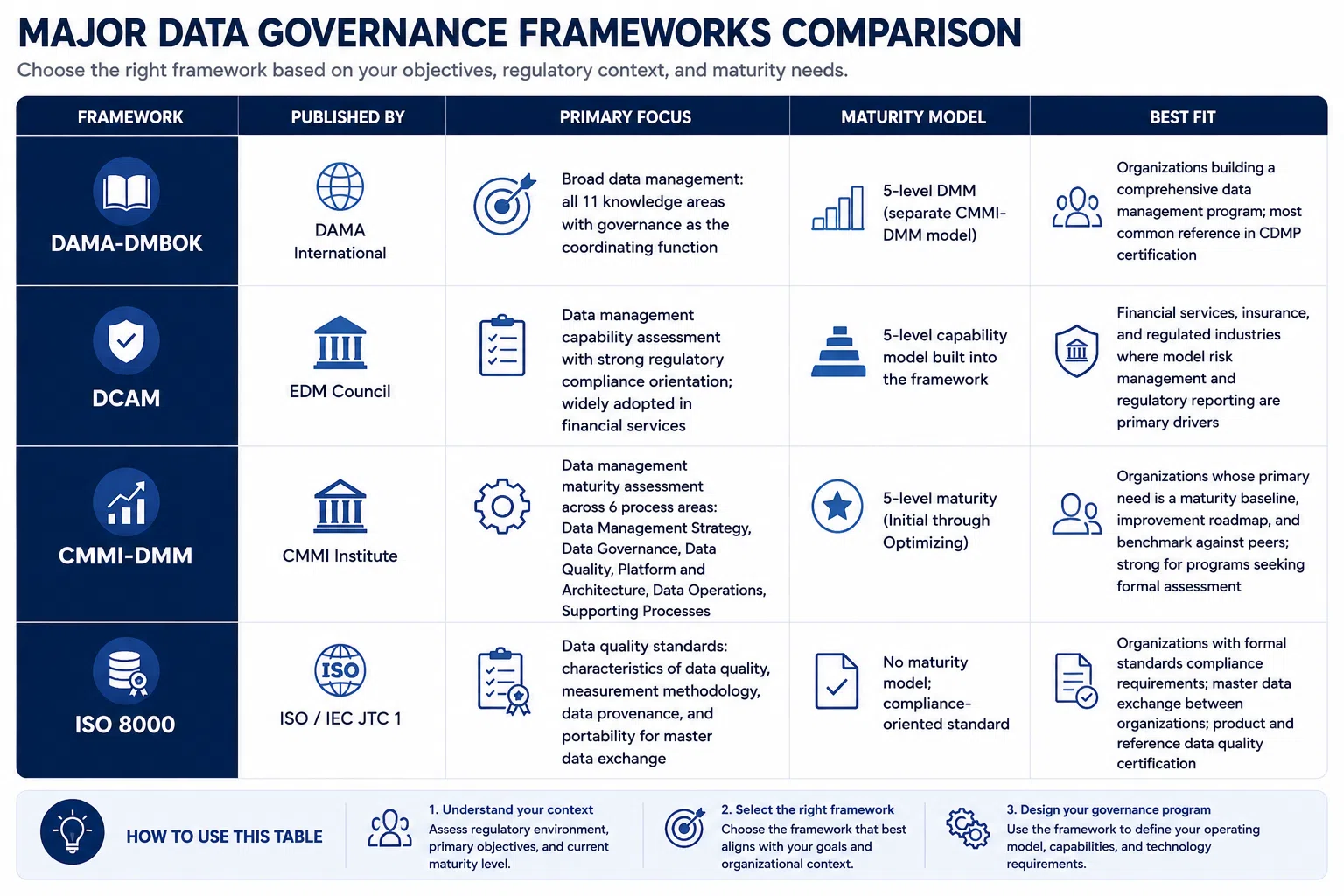
DAMA-DMBOK (Data Management Body of Knowledge) is the most widely adopted data management framework, published by DAMA International in its second edition of 2017. It defines 11 knowledge areas and positions Data Governance as the function that coordinates the other 10. It is the reference framework for the Certified Data Management Professional (CDMP) credential. DAMA-DMBOK is suitable for most organizations building a governance program from scratch because it is comprehensive, vendor-neutral, and not industry-specific. Its breadth is also its limitation: because it covers all data management, organizations need to scope their DMBOK-aligned program explicitly rather than implementing everything the framework describes.
DCAM: the financial services framework
DCAM (Data Management Capability Assessment Model) is published by the EDM Council and is the dominant governance framework in financial services, insurance, and asset management. It was developed in response to post-2008 regulatory demands for data quality, lineage, and model risk management, and it has strong alignment with BCBS 239 (Basel Committee on Banking Supervision Principles for Effective Risk Data Aggregation and Risk Reporting). DCAM is more prescriptive than DAMA-DMBOK about governance controls and capability requirements, which makes it easier to align with regulatory audit expectations. For organizations outside financial services, DCAM’s compliance orientation may be more restrictive than necessary.
CMMI-DMM: the maturity assessment framework
The CMMI Institute’s Data Management Maturity model is designed primarily as an assessment and improvement planning tool. It defines six process areas across five maturity levels and provides the structure for a formal maturity assessment that produces a scorecard, a gap analysis, and an improvement roadmap. The DMM is particularly useful for organizations that need to demonstrate their governance maturity to external stakeholders (regulators, auditors, acquirers) or that want a structured baseline before beginning a governance improvement program. It is less prescriptive about ongoing governance operations than DAMA-DMBOK or DCAM, because its primary output is an assessment, not an operating model.
From the field
The most consistent pattern in framework selection errors is organizations in regulated industries choosing DAMA-DMBOK when DCAM would be more appropriate, and general-purpose enterprises spending six months performing a CMMI-DMM maturity assessment when their actual need was to start governing data, not to document their current state. Framework selection should start with the primary governance objective: if the objective is regulatory compliance, DCAM or DAMA Chapter 11 (with explicit regulatory mapping) is the right anchor; if the objective is building an improvement roadmap to show executives, CMMI-DMM is the right structure; if the objective is building a comprehensive operating data management program, DAMA-DMBOK is the most complete starting point.
Choose the Right Data Governance Approach
Get expert guidance to select and implement a governance framework aligned with your organization’s data, regulatory, and business requirements.
How Framework Choice Shapes Technology Requirements The four tool categories and how the framework determines what you need from each
Governance technology falls into four categories: data catalogs, data quality platforms, data lineage tools, and policy management systems. These categories exist independently of any framework — but what your chosen framework requires from each category is determined by the governance objectives the framework is built around. A compliance-oriented framework like DCAM requires specific lineage and auditability capabilities that a quality-oriented framework like ISO 8000 does not prioritize in the same way. Selecting tools before the framework is finalized means selecting against the wrong requirements.
| Tool category | What it does | What the framework determines | Selection criteria |
|---|---|---|---|
| Stewardship coverage | Business glossary, data asset inventory, metadata management, classification, ownership assignment, certified data product tracking | DAMA-DMBOK: A comprehensive catalog across all 11 areas. DCAM: regulatory data inventory and lineage start point. CMMI-DMM: catalog completeness as a maturity indicator. ISO 8000: product data classification and provenance metadata. | Federation model (does it support domain-level stewardship?); glossary workflow (can domain owners manage definitions without IT?); certification workflow (can data products be formally certified?); API for integration with quality and lineage tools |
| Data Quality Platform | Quality rule definition, automated quality monitoring, alerting, quality scoring, remediation workflow, quality trend reporting | DAMA-DMBOK: quality across the six DAMA quality dimensions. DCAM: regulatory-grade quality controls with audit trail. CMMI-DMM: Quality measurement for maturity assessment. ISO 8000: Conformance to ISO quality characteristics and measurement methodology. | No-code rule authoring (can business stewards define rules?); scheduling flexibility (continuous vs batch vs trigger-based); integration with pipeline tools (Snowflake DMF, dbt tests, Spark); quality metric export for governance scorecard reporting |
| Data Lineage | End-to-end data flow documentation, column-level lineage, transformation capture, impact analysis, compliance lineage for regulatory reporting | DAMA-DMBOK: lineage as component of metadata and architecture management. DCAM: lineage for BCBS 239 compliance and regulatory data aggregation. CMMI-DMM: lineage documentation as a process maturity indicator. ISO 8000: Provenance Chain for master data quality certification. | Automated discovery vs manual documentation (automated is critical for large estates); column-level granularity for regulatory lineage; integration with catalog (does lineage surface in the catalog?); impact analysis for change management |
| Policy Management | Policy authoring, version control, approval workflow, policy assignment to data assets, exception management, policy compliance monitoring | DAMA-DMBOK: policy framework across all data management areas. DCAM: regulatory control documentation and evidence management. CMMI-DMM: policy maturity indicators. ISO 8000: standards compliance documentation. | Integration with catalog (are policies linked to data assets in the catalog?); workflow for cross-domain policy changes (does it support the Governance Council approval process?); audit trail (are policy changes and exceptions logged?); regulatory mapping (can policies be tagged to specific regulations?) |
Note: Most large enterprise governance platforms (Collibra, Alation, Atlan, Microsoft Purview, IBM Knowledge Catalog) are primarily data catalog products with varying degrees of native quality, lineage, and policy management capability. Best-of-breed approaches use a specialized catalog plus a specialized quality platform plus automated lineage discovery. Integrated platform approaches sacrifice depth in individual categories for reduced integration complexity. The right choice depends on the organization’s integration overhead tolerance, existing data stack, and governance maturity stage. Verify vendor technical documentation for current capability boundaries before selection, as product capabilities in this space change frequently.
Recommended Reading:
Implementation Sequencing: Framework to Running Program Moving from framework selection to an operating governance program without the most common mistakes
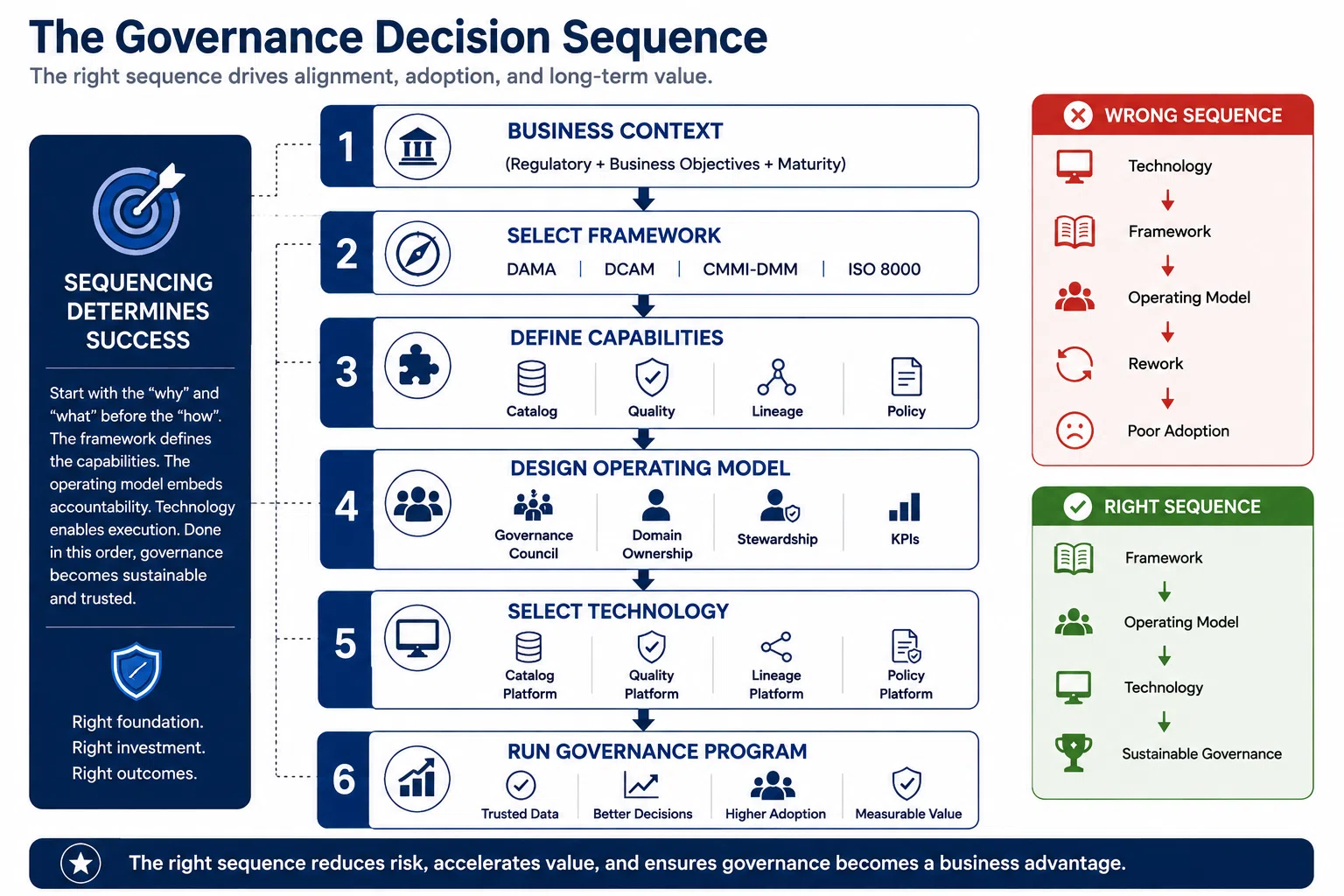
Framework selection (weeks 1-4)
Framework selection should be a deliberate four-week activity, not a default choice. The selection inputs are the regulatory environment (financial services and BCBS 239 obligations point toward DCAM; general enterprise points toward DAMA-DMBOK; formal maturity assessment requirement points toward CMMI-DMM); the primary governance objective (compliance, quality improvement, analytics enablement, or AI readiness); and the current maturity stage. The output is a selected framework with documented rationale, including what the framework does not cover and how those gaps will be addressed. Skipping this rationale creates drift later when program decisions need to be justified.
Scope and domain prioritization (weeks 4-8)
No governance program should attempt to govern all data simultaneously. Scope prioritization identifies the data domains and data assets where governance investment will produce the highest business value or reduce the most significant risk. The prioritization inputs are regulatory obligations (certain data must be governed for compliance), strategic analytics dependencies (data that is required for the analytics use cases the business has committed to), and quality incident history (domains with repeated data quality failures). The output is a Tier 1 domain list (govern first), Tier 2 list (govern within 12 months), and Tier 3 list (monitor but do not invest heavily yet).
Operating model design (weeks 8-12)
Operating model design defines the governance leadership structure, the Data Governance Council charter, domain ownership assignments, stewardship role definitions, policy framework structure, and KPI measurement approach. This phase produces the governance operating model document, which is the foundational reference for program operation. Technology selection cannot be finalized before operating model design is complete, because the operating model determines what workflow, access control, and integration requirements the technology must support. This is the most common sequencing error: technology selection beginning in parallel with or before operating model design.
Technology selection and deployment (weeks 12-24)
Technology selection should begin with a requirements document derived from the framework choice and the operating model. The requirements should specify what each of the four tool categories needs to do for this specific program, not generic feature lists. Vendor evaluation should include proof-of-concept testing against actual data domains and actual governance workflows, not just demonstration environments. Deployment should be phased: Tier 1 domains first, quality monitoring before catalog completion, lineage discovery before manual lineage documentation. Platform deployment before the stewardship model is operational is a significant risk: the technology creates the expectation of governance but without the operational model to maintain it, catalog quality degrades rapidly.
Program operation and measurement
Program operation begins with the KPI baseline established before governance investment changes the metrics, following the measurement framework. Quarterly governance scorecard reporting to the C-suite uses outcome KPIs from day one. Operational KPIs are reported monthly to the CDO and domain owners. The Data Governance Council meets monthly from the first month of operation, not from whenever the governance program feels “ready.” A council that starts meeting only after the technology is deployed has missed the cross-domain coordination function for the duration of deployment, which is often when the most important cross-domain decisions need to be made.
Note: The single most common implementation of sequencing error, in BluEnt’s experience working with governance programs across industries, is beginning technology selection before completing the operating model design. The technology selection drives the operating model rather than the operating model driving the technology selection. The result is a governance program shaped around what the chosen platform does rather than what the organization needs governance to accomplish. Operating model design must be complete before vendor RFPs are issued.
The bottom line
Framework selection is the first real governance decision, and it shapes everything that follows: the operating model design, the technology requirements, the KPI structure, and the regulatory alignment story. Getting it right requires treating it as a deliberate decision with documented rationale, not as a default to whichever framework a vendor or consultant brought up first.
-
DAMA-DMBOK is the most comprehensive starting point for general-purpose enterprise governance; DCAM is the right anchor for financial services and regulated industries; CMMI-DMM is best when a formal maturity baseline is the primary output needed.
-
Framework choice must be completed before operating model design, and operating model design must be completed before technology selection.
-
Governance technology falls into four categories (catalog, quality, lineage, policy management); the framework determines what depth is required from each.
-
Technology before framework produces governance programs shaped by what the platform does rather than what the organization needs governance to accomplish.
-
Initial program operation for Tier 1 domains is achievable in six to nine months with adequate executive sponsorship and available stewardship capacity.
The organizations that build the most durable governance programs are not the ones that are selected as the most sophisticated platform. They are the ones that made the framework decision deliberately, designed the operating model before buying software, and governed a small number of critical domains well before expanding scope.
Select the right governance framework and build the program that lasts
BluEnt works with CDOs and enterprise data teams to evaluate governance frameworks, design operating models, define technology requirements, and implement governance programs aligned to regulatory obligations and strategic objectives. We bring practitioner experience across DAMA-DMBOK, DCAM, and NIST AI RMF implementations across financial services, healthcare, manufacturing, and technology sectors.
Common Questions What CDOs and governance leads ask when evaluating frameworks and selecting governance technology
Do we need to implement an entire framework, or can we use parts of it?You can and should scope your implementation of any framework to the area’s most relevant to your current objectives and maturity stage. DAMA-DMBOK explicitly states that organizations should scope their data management program based on their specific context. The value of a framework is not in implementing all of it simultaneously, but in having a complete reference that tells you what you are not yet governing. A well-scoped DAMA-DMBOK implementation might focus initially on Chapters 2 (Data Governance) and 13 (Data Quality) and defer the remaining knowledge areas until the foundational program is stable. DCAM similarly can be implemented at the process area level, prioritizing the capability areas most relevant to the organization’s immediate regulatory obligations. Use the framework as a completeness reference and implementation road map, not as a deployment checklist.
What is the relationship between DAMA-DMBOK and DCAM?DAMA-DMBOK and DCAM are complementary rather than competing frameworks, and some organizations use both. DAMA-DMBOK provides a comprehensive data management knowledge area structure that covers the full scope of data management practice. DCAM provides a capability maturity model with stronger regulatory compliance orientation and more prescriptive control requirements. In financial services organizations that need both a comprehensive data management framework and regulatory compliance alignment, a DAMA-DMBOK-grounded operating model with DCAM capability assessment is a common combination. For general-purpose enterprises without strong financial services regulatory obligations, DAMA-DMBOK alone is typically sufficient. DCAM’s regulatory control specificity adds complexity that is not necessary outside regulated financial services contexts.
How do we choose between a single integrated platform and best-of-breed tools?The integrated platform versus best-of-breed decision depends primarily on two factors: the organization’s integration overhead tolerance and the depth of capability required in each tool category. An integrated governance platform (such as Collibra, Microsoft Purview, or Atlan) provides a single vendor relationship, a unified data model across catalog, lineage, and policy, and lower integration complexity. Best-of-breed combinations (a dedicated catalog, a dedicated quality platform, automated lineage discovery) typically provide greater depth in each category but require integration investment and multi-vendor management. Organizations with limited governance engineering capacity and moderate capability requirements across all four categories often do better with an integrated platform. Organizations with high data volumes, complex quality requirements, or strict regulatory lineage needs often find that integrated platforms do not provide sufficient depth in quality or lineage and need a best-of-breed approach. Verify current platform capabilities directly with vendors before selection, as this market evolves rapidly.
Can we implement a governance framework without a dedicated governance platform?Yes. Many organizations run effective governance programs with a combination of existing enterprise tools (Confluence or SharePoint for policy and glossary, JIRA or ServiceNow for stewardship workflows, existing BI platform metadata for catalog functions) at early maturity stages. A dedicated governance platform is most valuable when the organization’s data estate has grown beyond what manually maintained documentation can cover accurately, when stewardship workflows require automation and accountability tracking at scale, or when regulatory lineage requirements need automated end-to-end lineage discovery rather than manually documented lineage maps. Implementing a governance platform before the operating model is stable is a significant risk: the platform creates infrastructure that requires ongoing maintenance, and if the operating model changes significantly after deployment, the platform configuration may need to be substantially reworked.
How long does governance framework implementation typically take?A governance program that follows the recommended five-phase sequence — framework selection, scope and domain prioritization, operating model design, technology selection and deployment, and program operation — typically reaches initial operational status within six to nine months for Tier 1 domains. A cross-enterprise program covering all major data domains typically takes 18 to 24 months to reach consistent operational maturity. These timelines assume adequate executive sponsorship, named domain owners, available stewardship capacity, and a technology selection completed within the Phase 4 window. Programs that encounter delays in executive sponsorship (the most common cause of timeline extension) or that begin technology selection before completing operating model design typically take significantly longer and often require a partial restart when operating model decisions force platform reconfiguration.
What is the right governance framework for an organization building an AI governance program?AI governance programs benefit from the intersection of two frameworks rather than a single choice. NIST AI RMF 1.0 (January 2023) provides the AI-specific governance structure: the four functions (Govern, Map, Measure, Manage) and the AI risk taxonomy. DAMA-DMBOK provides the data governance foundation that AI governance depends on the data quality, lineage, catalog, and stewardship infrastructure that determines whether AI models can be trained on trusted data and whether their outputs can be traced to their data sources. Organizations building AI governance programs should implement the NIST AI RMF for the AI model lifecycle and risk management layer, grounded in a DAMA-DMBOK-aligned data governance program for the data foundation layer. ISO/IEC 42001:2023 (AI Management Systems) provides additional structure for organizations that need a certifiable AI management standard.

 Governing AI Tools in AEC: Copilot, Digital Twins, and Generative Design
  Data Governance for AI and Advanced Analytics: Building the Foundation That Works
  Centralized vs. Federated vs. Hybrid Data Governance: Which Model Fits Your Organization
  Data Governance Roles and Responsibilities in AEC Organizations