











Short answer
Automated data lineage tools capture data flows through SQL parsing, native platform APIs (dbt manifest, Spark query plans, Snowflake and Databricks connectors), and OpenLineage-standard instrumentation. The right tool depends on the primary use case: compliance lineage (column-level, regulatory audit trail) requires different capabilities than pipeline debugging (job-level, execution context) or impact analysis (forward lineage, change propagation). Tool selection should be driven by a requirements document derived from the two or three use cases the organization will activate in the first 12 months, not by a feature checklist. Deployment succeeds when lineage is connected to the data catalog, allowing stewards and analysts to access it in context, and when new pipelines are instrumented by default, so lineage remains current without manual maintenance. Lineage deployed as a standalone discovery tool that is not integrated with the data catalog or stewardship workflows consistently becomes shelfware within a year of deployment.
The typical automated lineage deployment story goes like this. A data engineering team evaluates three or four lineage tools, selects one that produces impressive pipeline diagrams in the proof of concept, negotiates a contract, and spends two months connecting sources. At the end of the connection phase, they have a lineage graph covering most of their Snowflake and dbt environment. It is accurate. It is visually compelling. Three people on the data platform team know how to use it.
Six months later: the dbt project has been refactored twice, and the lineage covers the old structure. Several new pipelines were built in Python and are not in the lineage graph at all. The compliance team tried to use it for an audit and found that the column-level lineage stops at the data warehouse boundary. The catalog integration was scoped out of the initial deployment to hit the deadline and has not been picked up. The data stewards who were supposed to use it for impact analysis were never trained on it.
None of this is caused by a bad tool selection. It is caused by deploying lineage as a discovery project rather than as operational infrastructure. This article covers what automated lineage tools can and cannot do, how to select against the use cases that matter, and how to deploy so that the lineage stays current and gets used.
Table of Contents:
How Automated Lineage Tools Work: The Four Capture Methods SQL parsing, native platform APIs, OpenLineage instrumentation, and agent-based discovery
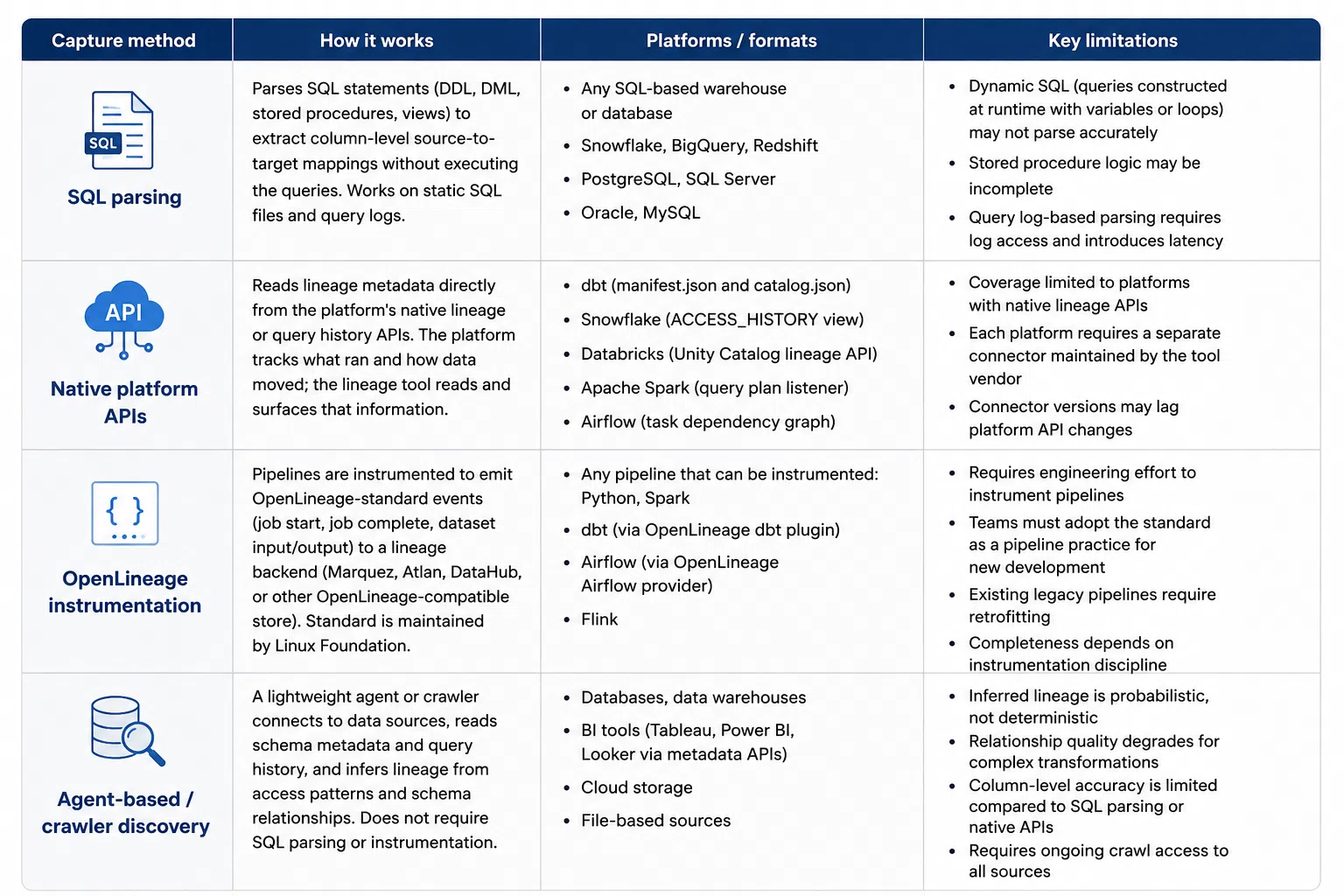
Most production lineage deployments use a combination of methods: SQL parsing for historical query-based lineage in the warehouse, native platform APIs for dbt and Spark pipelines, and OpenLineage instrumentation for new pipeline development going forward. Selecting a tool that supports only one method will produce coverage gaps for the portions of the data estate that method does not reach.
| 4 | DAMA-DMBOK 2nd Edition defines four categories of enterprise metadata: Business Metadata, Technical Metadata, Operational Metadata, and Reference Metadata. Data lineage is classified as Technical Metadata, alongside physical data models, system interfaces, and ETL job metadata. Integrating lineage with the broader metadata program, particularly the Business Metadata in the data catalog, is what makes it useful for governance, not just for engineering. Source: DAMA International, DAMA-DMBOK 2nd Edition, Chapter 12: Metadata Management, 2017 |
|---|
Is Your Data Governance Ready for Automated Lineage?
Assess your governance maturity across metadata, ownership, data quality, and traceability to identify gaps before deploying lineage tools
Data Governance Maturity Assessment
A structured diagnostic for CDOs, CIOs, and Chief Compliance Officers. 18 questions across six governance dimensions. Receive a scored maturity profile and prioritised recommendations.
Your Details
Your Assessment Results
Overall Governance Maturity Level
Receive Your Full Report
A BluEnt governance consultant will prepare a personalised report with specific recommendations for your highest-priority gaps. Book a 60-minute discovery call to discuss your findings.
What Automated Lineage Cannot Capture The persistent documentation gaps and how to address them
The four manual documentation gaps
Automated lineage tools capture what flows through instrumented, parseable, or API-accessible systems. They do not capture what happens outside those systems. In most enterprise environments, four categories of data movement are consistently outside the reach of automated lineage tools and require manual documentation or process controls to address.
-
Spreadsheet transformations: Data extracted from a governed system, modified in Excel, and loaded back into a reporting system. This is the most common lineage break in practice and the most difficult to address automatically. The manual adjustment happens outside the lineage tool’s scope. Process controls, such as requiring all spreadsheet-based adjustments to be logged in a catalog-linked exception record with the before-and-after values and the approver, are the only practical mitigation for organizations that cannot eliminate spreadsheet transformations entirely from their data pipelines.
-
Custom Python scripts without OpenLineage instrumentation: Python transformations that do not emit OpenLineage events and are not parsed by SQL parsers are invisible to most lineage tools. The mitigation is to adopt OpenLineage instrumentation as a mandatory pipeline standard for all new Python-based pipeline development and to retrofit critical existing pipelines as a prioritized backlog item. For this purpose, critical refers to pipelines that carry regulated data, produce outputs used in regulatory reports, or feed downstream AI models.
-
API-to-API data flows: Data transferred between systems through REST APIs without passing through a monitored data platform. This is common in operational data flows between SaaS applications and is rarely captured by lineage tools unless the API integration layer, such as an iPaaS platform or event streaming system, emits lineage metadata. For compliance purposes, API-to-API flows involving regulated data should be documented in the Article 30 processing register and the data catalog, even when automated lineage cannot capture them.
-
Business context and semantics: Automated lineage tools capture technical data flows but not the business meaning behind those flows. For example, which transformation applies to a regulatory business rule? Which aggregation produces a metric with a defined compliance meaning? Which join enforces a consent filter to ensure personal data is used only for its authorized purpose? These semantic annotations must be added by data stewards in the data catalog because they cannot be inferred from technical lineage.
From the field
The most practically impactful lineage gap is Python pipelines without OpenLineage instrumentation, and the most tractable fix is making OpenLineage instrumentation a standard part of the pipeline template that engineers use for all new development. When instrumentation is built into the starting template, every new Python pipeline emits lineage events automatically, without requiring engineers to instrument individually. The cost is near zero for new pipelines. The payoff is that the lineage graph grows with the pipeline estate rather than falling behind it. The mistake is treating instrumentation as a retrofit project for existing pipelines rather than a default for new ones.
Choose the Right Data Lineage Approach
Evaluate your data environment and implement a lineage strategy aligned with your governance, compliance, and business requirements.
Selecting Against Use Cases, Not Feature Lists The four lineage use cases, required capabilities, and the evaluation questions that reveal whether a tool delivers
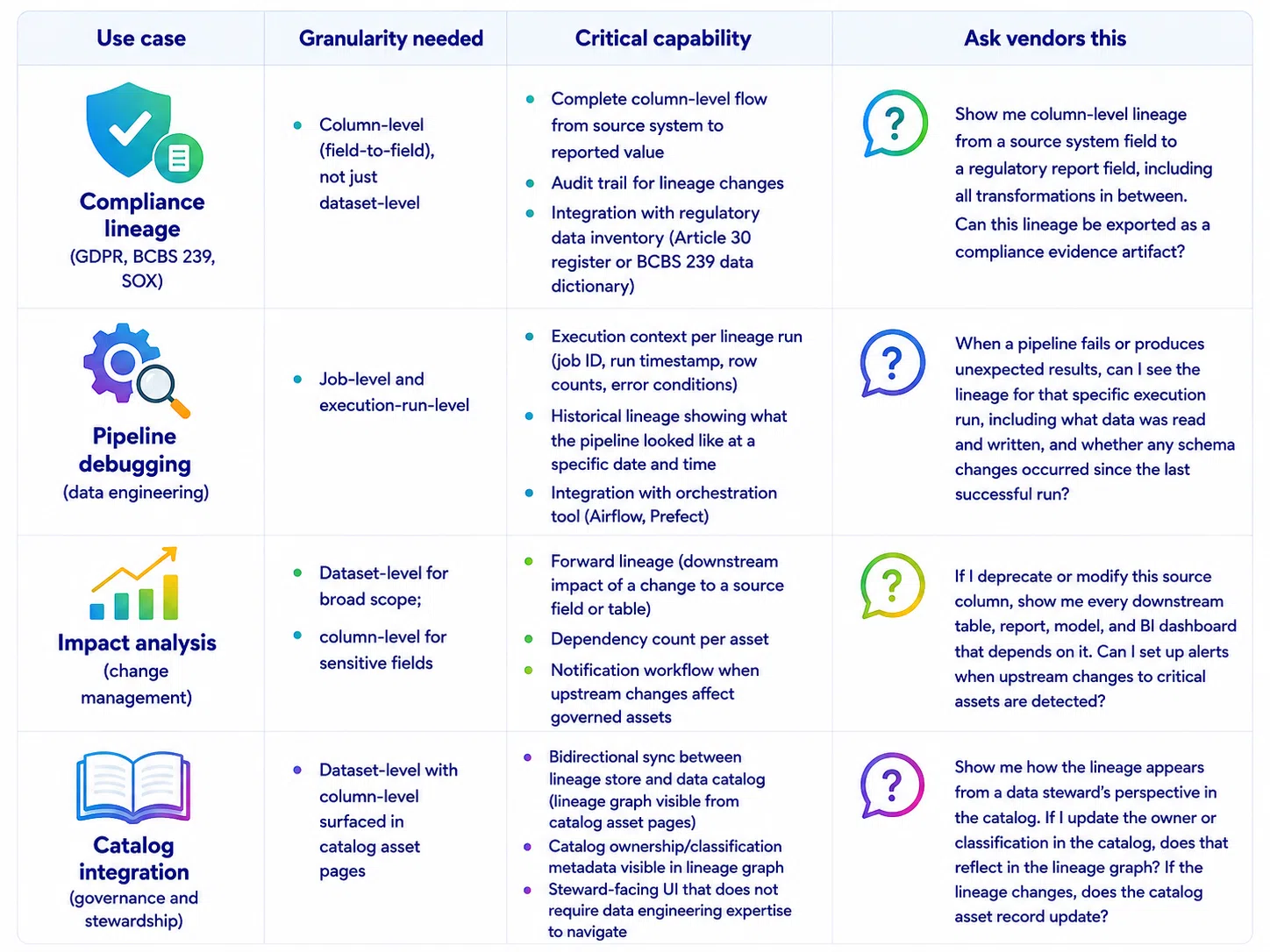
Note: Vendor demonstrations almost always show the best-case scenario: a clean, well-instrumented environment with full column-level lineage across a small number of well-connected sources. Before selecting a tool, run a proof of concept against your actual environment: your specific Snowflake query complexity, your actual dbt project structure, your Python pipelines. Ask the vendor to demonstrate column-level lineage through a complex transformation (a multi-step aggregation with CTEs and window functions), not a simple SELECT statement. The difference between what a tool demonstrates and what it delivers in a complex production environment is where most lineage tool disappointments originate.
Recommended Reading:
Deployment Sequencing: From Connection to Active Use The five phases that produce lineage people use, and the anti-patterns that produce shelfware
Connect and discover (weeks 1-4)
Connect the tool to the primary data platforms (typically the data warehouse and the primary transformation layer: dbt, Spark, or both) and run the initial discovery. The output of Phase 1 is a lineage graph covering the connected sources. Resist the temptation to connect every source immediately because connecting all sources at once produces a large, partially inaccurate graph that is difficult to validate and discourages trust in the lineage. Connect Tier 1 data domain sources first, validate the lineage for those sources, and expand from there.
Validate and scope (weeks 4-8)
Validate the lineage accuracy for the connected sources by tracing three to five known data flows manually and comparing them against the automated lineage output. Identify the manual documentation gaps (Python pipelines, spreadsheet transformations, and API flows) and decide how each will be addressed through instrumentation, process controls, or documented acceptance of the gap. Define the scope of the first active use case, such as compliance lineage or impact analysis, that will be activated in Phase 4 and confirm that the tool’s coverage is sufficient before proceeding.
Catalog integration (weeks 8-14)
Integrate the lineage tool with the data catalog so that lineage is visible from catalog asset pages and catalog ownership and classification metadata is visible within the lineage graph. This phase is the one most commonly removed under time pressure and is also the single most important integration for governance value. Lineage without catalog integration is accessible only to the data engineering team that can navigate the lineage tool directly. Lineage surfaced through the data catalog is accessible to data stewards, compliance teams, and analysts, enabling them to answer governance questions without relying on a data engineering intermediary. Skipping Phase 3 is the most common cause of lineage shelfware.
Use case activation (weeks 14-20)
Activate the first defined use case with the stakeholder audience that will use it. For compliance lineage, this means showing the compliance team how to trace a regulatory data flow and export the lineage as a compliance evidence artifact. For impact analysis, this means training data stewards and architects to perform an impact analysis before making a schema change. For pipeline debugging, this means integrating lineage access into the data engineering team’s incident response runbook. Use case activation is not simply a training session. It is the point at which lineage becomes part of an existing operational workflow rather than a capability that users may or may not adopt in the future.
Instrumentation as standard (ongoing)
Establish OpenLineage instrumentation as the default standard for all new Python pipeline development by incorporating it into the pipeline template. Establish a quarterly lineage coverage review that identifies new data flows added since the previous review that are not represented in the lineage graph and routes them to the appropriate capture method (SQL parsing, native API connection, or OpenLineage instrumentation), or documents them as accepted gaps. The quarterly review prevents lineage drift, which is the gradual accumulation of undocumented data flows that makes the lineage graph progressively less representative of the actual data estate.
The bottom line
Automated lineage tools solve the discovery problem well. They do not solve the maintenance problem, the integration problem, or the adoption problem automatically. Those require deployment discipline: defining the use cases before selecting the tool, completing the catalog integration before activating governance use cases, and establishing instrumentation as a pipeline standard so the lineage grows with the estate rather than falling behind it.
-
Select against two or three specific use cases with documented capability requirements, not against a generic feature list
-
The four capture methods (SQL parsing, native platform APIs, OpenLineage, agent-based) each have coverage gaps; most production deployments use a combination
-
Spreadsheets, uninstrumented Python, API flows, and business context are the four gaps that automated tools cannot close
-
Phase 3 catalog integration is the most important deployment step for governance value and the one most commonly deferred under time pressure
-
OpenLineage instrumentation built into the pipeline template from the start is the most cost-effective lineage freshness strategy
-
Quarterly lineage coverage reviews prevent the gradual staleness that turns accurate lineage into misleading lineage
The difference between a lineage investment that delivers value and one that becomes shelfware is not which tool was selected. It is whether the deployment was sequenced to produce active use cases, and whether the organization committed to the ongoing maintenance practices that keep lineage current after day one.
Deploy lineage that stays current and gets used
BluEnt works with data engineering teams and governance leads to evaluate automated lineage tools against specific use cases, design deployment sequences that integrate lineage with data catalogs, instrument pipelines to the OpenLineage standard, and establish the quarterly coverage review practices that prevent lineage drift.
Common Questions What data engineering leads and governance teams ask about lineage tools
What is the difference between dataset-level lineage and column-level lineage, and when do we need each?Dataset-level lineage documents that table A is an input to table B, without specifying which columns in A contribute to which columns in B. Column-level lineage (also called field-level or attribute-level lineage) documents the specific column-to-column relationships, including the transformation logic applied. Dataset-level lineage is sufficient for impact analysis (knowing that a change to table A will affect table B is enough to trigger a review) and for general data flow documentation. Column-level lineage is required for regulatory compliance use cases where auditors need to trace a specific field value from its origin through every transformation to its appearance in a regulatory report. BCBS 239 risk data aggregation, GDPR personal data flow documentation, and SOX financial data traceability all require column-level lineage. If compliance lineage is a primary use case, column-level capability should be a hard requirement in tool selection, not a nice-to-have.
What is OpenLineage and should we build our lineage strategy around it?OpenLineage is an open standard for lineage metadata collection, maintained by the Linux Foundation. It defines a common specification for how pipelines emit lineage events (job start, job complete, dataset input and output) and how those events are consumed by compatible lineage backends. The practical value of building around OpenLineage is portability: a pipeline instrumented to the OpenLineage standard can send lineage data to any OpenLineage-compatible backend, which means switching lineage platforms does not require re-instrumenting pipelines. Major data tools including Airflow, dbt, and Spark have OpenLineage providers or plugins maintained by the open-source community. For organizations building new data platform infrastructure, adopting OpenLineage as the default pipeline lineage standard from the start avoids vendor lock-in and produces a lineage foundation that persists across tool changes. For organizations with existing non-instrumented pipelines, the migration cost to OpenLineage instrumentation is real and should be phased against the coverage gaps that instrumentation would close.
How do we keep lineage current as the data estate changes?Lineage staleness is the primary reason lineage investments fail to deliver long-term value. Three practices keep lineage current. First, instrumentation as a pipeline development standard: all new pipelines emit OpenLineage events by default, so new flows are captured automatically without requiring a separate lineage discovery step. Second, a quarterly lineage coverage review: a structured review that compares the current lineage graph against known data flows (from the data catalog, the architectural inventory, or change management records) and identifies gaps. Third, CI/CD integration for SQL and dbt changes: lineage tools that integrate with the dbt CI/CD pipeline can detect column-level changes during the pull request review process and flag downstream impacts before they are deployed. This turns impact analysis from a retrospective investigation into a proactive change management step.
Can we use a data catalog’s built-in lineage instead of a dedicated lineage tool?Many data catalog platforms (Microsoft Purview, Collibra, Atlan, Alation) include built-in lineage capabilities. Built-in catalog lineage is well-suited for organizations where the catalog is the primary governance interface and the lineage use cases are primarily governance-oriented: impact analysis, compliance documentation, steward-facing data flow visibility. Dedicated lineage tools typically offer greater depth for data engineering use cases: more granular execution-run-level lineage, tighter integration with orchestration tools, and more advanced SQL parsing for complex transformations. The choice depends primarily on the lineage use case priority: if the primary audience is data stewards and compliance teams using the catalog, built-in catalog lineage is often sufficient. If the primary audience is data engineers debugging pipelines or compliance teams requiring deep column-level regulatory traceability, a dedicated lineage tool integrated with the catalog is more likely to deliver the required depth. Verify current built-in lineage capabilities with your catalog vendor before making the decision, as this feature area is evolving rapidly across all major platforms.
How do lineage tools handle multi-cloud and hybrid data estates?Multi-cloud and hybrid data estates (Snowflake on AWS, Databricks on Azure, legacy Oracle on-premises, and SaaS applications) present the most challenging lineage coverage problem because each environment requires a different capture method and different connector support from the lineage tool. In practice, coverage is determined by the availability of connectors: most commercial lineage tools have strong coverage for the major cloud data platforms and limited or no coverage for niche on-premises databases and SaaS applications. For hybrid environments, a pragmatic approach is to achieve full lineage coverage for Tier 1 and Tier 2 data domains (the governed domains with the most significant compliance and quality obligations) using the available connectors, and to document Tier 3 data flows and legacy system lineage manually in the catalog until connector support becomes available or migration to a connectable platform occurs. Trying to achieve 100% automated lineage coverage across a heterogeneous estate before activating governance use cases is a scope that consistently delays value delivery.

 Governing AI Tools in AEC: Copilot, Digital Twins, and Generative Design
  Data Governance for AI and Advanced Analytics: Building the Foundation That Works
  Centralized vs. Federated vs. Hybrid Data Governance: Which Model Fits Your Organization
  Data Governance Roles and Responsibilities in AEC Organizations