











Most organizations fail in their data governance efforts not because of the absence of tools or outlay, but because of the absence of accounting responsibility at both business and IT operations as well as the strategic challenge of identification of the decision maker.
Due to the growing size of data, analytic, and artificial intelligence programs in enterprises, the lack of a formal decision-making authority introduces delays, ownership, and non-uniform policy implementation. That is where Data Governance Council Framework can be of paramount importance not as a compliance tool, but a strategic leadership tier, which correlates data initiatives with business performance.
As the global data governance market is estimated to expand by thousands of billions in the coming decade, organizations that entrench sound governance leadership frameworks are in better positions to reap in value in data whilst mitigating and addressing regulatory and operational risks.
The market is projected to grow from USD 5.38 billion in 2026 to USD 24.07 billion by 2034. A governance council will offer leadership oversight, ownership disputes and match governance initiatives with business interests.
For CIOs, CDOs, and risk leaders, the question is no longer whether to establish a governance council—but how to design one that drives measurable business impact.
Table of Contents:
- Introduction
- Why a Data Governance Council Matters
- What is a Data Governance Council
- Core Elements of a Data Governance Council Framework
- Best Practices for Establishing a Governance Council
- Governance Council Roles and Responsibilities
- Governance Council and Enterprise Data Strategy
- Why Enterprises Partner with BluEnt
- Conclusion
- FAQs
The development of effective enterprise data councils is the key to developing trusted data environments that aid analytics, compliance, and digital transformation, which is necessary for CIOs, CDOs, and governance leaders.
Why a Data Governance Council Matters
The failure of governance initiatives is common when policies are provided without the mechanisms of enforcement or matching of leaders. The solution to this is presented by a governance council, which is the central decision maker on enterprise data.
The formal governance structure that supports data quality, accelerated decisions, and enhanced regulatory compliance is revealed in organizations with formal governance structures according to the industry standards like the DAMA-DMBOK and the data governance framework provided by Gartner.
A well-established governance council enables:
-
Clear ownership and accountability across data domains
-
Faster resolution of cross-functional data issues
-
Alignment between governance initiatives and business priorities
-
Regulatory compliance anddata risk management
-
Increased adoption of governance policies across teams
Business Impact Insight:
Companies that have a well-structured leadership in terms of governance usually minimize inefficiencies related to data and delays in one-time reporting, which directly affect working performance and decision-making timeliness.
Data Governance Maturity Assessment
A structured diagnostic for CDOs, CIOs, and Chief Compliance Officers. 18 questions across six governance dimensions. Receive a scored maturity profile and prioritised recommendations.
Your Details
Your Assessment Results
Overall Governance Maturity Level
Receive Your Full Report
A BluEnt governance consultant will prepare a personalised report with specific recommendations for your highest-priority gaps. Book a 60-minute discovery call to discuss your findings.
What is a Data Governance Council
A data governance council is an interdepartmental management team that manages to drive governance policies, governance implementation, and coordinate governance activities to data governance implementation strategy.
The council is one of the major entities of the data governance organizational model and offers strategic governance program oversight.
The general governance council roles include:
-
Defining enterprise governance priorities
-
Approving governance policies and standards
-
Overseeing data ownership and stewardship models
-
Monitoring governance maturity and adoption
-
Addressing cross-domain data challenges
In mature organizations, governance councils also guide decisions related to the data governance operating model and governance implementation strategies.
Decision Framework: When and How to Establish a Governance Council
To the leaders of an enterprise, having a governance council must always be a strategic move, depending on the requirements of an organization.
1. Trigger Indicators
It may be important to consider forming a governance council when:
-
There are a number of teams that come up with contradictory reports.
-
Data ownership is unclear across domains
-
Regulatory pressure is increasing
-
Analytics initiatives are delayed due to data issues
2. Organizational Readiness
-
Early-stage governance → Start with a small executive council
-
Mid-stage → Expand with domain representation
-
Mature organizations → Formalize council with sub-committees and governance KPIs
3. Operating Model Alignment
-
Centralized organizations → Strong central council authority
-
Federated organizations → Council acts as coordination and policy body
4. Success Metrics
Define clear KPIs such as:
-
Data quality improvement
-
Policy adoption rates
-
Issue resolution time
-
Compliance audit success
Executive Takeaway: The creation of a governance council is not a show, but a design of a decision-driven engine, which expedites the creation of data values in the enterprise.
Recommended Reading:
Core Elements of a Data Governance Council Framework
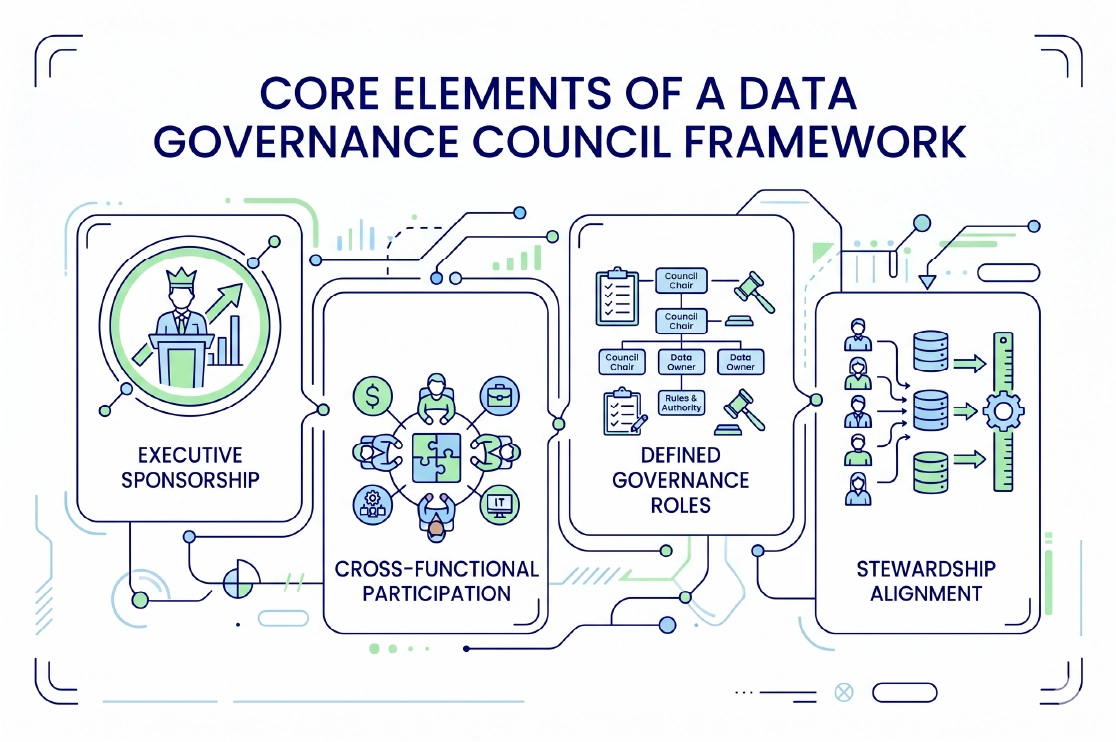
A good Data Governance Council Framework encompasses a number of structural aspects that assist in the decision making and operational adoption of governance.
Executive Sponsorship
A governance council needs an effective executive, which is usually offered by the Chief Data Officer or CIO. Executive sponsorship provides governance initiatives with authority and resources in the organization.
Cross-Functional Participation
The business units, IT, data management, risk, and compliance teams should be represented by the governance councils. This makes governance decisions to be priorities of the enterprise.
Defined Governance Roles
Data governance has defined accountability among governance leaders, data owners, and stewardship teams through roles and responsibilities.
Stewardship Alignment
The governance councils should be consistent with the data stewardship model in the organization, where the policies of governance should be extended in all data domains.
Best Practices for Establishing a Governance Council
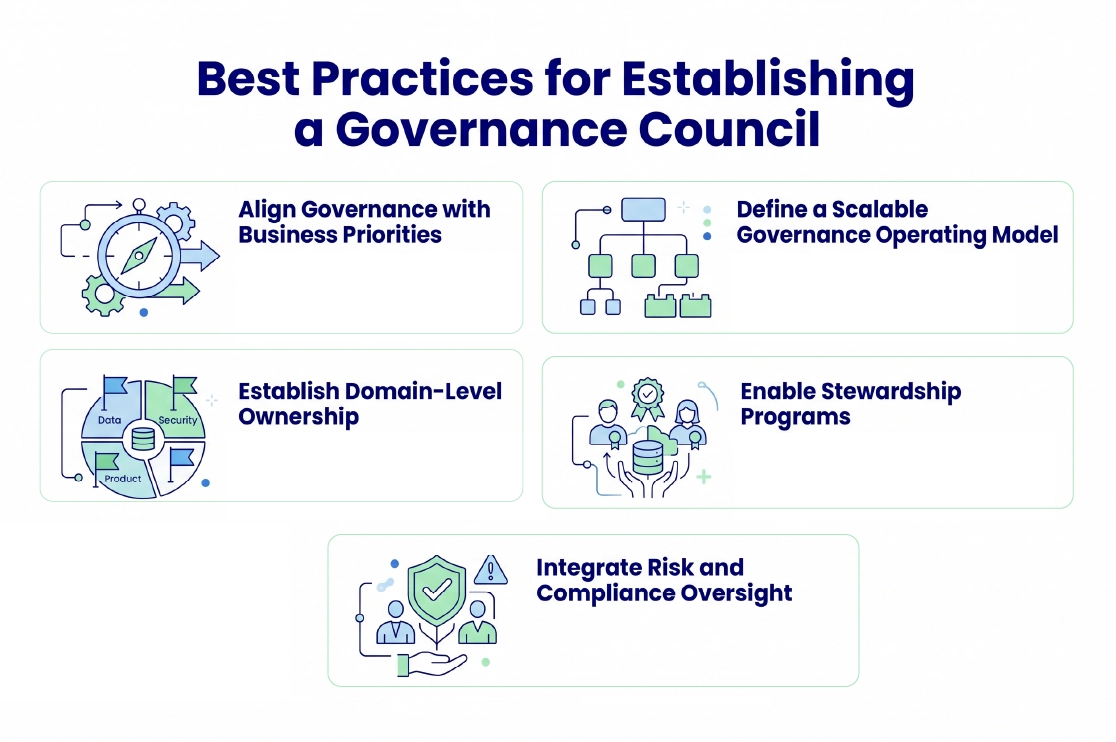
To ensure the effectiveness of the governance council in the long run, organizations developing governance councils ought to use a number of data governance best practices.
Align Governance with Business Priorities
Strategic goals that should be met through governance initiatives include compliance with regulations, better analytics, and operational efficiency.
Define a Scalable Governance Operating Model
Data governance operating model is a structured and well-organized approach that guarantees that the duties of the governance are allocated efficiently to business sectors and leadership.
Establish Domain-Level Ownership
The governance councils are encouraged to establish clear data ownership of key enterprise areas like customer, financial, and operational data.
Enable Stewardship Programs
Effective governance requiresData Governance & Stewardship Services that operationalize governance policies and resolving data quality issues.
Integrate Risk and Compliance Oversight
Governance councils should support enterprise Data Risk Management initiatives by aligning governance policies with regulatory and security requirements.
Real-World Enterprise Examples
Financial Services Organization
A global bank has set up a governance council to manage the compliance between regulations and information risk. This was leading to better audit preparedness and less regulatory vulnerability.
Retail Enterprise
A multinational retailer employed a governance council to standardize customer and product data in every region, enhancing the reliability of analytics and enabling them to use this for better price mechanisms.
Healthcare Provider
One of the healthcare organizations established a governance council to ensure privacy of patient information and analytics to enhance efficiency and optimization of operation and care.
These illustrations reflect the fact that the governance of councils goes beyond imposing policies to inject tangible business achievements.
Governance Council Roles and Responsibilities
A successful governance council requires participation from leadership, operational stakeholders, and technology teams.
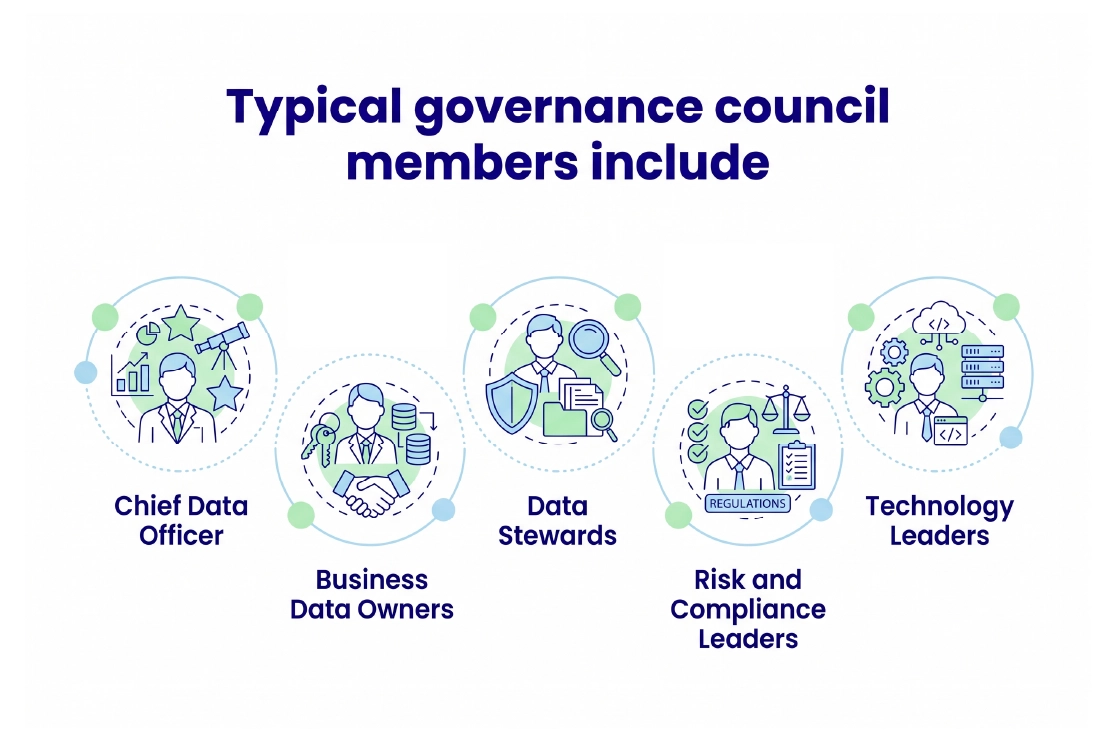
Typical governance council members include:
Chief Data Officer
The CDO offers strategic leadership to the organization’s data governance strategy and leads the governance council meetings.
Business Data Owners
Domain leaders make sure that governance policies are in line with the data used during operations and business goals.
Data Stewards
Stewards are used to check the quality of data and to implement governance policy and organize issues to be resolved.
Risk and Compliance Leaders
Compliance leaders are in charge of governance policies being in compliance with regulatory and data IT security requirements.
Technology Leaders
Governance is delivered with the support of IT and data platform teams by utilizing architecture, metadata management, and access controls.
Together, these roles ensure governance initiatives balance strategic oversight with operational execution.
Governance Council and Enterprise Data Strategy
A governance council should operate as a strategic leadership body supporting the broader enterprise data governance strategy.
Governance councils help coordinate initiatives such as:
-
Data architecture modernization
-
Enterprise data quality programs
-
Analytics and AI initiatives
-
Metadata and data catalog initiatives
Recommended Reading:
Why Enterprises Partner with BluEnt
Although the existence of governance councils is acknowledged in most organizations, a governance council developed on a large scale, needs the alignment of its strategy, operating models, and execution layers.
The BluEnt helps businesses transform the intent of governance into practical outcome-based frameworks that comprise leadership, business teams, and technology platforms.
BluEnt assists organizations in ensuring that governance structures are formed to bring leadership, governance policies, and the operational data governance consulting services processes into sync.
Our governance programs support:
-
Governance strategy development
-
Governance council structure design
-
Governance operating model implementation
-
Data stewardship and quality programs
By combining governance strategy, stewardship programs, and enterprise data architecture expertise, BluEnt helps organizations build governance models that scale with enterprise growth.
Conclusion
A Data Governance Council Framework is not a structural part of governance – it is a strategic ability that defines how successfully an organization could grow data, analytics, and AI programs.
Enterprises build a platform by forming a formal council of governance whereby, they develop:
-
Clear decision-making and accountability
-
Stronger regulatory compliance and risk management
-
Improved data quality and trust
-
Faster and more consistent business insights
But the real worth of a governance council is that it is in a position to bridge the gap between strategy and execution.
Next Step for Leaders:
Measurability of your existing governance maturity, determine the decision gaps and enterprise operating model of business priorities, and form a governance council and business priorities.
Those organizations that make investments in governance leadership today have a greater chance to contest in the world of data.
Frequently Asked Qwestion (FAQs)
What is a Data Governance Council Framework?A Data Governance Council Framework specifies the leadership model that oversees the policies of governance, its management, and synchronization of the governance efforts with the priorities of enterprise data.
Who should be part of a data governance council?The members of an average enterprise data council comprise the Chief Data Officer, business data owners, data stewards, compliance leaders, and IT stakeholders who lead the implementation of governance.
Why is a data governance council important?A governance council helps organizations define clear data governance roles and responsibilities, improve decision-making, and ensure governance policies are adopted across business units.
How does a governance council support enterprise data strategy?Governance councils guide the enterprise data governance strategy by aligning governance policies with business priorities, compliance requirements, and data management initiatives.
What are best practices for building a governance council?The most common data governance best practices are the definition of clear ownership models, the creation of stewardship programs, alignment between governance and business priorities, and a scalable governance operating model.

 Governing AI Tools in AEC: Copilot, Digital Twins, and Generative Design
  Data Governance for AI and Advanced Analytics: Building the Foundation That Works
 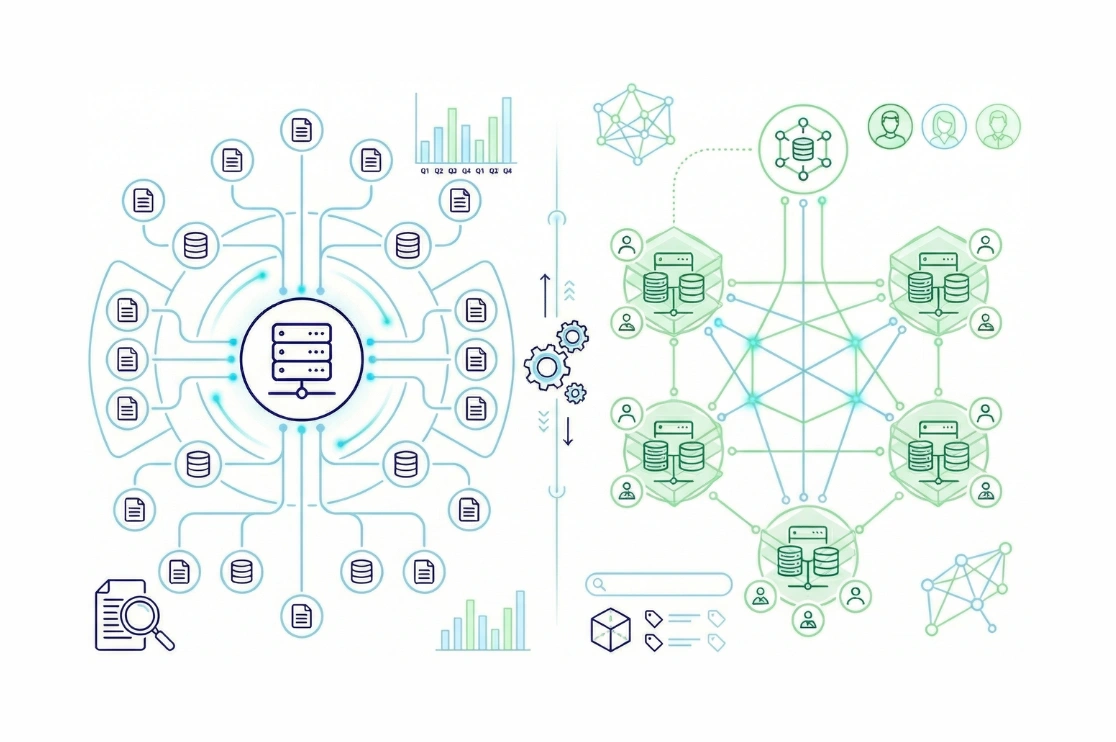 Centralized vs. Federated Data Governance: Which Model Fits Your Organization
 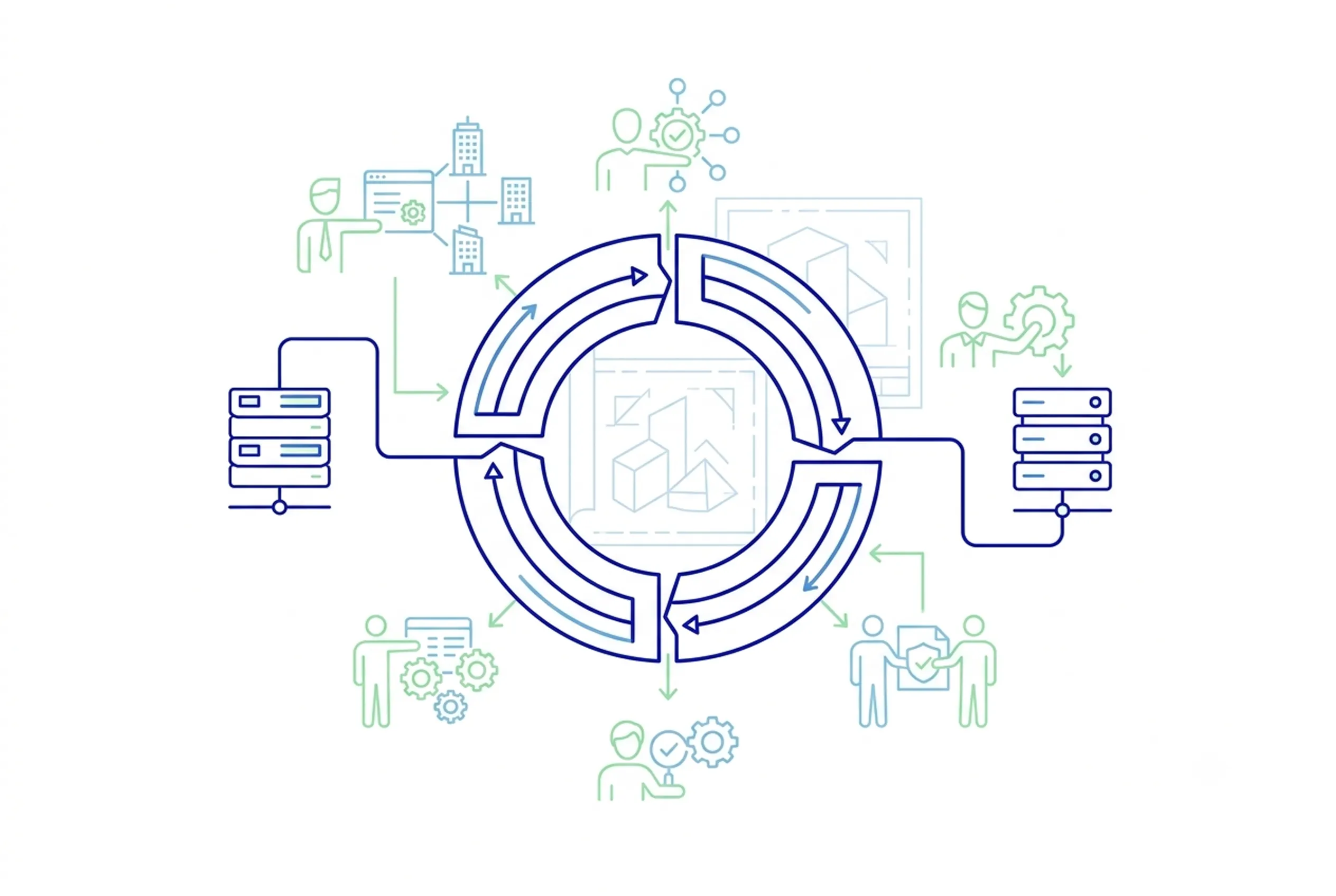 Data Governance Roles and Responsibilities in AEC Organizations