











Short answer
Data traceability is the organizational capability to answer specific questions about a data element’s origin, transformation history, quality validation status, ownership chain, and business use in a manner that satisfies a regulatory or audit requirement. Data lineage is the technical documentation of data flows between systems and transformations. Lineage is a necessary component of traceability but not sufficient on its own: audit-ready traceability also requires business context (who owns the data, what decisions it supports), quality evidence (what validation was performed and when), and approval records (who authorized the data’s use in a specific regulatory context). Organizations that invest in lineage tooling without building the broader traceability capability will find that they can demonstrate how data moved but cannot answer the audit questions that regulators actually ask.
Data lineage has become a standard component of enterprise data governance. Most organizations with a governance program have some form of lineage documentation: pipeline diagrams, column-level flow documentation in a catalog, or automated lineage captured by a data integration platform. What many of those organizations discover during a regulatory audit is that their lineage documentation answers the wrong questions.
A regulatory auditor reviewing GDPR compliance asks: can you show me every system that holds personal data about a specific data subject, who owns that data, what decisions it has been used to support, and who authorized those uses? A BCBS 239 auditor asks: can you show the complete aggregation path for this risk figure, including the quality checks performed at each stage and the approval chain for the final reported number? A SOX auditor asks: can you demonstrate that the financial data in this report came from an approved source, was not modified outside the authorized process, and was reviewed by the appropriate control owner?
These are not questions that a pipeline diagram answers. They require a traceability record that combines technical lineage with business context, quality evidence, and approval documentation. This article defines what audit-ready traceability requires and how to build it.
Table of Contents:
Traceability vs Lineage: Why the Distinction Matters The precise difference between data lineage and data traceability, and why conflating them produces compliance gaps
Data lineage: the technical record
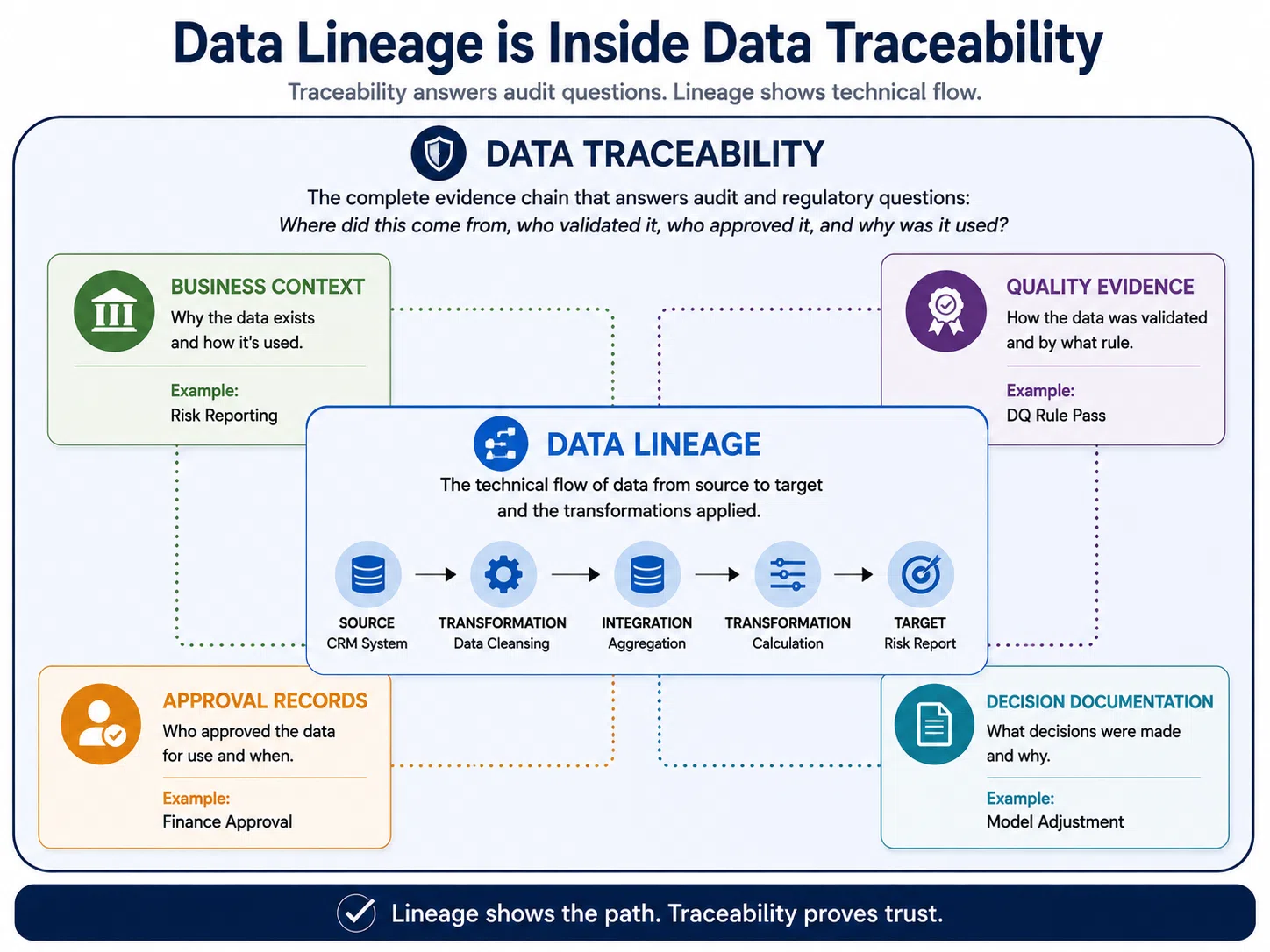
Data lineage is the technical documentation of how data flows from its origin through transformations to its current state. Column-level lineage documents which source column contributed to which target column through which transformation logic. Pipeline-level lineage documents which systems a dataset passes through between origin and consumption. Automated lineage tools capture this by parsing SQL, dbt transformation definitions, Spark jobs, and ETL pipeline metadata. Lineage answers: where did this data come from and what transformations were applied to it?
Lineage is a technical artifact. It documents what the pipeline does. It does not document who validated the output, who owns the data, whether it was approved for use in a specific regulatory context, or whether the quality standard required for that use was met at the time of use. These are the gaps that produce audit findings when organizations present lineage documentation as a complete traceability response.
Data traceability: the audit record
Data traceability is the organizational capability to answer specific questions about a data element’s complete history in a manner that satisfies a regulatory or audit requirement. The DAMA-DMBOK Metadata Management chapter describes data provenance (a closely related concept) as encompassing not just technical lineage but the complete context needed to assess the trustworthiness and appropriate use of a data element: its origin, transformation history, ownership, quality status, and the decisions it has supported.
Traceability adds four things to lineage: business context (who owns the data, what domain it belongs to, what policies govern its use), quality evidence (what quality checks were run, what the results were, and when they were run), approval records (who authorized the data’s classification, its quality SLA, and its use in specific downstream applications), and decision documentation (what business decisions the data has supported and whether any downstream corrections were required when data quality issues were discovered). Together with lineage, these produce an audit-ready traceability record.
Identify Gaps in Your Data Governance Framework
Evaluate your governance maturity and gain actionable insights into the areas that need attention.
Data Governance Maturity Assessment
A structured diagnostic for CDOs, CIOs, and Chief Compliance Officers. 18 questions across six governance dimensions. Receive a scored maturity profile and prioritised recommendations.
Your Details
Your Assessment Results
Overall Governance Maturity Level
Receive Your Full Report
A BluEnt governance consultant will prepare a personalised report with specific recommendations for your highest-priority gaps. Book a 60-minute discovery call to discuss your findings.
What Regulators Actually Ask: GDPR, BCBS 239, SOX, and HIPAA The specific traceability requirements in each framework and the audit questions you must answer
| Article 30 | GDPR Article 30 requires data controllers, subject to specific exceptions, to maintain records of processing activities. These records document the purposes of processing, categories of data subjects and personal data, recipients, envisaged erasure time limits, applicable international transfers, and a general description of relevant technical and organizational security measures. Source: Regulation (EU) 2016/679, Article 30, Records of processing activities. |
|---|
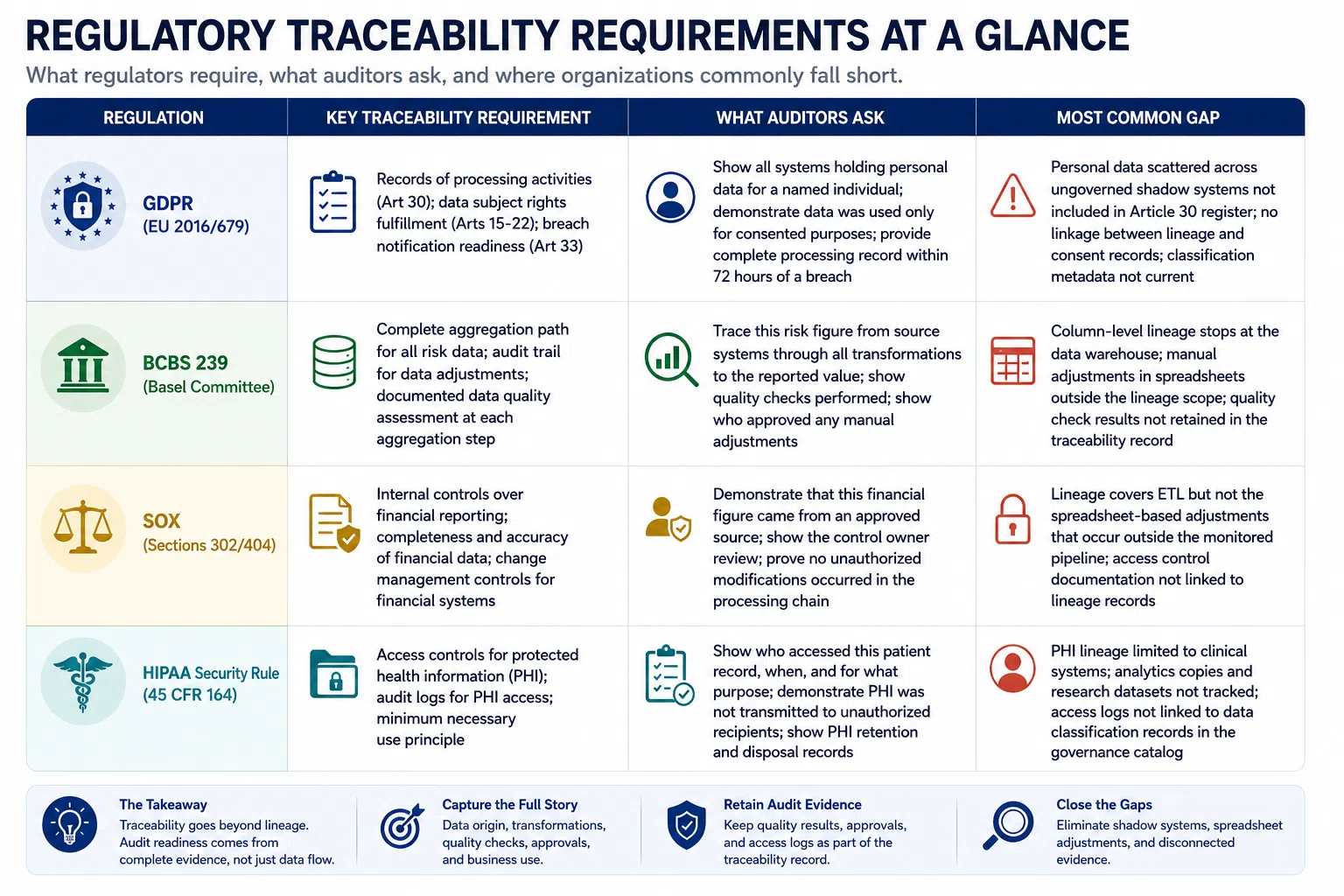
Three patterns emerge across these regulatory frameworks. First, every framework requires not just how data moved but why: the purpose of processing, the business use, the approval chain. Second, every framework requires evidence that quality or control checks were performed, not just that the data arrived at its destination. Third, every framework creates a time-bound audit response requirement: GDPR’s 72-hour breach notification window is the most acute, but SOX quarterly certification and BCBS 239 annual attestation also require the organization to produce traceability records on demand. Traceability that must be assembled retrospectively under audit time pressure is not audit-ready traceability.
Strengthen Your Data Governance Strategy
Connect with our experts to discuss your governance priorities, compliance requirements, and data management challenges.
The Four-Stage Traceability Chain What must be captured at each stage, who is responsible, and the audit risk if any stage is missing
Audit-ready traceability requires documented evidence at four stages in the data lifecycle. A gap at any stage breaks the traceability chain, even if the other stages are well-documented. The four stages are: origin (where the data came from and under what terms), transformation (what changes were made and by whom), quality validation (what quality checks were performed and what their results were), and business use (what decisions the data supported and whether those uses were authorized).
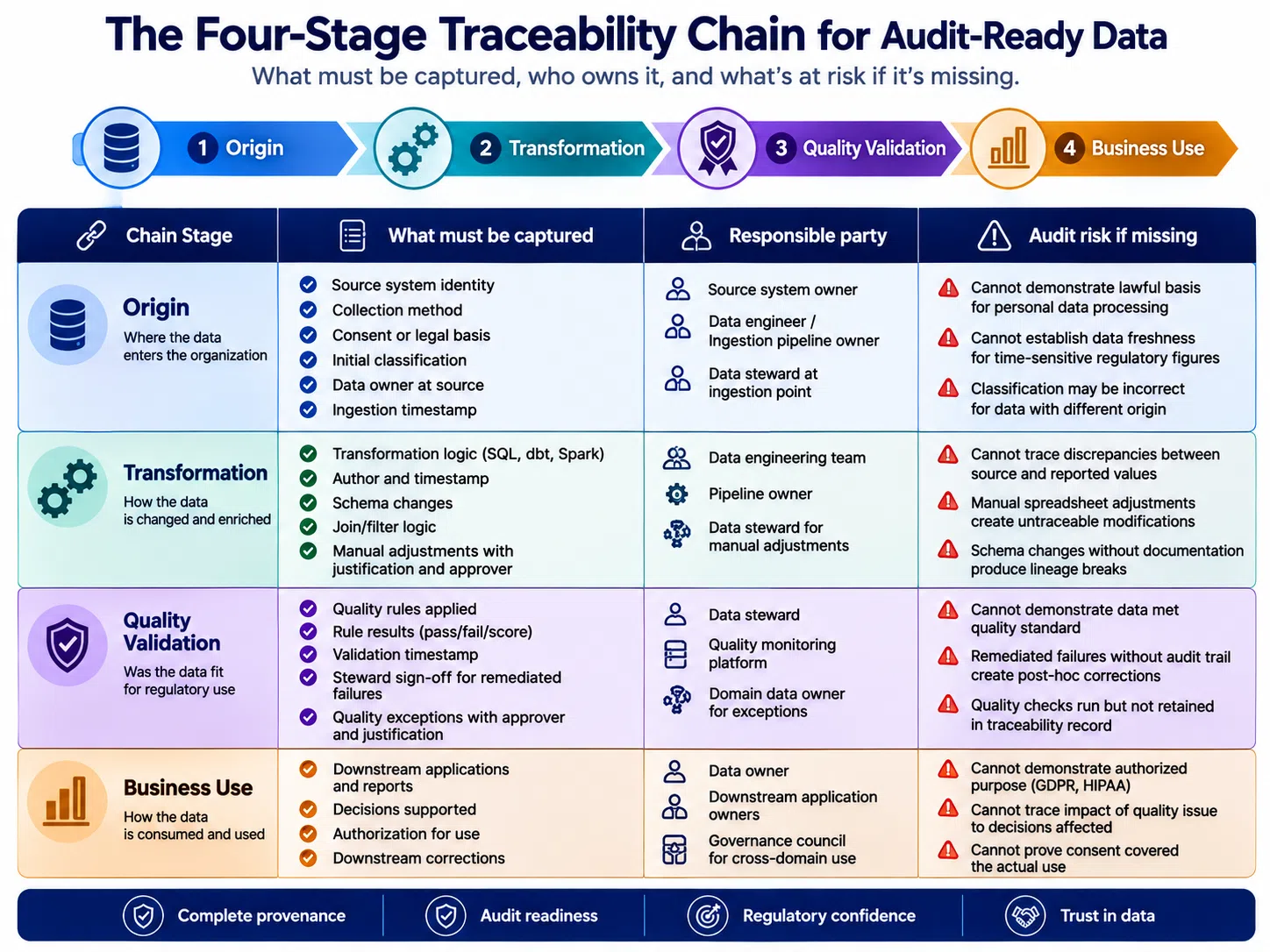
From the field
The most common traceability gap in audit-ready programs is at the quality validation stage: organizations run quality checks but do not retain the results in a form that can be produced under audit. The quality monitoring platform shows a dashboard of current quality scores, but the historical record of what the quality score was on the date a specific regulatory report was produced, and whether any exceptions were approved for that report, is not available. Building traceability means retaining quality evidence as a time-stamped record linked to the data asset and the downstream use, not just displaying current quality status.
Recommended Reading:
Building Audit-Ready Traceability Program design decisions that determine whether traceability holds up under audit
The data catalog as the traceability record
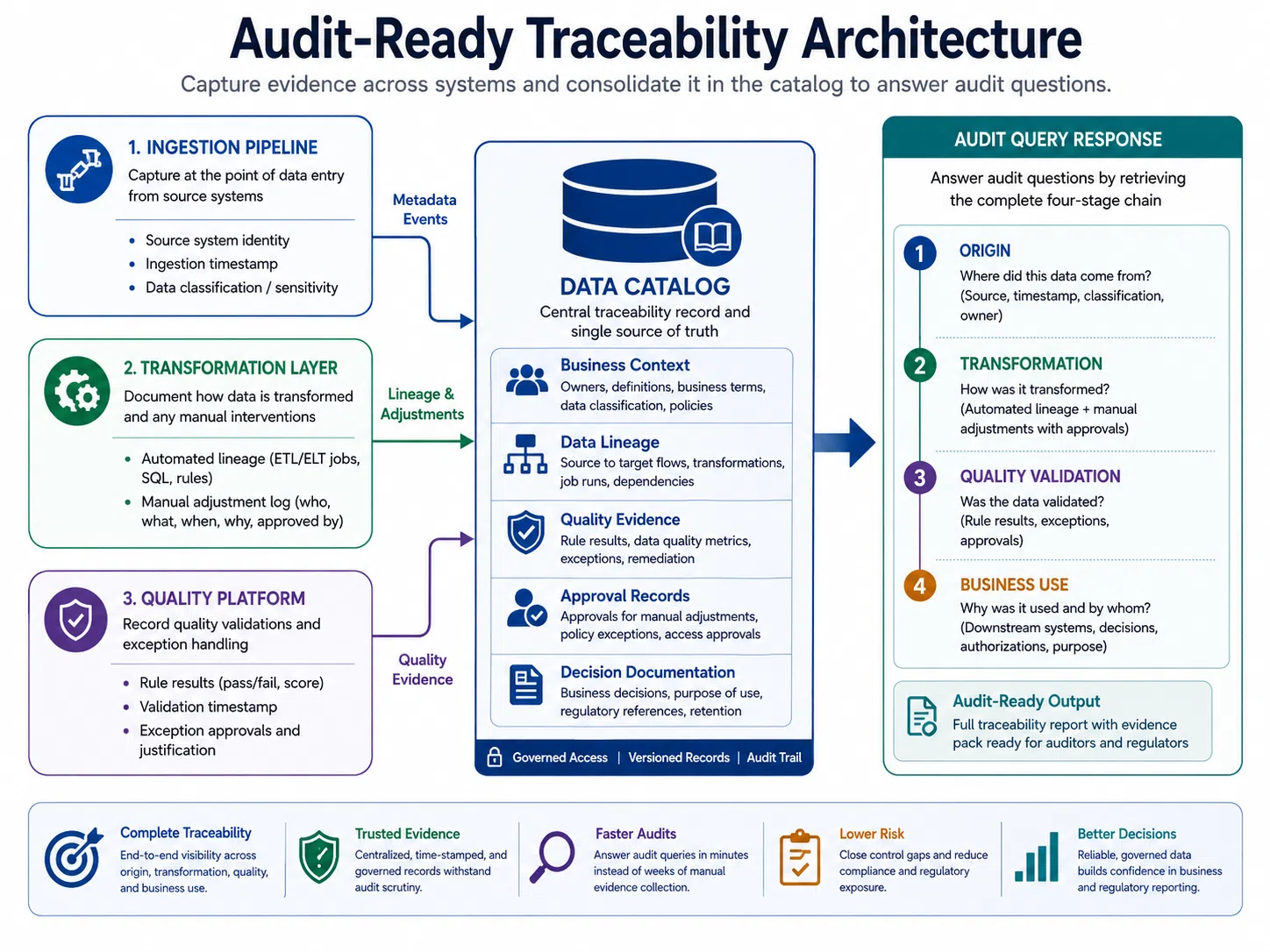
The data catalog is the appropriate repository for the non-technical components of traceability: business context (ownership, classification, domain assignment, policies), quality evidence (quality score history, exception records, steward sign-offs), and approval records (authorization for use in specific downstream applications and regulatory contexts). Technical lineage, produced by automated lineage tools, should be surfaced in the catalog so that the full traceability record is accessible from a single point rather than assembled from multiple systems under audit time pressure.
Catalog configuration for traceability means more than populating business definitions and owners. It means treating the catalog as an evidentiary system: every quality check result should be written to the catalog asset record with a timestamp; every exception approval should be documented with the approver, justification, and scope; every classification change should be logged with who made the change and why. The audit artifact is the catalog record for the data asset, which should be complete enough to answer the four-stage traceability chain without requiring additional investigation.
Capture points and metadata requirements
Traceability metadata must be captured at specific points in the data lifecycle rather than reconstructed after the fact. Three capture points require deliberate engineering. At ingestion, the pipeline must write source system identity, ingestion timestamp, initial classification (if determined at ingestion), and consent or legal basis reference (for personal data) to the catalog record. This is typically implemented as a catalog of API call in the ingestion pipeline that creates or updates the asset record when new data arrives.
At transformation, the pipeline must log transformation identity (job name, version, execution ID), execution timestamp, and any manual adjustment records to the lineage system. Automated lineage tools capture SQL and dbt transformations passively; manually coded Python transformations and spreadsheet-based adjustments require explicit instrumentation. The most common lineage break in practice is the point where data moves from an automated pipeline into an analyst’s Excel model for adjustment before being loaded back into the reporting system. This stage is frequently outside the lineage tool’s scope and must be addressed through process controls rather than automated capture.
At quality validation, the quality monitoring platform must write results to the catalog asset record with timestamp and rule identity, not just display them on a dashboard. Quality exceptions require a documented approval workflow: the steward identifies the exception, escalates to the domain owner, the domain owner approves with a documented justification, and the approval is written to the catalog record linked to the specific data asset and the downstream use for which the exception was granted.
GDPR-specific: the Article 30 register as a traceability anchor
GDPR Article 30 requires data controllers to maintain a register of processing activities that includes the purpose of each processing activity, the categories of personal data involved, the recipients, the retention period, and the technical and organizational measures in place. In practice, many organizations maintain this register as a standalone spreadsheet that is updated manually and infrequently. For audit-ready traceability, the Article 30 register should be linked to the data catalog: each processing activity in the register should reference the catalog assets involved, the lineage showing data flows between systems, and the classification records confirming which assets contain personal data.
This linkage is what enables a timely response to a data subject access request or a breach notification: the Article 30 register identifies the processing activities involving the data subject, the catalog links to the assets involved, and the lineage shows which systems they have passed through. Without this linkage, breach of response requires a manual investigation that cannot be completed within the 72-hour GDPR notification window for complex data estates.
Note: Manual lineage documentation — pipeline diagrams maintained in Confluence or SharePoint — degrades rapidly and silently. When a pipeline changes, the documentation is rarely updated in parallel. When an audit occurs, the documentation reflects an earlier state of the pipeline rather than its current state. Automated lineage capture from SQL parsers, dbt manifest files, and Spark query plans maintains current accuracy without relying on manual updates. For organizations with mixed automated and manual pipelines, automated lineage should be the standard for all new pipelines, and manual documentation should be reserved for the legacy pipelines where automation is not feasible, with a clear remediation plan for those legacy gaps.
The bottom line
Lineage tells you how data moved. Traceability tells you whether you can defend every step under audit. The gap between the two is where most compliance findings originate: the organization documented the pipeline but not the quality evidence, the approval chain, or the business context that regulators need to assess whether the data was used appropriately.
-
Traceability = lineage + business context + quality evidence + approval records + decision documentation
-
GDPR, BCBS 239, SOX, and HIPAA each embed specific traceability requirements that go beyond technical pipeline documentation
-
The data catalog is the appropriate repository for the non-technical traceability record; lineage tools feed into it, not replace it
-
Quality check results must be retained as time-stamped records linked to data assets, not just displayed as current dashboards
-
Manual adjustment points (spreadsheets, analyst models) are the most common source of traceability breaks in otherwise well-documented pipelines
-
Traceability records must be available on demand, not assembled retrospectively under audit time pressure
Organizations that treat lineage tooling as equivalent to traceability will discover the gap the first time they face a detailed regulatory audit. Building audit-ready traceability requires addressing all four stages of the chain, not just the technical pipeline documentation that automated tools make easy.
Build traceability that holds up under regulatory audit
BluEnt works with compliance teams and data governance leads to design audit-ready traceability programs: mapping regulatory traceability requirements to governance capabilities, identifying gaps in existing lineage and catalog implementations, and building the metadata capture architecture that makes the complete four-stage traceability chain available on demand.
Common Questions What compliance teams and governance leads ask about building audit-ready traceability
What is the difference between data lineage and data provenance?Data lineage and data provenance are closely related but carry different emphases in practice. Data lineage typically refers to the technical record of data flows: source systems, transformations, and destination systems, documented at the pipeline or column level. Data provenance has a broader scope that includes the origin of the data (where it was created, under what terms, by whom), its ownership chain, the quality of its origin source, and the context that makes it trustworthy or untrustworthy for a specific use. The DAMA-DMBOK Metadata Management chapter uses provenance in this broader sense. For practical purposes, both terms are used in the industry to mean roughly the same thing, with lineage being the more common term in data engineering contexts and provenance being more common in regulatory and academic contexts. The distinction that matters for compliance is that technical lineage alone is not sufficient; the broader provenance context, including ownership, quality, and authorization, is required for audit-ready traceability.
How do we handle traceability for data that passes through spreadsheets or manual processes?Data that moves through manual processes — Excel models, manual database updates, analyst adjustments — is the most challenging component of an audit-ready traceability program because automated lineage tools cannot capture it. Three approaches are used in practice. For high-risk data (regulatory reporting inputs, financial figures subject to SOX controls), the preferred approach is to eliminate the manual step entirely by replacing it with a governed pipeline. For medium-risk data, a process control approach requires that manual adjustments be documented in a controlled log (a SharePoint form, a ServiceNow ticket, or a catalog-linked exception record) with the reason, approver, and before/after values captured. For lower-risk data, sampling-based quality monitoring can detect when manual adjustments have introduced anomalies without requiring full documentation of every change. The regulatory risk of undocumented manual adjustments is highest for SOX-covered financial reporting and BCBS 239-covered risk data aggregation, where any unexplained difference between source and reported values is a finding.
How long must traceability records be retained?Retention requirements for traceability records vary by regulation. GDPR does not specify a retention period for Article 30 processing records, but the records must be maintained for as long as the processing activity is conducted and must be available on request from supervisory authorities. SOX Section 802 requires retention of audit records and related documentation for seven years. BCBS 239 requires that risk data aggregation documentation be available for supervisory review. HIPAA requires retention of security documentation for six years from the date of creation or last effective date. In practice, organizations should align traceability record retention to the longest applicable retention period for their regulatory environment, and the retention policy should cover not just the data lineage documentation but also quality check results, exception approvals, and classification change logs. Retaining lineage diagrams without retaining quality evidence or approval records leaves gaps that will be identified during a detailed audit.
Can we use our existing BI platform as a traceability tool?Business intelligence platforms (Tableau, Power BI, Looker) typically capture dataset-level lineage — which datasets a report consumes — but not column-level lineage, transformation logic, quality validation records, or approval documentation. They are useful as one component of a traceability architecture, particularly for documenting which reports consume which governed data assets, but they are not sufficient as a complete traceability system. For audit-ready traceability, the BI platform’s dataset references should be integrated into the data catalog so that the consumption layer of the traceability chain is connected to the origin, transformation, and quality stages. Most modern data catalogs support BI platform connectors that extract report-to-dataset lineage automatically.
What is the minimum viable traceability program for GDPR compliance?A minimum viable GDPR traceability program has four components. First, an Article 30 register that covers all personal data processing activities and is linked to the data assets in the governance catalog. Second, classification metadata in the catalog that identifies which assets contain personal data and what category of personal data (identifying, sensitive, health, financial). Third, lineage documentation covering the flow of personal data between systems, sufficient to answer a data subject access request and to scope a breach notification. Fourth, an access control record showing who has access to personal data assets and under what authorization. Organizations that already have a catalog, a lineage tool, and access management should audit those systems against these four requirements before the next GDPR review, rather than treating traceability as a separate program. The question is not whether the tools exist but whether the required metadata is captured and current.

 Governing AI Tools in AEC: Copilot, Digital Twins, and Generative Design
  Data Governance for AI and Advanced Analytics: Building the Foundation That Works
  Centralized vs. Federated vs. Hybrid Data Governance: Which Model Fits Your Organization
  Data Governance Roles and Responsibilities in AEC Organizations