








Snowflake and Databricks give your enterprise powerful enforcement capabilities. But the platform controls only function as well as the operating model, policy library, and stewardship structure behind them. Without those foundations, Unity Catalog is switched on but underused. Horizon tags are inconsistent across accounts. Sensitive data is classified differently by different teams. Audit evidence has to be assembled manually every cycle. Governance exists in documentation but not in the platform.
BluEnt designs and implements the governance layer that makes Snowflake and Databricks operate as they were built to. We build policy libraries, configure the native controls, activate the stewardship networks, and map every control to the regulatory obligations active in your operating jurisdictions. The result is a governed lakehouse where your data does what your governance framework says it will.
Organisations That Trust BluEnt With Their Data
Free Lakehouse Governance Readiness Assessment
Find out exactly where your Snowflake or Databricks governance stands — and what to fix first. 15 targeted questions across five critical dimensions. Under six minutes.
Your Platform
Your Details
Your Lakehouse Governance Score
Overall Readiness Level
Book Your 60-Minute Scoping Call
A BluEnt Snowflake and Databricks governance specialist will review your results and walk you through a prioritised configuration plan — specific to your platform, your industry, and your regulatory environment.
Trusted By
Organizations That Trust BluEnt With Their Data
- Gift Card Management, Reporting, Data Integration, Analytics Solutions, Book Keeping NetSuite Reporting, NetSuite Records Maintenance, Income Statement, Audit Support
- Gift Card Management, Reporting, Data Integration, Analytics Solutions
- Invoicing, AP Reports, Sales Data Analytics
- MuleSoft Integration, Analytics & Dashboards - [Tableau, MS SQL Server, SSIS]

- ERP Onboarding and Implementation, Data Migration, Custom Report Building, Audit Support and Finalization, Draft Financials Statements, Bidding Website Development
- Data Analytics and Dashboards
- V-Bucks Gift Card Sales Analytics, Reconciliation, Financial Tracking and Reporting
- Web Asset Creation
- HubSpot Campaign Management, Workflow Automation, UX/UI Development, Mobile App Development, Application Development

- Data Analytics and Dashboards, Website Development, Website Maintenance, Application Development, HubSpot Automation and Integration, Asana Management
- SEO, Website UX/UI Development, Data Management, Third-Party Integration, Website Maintenance

- Shopify Website Development, Klaviyo Email Marketing, Email Campaign Setup, Third-Party Shopify App Integration
- Website and SEO Audit, Shopify Website Maintenance, SEO and Analytics
- Website Design and Development, Website Maintenance
- Website Design and Development, Website Maintenance
- Website Design and Development, Website Maintenance, SEO and Analytics
Is This Your Situation?
This page is written for the CDO, CIO, Chief Compliance Officer, or governance programme director who is accountable for how Snowflake, Databricks, or both are governed in their organisation. The following situations are what bring most of our clients to us.
-
You have Snowflake or Databricks in production, but governance is partial: tags are inconsistent, Horizon or Unity Catalog is underused, and audit evidence has to be assembled manually.
-
You are preparing for, or mid-way through, a migration to Snowflake or Databricks and need governance activated at go-live, not retrofitted a year later.
-
You have both Snowflake and Databricks in the estate and are struggling to keep policy, classifications, and access rules consistent across both platforms.
-
A regulator, auditor, or internal risk committee has flagged gaps in data lineage, access traceability, masking enforcement, or cross-border transfer controls on your lakehouse.
-
You are standing up AI or machine learning on Databricks and recognise that ungoverned data and unclassified feature stores will produce models you cannot validate or defend.
-
A previous governance initiative produced a catalog deployment that was not adopted, tags that were not maintained, and a framework that exists in documents rather than in the platform.
If you are currently evaluating Snowflake and Databricks data governance consulting firms, the section on choosing the right partner below is written specifically to help you make that decision.
Why a Platform Licence Is Not a Governance Programme
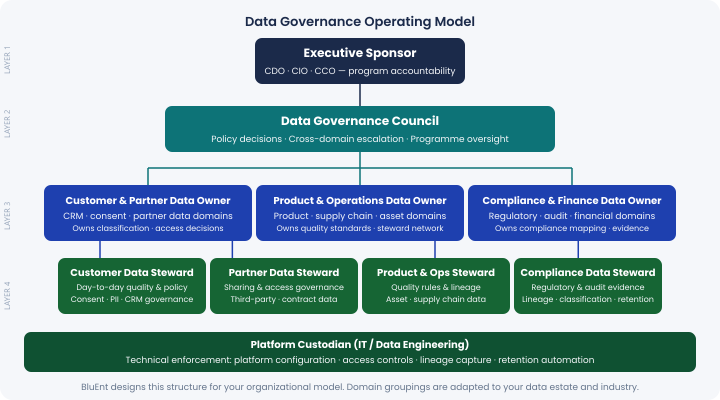
This is the most expensive misunderstanding in lakehouse governance procurement. Snowflake and Databricks provide the enforcement engine. They do not provide your operating model, your policy library, your steward roles, your data ownership structure, your regulatory compliance mapping, or the change management that makes governance stick across your organisation.
| Snowflake and Databricks Provide: | A Consulting Partner (BluEnt) Provides: |
|---|---|
|
Native cataloguing, classification, and lineage engines (Horizon Catalog, Unity Catalog) Enforcement primitives: tag-based masking, row access policies, ABAC, column masks Workflow hooks and APIs for stewards and engineers Access History, audit logs, query lineage, and sharing controls The platform to enforce governance rules once they are designed |
A governance operating model tailored to your industry, regulatory obligations, and platform topology Role, ownership, and stewardship design: data owner, steward, custodian, consumer, auditor Policy, tag taxonomy, and classification libraries mapped to named regulations Configuration of native controls so the platform enforces the framework Change management, steward activation, and capability transfer to your team |
BluEnt has delivery experience across Snowflake, Databricks, Microsoft Fabric, Azure Purview, AWS Glue, Collibra, and Alation. Our recommendations are governed by what fits your environment, not by a reseller agreement.
Snowflake, Databricks, or Both: Making the Right Choice for Your Governance Programme
Most enterprise buyers evaluating governance for Snowflake and Databricks are not choosing between two substitutes. They are working out how much of each platform their landscape already contains, where the data volumes sit, and where governance must land first. The table below is the decision framing BluEnt uses in vendor selection conversations.
| If your priority is | Snowflake tends to fit when | Databricks tends to fit when |
|---|---|---|
| Primary workload | Structured analytics, BI, data sharing, operational reporting | Data science, machine learning, streaming, unstructured data |
| Team composition | SQL-heavy analyst and data engineering teams | Mixed engineering, data science, and ML engineering teams |
| Existing investments | Power BI, Tableau, Fivetran, dbt ecosystems | Apache Spark, MLflow, open table formats (Delta, Iceberg) |
| Governance focus | Tag-driven policy, cross-region sharing, data clean rooms | ABAC across lakehouse, model and feature governance, open lineage |
| Common enterprise pattern | Snowflake as governed warehouse and data exchange layer | Databricks as lakehouse for engineering and ML, Delta Sharing to consumers |
BluEnt is platform-agnostic. We do not resell Snowflake or Databricks licences and we are not incentivised to expand either footprint. That independence is why CDOs and CIOs bring us into vendor selection conversations before contracts are signed, not after.
Snowflake Horizon Catalog and Databricks Unity Catalog: The Native Controls BluEnt Configures
The table below maps the governance capabilities BluEnt configures on your behalf. Whether your landscape is Snowflake-first, Databricks-first, or genuinely dual-platform, we design the taxonomy, role model, and policy libraries that make these native controls enforce your governance rules consistently across both environments.
| Governance Capability | Snowflake (Horizon Catalog) | Databricks (Unity Catalog) |
|---|---|---|
| Metadata and discovery | Object tagging, Universal Search, data classification | Unity Catalog metastore, Catalog Explorer, system tags |
| Access control model | Role-based access control with tag-driven policies | Attribute-based access control, row and column filters |
| Masking and row security | Dynamic data masking, row access policies, tag-driven enforcement | Column masks, row filters, ABAC policies across catalogs (ABAC currently in public preview on Databricks) |
| Lineage | Access History, Object Dependencies, column-level lineage | End-to-end lineage across tables, notebooks, jobs, ML assets |
| Data sharing governance | Secure Data Sharing, Listings, Snowgrid cross-cloud | Delta Sharing with recipient-level controls and audit logs |
| ML and AI asset governance | Snowpark governance, model registry integration | Unity Catalog for models, features, volumes, and functions |
| Where BluEnt adds value | Policy design, tag taxonomy, cross-account governance, third-party catalog integration | Metastore design, ABAC policy libraries, Hive metastore migration, Delta Sharing controls |
What a Well-Governed Snowflake or Databricks Environment Looks Like
Governance on Snowflake and Databricks is not a configuration project with a go-live date. It is an operational state your environment reaches when policy, platform controls, and stewardship are working together. The following are the six markers of a mature, well-governed lakehouse programme.

Every Sensitive Dataset Is Tagged, Classified, and Masked Consistently
No undiscovered PII. No inconsistent sensitivity labels across accounts or workspaces. Every sensitive attribute is tagged at source and masked dynamically based on the role accessing it, without engineering intervention for each new use case.

Audit Evidence Is Generated Automatically, Not Assembled Manually
Regulators and internal risk committees receive lineage reports, access logs, and masking evidence pulled directly from Horizon Access History and Unity Catalog audit logs. Your compliance team uses the evidence rather than spending cycles finding it.

AI and ML Models Are Built on Data You Can Trace and Defend
Every feature used in a Databricks model has documented lineage, a classified sensitivity level, and an access policy controlling who can read it. Models can be validated, explained, and presented to regulators because the data governance underneath them is enforced.

Cross-Border Data Sharing Is Governed, Not Assumed
Snowflake Secure Data Sharing and Databricks Delta Sharing are configured with recipient-level controls, tag-driven policies on shared objects, and cross-border transfer documentation that satisfies GDPR, APRA, and CCPA requirements.

Data Quality Issues Are Caught at Source, Not Discovered in Reports
Quality rules are embedded in the governance framework and enforced at the platform level. Issues surface in stewardship workflows rather than in executive dashboards, quarterly reporting, or customer-facing systems.

Your Team Runs the Programme Without Long-Term External Dependency
Domain owners, data stewards, platform administrators, and audit liaisons are trained and active. The platform is configured, runbooks are written, and the governance council is operating. BluEnt has transferred capability, not created dependency.
How BluEnt Delivers Snowflake and Databricks Data Governance Consulting
Every BluEnt engagement follows a five-stage delivery methodology designed to produce early wins, build progressively toward full maturity, and transfer capability to your internal teams throughout. Each stage is adapted to your Snowflake and Databricks topology, your sector, and your regulatory obligations.
One senior consultant owns your engagement from scoping through to operationalisation. You are never handed between teams.

Stage 1: Lakehouse Governance Readiness Assessment (Weeks 1 to 5)
We begin by understanding where your Snowflake account or Databricks workspace actually stands. The assessment covers account and workspace topology, existing tag and catalog coverage, role and entitlement models, current masking and row security configuration, lineage completeness, steward coverage, and regulatory exposure by jurisdiction.
Deliverable: Lakehouse Governance Maturity Report and Prioritised Implementation Roadmap.

Stage 2: Framework, Policy, and Taxonomy Design (Weeks 4 to 12)
Using the roadmap as the foundation, we design a governance framework specific to your organisation. This includes domain mapping, stewardship role design, a tag taxonomy covering sensitivity, ownership, retention, and lineage, a full classification library, and regulatory compliance mapping by jurisdiction.
Deliverable: Governance Framework, Tag Taxonomy, Policy Library, Regulatory Compliance Map.

Stage 3: Horizon and Unity Catalog Implementation (Weeks 8 to 20)
We configure Horizon Catalog on Snowflake and Unity Catalog on Databricks to enforce the policy library natively. This includes object tagging, dynamic data masking, row access policies, and Access History activation on Snowflake; metastore design, ABAC attributes, column masks, row filters, and lineage on Databricks; and dual-platform policy reconciliation where both environments are in scope.
Deliverable: Configured Horizon and Unity Catalog Environments, Activated Lineage, Dual-Platform Policy Reconciliation.

Stage 4: Stewardship Operationalisation and Change Management (Weeks 16 to 28)
This is where most lakehouse governance programmes fail when run without change management expertise. Platform controls only deliver value when the people responsible for data adopt them. Stage 4 covers steward activation, role-based training, governance workflow embedding in Snowflake and Databricks tooling, and governance council launch.
Deliverable: Active Steward Network, Governance Council Charter, Role-Based Training, Operational Runbooks.

Stage 5: Measurement, Optimisation, and Capability Transfer (Ongoing from Month 6)
Governance is a capability, not a project. Stage 5 establishes the measurement framework (tag coverage, exception rates, lineage completeness, sharing governance, compliance posture) and progressively transitions ownership to your internal team. BluEnt remains available for quarterly reviews, evolving regulatory obligations, and new domain onboarding.
Deliverable: Governance Measurement Dashboard, Capability Transfer Plan, Optional Managed Governance Retainer.
We bring the agenda, the questions, and the Horizon and Unity Catalog expertise. You bring your environment.
What Our Snowflake and Databricks Data Governance Consulting Covers

Lakehouse Governance Readiness Assessment
A structured diagnostic of your Snowflake or Databricks governance posture: topology, catalog coverage, tag maturity, ABAC configuration, lineage completeness, and regulatory exposure. Produces a sequenced implementation roadmap you can use independently or as the foundation for a BluEnt engagement.

Snowflake Horizon Catalog Implementation
Tag taxonomy design, dynamic data masking, row access policies, Access History activation, and cross-account governance for enterprises running Snowflake as their primary analytics and data sharing platform.

Databricks Unity Catalog Implementation
Metastore design, catalog and schema topology, attribute-based access control, column masks, row filters, volumes, and ML asset governance for lakehouse-first enterprises and data science platforms.

Policy, Tag, and Classification Library
A reusable policy pack covering sensitivity classification, retention, data sharing, purpose binding, and regulatory controls, mapped to your active jurisdictions and enforced natively in Horizon and Unity Catalog.

Dual-Platform Governance Reconciliation
A single operating model enforced consistently across both Snowflake and Databricks: consistent taxonomies, consistent classifications, consistent access controls, and unified audit evidence for regulators.

Lineage and Access Evidence Design
End-to-end lineage activation across Snowflake Access History and Unity Catalog, plus structured evidence packs your compliance and audit teams can present to regulators without manual rework.

Data Sharing and Clean Room Governance
Secure Data Sharing, Listings, Snowgrid, and Delta Sharing controls designed for cross-border sharing, partner data exchange, and regulated clean room use cases across multiple jurisdictions.

Steward Enablement and Capability Transfer
Role-specific training for data owners, stewards, custodians, and auditors, with playbooks, runbooks, and domain onboarding plans so your team operates the programme without long-term BluEnt dependency.
How to Choose the Right Snowflake and Databricks Data Governance Consulting Partner
The Snowflake and Databricks consulting market is crowded. Platform resellers with attached governance practices, large system integrators, and boutique specialists all compete for the same engagements. The criteria below are specific to lakehouse governance capability. Use them in every vendor conversation before you sign.
Can They Show Working Horizon and Unity Catalog Implementations, Not Methodology Decks?
Ask for direct evidence of configuration experience: tag taxonomies built in Snowflake Horizon, row access policies deployed in production, Unity Catalog attribute-based access control across a live metastore, Delta Sharing recipient controls in a regulated environment. Any consultancy can describe these capabilities in a presentation. Only a small number have actually implemented them at enterprise scale. Ask for specific topology descriptions and what they configured, not what they can do in theory.
Do They Understand Both Platforms Independently and Together?
Many firms specialise in one platform or the other. Enterprises running both Snowflake and Databricks need a partner who can design a single governance operating model that enforces consistently across both. Ask specifically how they reconcile policy, taxonomy, and access model design when both platforms are in the estate simultaneously. The answer will tell you quickly whether they have done it before.
Is Their Regulatory Knowledge In-Market, Not Generic?
A governance framework built for US HIPAA compliance does not translate directly to UK GDPR, DORA, APRA CPS 234, NIS2, or PIPEDA. The partner you choose must be able to name the specific regulations active in each jurisdiction you operate in and demonstrate how those obligations map to Horizon and Unity Catalog controls. Generic regulatory awareness is not sufficient for a multi-jurisdiction enterprise.
Are They Platform-Agnostic, or Commercially Aligned to One Platform?
A consultancy with a reseller or referral agreement with Snowflake or Databricks has a structural conflict of interest. Their recommendation may be shaped by their commercial arrangement rather than your actual requirements. Ask directly whether they hold any commercial relationship with either platform vendor. BluEnt does not resell Snowflake or Databricks licences and has no incentive to favour either platform over the other.
Do They Have Programmes That Were Adopted, Not Just Deployed?
Catalog configuration is the easy part. Adoption is where lakehouse governance programmes fail. Ask for case studies that describe not just what was configured, but how stewards were activated, how the governance council was established, and what usage metrics looked like at six and twelve months post-deployment. A programme that runs in production a year after go-live is a fundamentally different achievement from a successful handover meeting.
Will Your Team Run the Programme After Go-Live?
A well-designed governance programme progressively transfers capability to your internal team. Ask specifically what the capability transfer model looks like. BluEnt delivers role-specific training for data owners, stewards, custodians, and audit liaisons, with documented runbooks and playbooks that remain with your team. After engagement completion, your team should be able to onboard new domains, respond to regulatory changes, and extend governance to new platforms without returning to BluEnt for every change.
Not ready to evaluate yet? Start with our Free Lakehouse Governance Readiness Assessment. A structured diagnostic that maps your current Snowflake or Databricks governance posture against a defined maturity model and produces a realistic implementation path. Use it before any vendor conversation.
Free Lakehouse Governance Readiness Assessment
Find out exactly where your Snowflake or Databricks governance stands — and what to fix first. 15 targeted questions across five critical dimensions. Under six minutes.
Your Platform
Your Details
Your Lakehouse Governance Score
Overall Readiness Level
Book Your 60-Minute Scoping Call
A BluEnt Snowflake and Databricks governance specialist will review your results and walk you through a prioritised configuration plan — specific to your platform, your industry, and your regulatory environment.
Proof Point: Enterprise Governance Programme Delivered Across 14 Business Units
BluEnt delivered a multi-country enterprise data governance programme for a confidential client in the architecture, engineering, and construction sector. The engagement began with a governance maturity assessment across 14 business units operating in three countries, identified significant gaps in data ownership, classification, and policy enforcement, and produced a full governance framework within 90 days of the contract award.
Catalogue deployment was live across all 14 business units within six months. The stewardship network launched with 34 domain stewards and achieved an 80 percent reduction in manual governance effort within the first year of operation.
The Challenge
A construction and engineering group operating across 14 business units in three countries faced a governance programme that existed in documentation but was not enforced in practice. Data ownership was undefined across project, asset, and contract data domains. Classification was inconsistent. Compliance documentation was assembled manually for each audit cycle. A previous governance initiative had produced a policy library that was not adopted by the business.
What We Delivered
-
Governance framework delivered within 90 days of contract award
-
Data catalogue live across 14 business units within 6 months
-
34 domain stewards activated across all business units
-
80 percent reduction in manual governance effort
-
Compliance documentation automated and audit-ready
-
Stewardship network operating independently within 12 months
The governance operating model, stewardship design, and policy library developed for this engagement form the authoritative case reference across BluEnt’s data governance service pages. For the full engagement breakdown, see our Enterprise Data Governance Solutions page.
Snowflake and Databricks Governance Across Your Industry
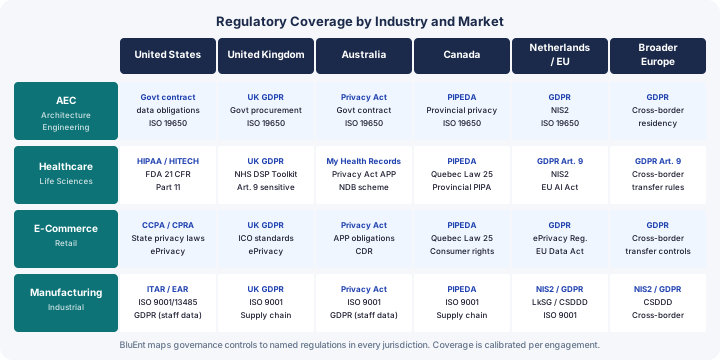
Governance requirements differ significantly by industry. Regulatory frameworks, data types, stewardship obligations, and acceptable risk levels are not uniform. BluEnt applies sector-specific governance knowledge to every Snowflake and Databricks engagement. The following are the governance priorities we address by vertical.
Architecture, Engineering, and Construction (AEC)
AEC enterprises run some of the most fragmented data environments of any industry: project data, BIM models, asset registers, contract documentation, and supply chain data spread across dozens of entities and geographies.
Governance on Snowflake or Databricks for AEC means establishing consistent classification standards for project and asset data, enforcing access controls that reflect project boundaries and entity structures, and governing BIM-derived datasets with documented lineage. Regulatory context: Government contract data obligations (UK, Australia, US), ISO 19650 BIM data management standards, procurement compliance frameworks.
Healthcare and Life Sciences
Healthcare organisations face the most demanding data governance environment of any sector BluEnt serves. On Databricks, Unity Catalog attribute-based access control (currently in public preview) is the recommended mechanism for controlling access to patient data where available: attribute-based policies that enforce purpose limitations, role restrictions, and cross-border transfer controls natively in the platform. Where ABAC is not yet in scope, BluEnt implements role-based controls with column masks and row filters as the interim access model.
On Snowflake, dynamic data masking and row access policies deliver equivalent protection for structured patient and clinical datasets. Regulatory context: HIPAA and HITECH (US), NHS Data Security and Protection Toolkit (UK), My Health Records Act (Australia), GDPR Article 9 sensitive data obligations (EU), FDA 21 CFR Part 11 (clinical trials).
E-Commerce and Retail
Retail enterprises are navigating the collapse of third-party data ecosystems and the regulatory pressure that accompanies first-party data growth. Snowflake is increasingly used as the governed platform for customer data assets: tag-driven masking for PII, Secure Data Sharing for partner data exchange, and cross-border controls for GDPR and CCPA compliance.
BluEnt governs the classification, purpose binding, and sharing governance for these environments. Regulatory context: GDPR (EU), UK GDPR, CCPA and CPRA (US), PIPEDA (Canada), Australian Privacy Act, ePrivacy Regulation.
Manufacturing and Industrial Enterprises
Manufacturing enterprises run some of the most complex data environments BluEnt governs: operational technology data from IoT sensors, SCADA systems, and production lines converging with ERP, MES, and supply chain platforms in a single lakehouse or cloud data environment.
On Databricks, Unity Catalog governs the high-volume streaming sensor data, machine learning models trained on production datasets, and feature stores built from operational telemetry that AI-enabled manufacturing programmes depend on.
On Snowflake, Secure Data Sharing governs multi-tier supplier data exchange, and tag-driven masking protects commercial and financial data shared across operating entities and joint ventures. BluEnt establishes classification standards across OT-derived and IT-derived data domains, enforces access controls that reflect production facility and supplier relationship structures, and configures lineage to support product traceability, quality management audits, and supply chain due diligence documentation.
Regulatory context: NIS2 Directive for critical infrastructure operators (EU), German Supply Chain Due Diligence Act (LkSG), EU Corporate Sustainability Due Diligence Directive (CSDDD), ITAR and EAR export controls (US), ISO 9001 and ISO 13485 quality data obligations, GDPR and UK GDPR for employee and customer data across manufacturing operations.
For full regulatory framework coverage by jurisdiction and solution blueprints by industry, see our dedicated service pages.
Snowflake and Databricks Governance Across Six Markets
Data governance obligations, audit expectations, and compliance frameworks differ materially between jurisdictions. BluEnt maintains in-market regulatory knowledge across all six markets we operate in, ensuring the controls we configure in Horizon and Unity Catalog meet the compliance standards active in your operating environment, not a generic international template.

United States: HIPAA, HITECH, GLBA, SOX, CCPA and CPRA, plus state privacy laws including the Virginia CDPA, Colorado Privacy Act, Connecticut Data Privacy Act, and Texas Data Privacy and Security Act.
United Kingdom: UK GDPR, Data Protection Act 2018, ICO enforcement standards, FCA operational resilience expectations, NHS data standards for healthcare clients.
Australia: Privacy Act 1988, Australian Privacy Principles (APP), Notifiable Data Breaches scheme, APRA CPS 234 for information security, APRA CPS 230 for operational risk, Consumer Data Right (CDR).
Canada: PIPEDA at federal level, plus provincial privacy legislation including Quebec Law 25, British Columbia PIPA, and Alberta PIPA, and OSFI guideline B-13 on technology and cyber risk management for federally regulated financial institutions.
Netherlands and EU: GDPR, Digital Operational Resilience Act (DORA) for financial entities, NIS2 Directive for critical infrastructure, EU Data Act, and Autoriteit Persoonsgegevens (AP) guidance for Dutch entities.
Broader Europe: DORA implementation across EU member states, cross-border data residency controls, sector-specific regulatory frameworks including those applicable to financial services, healthcare, and critical infrastructure.
Choosing the Right Consulting Partner Is the Decision That Makes Everything Else Work
A Snowflake or Databricks governance programme built for your organisation, your regulatory environment, your industry, and your operational reality delivers significantly more than a generic model applied from a playbook. The difference is not in the platform. It is in the operating model, the policy design, and the adoption work that follows configuration.
BluEnt brings the platform depth on Horizon and Unity Catalog, the in-market regulatory knowledge, and the implementation experience to deliver a governance programme that runs in production. Start with a 60-minute scoping call. No preparation required. No pitch deck. We bring the agenda, the questions, and the technical expertise.
Not ready to evaluate yet? Start with our Free Lakehouse Governance Readiness Assessment. A structured diagnostic that maps your current Snowflake or Databricks governance posture against a defined maturity model and produces a realistic implementation path. Use it before any vendor conversation.
Free Lakehouse Governance Readiness Assessment
Find out exactly where your Snowflake or Databricks governance stands — and what to fix first. 15 targeted questions across five critical dimensions. Under six minutes.
Your Platform
Your Details
Your Lakehouse Governance Score
Overall Readiness Level
Book Your 60-Minute Scoping Call
A BluEnt Snowflake and Databricks governance specialist will review your results and walk you through a prioritised configuration plan — specific to your platform, your industry, and your regulatory environment.
Frequently Asked Questions
What is data governance for Snowflake and Databricks?
Data governance for Snowflake and Databricks is the practice of defining ownership, classification, access, quality, and lineage rules for every dataset held in a Snowflake account or Databricks workspace, and enforcing those rules through the platform’s native controls. On Snowflake this is delivered through Horizon Catalog using object tags, dynamic data masking, row access policies, and Access History lineage. On Databricks this is delivered through Unity Catalog using metastore governance, attribute-based access control, column masks, row filters, Delta Sharing controls, and end-to-end lineage across tables, notebooks, jobs, and ML assets. Effective governance requires both the platform configuration and the operating model behind it: defined data ownership, steward roles, policy libraries, and regulatory compliance mapping.
Do I need a consulting partner if I already have Snowflake or Databricks licences?
Yes, in almost every enterprise environment. Snowflake and Databricks provide the enforcement engine but not the operating model, steward roles, domain ownership structure, policy library, or regulatory mapping. A consulting partner designs those layers and configures the platform so the native controls enforce your governance rules consistently. Without the operating model behind it, Unity Catalog and Horizon Catalog sit partially configured, tags are inconsistent across accounts, and sensitive data is governed differently by different teams. The platform does not create governance. It enforces governance that has been designed and operationalised.
How is Snowflake Horizon Catalog different from Databricks Unity Catalog?
Snowflake Horizon Catalog is the governance layer for data, applications, and metadata inside a Snowflake account. It is built around object tags, role-based access control with tag-driven policies, dynamic data masking, row access policies, and Access History lineage. Databricks Unity Catalog is a unified governance layer for the entire Databricks lakehouse: tables, volumes, models, features, notebooks, and functions. It uses column masks, row filters, and end-to-end lineage across all Databricks assets, with attribute-based access control available in public preview. Both are native enforcement engines. Horizon is optimised for structured analytics and data sharing governance. Unity Catalog is designed for a broader lakehouse including ML assets and open data formats. BluEnt configures both and can reconcile governance across a dual-platform estate.
Can BluEnt govern a dual-platform Snowflake and Databricks environment?
Yes. BluEnt designs a single governance operating model and policy library that is enforced natively in Snowflake via Horizon Catalog and in Databricks via Unity Catalog. The tag taxonomy, sensitivity classifications, and role model are consistent across both platforms, so a dataset classified as restricted in Snowflake is governed under the same rules when accessed or shared in Databricks. Dual-platform governance reconciliation is one of our core capabilities and is particularly relevant for enterprises where Snowflake serves as the governed warehouse and analytics layer while Databricks handles data science, ML, and streaming workloads.
How long does a Snowflake or Databricks governance implementation take?
A Lakehouse Governance Readiness Assessment typically takes four to six weeks. Policy, catalog, and role implementation on Horizon or Unity Catalog typically takes eight to sixteen weeks depending on domain count, starting control maturity, and regulatory complexity. On a comparable multi-country enterprise governance engagement, BluEnt delivered the full governance framework within 90 days of contract award and had the catalogue live across 14 business units within six months. These timelines assume active stakeholder engagement and access to platform environments. BluEnt provides a scoped timeline estimate at the end of the readiness assessment.
How much does Snowflake and Databricks governance consulting cost?
Costs depend on the scope of your estate, the number of Snowflake accounts or Databricks workspaces in scope, the number of data domains to be governed, your starting governance maturity, and the complexity of your regulatory obligations across jurisdictions. BluEnt structures engagements in defined phases, with each phase producing a discrete deliverable and a decision point before the next phase begins. This approach allows organisations to start with the readiness assessment and roadmap before committing to full implementation. Contact us to discuss your specific environment and receive a scoped estimate.
Is BluEnt a Snowflake or Databricks partner?
BluEnt is platform-agnostic. We do not resell Snowflake or Databricks licences and have no commercial incentive to favour one platform over the other. Our work begins from the platforms you have already selected or are actively evaluating, and focuses on the operating model, policy design, role structure, and native control configuration that makes those platforms enforce your governance rules. When we recommend Snowflake, Databricks, or both, that recommendation is based entirely on your data environment, your workload patterns, and your regulatory obligations.
Which regulations do you map Snowflake and Databricks governance controls to?
BluEnt implements governance controls mapped to named regulations by jurisdiction. In the United States: HIPAA, HITECH, GLBA, SOX, CCPA, and CPRA plus state privacy laws. In the United Kingdom: UK GDPR, Data Protection Act 2018, FCA operational resilience, NHS data standards. In Australia: Privacy Act 1988, APRA CPS 234, APRA CPS 230, Notifiable Data Breaches, Consumer Data Right. In Canada: PIPEDA, provincial legislation including Quebec Law 25, British Columbia PIPA, and Alberta PIPA, plus OSFI B-13. In the Netherlands and EU: GDPR, DORA, NIS2, EU Data Act. In broader Europe: DORA implementation and cross-border data residency frameworks. Each engagement includes a regulatory compliance map that translates named obligations into specific Horizon and Unity Catalog controls.
How does BluEnt handle data sharing governance across Snowflake and Databricks?
BluEnt treats outbound data sharing as a first-class governance domain on both platforms. On Snowflake this means tag-driven policies on shared objects, Listings governance, and cross-region Snowgrid controls for cross-border or cross-cloud sharing. On Databricks this means recipient-level controls on Delta Sharing, table-level share configuration, and audit logging of all share access. For regulated industries with cross-border sharing obligations under GDPR, APRA, or CCPA, we design the sharing governance controls alongside the classification and access model so outbound sharing is governed from day one, not added as an afterthought.
Does BluEnt work with organisations whose prior governance initiative stalled?
Yes, and this is a significant portion of our engagement work. Many enterprises come to BluEnt after a previous effort produced a catalogue that was not adopted, tags that became inconsistent across accounts, or Unity Catalog switched on without a policy library behind it. Our rescue engagement process begins with a structured diagnostic of what was built, what was not adopted, and why. We identify the operating model gaps rather than rebuilding from scratch where the technical work is sound. If prior configuration is defensible, we build on it. Where it is not, we replace it. In both cases we address the adoption failure that caused the programme to stall.
Can BluEnt deliver in my region?
BluEnt delivers Snowflake and Databricks governance programmes across six markets: the United States, the United Kingdom, Australia, Canada, the Netherlands, and the wider European Union. Each engagement is mapped to the named regulations active in your jurisdiction. BluEnt does not apply a single governance template across all markets. The operating model, policy library, and native control configuration reflect the specific compliance obligations of each jurisdiction in scope.
View Our Projects
Dive into our portfolio and witness how BluEnt transforms bold ideas into powerful digital solutions.
From enterprise-grade applications to data-driven platforms, each project tells a story of innovation,
ROI, and long-lasting impact.

HubSpot | Case Study
Asana-HubSpot Integration
Discover how BluEnt help HFS in achieving task automation with real-time data synchronization and efficient ecosystem.

Wordpress | Case Study
HFS Website Overhaul
Learn how BluEnt modernized the website to support heavy research content & deliver consistent UI/UX with better performance.
Wordpress | Case Study
Author Dashboard Transformation
Explore how BluEnt developed a unified & comprehensive dashboard for better performance tracking and report collaboration.

Wordpress | Case Study
Custom Elementor Widget
Learn how the custom elementor widget, developed by BluEnt, let HFS Research get off from its dependency over expensive…
Wordpress | Case Study
Custom WordPress Videocast Plugin
Discover how BluEnt created a custom WordPress videocast plugin to improve loading time & performance of HFS Research podcast…

Wordpress | Case Study
Report Analytic Dashboard
Discover how BluEnt designed & developed a comprehensive report analytic dashboard for HFS to generate accurate data.
Industry Trends & Innovation
Ideas That Drive Industries
Explore a 360° content hub featuring expert-written blogs, practical use cases, and FAQs,
all designed to spark innovation, solve challenges, and sharpen your competitive edge.
Whether you're shaping strategy or validating decisions, our insight-driven content
equips you with clarity, confidence, and the direction you need to stay ahead.