












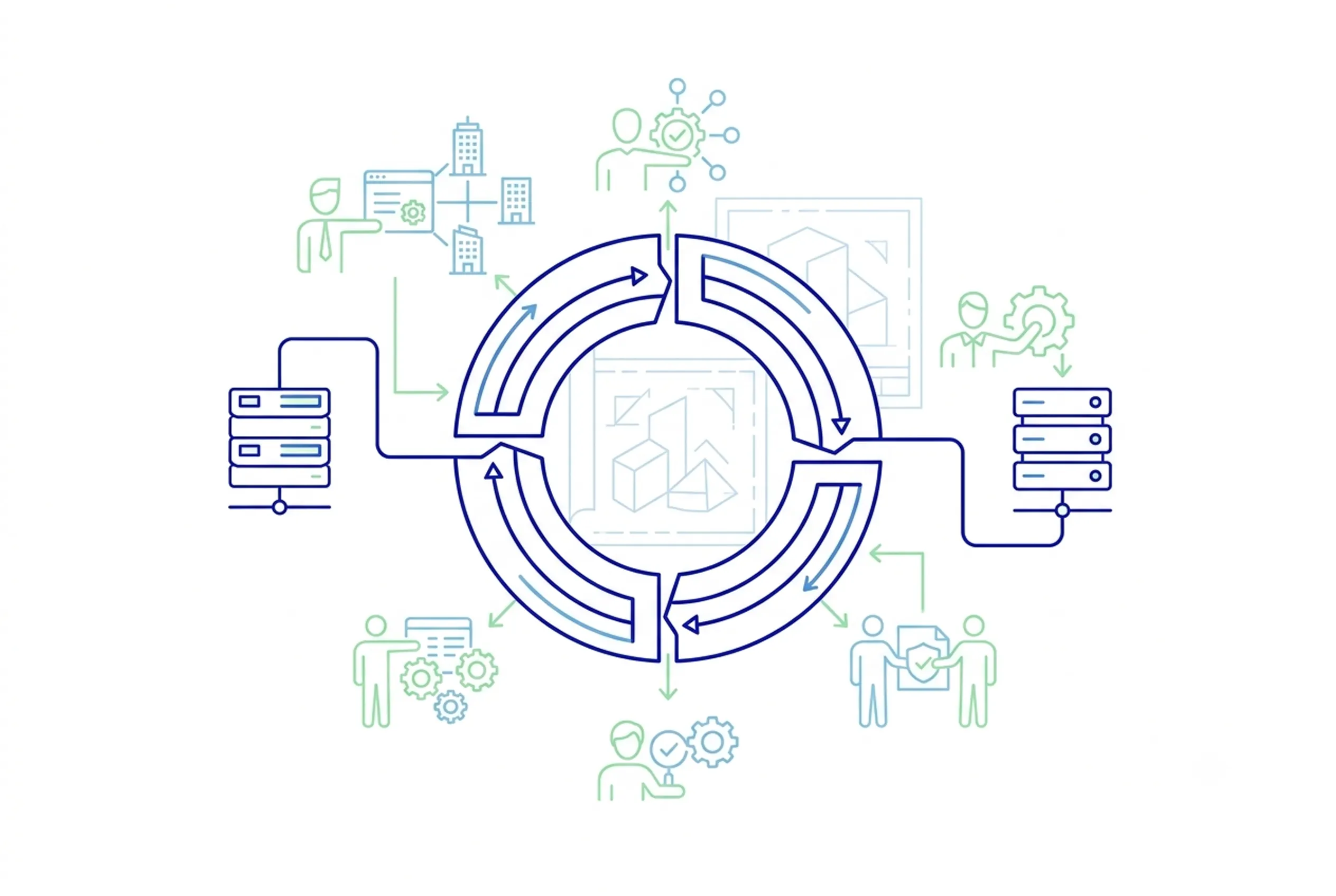
The data governance flywheel is a self-reinforcing cycle where data governance processes and activities are integrated into business operations to build trust and value, creating a continuous loop of improvement.
It combines top-down expertise with bottom-up feedback to manage data quality, security, and usability, which, in turn, drives better data products and greater user engagement, generating more data to govern. This leads to a sustainable competitive advantage by ensuring that, as data use grows, the data remains trustworthy and valuable.
How does it work?
Data owners and experts define standards, policies, and quality rules for data, and publish them for wider use. Then, users and developers leverage governed data, provide feedback, suggest metadata, and identify new use cases, which feed back into the governance process.
This cycle applies to data products, where the goal is to build products that users trust and engage with repeatedly, not just to provide dashboards.
Insights from user engagement and feedback are incorporated to improve the data, creating a positive feedback loop. As new data sources or user groups are onboarded, the cycle is performed swiftly and effectively to maintain momentum.
Key benefits
-
Increased trust and adoption: By embedding governance, data becomes more trustworthy, leading to higher engagement and adoption rates.
-
Sustainable competitive advantage: A well-functioning data flywheel builds a data-driven culture and a compounding advantage that is difficult for competitors to replicate.
-
Scalability: It provides a framework to scale data initiatives across an organization without creating bottlenecks.
-
Improved data quality: User feedback helps maintain and improve data quality over time.
Three Challenges of Data Governance Flywheel
-
Large-scale data processing introduces computational complexity: The flywheel’s potential lies in its ability to scale. But this ability is directly linked to the technical strength or capacity. For supporting real-time updates, AI integration, and dynamic learning, enterprises need a robust infrastructure.
-
Data governance is often resource-intensive: A healthy data governance flywheel relies on consistent, explainable, and clean data. This means governance is not optional; it must be foundational. It requires alignment, automation, and oversight. For many enterprises, this overall becomes a heavyweight. But CXOs need to keep in mind that although the initial struggle is real, so are the long-term benefits.
-
Bias needs to be tracked and managed: the data governance flywheel can be pictured as a standard wheel. The more it spins, the more power it gains/generates. However, power that’s without control can be quite risky. If your data governance framework is compromised by biased/inaccurate/incomplete data, the final report or results will be inaccurate/incomplete as well.
To address these challenges, robust analysis is required to identify blind spots and feedback loops, and to devise ways to mitigate them. This helps to ensure that outcomes from the data governance flywheel remain accurate and well aligned with the organizational objectives.
Data Governance KPIs That Matter to the C-Suite
Data governance KPIs that matter to the C-suite are those that link data initiatives to business value, focusing on outcomes like risk reduction, operational efficiency, and strategic enablement.
Key metrics include compliance and risk management, data quality and trust, data usage and adoption, and cost savings from improved data quality and operational efficiency.
Strategic and value-driven KPIs: When we talk about KPIs related to value and strategy, CXOs need to consider measuring their financial performance and how much it needs to be upgraded to achieve better data quality and operational efficiency. Plus, decision-makers need to showcase how improved data governance has contributed to, or is contributing to, better decision-making. Also, the strategy involves risk mitigation to tackle financial and regulatory risks.
Usage and adoption KPIs: CXOs need to measure how frequently data is used and how effectively business units are using the governed data to execute their decisions. This would reflect the data’s efficiency.
Operational and compliance KPIs: Possibly the most vital yet mentioned last, these compliance KPIs should be taken seriously. As a decision maker, it’s your responsibility to evaluate data assets that all the internal policies and regulatory parameters. Also, the quality of the data revolves around 3 main aspects: accuracy, completeness, and consistency.
Data Governance Maturity Assessment
A structured diagnostic for CDOs, CIOs, and Chief Compliance Officers. 18 questions across six governance dimensions. Receive a scored maturity profile and prioritised recommendations.
Your Details
Your Assessment Results
Overall Governance Maturity Level
Receive Your Full Report
A BluEnt governance consultant will prepare a personalised report with specific recommendations for your highest-priority gaps. Book a 60-minute discovery call to discuss your findings.
Four Best Practices for Establishing Data Governance KPIs
Knowing the data governance KPIs might not be enough, especially for decision-makers at a new enterprise. Here are four best practices to help CXOs establish their data governance KPIs.
Prepare an outline before implementing them. Data governance is something that cannot be messed with. Rather than implementing them at the first instance, it is ideal to lay out the objectives first, such as incident rates, dataset usage, access control violations, and data quality scores. Without a proper outline, it would not be possible to put a data governance plan in place.
Sync the KPIs with business objectives. Again, simply outlining the KPIs is not enough. Those KPIs need to align with your business goals. For example, a KPI for operational efficiency is not aligned with the strategies to achieve the desired level of efficiency. Similarly, the KPI for achieving a higher customer satisfaction rate is not linked to the means to achieve that mark. Remember, when KPIs are clearly mapped with the business strategic goals, they are more likely to be taken seriously.
Implement both quantitative and qualitative parameters. Quantitative parameters include reduced data quality and increased dataset usage. Based on these quantitative aspects, relevant qualitative feedback is provided. This process lets decision-makers devise strategies, such as surveys, to gather stakeholder feedback/trust or to identify areas for improvement.
Automating the metric collection and reporting. If you rely too heavily on manual methods for monitoring data governance outcomes, you will end up with inaccurate data. Instead, incorporate automated tracking and analysis of the data collected. There are various tools that support continuous data quality checks and the use of datasets. This automation decreases the burden on governance teams while delivering continuous improvement.
Reporting Value of Data Governance to the Board
Data governance enables decision-makers to publish & share reports on data value by ensuring that data is accurate, compliant, and reliable. This enables better decision-making, increased efficiency, and reduced risk. To report value, the board can see how governance improves data quality, boosts efficiency through streamlined processes, ensures regulatory compliance, enhances security, and ultimately supports confident, data-driven strategic decisions that lead to business growth.
How does data governance demonstrate value to the board?
Improved decision-making: By providing a single source of truth and high-quality, consistent data, data governance empowers the board to make more confident and informed strategic decisions.
Enhanced compliance and risk mitigation: Effective governance ensures the organization meets regulatory requirements (such as GDPR or SOX) and industry standards, reducing the risk of fines, legal action, and reputational damage.
Increased efficiency and cost reduction: Streamlining processes, reducing data redundancy, and improving data management reduces operational costs and the time spent on data verification.
Greater data integrity and trust: Governance protocols establish clear ownership and quality control measures, building trust in the data used for reporting, which is critical for investors and auditors, especially in publicly traded companies.
Support for innovation: With reliable data, the organization can more effectively use analytics to drive innovation and achieve business goals, a key metric for board-level performance.
Measurable ROI: The value can be demonstrated through metrics such as reductions in data errors, faster reporting, the number of issues resolved, and the financial impact of improved data management.
Conclusion
Most organizations struggle with one core truth: you cannot improve what you cannot measure. Data governance often operates behind the scenes, making its impact difficult to quantify. But with the right set of KPIs, frameworks, and reporting models, data governance becomes a visible engine for your business, adding value.
BluEnt helps enterprises translate governance objectives into measurable, board-ready KPIs. From establishing KPI baselines to implementing real-time dashboards and automating stewardship workflows, we ensure your data governance and compliance program delivers higher data trust, quality, and security, along with faster & better insights.
FAQs
What are the most important KPIs for measuring data governance success?The most important Key Performance Indicators (KPIs) for data governance success include data quality metrics (like accuracy, completeness, and consistency), compliance rates, security incident frequency, and data accessibility/availability. Other crucial metrics are stakeholder engagement and data usage to ensure the program delivers business value and is adopted across the organization.
How often should data governance KPIs be reviewed?Data governance KPIs should be reviewed quarterly to stay aligned with organizational goals and regulatory requirements. However, the frequency can vary; more dynamic industries may benefit from quarterly reviews, while stable environments might only need biannual assessments. It’s also advisable to review KPIs after significant changes, such as the deployment of new AI models or major regulatory shifts.
How do I show the ROI for data governance to executives?To demonstrate ROI, combine tangible benefits such as cost savings and revenue growth with intangible benefits, such as improved decision-making. Start by establishing a baseline and defining metrics that align with business goals, then track your progress. Presenting a mix of quantitative and qualitative data, supported by clear visuals, will provide a comprehensive picture of data governance’s value.
Can BluEnt help set up dashboards to track governance KPIs?Yes, BluEnt can help set up dashboards to track governance KPIs as part of its business intelligence and data visualization services. This includes defining KPIs, assessing data readiness, and recommending the right technology stack to build a dashboard that provides a clear, visual overview of governance performance metrics.

 Governing AI Tools in AEC: Copilot, Digital Twins, and Generative Design
  Data Governance for AI and Advanced Analytics: Building the Foundation That Works
  Centralized vs. Federated Data Governance: Which Model Fits Your Organization
  Data Governance Roles and Responsibilities in AEC Organizations