










Short answer
Disaster recovery (DR) is the process of restoring IT systems and data after a disruptive event. Business continuity (BC) is the broader capability to maintain critical business functions during and after a disruption. DR is a component of BC. The distinction matters because an organization can achieve its DR targets, with systems restored within the defined RTO window, and still fail its BC objectives if the recovered data environment is not trusted, documented, or usable by the business. The data governance layer, including ownership records, lineage documentation, quality baselines, and data catalog metadata, is routinely excluded from DR backup scope. When it is, organizations discover that technically recovered data takes additional days or weeks to become operationally trusted and usable.
Your DR plan has defined RTO and RPO targets. Your infrastructure team tests failover annually. Your backup systems are running nightly. On paper, you are prepared for a data platform disruption. In practice, there is a gap in most enterprise recovery plans that only surface during an actual incident: the data governance layer was not in scope.
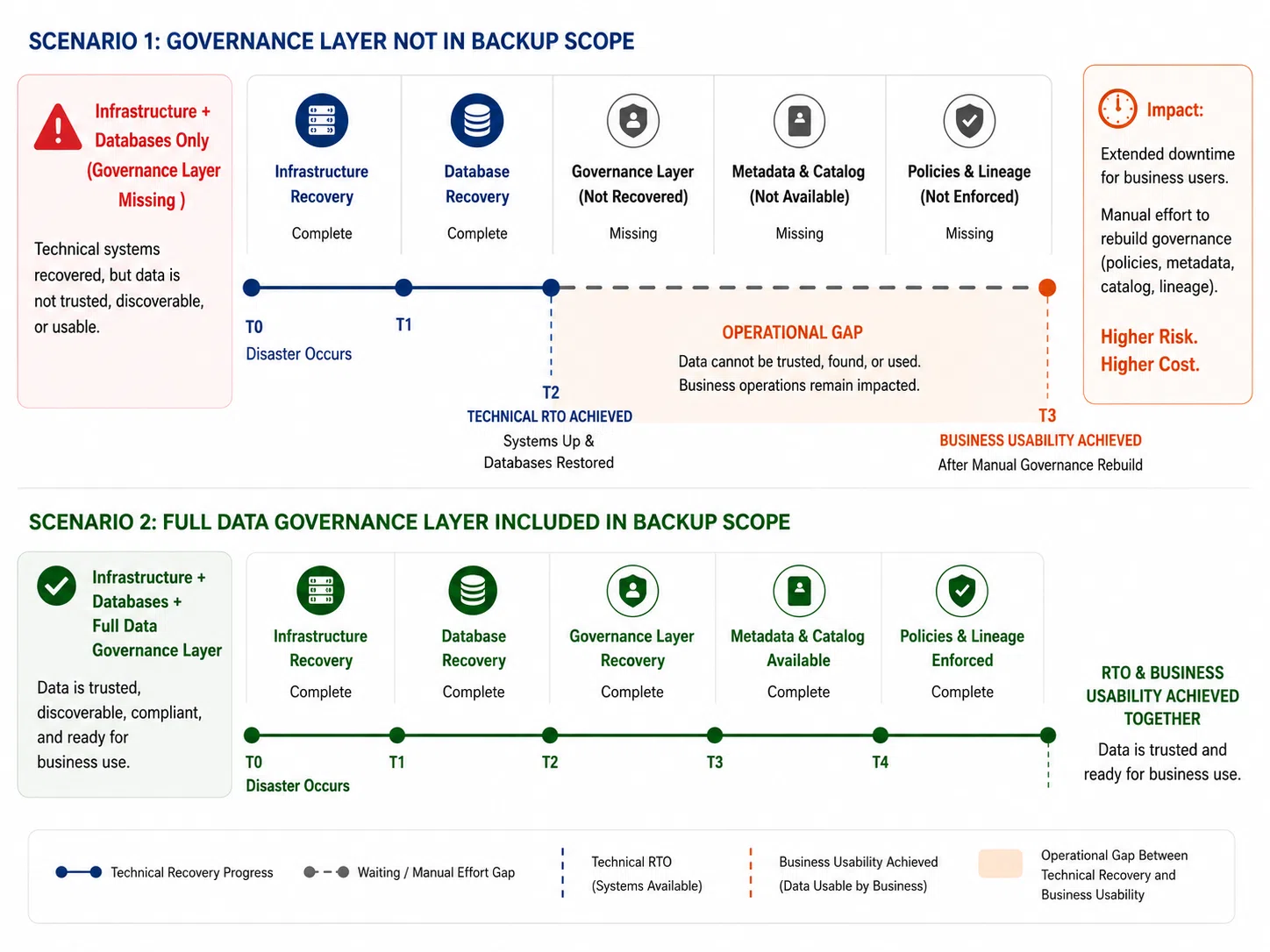
When systems come back online after a significant incident, the infrastructure is restored and the data is present. But the data dictionary that tells analysts what each field means is outdated. The lineage documentation that connects reports to their source tables has not been restored. The quality baselines that define what good data looks like for each domain have not been recovered. The ownership records that identify who is accountable for each data asset are missing. The result is a technically recovered data environment that the business cannot confidently use for days or weeks after the infrastructure RTO target has been met.
This is the gap between DR success and BC success. This article covers how to close it.
Table of Contents:
| 72 hours | Organizations subject to the GDPR must notify the relevant supervisory authority of a qualifying personal data breach without undue delay and, where feasible, within 72 hours of becoming aware of it, unless the breach is unlikely to result in a risk to individuals’ rights and freedoms. Effective data governance, including accurate data inventories and lineage, can significantly improve an organization’s ability to identify affected personal data, assess the breach, and meet regulatory notification requirements during incident response. Source: GDPR Article 33, Notification of a personal data breach to the supervisory authority, Regulation (EU) 2016/679 |
|---|
DR vs BC: The Distinction That Matters When Things Go Wrong Why meeting DR targets does not guarantee meeting BC objectives
| Dimension | Disaster Recovery (DR) | Business Continuity (BC) |
|---|---|---|
| Primary objective | Restore IT systems, data, and infrastructure after a disruptive event | Maintain critical business functions during and after a disruption |
| Scope | Technology: servers, databases, networks, applications | People, processes, facilities, technology, communications, and data |
| Key metrics | RTO (Recovery Time Objective), RPO (Recovery Point Objective) | Maximum Tolerable Period of Disruption (MTPD) per business function |
| Standard | NIST SP 800-34, vendor-specific DR frameworks | ISO 22301:2019, Business Continuity Management Systems |
| Success criterion | Systems restored within RTO; data loss within RPO | Critical business functions maintained or restored within MTPD |
| Data governance role | Typically limited to database backup and replication | Requires data to be usable and trusted, not just present |
RTO and RPO measure recovery speed, not recovery quality
Recovery Time Objective (RTO) defines the maximum acceptable time for a system or process to be restored after a disruption. Recovery Point Objective (RPO) defines the maximum acceptable data loss, expressed as the point in time to which data must be recoverable. These metrics measure whether systems are back, and data is present. They do not measure whether the recovered data environment is trusted and usable by the business.
An organization can meet a 4-hour RTO target with precision, restoring all databases and applications within the defined window, and still find that business teams cannot confidently use the recovered data environment for another 48 hours. If the data dictionary is from a stale backup, analysts do not know what the recovered fields mean. If lineage documentation was not in backup scope, the BI team cannot verify which reports are safe to run against recovered data. If quality baselines were not recovered, the data governance team cannot confirm whether the recovered data meets the quality standard the business expects.
Business continuity requires more than infrastructure recovery
ISO 22301:2019, the international standard for business continuity management systems, defines business continuity as the capability of an organization to continue the delivery of products and services within acceptable timeframes at predefined capacity during a disruption. Delivering data-dependent products and services at predefined capacity requires not just recovered infrastructure, but trusted data that business teams can act on.
The Maximum Tolerable Period of Disruption (MTPD) for a business function that depends on data, for example a risk reporting function, a fraud monitoring function, or an AI-driven operational process, includes both the infrastructure recovery time and the time to establish confidence in the recovered data environment. If data governance metadata is not in scope for recovery, the MTPD is effectively the RTO plus however long it takes to reconstruct the governance context manually.
Is Your Data Governance Ready for Business Continuity?
Assess your data governance maturity to identify gaps in data resilience, recovery readiness, ownership, and governance before they impact business continuity.
Data Governance Maturity Assessment
A structured diagnostic for CDOs, CIOs, and Chief Compliance Officers. 18 questions across six governance dimensions. Receive a scored maturity profile and prioritised recommendations.
Your Details
Your Assessment Results
Overall Governance Maturity Level
Receive Your Full Report
A BluEnt governance consultant will prepare a personalised report with specific recommendations for your highest-priority gaps. Book a 60-minute discovery call to discuss your findings.
The Data Governance Gap in Most DR/BC Plans What the governance layer contains and what happens when it is missing from recovery
What the data governance layer contains
The data governance layer is the set of metadata, documentation, and configuration that makes data trustworthy and usable. It includes: the data catalog with business definitions, data classifications, and ownership records; data lineage documentation tracing datasets from source to consumption; quality baselines and SLA definitions for each governed data domain; data stewardship records identifying who is accountable for each data asset; access control configurations and data classification policies; and the governance metadata stored within governed data platforms (Unity Catalog registrations, Snowflake data catalog entries, dbt documentation).
None of these assets are typically included in standard database backup scope. Database backups capture the data itself. The governance metadata often lives in separate systems: a catalog tool, a documentation wiki, a governance platform, or configuration files in a version control repository. If these systems are not explicitly included in the DR backup and recovery plan, they are not recovered.
The operational impact of missing governance metadata
When governance metadata is absent from the recovered environment, several things happen simultaneously. Analysts cannot confirm whether recovered data meets quality standards, because the quality baselines and monitoring configurations have not been restored. Data stewards cannot verify ownership assignments, because the stewardship records have not been recovered. BI teams are reluctant to publish reports from recovered data, because they cannot trace the recovered data back to a known-good source. Compliance teams cannot respond to regulatory inquiries, because the data classification and lineage records needed for incident analysis have not been restored.
Each of these gaps adds time to the period during which the business cannot operate normally on its data platform. In regulated industries, some of these gaps create compliance exposure: GDPR Article 33 requires breach of notification within 72 hours based on information about which data was affected and where it came from. If lineage documentation has not been recovered, that analysis must be performed manually from partially restored systems under incident response pressure.
From the field
In DR testing exercises where we have included a data governance layer check alongside standard infrastructure recovery tests, the most frequently missing elements are data catalog metadata and quality monitoring configurations. Both are typically stored in separate systems from the primary data platform and are not included in the database backup scope reviewed by the infrastructure team. Adding them to backup scope is straightforward once the gap is identified. The challenge is that the gap is only visible to someone who knows to look for it, which requires data governance team participation in DR plan review, not just the infrastructure and application teams.
Build a More Resilient Data Governance Strategy
Our experts help organizations strengthen data governance to support business continuity, disaster recovery, and long-term operational resilience.
Designing Data Recovery into Business Continuity Planning Changes to backup scope, RTO/RPO definitions, and recovery sequencing
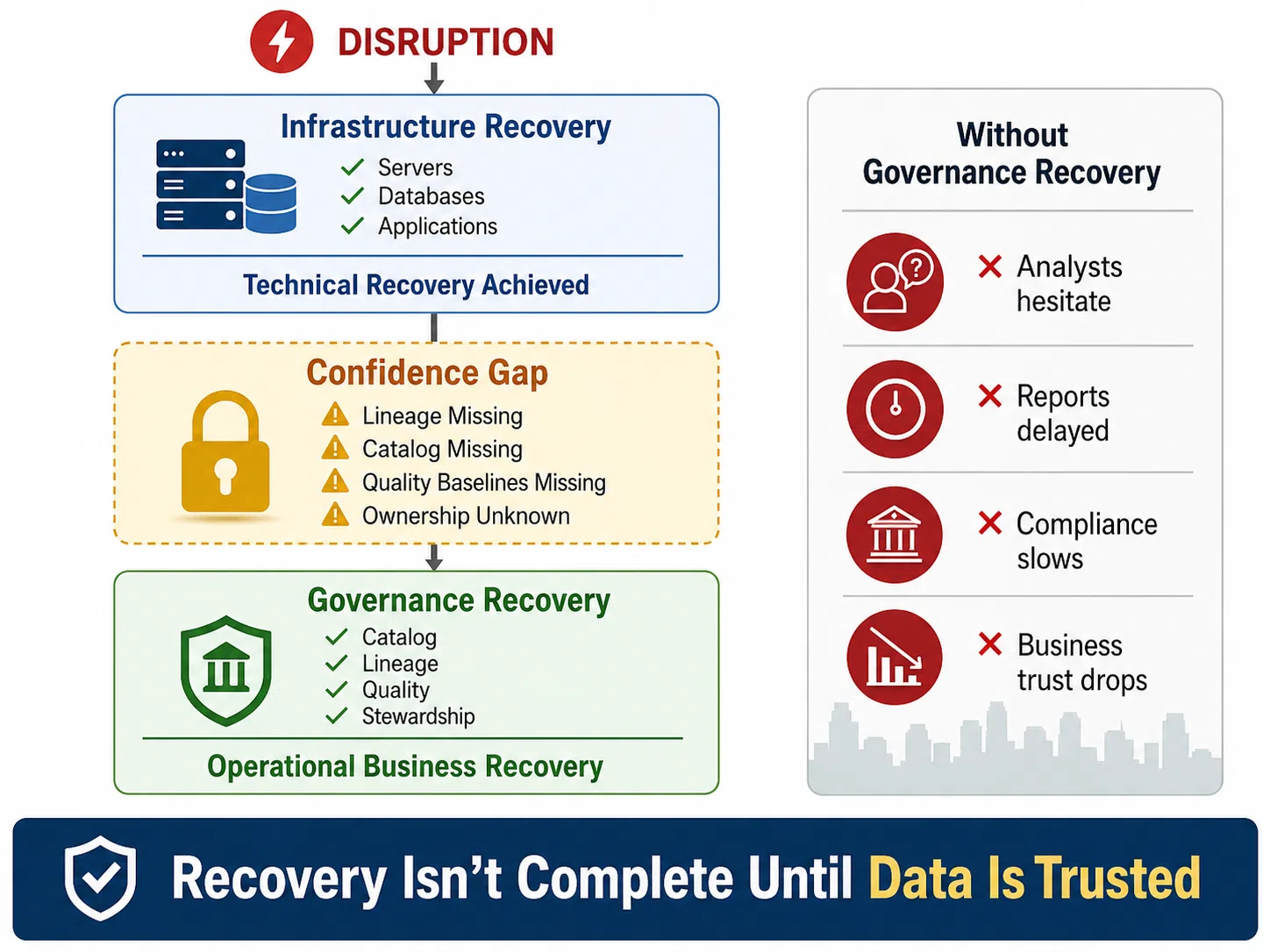
Step 1: Include governance metadata in backup scope
The first change is operational: ensure the systems and artifacts that contain governance metadata are included in the DR backup scope. This typically means adding the data catalog system and its database, the data quality monitoring configuration and its results store, the lineage documentation store, any governance platform databases, and the version-controlled configuration files that define data platform governance settings (Unity Catalog policies, Snowflake row access policies, dbt project files).
Catalog the governance metadata systems the same way infrastructure systems are catalogued for DR: identify the system, define the RPO and RTO for that system, specify the backup method and frequency, and include it in recovery sequencing. Governance metadata systems are typically smaller and faster to recover than primary data platforms, so adding them to backup scope adds minimal cost and complexity.
Step 2: Define data-layer RTO and RPO separately from infrastructure RTO and RPO
Most BC plans define a single RTO per system. For data-dependent business functions, it is more useful to define two targets: the infrastructure RTO (the time to restore systems so that data is accessible) and the data usability RTO (the time to restore the governance context so that data is trusted and operational decisions can be made from it). The gap between these two targets, when data governance metadata is not in scope, is where BC plans fail to deliver on their promise.
Define data usability of RTOs for each critical business function that depends on data. What is the maximum time after a disruptive event before the fraud monitoring team needs to be able to trust the transaction data in the recovered environment? What is the maximum time before the risk reporting function needs reliable data outputs? These answers drive the governance metadata recovery requirements, including which governance systems need to be recovered in what sequence.
Step 3: Sequence governance metadata recovery before data consumption
Recovery sequencing should place governance of metadata restoration before data consumption activities are permitted. The sequence for a data platform recovery event should be restore infrastructure and databases (achieving the infrastructure RTO target), restore governance metadata systems and validate their integrity, restore quality monitoring configurations and run baseline validation checks against recovered data, notify data stewards and confirm ownership is clear in the recovered environment, and only then permit business users to run reports and analyses against the recovered data.
This sequencing adds time between infrastructure recovery and data consumption. The time added is the time to restore and validate governance metadata, which for a well-prepared plan with governance systems in backup scope should be measurable in hours rather than days. The alternative, allowing data consumption before governance validation, means business teams are using recovered data without knowing its quality or lineage status, which is a risk to decision quality during an already high-stress incident response period.
Step 4: Include data governance requirements in vendor and cloud DR agreements
For organizations using cloud data platforms (Snowflake, Databricks, BigQuery, Azure Synapse) or managed data services, the DR agreement with the vendor defines what is recovered and when. Review vendor DR commitments specifically for governance metadata: does the managed Snowflake environment backup include Unity Catalog registrations? Does the managed Databricks environment backup include MLflow experiment records and model registry state? Does the data catalog SaaS tool have its own DR commitments, and are they aligned with your data platform’s recovery targets?
Gaps in vendor DR coverage for governance metadata may require supplemental backup of governance configuration exports, or contractual amendments to expand the vendor’s recovery scope. This is an easier negotiation during contract renewal than during an active incident.
Note: Many cloud-managed data platform services treat governance metadata as customer-managed configuration rather than platform-managed data. This means the vendor’s DR commitments cover the platform infrastructure and primary data storage but may not cover the governance configuration the customer has built on top of the platform. Review vendor DR terms specifically for this distinction before assuming that governance metadata is covered.
Recommended Reading:
Testing for Data Completeness, Not Just Infrastructure Recovery Adding a data governance validation layer to DR testing
What standard DR tests miss
Standard DR tests verify that systems come back online within the defined RTO, that data is present and within the defined RPO, and that critical applications are functional. They do not typically verify that the recovered data environment is usable in the sense that matters for business continuity: that analysts can find data assets in the catalog, that lineage documentation is current and consistent with the recovered data state, that quality monitoring is running and producing results, and that ownership assignments are clear and current.
These usability checks require data governance team participation in DR testing, not just the infrastructure and application teams. In most organizations, the data governance team is not included in DR test exercises. The test is declared successful when systems are restored within target. The data governance gaps are only discovered during an actual incident, when the pressure to deliver business outputs is highest.
A data governance validation checklist for DR tests
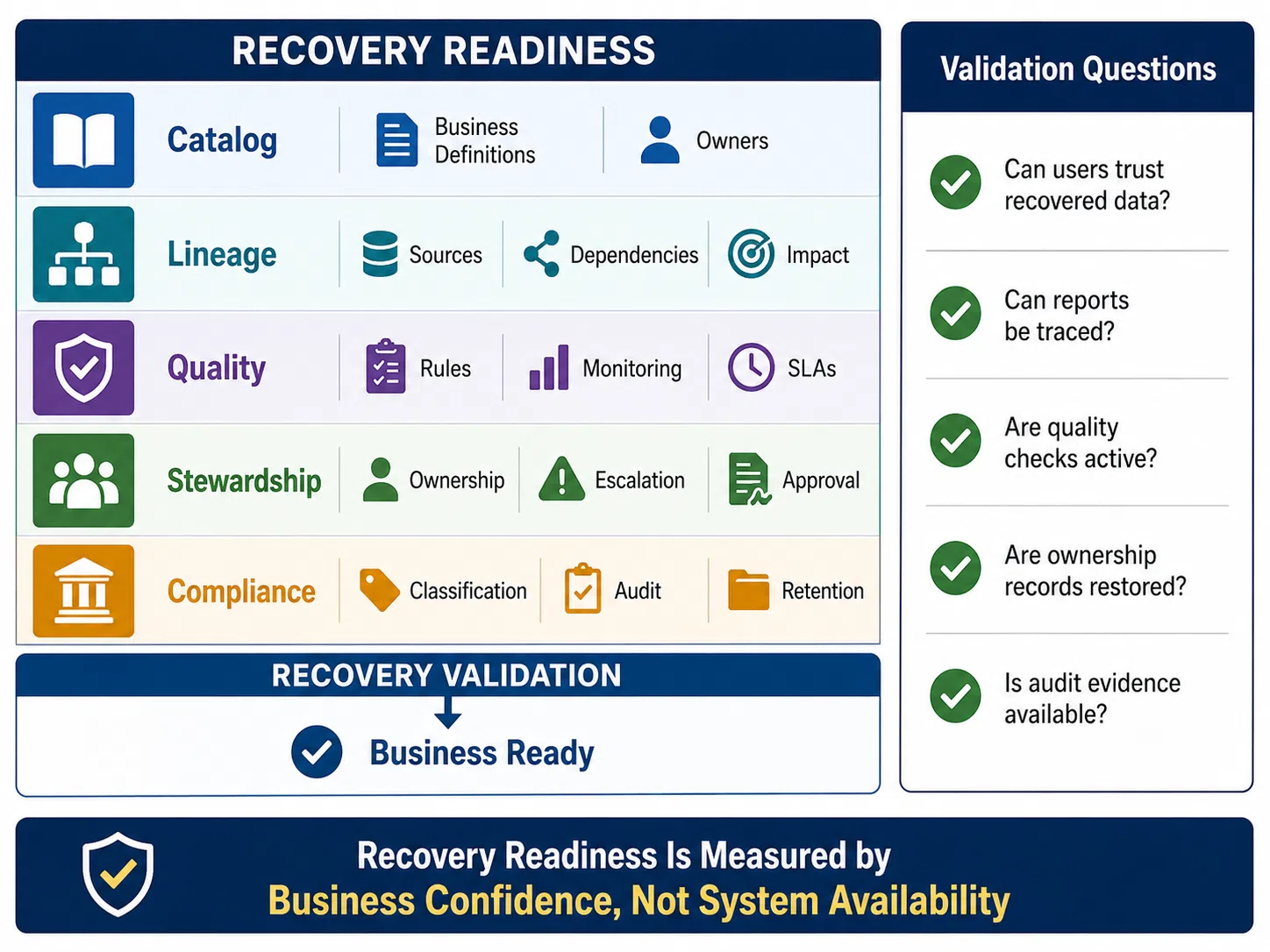
Add the following validation steps to DR test exercises, to be completed after infrastructure recovery is confirmed and before the test is declared successful:
-
Data catalog integrity: Can data stewards access the catalog and find their data assets? Are business definitions, ownership records, and classification tags present and current as of the recovery point?
-
Lineage validation: Can the BI team trace a critical report’s source tables through the lineage graph to the ingestion layer? Does the lineage reflect the pre-incident state?
-
Quality monitoring status: Are automated quality monitoring checks running against recovered data? Are the quality baselines appropriate to the recovered data state?
-
Ownership confirmation: Can data stewards confirm their accountability for data assets in the recovered environment? Are stewardship workflows accessible and operational?
-
Compliance readiness: If a regulatory inquiry arrived within 24 hours of the incident, could the team identify which data was affected, where it came from, and who had access to it from the recovered environment?
Document failures in any of these checks as BC gaps alongside infrastructure RTO misses. Address them in the same remediation cycle. A DR test that passes infrastructure checks but fails data governance validation has identified a real BC risk that will surface in an actual incident.
Frequency and scope of data governance DR testing
Full DR tests with data governance validation should run at the same frequency as infrastructure DR tests, typically annually for full tests and quarterly for targeted component tests. Additionally, data governance team participation in tabletop exercises, where a simulated incident scenario is walked through without actual system failover, allows governance gaps to be identified and remediated without the cost of a full infrastructure failover test. Tabletop exercises are particularly useful for testing the GDPR 72-hour breach notification scenario, where governance metadata quality under incident conditions can be assessed without requiring a live recovery.
The bottom line
DR and BC are not the same objective. DR restores systems. BC restores the ability to operate. For data-dependent organizations, the distance between those two outcomes is determined by whether the data governance layer was included in recovery scope. Most plans include infrastructure. Most plans miss governance metadata. The gap surfaces during incidents, under pressure, and costs more to close than it would have cost to prevent.
-
Include governance metadata systems explicitly in DR backup scope: catalogs, lineage stores, quality monitoring configurations, stewardship records
-
Define data usability RTOs for each critical business function separately from infrastructure RTOs
-
Sequence governance metadata validation before permitting data consumption in the recovery process
-
Include the data governance team in annual DR test exercises and quarterly tabletop scenarios
-
Review cloud vendor DR commitments specifically for governance metadata coverage, not just primary data platform recovery
If your current DR/BC plan was designed by the infrastructure and application teams without data governance team input, a governance-layer review of the plan will identify the specific gaps and the remediation steps to close them before the next incident.
Close the data governance gap in your DR/BC plan
BluEnt’s data governance team works with CIOs, CDOs, and resilience planners to audit DR/BC plans for data governance coverage, identify governance metadata backup gaps, define data usability RTOs, and design the recovery sequencing and testing protocols that ensure technical recovery translates into operational business continuity.
Common Questions What CIOs, CDOs, and resilience planners ask about the data dimension of DR/BC
What is the difference between RTO and RPO?Recovery Time Objective (RTO) is the maximum acceptable time for a system, process, or function to be restored after a disruption. An RTO of 4 hours means the organization cannot tolerate the system being unavailable for more than 4 hours. Recovery Point Objective (RPO) is the maximum acceptable data loss, expressed as the age of the most recent data that must be recoverable. An RPO of 1 hour means backups must be taken at least every hour, so that no more than 1 hour of data is lost in a recovery scenario. RTO governs recovery speed; RPO governs backup frequency. Both are measured from the perspective of individual systems or business processes, not the organization as a whole, because different systems have different recovery criticality.
What is ISO 22301 and does it cover data governance?ISO 22301:2019 is the international standard for Business Continuity Management Systems. It specifies requirements for planning, establishing, implementing, operating, monitoring, reviewing, maintaining, and continually improving a documented management system to protect against, reduce the likelihood of occurrence of, prepare for, respond to, and recover from disruptive incidents. ISO 22301 addresses business continuity at the organizational and process level, not the specific technical scope of backup systems. Data governance is not explicitly named in the standard, but the requirement to maintain critical business functions within the Maximum Tolerable Period of Disruption implicitly requires that data assets be recoverable in a trusted and usable state, not just technically present.
What data governance metadata should be included in DR backup scope?The governance metadata assets most commonly missing from DR backup scope include: the data catalog database and its metadata (business definitions, classifications, ownership records, quality scores); data lineage documentation stored in catalog or lineage tools; quality monitoring configurations and historical quality results; data stewardship records and accountability assignments; access control policy configurations for data platforms; and governance metadata stored within managed platform services (Unity Catalog registrations, MLflow model registry state, Snowflake data catalog entries). The specific assets and the systems in which they reside vary by organization. A governance metadata audit, conducted with the data governance and IT teams together, identifies the specific assets and their current backup coverage.
How does GDPR affect DR/BC planning for data teams?GDPR creates two specific requirements that intersect with DR/BC planning. Article 33 requires notification to the supervisory authority within 72 hours of becoming aware of a personal data breach, including information about the nature of the breach, the categories and approximate number of data subjects affected, and the likely consequences of the breach. This notification requires data lineage and classification information to be available during incident response, potentially from partially recovered systems. Article 32 requires appropriate technical and organizational measures to ensure a level of security appropriate to the risk, including the ability to restore the availability and access to personal data in a timely manner in the event of a physical or technical incident. DR plans for systems containing personal data must therefore be able to demonstrate that access can be restored within a defined timeframe, which is a testable requirement.
Should the CDO be involved in DR/BC planning?Yes. DR/BC planning for data-dependent organizations requires CDO or data governance team participation at the planning stage, not only at the incident response stage. The CDO or data governance team brings three things the infrastructure DR team typically does not have: knowledge of which data assets are most critical to business operations and require the tightest recovery targets, knowledge of which governance metadata systems need to be included in backup scope, and the ability to define and test data usability RTOs in addition to infrastructure RTOs. Without this participation, DR plans are typically adequate for infrastructure recovery and inadequate for business continuity of data-dependent functions.
What is a data usability RTO and how is it different from an infrastructure RTO?An infrastructure RTO defines the time to restore systems so that data is technically accessible. A data usability RTO defines the time to restore the governance context so that data is trusted and operational decisions can be made from it. The gap between the two is the time required to restore and validate governance metadata after infrastructure recovery is complete. In a well-prepared organization with governance metadata in backup scope, this gap may be a few hours. In an organization where governance metadata was not in backup scope, this gap may be days or weeks, as governance metadata is reconstructed manually from stale sources. Defining data usability RTOs for each critical business function and testing against them in DR exercises is the mechanism for closing this gap proactively.

 Governing AI Tools in AEC: Copilot, Digital Twins, and Generative Design
  Data Governance for AI and Advanced Analytics: Building the Foundation That Works
  Centralized vs. Federated vs. Hybrid Data Governance: Which Model Fits Your Organization
  Data Governance Roles and Responsibilities in AEC Organizations