










Short answer
Data risk management covers six distinct risk types: data quality risk, data security and breach risk, regulatory and compliance risk, data availability and resilience risk, shadow data risk, and third-party data risk. Most enterprise organizations have mature programs for security risk and compliance risk, and ad hoc or absent programs for the other four. The organizations with the strongest overall data risk posture treat data governance as the unifying capability: quality management, lineage documentation, data classification, and stewardship accountability together provide the control layer that reduces risk across all six categories simultaneously.
Ask a CRO about what their organization’s biggest data risks are, and you will typically hear two answers: data breaches and regulatory non-compliance. Both are real, and both deserve the investment they receive. But they account for roughly a third of the data risk landscape that enterprise organizations actually face.
Data quality risk, which produces incorrect analytics and AI outputs that drive bad decisions, rarely appears in the enterprise risk register. Shadow data risk, which exposes organizations to breaches and compliance failures from data stores that no governance program has catalogued, is systematically undercounted. Third-party data risk, which grows with every vendor relationship and API integration, is frequently managed by procurement rather than risk or data governance teams. Data availability risk, which determines whether the business can continue to operate when a data platform fails, is often owned entirely by IT infrastructure with no data-layer risk assessment.
A comprehensive data risk management program addresses all six categories within a coherent framework. Data governance is the enabling capability that makes it possible without building six separate programs.
Table of Contents:
| $4.45M | Average global cost of a data breach in 2023, the highest figure recorded in the report’s 18-year history. Strong data governance, together with mature security and incident response capabilities, helps reduce organizational exposure to data-related risks. Source: IBM Cost of a Data Breach Report 2023, Ponemon Institute. |
|---|
Why Data Risk Is Broader Than Most Risk Frameworks Recognize The categories outside most enterprise risk programs and why they matter
The visibility problem
Data breach risk is visible: it produces regulatory fines, legal liability, and news coverage that appear in board-level risk discussions. Regulatory compliance risk is visible: auditors and regulators identify it explicitly, and non-compliance has defined financial consequences. These two categories have mature industry frameworks, dedicated organizational functions, and significant technology investment.
Data quality risk is largely invisible until it causes a decision failure: a forecast based on incorrect data that leads to a wrong inventory call, a credit model that produces systematically biased scores for a customer segment, an AI system whose training data was corrupted in a pipeline that nobody monitored. Failure appears as a business problem, not a data risk event. The data risk root cause is identified only when someone investigates why the decision went wrong.
The ownership gap
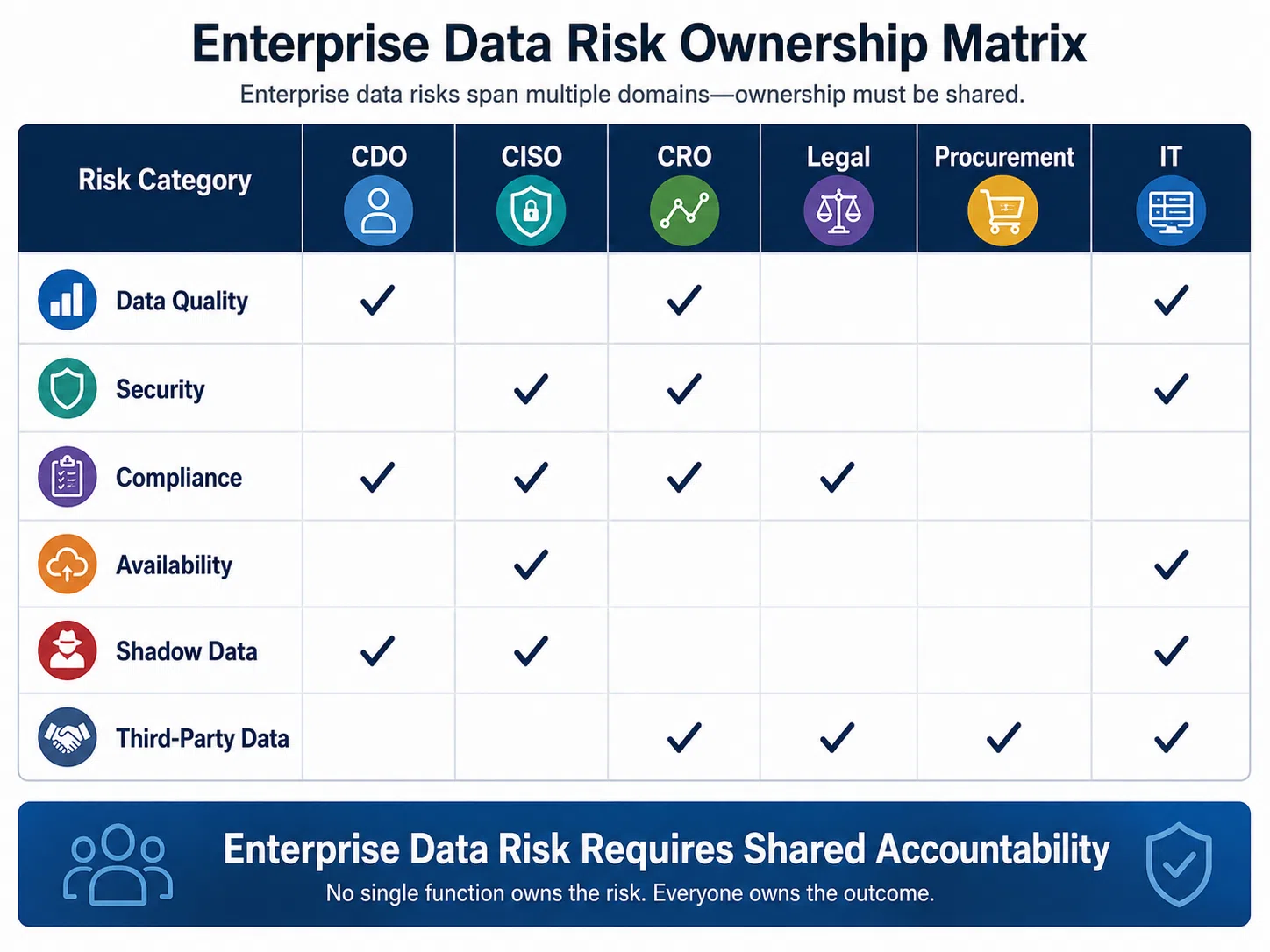
Security risk is owned by the CISO. Compliance risk is owned by the Chief Compliance Officer or General Counsel. These are clearly defined organizational functions with budget, authority, and accountability. Data quality risk, shadow data risk, and third-party data risk typically have no clear owner. They fall between the security function (which focuses on authorized data stores), the compliance function (which focuses on regulated data), and the data engineering team (which manages pipelines, not risk).
The CDO is the natural owner of a comprehensive data risk program, but many CDOs are measured against analytics delivery and AI enablement objectives rather than risk management outcomes. Building data risk management into the CDO mandate requires explicit sponsorship from the CRO and CEO, and a risk framework that connects data risk to business impact in terms the risk function recognizes.
The compounding effect
The six data risk categories compound each other. Shadow data, by definition, lacks the quality controls and access governance of managed data stores, so shadow data risk amplifies both quality risk and breach risk. Third-party data relationships introduce data into the environment from sources that the internal governance program does not control, creating quality risk and compliance risk simultaneously. A data availability event that takes down the primary data platform will disproportionately affect regulated business processes if the continuity planning did not include a data governance assessment of which data assets are business critical.
Assess Your Data Risk Management Readiness
Evaluate the governance capabilities that help organizations minimize data risk, strengthen compliance, and support trusted business decisions.
Data Governance Maturity Assessment
A structured diagnostic for CDOs, CIOs, and Chief Compliance Officers. 18 questions across six governance dimensions. Receive a scored maturity profile and prioritised recommendations.
Your Details
Your Assessment Results
Overall Governance Maturity Level
Receive Your Full Report
A BluEnt governance consultant will prepare a personalised report with specific recommendations for your highest-priority gaps. Book a 60-minute discovery call to discuss your findings.
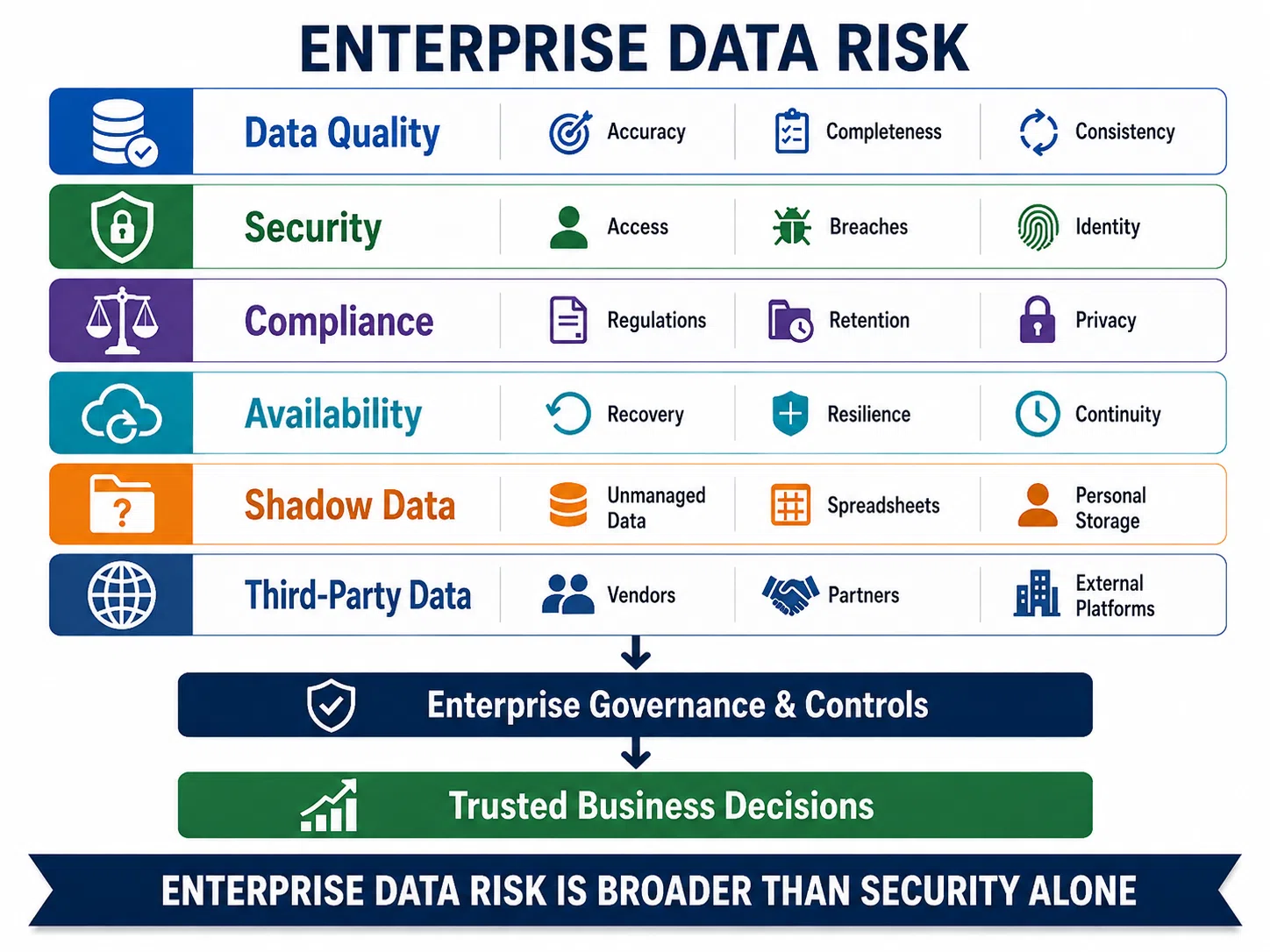
The Enterprise Data Risk Taxonomy Six data risk categories with definitions, typical owners, and primary controls
Enterprise metadata comes in three distinct categories, each with different owners, different tools, and different governance requirements. A mature metadata strategy addresses all three, not just the technical layer that automated tools can capture.
| Risk type | What goes wrong | Typical owner | Primary controls |
|---|---|---|---|
| Quality risk | Incorrect, incomplete, or inconsistent data drives flawed decisions, AI failures, and financial errors | CDO / Data stewards | Data quality management program, quality SLAs, automated monitoring, certified data products |
| Security and breach risk | Unauthorized access, exfiltration, or corruption of sensitive data assets | CISO | Access controls, encryption, RBAC, data classification, breach detection, incident response |
| Regulatory and compliance risk | Non-compliance with GDPR, CCPA, HIPAA, SOX, sector-specific mandates, resulting in fines or sanctions | CCO / Legal | Data classification, retention policies, consent management, audit trails, DPA obligations |
| Availability and resilience risk | Data platform downtime, backup failures, or disaster events that interrupt business-critical data access | CTO / IT Infrastructure | Data backup and recovery, multi-region replication, RTO/RPO definition, disaster recovery testing |
| Shadow data risk | Data stored outside governed systems: unsanctioned cloud storage, analyst spreadsheets, departmental databases | CDO / Compliance | Data discovery and classification, shadow data policies, data catalog governance, access audits |
| Third-party data risk | Data received from or shared with vendors, partners, and data providers that is ungoverned, low-quality, or non-compliant | Procurement / CDO | Third-party data due diligence, data sharing agreements, quality SLAs in contracts, API governance |
Strengthen Your Enterprise Data Risk Strategy
Our consultants help organizations establish governance frameworks that reduce data risk, improve compliance, and enable trusted decision-making.
Best Practices for Each Risk Category Actionable controls for the four categories most organizations under-manage
Data quality risk: treat quality as a business SLA, not a technical metric
The most effective data quality risk control is defining quality requirements from the business downstream, not from the data upstream. Instead of setting quality thresholds based on what the data team thinks is acceptable, define quality requirements based on the decisions each dataset informs and the cost of a quality failure in that context. A dataset that drives a daily operational decision has a different quality SLA than one used for annual trend reporting.
Automated data quality monitoring, using tools appropriate to the platform (DMFs in Snowflake, dbt tests in the transformation layer, data observability tools for continuous monitoring), enforces these SLAs without requiring manual checks. Quality scores for each governed dataset should be visible in the data catalog so data consumers can assess fitness-for-use before querying.
Data stewardship accountability is the governance mechanism that drives quality improvement when automated checks identify problems. Stewards own the quality of data in their domain, escalate issues that automated remediation cannot resolve, and are measured against quality SLA performance rather than completeness of documentation.
Shadow data risk: find it, classify it, govern it or eliminate it
Shadow data cannot be governed until it is found. Data discovery tooling, combined with a data classification policy, identifies data stores that exist outside the governed data environment: cloud storage buckets without access policies, departmental databases provisioned outside IT governance, analyst shared drives containing customer extracts, third-party analytics platforms with copies of production data.
Once discovered, each shadow data store has three outcomes: migrate it to the governed environment, decommission it if it duplicates governed data, or formally bring it under governance with documented ownership, classification, and access controls. The outcome is determined by the data’s business purpose and risk level. PII or regulated data found in an ungoverned store requires immediate remediation regardless of business purpose.
Note: Shadow data is an underestimated breach surface. When organizations conduct post-incident analysis of data breaches, exfiltrated data is frequently traced to shadow stores rather than primary governed systems. Attackers seek the path of least resistance, which is often a cloud storage bucket with public permissions or a departmental database that never received the access hardening applied to production systems.
Third-party data risk: build due diligence into procurement, not after it
Third-party data risk management begins in the procurement process, not after a vendor contract is signed. A third-party data due diligence process assesses the data governance maturity of vendors sharing data with or receiving data from the organization: how they classify data, what quality controls they apply, how they handle PII, what their breach notification process is, and whether their data practices comply with the regulations that apply to your use case.
Data sharing agreements should include contractual quality SLAs with defined remedies, data use restrictions that prevent vendors from repurposing your data, breach notification timelines that meet your regulatory obligations, and audit rights that allow your compliance team to verify vendor data practices. Many organizations discover that their vendor contracts were negotiated by procurement teams without data governance input and contain none of these provisions.
For vendors providing data feeds that feed AI training data or business-critical analytics, quality monitoring should be applied at the API boundary before that data enters the governed environment. A quality failure in a vendor data feed should trigger the same incident response as a quality failure in an internal pipeline.
Data availability and resilience risk: include data governance in business continuity planning
Most business continuity and disaster recovery planning focuses on infrastructure: server availability, network redundancy, backup frequency, and recovery time objectives. Data-layer risk assessment adds a dimension that infrastructure planning does not address: which data assets are business-critical, what their acceptable data loss window is (recovery point objective), and whether the backup and recovery process preserves not just the data but the governance metadata that makes it trustworthy and usable.
A recovered database without its data dictionary, lineage documentation, and quality history is technically present but functionally degraded. Business teams cannot immediately use data they cannot validate. Disaster recovery testing should include a data governance layer: verify that recovered data assets are accompanied by the metadata and documentation that makes them usable, not just that the byte count matches the original.
From the field
In post-incident reviews of significant data availability events, a recurring finding is that recovery time objectives were defined for infrastructure and databases, but not for the data governance metadata that makes recovered data usable. Organizations recovered data assets in their defined RTO window and then spent additional days to weeks reconstructing the ownership records, quality baselines, and business definitions needed to trust and use the recovered data. Including data governance metadata in backup scope and recovery testing eliminates this gap.
Recommended Reading:
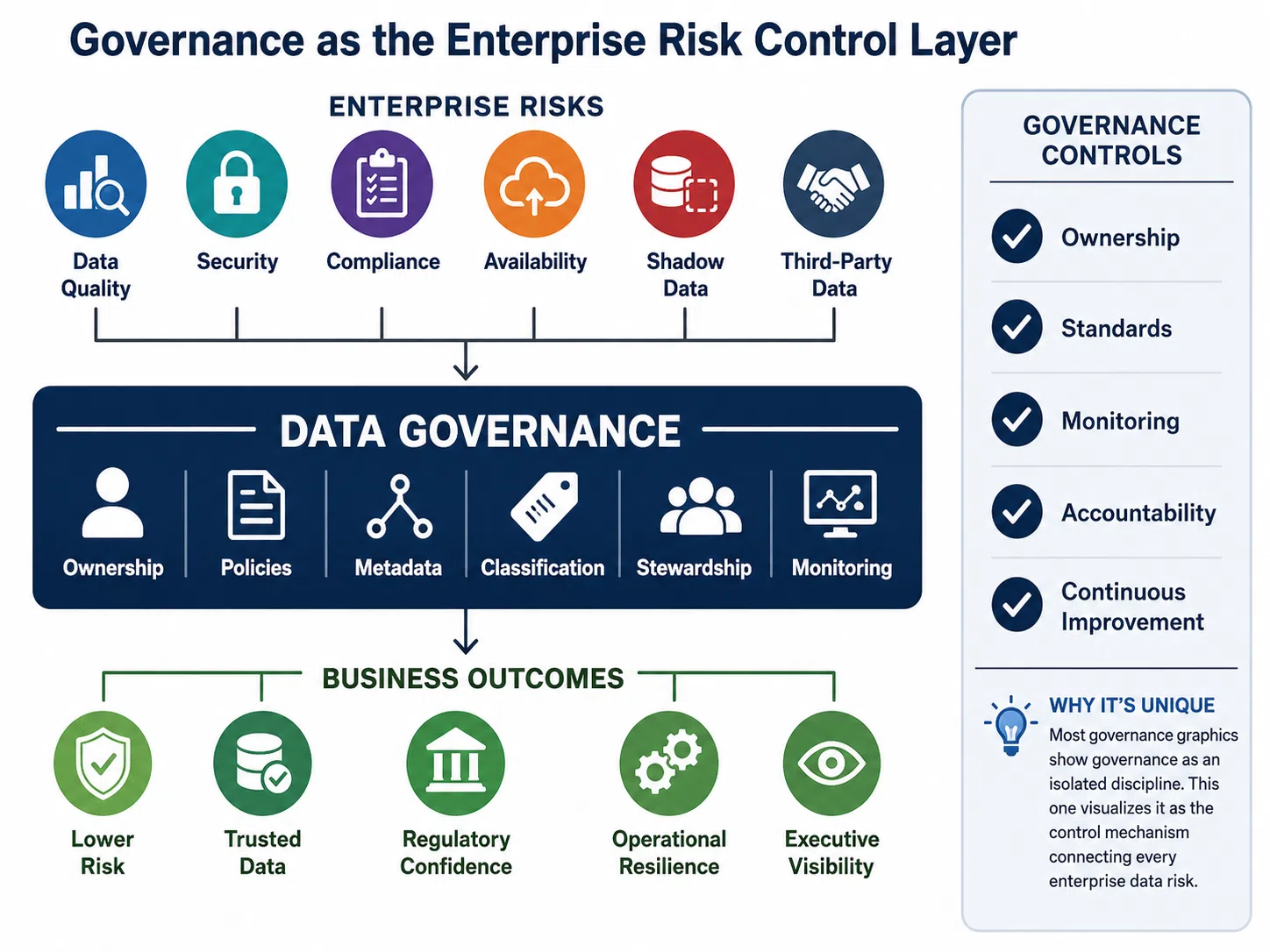
Data Governance as the Unifying Risk Control Layer How ownership, classification, lineage, and quality management reduce risk across all six categories
Data ownership: accountability that closes the ownership gap
Defined data ownership assigns a named individual or team as accountable for each data domain or data asset. This single governance element reduces risk across multiple categories simultaneously. The data owner is accountable for quality within their domain (addressing quality risk), responsible for ensuring appropriate access controls are in place (reducing breach risk), responsible for compliance with regulations that apply to their data (reducing compliance risk), and the point of contact when shadow data is discovered in their domain (addressing shadow data risk).
Organizations without defined data ownership have a structural accountability gap that no technical control compensates for. When a data quality incident occurs, the question of who is responsible for fixing it is unanswered. When an auditor asks who approved sharing a dataset with a third party, there is no answer. Data ownership provides the accountability anchor that the entire risk management program depends on.
Data classification: the foundation for security, compliance, and shadow data controls
Data classification assigns a sensitivity tier to every data asset, typically ranging from public to internal to confidential to restricted. The classification drives access control requirements, encryption standards, retention policies, and breach notification obligations. Without classification, security teams apply uniform controls across all data, which is either insufficient for sensitive data or unnecessarily costly for non-sensitive data.
Classification is also the mechanism for shadow data remediation. When a data discovery exercise finds an ungoverned data store, classification determines whether it requires immediate remediation (PII or regulated data) or routine governance integration (operational data without sensitivity). A data classification policy that is embedded in the data catalog and applied at the time of data creation prevents shadow data accumulation more effectively than periodic discovery exercises.
Data lineage: risk traceability when things go wrong
Data lineage documentation traces the origin, transformation, and movement of data through the pipeline from source system to analytical output. For risk management, lineage serves three purposes. First, when a data quality incident is detected, lineage identifies every downstream report, dashboard, or AI model that may be affected, enabling targeted impact assessment rather than broad quarantine. Second, when a compliance audit asks where a specific data element came from and how it was used, lineage provides the auditable trail. Third, when a data breach occurs, lineage identifies the scope of exposure by tracing which systems and outputs touched the compromised data.
Quality management: the primary control for quality risk and AI data risk
A data quality management program that defines quality standards per data domain, monitors compliance with those standards continuously, and routes quality failures to accountable stewards for remediation is the primary control for data quality risk. It is also the primary enabler for AI risk management: AI models trained on data governed to a defined quality standard inherit that standard’s reliability. Models trained on ungoverned data inherit its defects.
The quality management program connects to third-party data risk through vendor quality SLAs, to shadow data risk through the quality assessment that determines whether discovered shadow data can be migrated to the governed environment, and to availability risk through the quality baselines that verify recovered data is usable. Quality management is not a standalone program. It is the connective tissue across the risk landscape.
Note: A data governance program that addresses ownership, classification, lineage, and quality management does not require separate investments for each risk category. The governance infrastructure reduces risk across all six categories from a single investment. Organizations that build separate risk programs for each data risk category without a shared governance foundation find themselves rebuilding the same controls multiple times in different organizational contexts.
The bottom line
Enterprise data risk is broader than most risk programs acknowledge. Security and compliance risk receive structured investment. Quality risk, shadow data risk, third-party data risk, and availability risk are managed inconsistently if at all. The organizations with the strongest data risk posture are not running six separate programs. They built data governance as the unifying control layer, and risk management as the framework that measures its effectiveness against defined risk appetite.
-
Data ownership is the accountability anchor. Every data risk category requires someone to be responsible for the data in question.
-
Data classification enables security controls, compliance monitoring, and shadow data remediation simultaneously from a single policy.
-
Shadow data is the most consistently underaddressed risk category. Discovery and classification should be a near-term priority for most enterprise organizations.
-
Third-party data due diligence belongs in the procurement process, not as an afterthought to vendor contracts already signed.
-
Data governance metadata must be included in backup scope and disaster recovery testing. Recovered data without its governance context is technically present but operationally degraded.
If your data risk program covers security and compliance but has not addressed quality risk, shadow data, and third-party data risk in a structured way, a governance assessment identifies the gaps and sequences the remediation against your current program and risk appetite.
Build a comprehensive data risk management program grounded in governance
BluEnt’s data governance team works with CROs, CDOs, and risk leaders to assess data risk across all six categories, design governance-based control frameworks, and implement the ownership, classification, lineage, and quality management capabilities that reduce risk at enterprise scale.
Common Questions What CROs, CDOs, and risk leaders ask about comprehensive data risk management
What is the difference between data risk management and data governance? Data governance is the capability: the policies, ownership structures, quality programs, and catalog infrastructure that make data trustworthy and well-managed. Data risk management is the risk discipline that identifies, assesses, and prioritizes the risks associated with an organization’s data assets and applies controls to reduce them to an acceptable level. Data governance provides most of the control layer that data risk management depends on. A strong data governance program significantly reduces data risk without framing itself as a risk program. A data risk management program that does not build on a data governance foundation must recreate the same controls in a risk context, which is less efficient and typically less effective.
What is shadow data and why is it a significant risk?Shadow data is data that exists outside the organization’s governed data environment: files on personal drives or shared collaboration platforms, data extracted to analyst tools, databases provisioned by business units without IT governance, third-party analytics platforms that received data exports, and similar. Shadow data is a risk because it typically lacks the access controls, classification, quality management, and audit trails of governed data. It is an attractive target for attackers because it is less secured, and a compliance risk because data in ungoverned stores may violate retention policies, data sharing restrictions, or cross-border transfer rules without anyone being aware. Most organizations that conduct systematic shadow data discovery find materially more exposure than they expected.
How does data lineage help with risk management?Data lineage documents where data came from, how it was transformed, and where it flows. For risk management, lineage has three primary uses: impact assessment when a quality incident or breach occurs (which downstream consumers are affected?), compliance auditing (where did this data element originate and who has used it?), and AI risk management (what training data produced this model and what quality standard did it meet?). Without lineage, each of these questions requires a manual investigation that takes days. With lineage, the same questions can often be answered in minutes from the catalog.
Should the CDO or the CRO own the data risk management program?Accountability for the data risk management program works best when the CRO owns the risk framework and escalation, while the CDO owns the data governance capabilities that provide the primary controls. In practice, the most effective programs have joint ownership: the CRO defines risk appetite and risk reporting requirements, the CDO builds and operates the governance controls that address those risks, and both share accountability for the program’s outcomes. Programs owned exclusively by the CRO without CDO authority over data governance tend to identify risks without the mandate to fix them. Programs owned exclusively by the CDO without CRO framing tend to build governance capabilities that do not connect to the enterprise risk register.
How do we assess third-party data risk?Third-party data risk assessment covers five areas: the data governance maturity of the vendor or data provider (do they have classification, quality controls, and access governance?), the quality of data they provide (what are the documented quality SLAs and how are they measured?), their compliance posture for the data types involved (PII, regulated data, cross-border transfers), their breach notification and incident response capabilities, and the contractual protections in place (data use restrictions, audit rights, liability provisions). Many organizations find their existing vendor risk assessment frameworks address security controls and financial stability but do not include data governance maturity, quality SLAs, or data lineage documentation as assessment criteria.
What is the most common gap in enterprise data risk programs?The most consistently underaddressed data risk category in enterprise programs is shadow data. Most organizations have invested in security and compliance programs for their primary governed data environments. Shadow data exists outside those environments by definition, so the security controls and compliance monitoring that apply to governed data do not apply to shadow stores. Organizations typically discover the scope of their shadow data exposure only when a breach investigation or compliance audit traces the incident to an ungoverned store that was not in scope for the primary risk program. A systematic data discovery and classification exercise, combined with a shadow data governance policy, is the most efficient way to close this gap.

 Governing AI Tools in AEC: Copilot, Digital Twins, and Generative Design
  Data Governance for AI and Advanced Analytics: Building the Foundation That Works
  Centralized vs. Federated vs. Hybrid Data Governance: Which Model Fits Your Organization
  Data Governance Roles and Responsibilities in AEC Organizations