











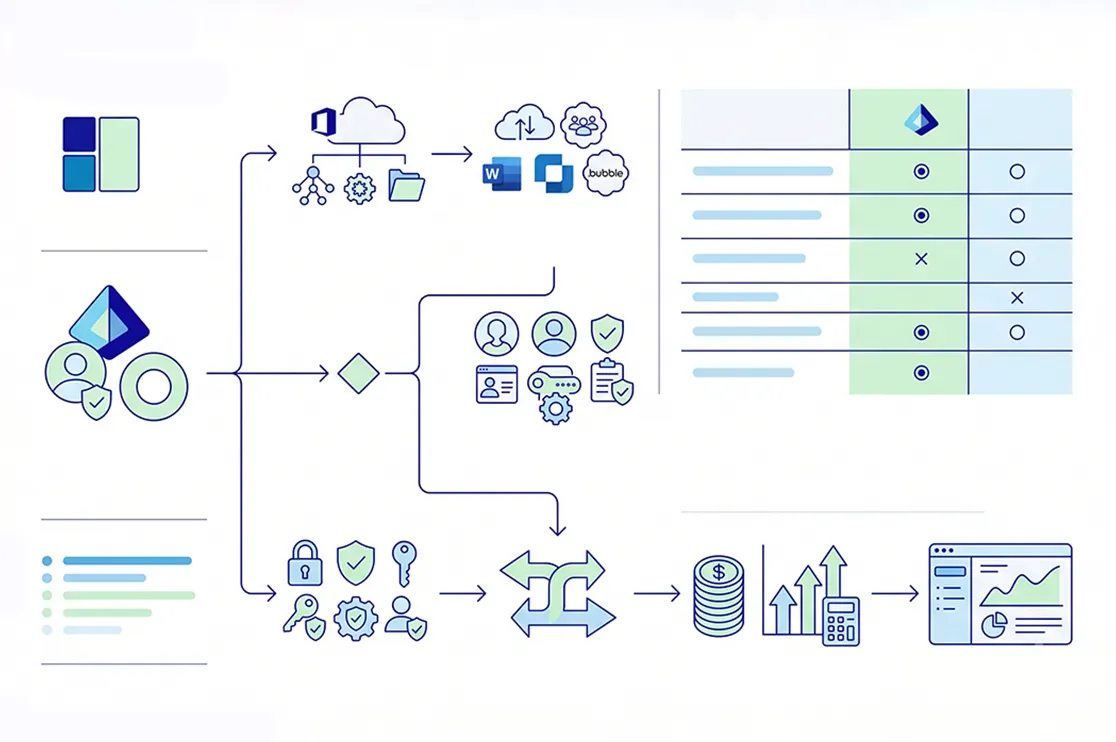
Most enterprises asking us “Entra or Okta?” are already running both in pockets. The decision that matters isn’t which platform to pick; it’s which one becomes the primary plane of identity control. This article gives you the seven dimensions we use in our Stage 1 reviews to make that call, plus a contrarian view on where the conventional comparisons mislead you.
Every quarter we get a version of the same scoping call. A new Director of Identity at a Series B-plus enterprise opens with: “we’re evaluating Entra ID and Okta — can you help us decide?” Two minutes into the call, they mention that engineering is already on Okta SSO for SaaS apps, finance is on Entra ID through Microsoft 365 licensing, and the customer-facing app uses Auth0 because it was the fastest choice at MVP.
So the real question isn’t which to pick. It’s which one to declare as the primary identity control plane and what to do about everything that’s already running on the other. That’s a different conversation, and the standard vendor-comparison content online doesn’t help much with it because it’s written as if you’re picking from a clean slate.
What follows is the framework we actually use in Stage 1 readiness reviews. Seven dimensions, the question we ask the client for each one, what we typically find, and which platform wins in our experience. None of it is theoretical; all of it comes from running this evaluation with enterprises in the four verticals our practice serves.
Table of Contents:
- Why “Entra or Okta” Is Usually the Wrong Question
- The Seven Dimensions
- Dimension 1: Existing Microsoft 365 and Azure footprint
- Dimension 2: Breadth of non-Microsoft SaaS integration
- Dimension 3: Customer Identity (CIAM)
- Dimension 4: Identity Governance (IGA) maturity
- Dimension 5: Privileged Access Management
- Dimension 6: Migration risk and reversibility
- Dimension 7: Total cost of ownership over five years
- How We’d Run This Decision in Your Environment
- If You Take One Thing from This
Quick gut check before you read further
Open three tabs. One on your Microsoft licensing portal, one on your Okta tenant, one on your HRIS. If you have meaningful activity in all three, you are not picking a platform — you are choosing which one to consolidate around. Read the dimensions below with that lens.
Why “Entra or Okta” Is Usually the Wrong Question
The vendor-comparison articles you’ll find on the open web treat this as a feature-parity exercise. They benchmark MFA options, federation breadth, license tiers, and so on, then conclude that Entra ID is best if you’re a Microsoft shop and Okta is best if you’re SaaS-first. That framing is roughly right, but it dramatically underestimates the cost of the answer.
In our engagements, friction is rarely the feature set. It’s the path. Migrating workforce identity from one platform to another is a six-to-twelve-month exercise touching every SaaS integration, every HRIS connector, every conditional access policy, and the muscle memory of every IT admin. The right question is whether the destination platform is so much better than the current state that the cost of the move is worth the gain.
Our default recommendation, before we walk a client through the seven dimensions: do not move unless the cost-benefit is decisively in favor of moving. Most enterprises end up declaring a primary, consolidating new workloads on the primary, and letting the non-primary atrophy over eighteen to twenty-four months. That’s a less satisfying answer than “migrate immediately,” but it’s what the math usually supports.
The Seven Dimensions
Dimension 1: Existing Microsoft 365 and Azure footprint
The question we ask in Stage 1: What percentage of your workforce already authenticates daily through a Microsoft identity? What licensing tier are you on (E3, E5, F3) and is Entra ID Premium P1 or P2 already part of the entitlement?
What we typically find: If the answer is more than seventy percent and the licensing already includes P1, Entra ID is meaningfully cheaper because the identity layer is bundled with what you’re already paying for. We see clients underestimate this; the apples-to-apples cost comparison against Okta is rarely actually apples-to-apples.
Who tends to win this dimension: Entra ID, for organizations with material Microsoft 365 footprint and P1 or P2 entitlement.
Dimension 2: Breadth of non-Microsoft SaaS integration
The question we ask in Stage 1: How many SaaS applications do your employees use that are not Microsoft? How many of those are federated today, and how many still have local user stores managed manually?
What we typically find: Okta’s integration network (the OIN catalog) is broader and more battle-tested than Entra ID’s gallery for non-Microsoft SaaS. We’ve engineered both, and Okta is usually faster to integrate a typical workforce SaaS stack of fifty-plus applications. Entra ID has closed much of this gap, but Okta’s lead on non-Microsoft federation is real.
Who tends to win this dimension: Okta, for SaaS-heavy estates with material non-Microsoft application sprawl.
Dimension 3: Customer Identity (CIAM)
The question we ask in Stage 1:Do you operate a customer-facing application, and if so, where do its users authenticate today?
What we typically find: If CIAM is in scope, the comparison shifts. Okta Customer Identity Cloud (the platform formerly known as Auth0) is the most mature CIAM platform we work with, particularly for B2C and high-volume scenarios. Microsoft Entra External ID has matured significantly and is the natural choice when the rest of the estate is on Entra, but the depth gap on CIAM-specific features (progressive profiling, account takeover defense, social-login breadth) is still visible. Many enterprises legitimately end up running Entra for workforce and Okta CIAM for customers; we don’t treat that as a failure of consolidation.
Who tends to win this dimension: Okta CIAM for B2C scale and feature depth; Entra External ID for Entra-aligned shops with simpler customer-identity needs.
Dimension 4: Identity Governance (IGA) maturity
The question we ask in Stage 1: Do you need quarterly access reviews, segregation-of-duties enforcement, attestation campaigns, and certification at scale today, or in the next twelve months?
What we typically find: Both platforms have IGA modules now (Entra ID Governance and Okta Identity Governance), and both are usable. They are also both newer than the standalone IGA market leaders (SailPoint, Saviynt) and have real gaps at the high end. For mid-market needs they are sufficient. For Fortune 500 IGA with thousands of applications and complex toxic-combination logic, the standalone players still win.
Who tends to win this dimension: Entra ID Governance and Okta Identity Governance are roughly even at the mid-market tier; SailPoint or Saviynt above that. We don’t see one platform’s IGA module decisively beat the other in our engagement scope.
Dimension 5: Privileged Access Management
The question we ask in Stage 1: How do you handle privileged accounts today, and what’s your current PAM tool – if any?
What we typically find: Neither Entra ID nor Okta is a primary PAM platform. Both have privileged identity features (Entra Privileged Identity Management, Okta Privileged Access in preview), and these are useful for break-glass and JIT elevation on the identity layer. But for full enterprise PAM with vaulting, session recording, and credential rotation, CyberArk, BeyondTrust, or HashiCorp Vault are still the answer. The decision here doesn’t usually drive the workforce-identity platform choice.
Who tends to win this dimension: Neither, on its own. Both are complemented by a dedicated PAM tool. Entra PIM has a slight edge for Microsoft-cloud-heavy environments where elevation is mostly Azure-role-based.
Dimension 6: Migration risk and reversibility
The question we ask in Stage 1: If you choose wrong, how painful is it to reverse? What’s the cost of a six-month migration that has to be undone?
What we typically find: This is the dimension everyone underestimates. Migrating workforce identity is not a tool switch; it’s a re-federation of every application, a rebuild of every conditional access policy, a retraining of every IT admin, and a slow drift in user behavior. We’ve seen migrations stall halfway and leave the organization paying for both platforms for two years. The lesson we’ve taken from those engagements is that the migration cost should be a first-class input to the decision, not a footnote.
Who tends to win this dimension: Neither platform; this dimension favors staying put unless the destination is decisively better than the current state.
Dimension 7: Total cost of ownership over five years
The question we ask in Stage 1: What’s the all-in cost over five years — licensing, integration engineering, ongoing operations, and migration? Not list price; modeled.
What we typically find: Apples-to-apples TCO is the modeling exercise most evaluations skip. Microsoft licensing is usually bundled in ways that change the equation; Okta licensing is more transparent but more expensive on a unit basis. The migration cost we just mentioned often dominates the five-year picture and rarely makes it into the comparison. Our typical Stage 1 deliverable on this dimension is a five-year TCO model that includes the migration cost explicitly.
Who tends to win this dimension: Entra ID typically wins on raw licensing for Microsoft-heavy estates. Okta typically wins on integration speed and lower configuration overhead for non-Microsoft estates. The migration cost decides which TCO actually applies.
Where we disagree with the conventional wisdom
The conventional comparison concludes that Entra ID wins for Microsoft shops and Okta wins for SaaS-first shops. We think that’s directionally right and operationally insufficient. The decision that matters more is whether the platform you choose is a single tenant that you actually consolidate workloads onto, or a parallel tenant that lives alongside the one you already had. Our experience is that organizations with two healthy tenants of either product spend more on identity than organizations with one slightly imperfect tenant. Single tenant beats best tenant.
How We’d Run This Decision in Your Environment
Our standard Stage 1 review on the Entra-vs-Okta question runs four to six weeks. Workshops with IT leadership, identity engineering, application owners, and security. Inventory of all current identity flows. Five-year TCO model with explicit migration cost. Documented recommendation with the dimensions above scored and weighted to your context.
The output is rarely “replatform now.” More often it’s “declare a primary, consolidate new workloads on it, sunset the secondary for non-critical apps over eighteen months.” Where we do recommend migration, the business case has to clear the bar we keep mentioning: the destination must be decisively better than the current state, not just marginally better.
This work also surfaces gaps we’d close regardless of which platform you stay on or move to: joiner-mover-leaver automation, conditional access policy hygiene, service-account inventory, MFA coverage on legacy authentication paths. Identity programs almost never fail at the platform layer; they fail at the operating-model layer underneath the platform.
From our Stage 1 notebook
A 1,400-person SaaS organization came to us convinced they needed to migrate from Okta to Entra ID for cost reasons. The Stage 1 TCO model showed the migration would cost more than three years of Okta licensing they were trying to save. We recommended they stay on Okta, tighten conditional access, and revisit in two years when their Microsoft footprint had grown enough to change the math. They renewed Okta and moved on. That’s the outcome we get to more often than the comparison content online suggests.
Recommended Reading:
If You Take One Thing from This
The right answer to “Entra or Okta?” is whichever platform you can credibly consolidate onto with the least friction relative to the gain. For most enterprises that’s not the platform that scores marginally higher in feature-by-feature comparison; it’s the platform that already has critical mass in your environment, plus the operating-model investment to make it run well.
Our IAM practice specializes in both Entra ID and Okta. We’ve migrated workforce identity in both directions and have engineered the operating model around each. The honest counsel we give clients is that the platform decision matters less than the discipline applied to whichever one you choose.
For the full IAM practice and how we engineer the operating model that sits underneath either platform, see our Identity and Access Management service page. For how identity controls feed compliance evidence, see our SOC 2 Compliance Services page.

 Why Your SOC 2 Type II Program Stalls in Year Two (and How to Restart It)
  Zero Trust in Cloud: The 8 Pillars and a 90-Day Implementation Roadmap
  The 5 Identity Decisions a CISO Makes in the First 90 Days
  How to Build a SOC 2 Compliant Identity and Access Management Program