












Is your business struggling to implement AI effectively because it lacks the required technical expertise and resources? Today’s world is all about AI and falling behind your competitors in implementing it can seriously impact business growth. The absence of no-code ai restricts your business’ activities and access to exceptional growth options. This leads to missed opportunities and competitive disadvantages.
Table of Contents:
The origin of no-code ai can be traced back to the rise of cloud computing and the development of tools for visual programming. Although the terminology—no-code AI—is quite recent, the actual working concept behind it has been evolving for several years.
No-code ai allows CXOs to develop, deploy, and implement AI models without needing to write complex code. These platforms offer user-friendly visual interfaces, drag-and-drop functionalities, and pre-built components, simplifying the AI development process.
This approach allows individuals and organizations with limited technical expertise to harness the power of AI for various applications, such as customer support, marketing automation, and predictive analytics.
Where is Snowflake fitting into this no code ai approach?
Snowflake plays a noteworthy role in democratizing AI by offering no-code and low-code interfaces that allow users of almost every technical level to create, deploy, and manage AI models. Users can easily implement AI and machine learning capabilities without the requirement for any sort of extensive coding expertise. This specific approach facilitates business users to collaborate and innovate with AI.
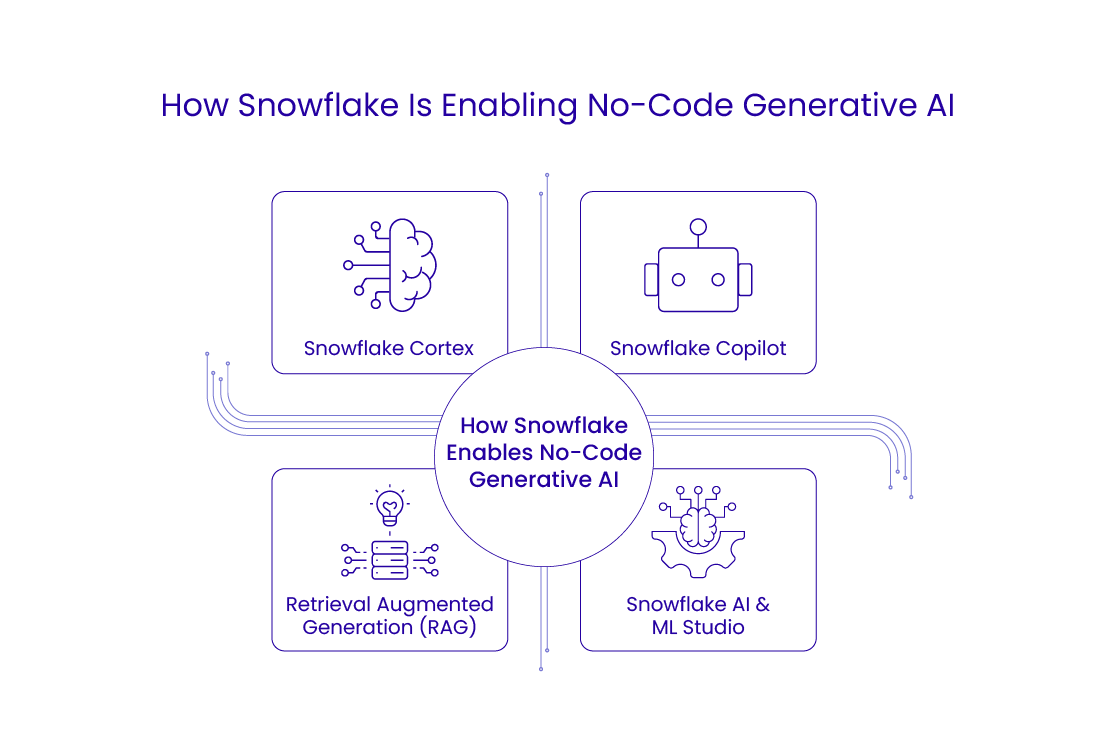
Some examples of Snowflake’s no-code & low-code AI capabilities include Snowflake AI & ML Studio, Snowflake Cortex, & Snowflake Copilot.
The Bottlenecks Holding Enterprises Back
Despite increasing investments in digital transformation, AI, and cloud technologies, several enterprises struggle to reach their full potential.
The question is, WHY?
It is because of some very vital challenges that are not related to the vision or objective but in the execution of the strategy to achieve that objective or vision. From security concerns to legacy integration issues, these hurdles silently slow down innovation, increase expenses, and restrict scalability.
Understanding these pain points is crucial for any organization looking to modernize its infrastructure and achieve sustainable growth.
Let’s break down the core challenges that continue to hold enterprises back.
Security and compliance
Enterprises work in highly managed environments and must meet strict compliance standards such as GDPR and HIPAA. Any solution that lacks built-in security protocols, fine-grained access control, data encryption, or auditing capabilities poses a serious risk. Failure here can result in legal penalties, loss of customer trust, and data breaches.
Integration with existing systems
Most enterprises already have a complex web of legacy systems, data warehouses, SaaS tools, and on-premises infrastructure. New platforms must seamlessly integrate with ERP, CRM, HRMS, and industry-specific tools. When integration is poor or requires heavy customization, it creates friction, slows adoption, and increases the time-to-value.
Vendor lock-in
Many enterprises are wary of being overly dependent on a single cloud provider or proprietary platform. Vendor lock-in restricts flexibility, drives long-term costs, and makes it harder to pivot alternative or more innovative solutions. Enterprises seek open standards, portability, and multi-cloud support to avoid being trapped in rigid ecosystems.
Skill gaps
Adopting cutting-edge solutions requires talent skilled in data engineering, AI/ML, DevOps, cybersecurity, and cloud architecture. However, many organizations lack the internal expertise needed to manage, optimize, and scale these solutions. This results in underutilized tech investments, longer implementation cycles, and increased dependence on external consultants.
Performance issues
Slow data pipelines, latency in real-time analytics, model inference delays, and sub-optimal workload execution can bottleneck mission-critical processes. Enterprises need platforms that scale elastically, support high concurrency, and offer optimized computing/storage performance. Otherwise, performance issues can directly impact business agility and customer experience.
Maintenance & governance
Ongoing maintenance such as patching, version upgrades, monitoring, and governance requires continuous effort. Without robust automated governance policies, metadata management, lineage tracking, and role-based access, enterprises struggle to maintain clean, trustworthy data and compliant operations. Poor governance also affects audit-readiness and stakeholder confidence.
Cost considerations
Enterprises often underestimate the total cost of ownership (TCO), which includes licensing, integration, customization, support, and personnel. If ROI is not clearly measurable or the solution lacks predictable pricing models, CFOs and procurement teams are likely to push back. Cost overruns quickly become a deal-breaker.
Limited options for customization
Out-of-the-box platforms that lack flexibility in workflows, user roles, dashboards, or pipeline configuration often fall short of enterprise needs. Large organizations need tools that support modular architecture, APIs, custom model integration, and domain-specific customization, especially differentiated use cases in R&D, supply chain, or customer analytics.
Recognizing these bottlenecks is the first step toward transformation. Enterprises that proactively address these pain points, whether by upskilling teams, choosing interoperable platforms, or enforcing robust governance, position themselves to lead in a competitive, data-driven world.
The goal is not just modernization, but scalable, secure, and intelligent operations that adapt to change and deliver real business outcomes.
“The future belongs to organizations that can move fast without breaking the rules”.
The Reality Check – Why Most GenAI Programs Stall/Fail?
The enthusiasm among enterprises to adopt and incorporate AI is high. However, the rate of operational success does not match that enthusiasm level.
According to an industry research conducted by Gartner, more than 80% of enterprises are incorporating or doing research to implement GenAI into their business workflows. However, less than one-third of those initiatives have moved beyond the pilot stage. The reason here is not the potential of the AI model. It is the execution capability of the enterprise.
Why does No Code AI matter?
The AI race in businesses is no longer about who is using the most advanced AI model. It is all about who can create, deploy, and repeat
The enterprise AI race is no longer about who has the most advanced model; it’s about who can build, deploy, and iterate faster. But traditional AI development still requires a rare mix of data scientists, engineers, and ML experts. This is where no-code AI becomes a game changer. By removing the need to write complex code, it democratizes AI, enabling business analysts, marketers, and domain experts to develop and apply AI models directly.
The competitive gap is growing. AI adoption is accelerating globally, but enterprise execution is uneven.
Organizations that have or are operationalizing GenAI now are:
-
Reducing manual workloads by 30–50%.
-
Automating customer-facing processes.
-
Improving time-to-insight dramatically.
-
Embedding AI into daily workflows.
And those who are delaying this operationalization are:
-
Falling behind faster-moving competitors.
-
Underutilizing their Snowflake investment.
-
Increasing technical debt.
-
Struggling with fragmented AI stacks later.
Keep in mind that the window for early advantage is narrowing. So, act fast or be sorry later.
Enterprises that have also started adopting GenAI have begun shifting from the experimental phase to the launch phase. Others, who have fallen behind, are at a greater risk of experiencing debt and scattered AI stacks
As the demand for intelligent automation and real-time insights grows, no-code AI is emerging as the foundation for agile, inclusive, and cost-effective innovation.
Why No-Code AI Matters: Features & Importance
No-code platforms break down the barrier to entry. Business users and non-technical professionals can now build, train, and deploy AI models without writing a single line of code. This helps bridge the skill gap and accelerates adoption across departments.
They significantly reduce development time. What once took weeks or months can now be done in days or even hours, enabling teams to respond to market changes and business needs in real time.
By reducing the need for large data science teams and extended development cycles, no-code solutions lower TCO (Total Cost of Ownership) while increasing the return on AI investments.
Business teams can test multiple use cases and models with minimal friction. This leads to faster prototyping, better decision-making, and quicker validation of ideas.
Modern no-code AI tools often come with enterprise-grade security, access controls, and governance frameworks, making them suitable for regulated industries like finance, healthcare, and insurance.
How Snowflake Is Standardizing No-Code GenAI Development
Snowflake is leading the charge by integrating no-code GenAI capabilities directly into its Data Cloud ecosystem, enabling enterprises to build intelligent applications without needing external ML infrastructure or complex codebases. Here’s how:
-
Snowflake Cortex: Cortex provides pre-built LLM functions (like text summarization, sentiment analysis, translation, etc.) natively inside Snowflake SQL. It allows business users and analysts to apply generative AI directly to data without leaving the Snowflake environment or writing custom Python.
-
Streamlit Integration: With native Streamlit in Snowflake, teams can build interactive AI-powered applications and dashboards using Python and minimal front-end coding. Paired with no-code LLM functions, Streamlit empowers data teams and business users to co-create AI tools without reinventing the wheel.
-
Unified Development Workflow: From data preparation to model invocation to application deployment, Snowflake offers a single, governed workflow. With features like Snowpark, Snowpipe, and native LLM APIs, it standardizes development while eliminating the need to manage infrastructure, environments, or APIs externally.
-
Integration with GenAI Ecosystem: Snowflake’s architecture supports plug-and-play integration with major tools like LangChain, Hugging Face, Amazon Bedrock, and Azure AI, while still maintaining governance, scalability, and cost controls—all within its no-code-friendly ecosystem.
No-code AI isn’t just a productivity tool—it’s a strategic enabler. It puts AI capabilities in the hands of many, not just the few, making innovation more democratic, iterative, and aligned with business goals.
With platforms like Snowflake Cortex and Streamlit, enterprises no longer need to choose between power and simplicity. They can have both enterprise-grade performance with no-code agility.
As AI adoption deepens, the future will favor organizations that empower all teams, not just engineers, to think and build intelligently.
How Snowflake Is Enabling No-Code Generative AI
While Snowflake provides the tools, execution determines outcomes. BluEnt brings deep expertise in Enterprise Data Architecture & AI Strategy, hands-on experience deploying Snowflake Cortex & AI/ML Studio, and proven frameworks for GenAI governance, security, and compliance.
Along with cross-industry implementation experience in Retail, Healthcare, Finance & Manufacturing, BluEnt offers accelerators for faster Snowflake-native AI deployment.
Unlike vendors who focus only on implementation, BluEnt aligns GenAI initiatives directly to business KPIs, ensuring every deployment is outcome driven.
Here’s how Snowflake is delivered on that promise:
-
Snowflake Cortex: Built-in LLM Power in SQL, Snowflake Cortex is the heart of its no-code GenAI strategy. It brings pre-trained large language models (LLMs) directly into the Snowflake ecosystem, accessible via SQL or Python with no infrastructure setup or model tuning required. Its native functions include CORTEX.COMPLETE, CORTEX.SUMMARIZE, and CORTEX.SENTIMENT that can be executed directly in SQL queries.
-
Snowflake AI & ML Studio: As a visual, point-and-click interface, Snowflake AI & ML Studio allows users to create, test, and deploy ML and GenAI workflows without any coding. It is focused on offering ease to both technical and non-technical individuals. It has excellent features like drag-and-drop interface, built-in connectors, pre-built templates, and complete governance with Snowflake’s native security, RBAC, and audit framework.
-
Retrieval Augmented Generation (RAG): Snowflake supports RAG pipelines natively, letting users connect enterprise data with LLMs for more accurate and context-rich outputs—a core capability for enterprise-grade GenAI. RAG in Snowflake uses Vector Search, Document AI, and Snowflake Cortex.
-
Snowflake Copilot: It is a natural language interface developed to facilitate users in writing queries, exploring data, and generating insights via conversations. Copilot converts plain English into SQL or Python and helps the user to explore datasets and accumulating insights without having any deep technical knowledge. Copilot allows business users to easily interact with data.
Snowflake’s ecosystem is not just making Generative AI possible. It makes it practical, scalable, and no-code friendly. This means business teams no longer must wait for technical resources or external consultants to innovate. With built-in AI capabilities and governed deployment paths, Snowflake is empowering enterprises to turn their data into intelligent action without writing a single line of code. It’s an AI for everyone, built for enterprise scale.
BluEnt POV on Why 70% of GenAI Pilots Fail
GenAI pilots fail mostly due to various reasons, most of which are highly predictable.
There’s no connection with the business KPIs. Also, there’s lack of executive ownership beyond the innovation team. With unclear governance models set up for the AI-generated outputs, the AI models tend to remain in their default state. Plus, enterprises often opt for tools that end up being non-compatible with the AI models, causing delay in launch.
This clearly indicates the difference between experimentation and enterprise value which lies in operating/executing the model.
How BluEnt perceive no-code without governance?
Now another risk to the no-code with any proper data governance protocols is dubbed as shadow AI. BluEnt understands that unmanaged access brings in risk. With a proper data governance protocol/framework, enterprises face issues such as sensitive business information getting uploaded into unauthorized software/tools, lack of proper clarity, insufficient training data, unwanted increase in API consumption, and risk of
Recommended Reading:
When To Choose No-Code Genai Vs. Custom-Built Models
Artificial intelligence has come a long way from being a mere innovation to absolute business necessity. Whether you are running a start-up or some high-profile entrepreneur, implementing AI allows explore infinite options that can elevate business growth and add a competitive advantage.
Still, CXOs still face the dilemma of which one to go with – should they choose the no-code platform that will allow them to make AI without any hassle, or should they build something from scratch to fit your requirements with precision?
The answer to this is not as simple as it should be – Every AI-centric platform has its advantages and bargains that can turn the tide of this competitive market in your favor or against you if you fall behind.
We are already familiar with what no-code ai and custom built ai models are. But that is just the first half. The second half requires understanding of their differences in terms of potential and usage.
Here is a tabular representation of those differences:
| Factors | No-Code AI | Custom Built AI Model |
|---|---|---|
| Deployment Speed | Quick prototyping & deployment | Longer development cycles |
| Usage | User friendly with drag and drop interface | Sufficient technical expertise needed |
| Control & Flexibility | Limited scope of customization | Full control over deployment & algorithms |
| Scalability | Moderate scalability | Strong scalability & complex data workflow |
| Maintenance | Automatic updates from platform | Constant maintenance & optimization needed |
| Cost | Affordable with subscriptions | High upfront cost with higher ROI in long run |
Now CXOs might come up with the question – Which Approach Should I Go For?
To be frank, both no-code ai and custom built ai models are ideal for their dedicated scenarios. Let’s look at those scenarios:
No-Code AI is applicable when:
-
You are exploring AI for the first time and want to test them.
-
Your team does not have sufficient technical expertise but needs clean, structured data.
-
You need a quick turnaround for various tasks, such as sales forecasting.
-
You are focused on no-code AutoML for data analysis and want to automate repetitive tasks.
When Custom AI can be used:
-
Your problem is highly specific or complex and cannot be solved with off-the-shelf models.
-
You require integration with multiple internal systems and APIs.
-
Compliance, data privacy, and regulatory considerations dictate full control over your AI pipeline.
-
You need to build one of the best AI tools for data pipeline automation tailored to your infrastructure.
Business Impact of No Code Gen AI
No-code generative AI, with its ability to create AI models and solutions without needing to write code, is poised to have a transformative impact across businesses, fostering several key benefits.
It fosters quicker AI adoption across departments, allowing AI to be accessible to a wider range of business users, and not just being limited to data scientists and developers.
Also, its easy-to-use visual interfaces on no-code platforms promote better collaboration between business users and technical teams, streamlining the AI development process.
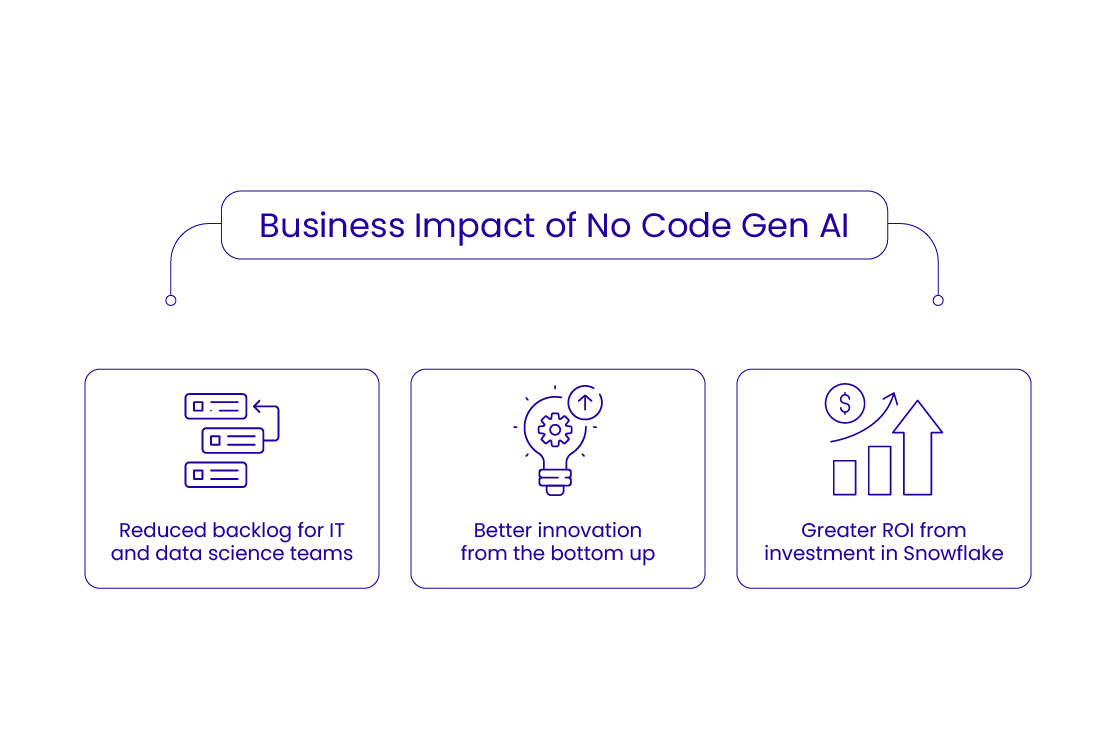
Below is a more detailed outlook on the benefits experienced by businesses with No-code Gen AI.
Reduced backlog for IT and data science teams
-
Delegating routine tasks: No-code AI platforms empower business users to handle repetitive AI tasks such as data preparation and model training, reducing the workload on IT and data science teams.
-
Focusing on strategic projects: By offloading routine tasks, IT and data science teams can dedicate more time and resources to complex and strategic AI initiatives that require specialized expertise.
-
Automating code generation and testing: Generative AI within no-code platforms can automate code generation, testing, and debugging, further improve development efficiency and reduce backlogs.
Better innovation from the bottom up
-
Exploring creativity: No-code generative AI tools enable employees with diverse skill sets to experiment with AI and develop innovative solutions to business challenges.
-
Responding to emerging needs: By allowing rapid prototyping and iteration, no-code AI empowers businesses to quickly respond to market demands and adapt to evolving customer expectations.
-
Fostering a data-driven culture: No-code AI platforms, coupled with generative AI capabilities, allow business users to easily analyze data and derive actionable insights, fostering a more data-driven culture within the organization.
Greater ROI from investment in Snowflake
-
Enhanced data analytics: No-code generative AI tools can enhance data analytics within Snowflake by enabling faster data processing, identifying patterns, and generating predictive models.
-
Streamlined workflows: Integrating no-code AI with Snowflake can automate workflows, optimize processes like customer service and inventory management, and generate tailored insights from data stored in Snowflake.
-
Increased efficiency and productivity: By leveraging no-code generative AI on Snowflake, businesses can achieve higher operational efficiency, reduce costs, and improve decision-making, leading to a greater return on their Snowflake investment.
-
Facilitating advanced use cases: Snowflake, combined with no-code generative AI, can facilitate more advanced use cases like predicting patient outcomes in healthcare or optimizing supply chain operations in manufacturing.
In essence, no-code generative AI promises to be a catalyst for widespread AI adoption, empowering individuals across the organization to drive innovation, improve efficiency, and ultimately maximize the value derived from their data platforms like Snowflake.
Is a hybrid approach of No-Code AI & custom build models in the future?
More organizations are discovering the benefits of combining both approaches. You might start with a no-code tool to validate a business case and then move to a custom solution for scalability and control. This hybrid strategy allows teams to be agile while laying the groundwork for long-term AI maturity.
For example, a retail company might use no-code AI to forecast short-term sales based on past trends; once they see value in the forecasts, they may invest in a custom AI pipeline that integrates with supply chain systems, POS data, and inventory management tools.
Use Case Example
Case Snapshot: Accelerating GenAI Adoption in Retail
A US-based retail enterprise was struggling with:
-
Slow content generation for 50,000+ SKUs.
-
Manual demand forecasting processes.
-
Overloaded data science teams.
BluEnt implemented a Snowflake-native GenAI framework using Snowflake Cortex for product description generation, RAG pipelines for context-rich inventory insights, and Streamlit dashboards for business user interaction.
This resulted in a 45% reduction in content production time, 32% improvement in forecast accuracy, 40% reduction in AI backlog for data teams, and faster cross-department AI adoption in just 6 months.
Conclusion
If you’re already using Snowflake, you’re sitting on untapped AI potential.
BluEnt, a leading name in the list of IT service providers, offers its experienced and dedicated services to help enterprises accomplish their designed AI applications without the need to fuss over extensive coding.
Remember: The Future Belongs to Enterprises That Move Fast & Govern Smart.
No-code GenAI should not be considered just any random technology upgrade. It is an operating model shift. BluEnt partners with enterprise leaders to architect secure GenAI ecosystems, reduce AI backlog, deliver measurable business outcomes, and scale Snowflake-native AI initiatives.
Our AI strategists combine data engineering, governance, and business alignment ensuring Snowflake GenAI initiatives don’t stall at experimentation.
We focus on operationalizing business outcomes. We do not just incorporate the No-Code AI ability of Snowflake. We start of by board level business metrics to ensure that every GenAI initiative is driving measurable ROI, rather than causing bottlenecks for your business.
FAQs
Can I use Generative AI without any coding knowledge? Yes. No-code platforms like Snowflake Cortex, Microsoft Copilot, and Peltarion allow users to build, train, and deploy generative AI models using simple interfaces—no programming required. These tools are designed for business users, marketers, analysts, and other non-technical roles.
Are there free resources to learn about no-code generative AI? You can find free learning paths on Coursera, YouTube, HubSpot Academy, and official documentation from tools like Snowflake, Google Vertex AI, or OpenAI. Many platforms offer hands-on tutorials, webinars, and sandbox environments for practice.
What kind of tasks can I automate with no-code generative AI? You can automate a wide range of tasks such as content creation (blogs, emails, ads), customer service (chatbots, automated replies), image generation, data summaries, report generation, and workflow automation—all without writing a single line of code.
What are the advantages of using a no-code platform for AI development? No-code platforms drastically reduce development time, lower entry barriers, and enable faster prototyping. They empower non-tech teams to build AI solutions independently, while still integrating with enterprise data and tools.
What are the differences between no-code and low-code for AI development? No-code tools offer drag-and-drop or prompt-based interfaces with no programming required. Low-code allows for basic scripting or code snippets, offering more flexibility and control for semi-technical users or developers needing customization.
What are some of the challenges in building enterprise-level applications with no-code? Common challenges include limited scalability, restricted customization, integration complexity, and vendor lock-in. While great for MVPs or departmental use cases, no-code tools may struggle with complex, high-performance enterprise requirements.

 Microsoft Fabric for Enterprise ESG and Sustainability Intelligence
  Microsoft Fabric 2.0: The Future of Unified Analytics in a Multi-Agent AI World
  Why Traditional Data Migration Falls Short and How AI Is Changing the Approach
  How CFOs and CIOs Actually Evaluate Cloud Data Strategy: Cost, Risk, and ROI