











Today’s enterprise leaders are constantly under pressure to work at a higher pace. Markets change rapidly, consumer demands are shifting, and rivals implement AI and cloud technologies to innovate at scale.
Yet many organizations still rely on outdated systems that were built for a different era. These legacy data environments are currently establishing themselves as a significant obstacle to development, resiliency, and innovation.
The urgency is clear to the CIOs and enterprise architects. Business leaders demand real-time information, quicker decision-making, and scalable digital platforms.
However, legacy infrastructure makes things slow. The longer organizations delay change, the higher the risk—higher costs, operational inefficiencies, and missed opportunities.
Table of Contents:
- Introduction
- The Hidden Cost of Legacy Systems
- Why Traditional Modernization Approaches Fall Short
- What Business Leaders Should Focus on First
- The Role of Cloud and AI in Legacy Modernization
- Common Barriers to Legacy Modernization
- Use Case 1: Improving Decision Speed
- Use Case 2: Reducing Infrastructure Costs
- Use Case 3: Strengthening Data Governance and Compliance
- Why a Structured Modernization Roadmap Matters
- Why Enterprises Choose BluEnt
- How to Get Started with Legacy Modernization
- Conclusion
That is why the legacy data modernization services are no longer an option. The legacy modernization market has reached $24.98 billion in 2025. They are a strategic investment in future competitiveness.
The Hidden Cost of Legacy Systems
Most organizations still have legacy systems in place since they are still operational. However, what appears stable on the surface often hides significant risks and costs. These systems turn out to be complex, fragile over time and expensive to maintain.
To start with, the operational costs are still increasing. Old systems demand special expertise, outdated hardware, and continuous patching. This diverts IT budgets away from innovation and toward maintenance.
Second, business agility is impaired. New products or dealing with market changes is a slow and expensive process when data is siloed and processes are inflexible. Rival brands built on the latest platforms are able to change more quickly.
Third, the risk exposure increases. Business continuity can be challenged by security weaknesses, noncompliance and lack of scalability. This may cause financial and reputational harm in the extremely regulated industry.
For CXOs, the key question is not whether modernization is needed. The only issue is how to modernize without interfering with the business operations.
Why Traditional Modernization Approaches Fall Short
Numerous businesses have already tried to go modern. But, the outcome is not always as good as it can be. This is because it is too technical and not geared towards business results.
Lift-and-shift cloud migrations, for example, move workloads without addressing deeper issues such as data silos or poor governance. This makes the costs high and does not enhance agility.
Similarly, the uncoordinated efforts at the departmental level establish new silos in the cloud. Lack of a guiding vision leaves organizations to have complicated hybrid environments that are hard to control.
An effective enterprise data modernization plan should be business-oriented. It should target such outcomes as the accelerated decision-making, customer experience, and ROI.
What Business Leaders Should Focus on First
To CIOs and architects, the modernization should start by being clear. Verizon’s 2024 Data Breach Investigations Report (DBIR) found attacks involving exploitation of vulnerabilities as the critical path to initiate a breach almost tripled (180% increase) from the prior year. Leaders must establish strategic priorities instead of being technology-centric.
These typically include:
-
Reducing infrastructure costs
-
Improving data governance and security
-
Enhancing operational resilience
This strategic alignment makes the modernization to bring real value.
The Role of Cloud and AI in Modernization
The use of data by organizations is changing due to cloud and AI. The new platforms enable real-time processing, scalable storage and advanced analytics. This enables companies to stop making reactive decisions in order to be more proactive and predictive.
However, the use of cloud does not necessarily ensure success. Companies require a road map and professional instructions. This is where cloud data migration consulting plays a critical role.
A structured approach helps enterprises:
-
Prioritize workloads
-
Reduce migration risks
-
Control costs
-
Ensure compliance
-
Accelerate innovation
Most importantly, it ensures business continuity throughout the transformation.
Common Barriers to Legacy Modernization
Many organizations are not in a position to take action even when the need is evident. There are a number of obstacles that retard development.
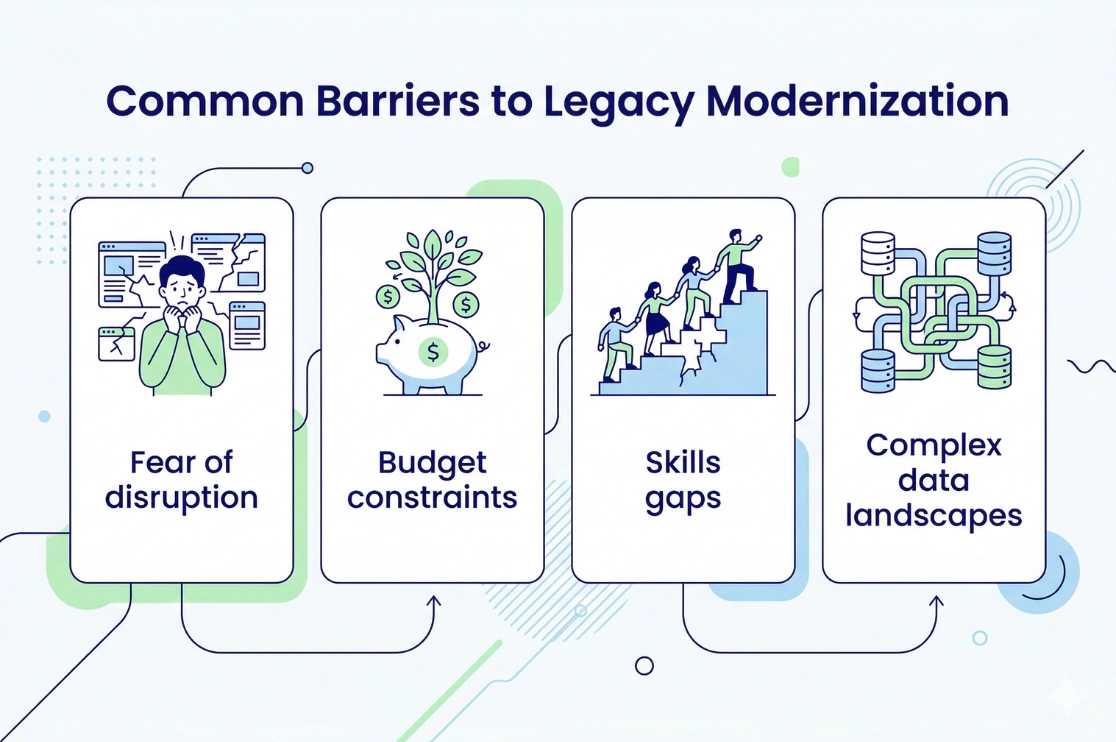
Fear of disruption
Business leaders are concerned about down time and operational risk. This gives rise to stagnant decisions.
Budget constraints
Modernization investments can hardly be justified without a strong business case.
Skills gaps
In-house teams might not experience the use of new architectures and cloud systems.
Complex data landscapes
Years of acquisitions and system growth create fragmented environments.
A large-scale transformation is not the answer. Rather, a step by step and results-oriented roadmap minimizes risk and creates confidence.
Request a phased migration roadmap workshop.
Use Case 1: Improving Decision Speed
The problem:
One of the global manufacturing companies was based on batch processing and old reporting. Executives got insights many days after events had taken place. This reduced the speed of decision-making and supply chain performance.
How modernization helps:
The adoption of a single cloud data platform facilitated real-time analytics in the organization. Information about the operations, logistics, and customer channels was combined into one environment.
Business result:
Leaders gained faster visibility into performance. There was a reduction in inventory expenses and an enhancement of agility.
This shows how legacy data modernization services have a direct influence on business performance.
Use Case 2: Reducing Infrastructure Costs
The problem:
The infrastructure had become outdated and a financial services company was incurring high expenses in maintaining the infrastructure. Prices were on the rise annually and the performance was low.
How modernization helps:
A cloud-first architecture lowered reliance on costly hardware. Data pipelines were automated, thus, making the process more efficient and less manual.
Business result:
The organization also saved on infrastructure besides redistributing budgets to innovation.
Use Case 3: Strengthening Data Governance and Compliance
The problem:
This was one of the instances of a healthcare business that was belligerent with compliance, which was predetermined by fragmented data and inefficient management.
How modernization helps:
Centralized data governance and automated controls enabled readiness to audit and transparency.
Business result:
The company minimized the risks of regulators and enhanced its stakeholder trust.
Why a Structured Modernization Roadmap Matters
Modernization does not only concern technology alone. It is concerning integrating information, practices, and individuals with business strategy.
A structured roadmap includes:
-
Clear business priorities
-
Phased migration approach
-
Continuous optimization
This is to make transformation provide long-term value. The $56.87 billion projection represents 17.92% CAGR growth as organizations accelerate modernization timelines. In the absence of a roadmap, the modernization will be reactive and fragmented.
Why Enterprises Choose BluEnt?
In the case of most organizations, execution is the greatest issue. This is the place where BluEnt can add quantifiable value.
BluEnt has a combination of extensive industry knowledge and effective modernization models. The focus is always on business outcomes rather than technology alone.
Key strengths include:
-
Well-developed experience in enterprise data modernization.
-
Strategic advisory for CXOs
-
End-to-end migration and transformation
-
Focus on ROI, reliability, and scalability
-
Accelerated cloud adoption with minimal disruption
BluEnt collaborates with CIOs and enterprise architects to create bespoke solutions in line with strategic priorities. This method removes the chance of risk and gives quicker outcomes.
Most importantly, BluEnt will make sure that modernization facilitates the innovation that will have a long-lasting effect, rather than a short-term efficiency.
How to Get Started?
Migration does not form the first step in most organizations. It is clear.
Leaders must have a view into their present data landscape, cost drivers as well as future opportunities. A structured assessment provides this clarity.
It also fosters internal alignment and confidence of the stakeholders.
Conclusion
Legacy data systems are no longer just an IT challenge; it is a business risk which directly affects agility, innovation and long term growth. In the current dynamic world, the CIOs and enterprise architects need to make sure that data platforms will be able to support real-time insights, AI-inspired decision-making, and scalable digital initiatives.
Modernization helps organizations to save on costs, enhance governance, and become more reliable, as well as respond more quickly to market opportunities. A structured, outcome-driven approach to legacy data modernization services is expected to reduce the impact of the matter and offer tangible ROI and value in the long term. The immediately acting enterprises will develop a more robust, future-facing data platform and have an evident competitive edge.

 The Power of Data in Enhancing Gift Card Customer Retention and Engagement
  Dell Boomi Integration Platform Explained: Architecture, Benefits, and Comparison with MuleSoft
  Explainable AI (XAI): Bridge of Trust Between AI and Humans
  How is the MuleSoft eCommerce Integration Platform Mitigating Retail Challenges?