








Regulatory compliance is not a data governance outcome. It is a governance requirement that must be designed into the framework from the start, not retrofitted after an audit finding. Organizations that build governance programs without mapping them to regulatory obligations consistently produce the same result: a framework that looks complete internally but cannot satisfy a regulator externally.
BluEnt builds data governance compliance solutions for enterprise organizations that must demonstrate ongoing regulatory compliance across multiple jurisdictions. We translate regulatory obligations into specific governance controls, configure those controls in your data platform, and structure the evidence architecture so audit evidence is generated continuously: not assembled manually under pressure when a regulator asks for it.
Data Governance Maturity Assessment
A structured diagnostic for CDOs, CIOs, and Chief Compliance Officers. 18 questions across six governance dimensions. Receive a scored maturity profile and prioritised recommendations.
Your Details
Your Assessment Results
Overall Governance Maturity Level
Receive Your Full Report
A BluEnt governance consultant will prepare a personalised report with specific recommendations for your highest-priority gaps. Book a 60-minute discovery call to discuss your findings.
Trusted By
Organizations That Trust BluEnt With Their Data

- Gift Card Management, Reporting, Data Integration, Analytics Solutions, Book Keeping NetSuite Reporting, NetSuite Records Maintenance, Income Statement, Audit Support

- Gift Card Management, Reporting, Data Integration, Analytics Solutions

- Invoicing, AP Reports, Sales Data Analytics

- MuleSoft Integration, Analytics & Dashboards - [Tableau, MS SQL Server, SSIS]

- ERP Onboarding and Implementation, Data Migration, Custom Report Building, Audit Support and Finalization, Draft Financials Statements, Bidding Website Development

- Data Analytics and Dashboards

- V-Bucks Gift Card Sales Analytics, Reconciliation, Financial Tracking and Reporting
- Web Asset Creation

- HubSpot Campaign Management, Workflow Automation, UX/UI Development, Mobile App Development, Application Development

- Data Analytics and Dashboards, Website Development, Website Maintenance, Application Development, HubSpot Automation and Integration, Asana Management
- SEO, Website UX/UI Development, Data Management, Third-Party Integration, Website Maintenance

- Shopify Website Development, Klaviyo Email Marketing, Email Campaign Setup, Third-Party Shopify App Integration

- Website and SEO Audit, Shopify Website Maintenance, SEO and Analytics
- Website Design and Development, Website Maintenance
- Website Design and Development, Website Maintenance

- Website Design and Development, Website Maintenance, SEO and Analytics
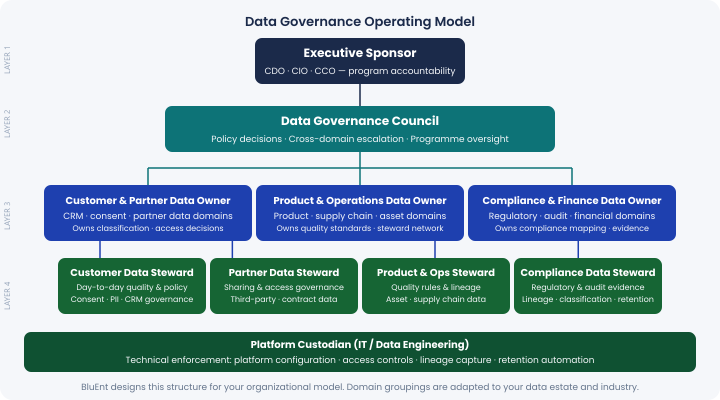
Built for the Leader Accountable for Regulatory Data Compliance
This page is written for the Chief Compliance Officer, Chief Data Officer, Chief Information Officer, or governance program director who is accountable for ensuring that data governance controls satisfy named regulatory obligations: and can prove it. If any of the following apply, BluEnt’s compliance governance work is the right engagement.
-
A regulator, internal auditor, or board committee has issued a finding related to data governance: lineage gaps, classification failures, access control weaknesses, or retention violations: and you need a structured remediation program with evidence of progress.
-
You operate across multiple jurisdictions with different regulatory frameworks and are struggling to maintain consistent governance controls that satisfy all applicable obligations without building a separate compliance program for each.
-
You are preparing for a specific regulatory deadline: DORA operational resilience, a GDPR adequacy review, an APRA CPS 234 attestation, or a SOX data controls audit: and need to close identified gaps before the deadline arrives.
-
Your data governance program produces policies and frameworks but cannot currently generate the audit evidence those frameworks are supposed to support. Regulators expect evidence, not documentation.
-
You have acquired a business, entered a new market, or expanded into a new jurisdiction and need to extend your compliance-driven governance controls to the new entity before the next regulatory reporting cycle.
-
You are building an AI or machine learning program and need your governance compliance architecture to address the EU AI Act, sector-specific AI obligations, or both before production deployment.
What Regulators Find When Governance Is Not Mapped to Compliance
The most common regulatory finding in data governance audits is not that policies do not exist. It is that existing policies are not connected to named regulatory obligations, not enforced through platform controls, and not generating the evidence regulators expect. Governance that cannot prove itself to a regulator is, from the regulator’s perspective, governance that does not exist.
The difference between governance that satisfies regulators and governance that fails audits is not the volume of documentation. It is the architecture of the evidence.
| Governance Without Compliance Mapping | Governance With BluEnt Compliance Solutions |
|---|---|
|
|
The Regulatory Frameworks BluEnt Maps to Governance Controls
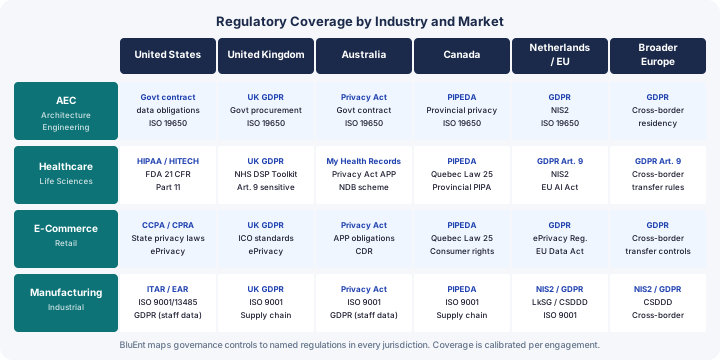
Data governance compliance is jurisdiction specific. The obligations that apply to a financial services organization in the Netherlands under DORA differ materially from those applying to a healthcare organization in the United States under HIPAA, or a retailer in Australia under the Privacy Act and Consumer Data Right.
BluEnt maintains active regulatory knowledge across all six markets we operate in and maps every engagement to the named frameworks applicable to the organization’s operating environment.
| Jurisdiction | Primary Regulatory Frameworks | Key Governance Controls Required |
|---|---|---|
| United States | HIPAA, HITECH, GLBA, SOX, CCPA and CPRA, Virginia CDPA, Colorado Privacy Act, Connecticut Data Privacy Act, Texas Data Privacy and Security Act | PHI classification and access controls, financial data lineage for SOX, consumer data purpose-binding, breach notification readiness, data subject rights workflows |
| United Kingdom | UK GDPR, Data Protection Act 2018, ICO enforcement standards, FCA operational resilience expectations, NHS Data Security and Protection Toolkit | Lawful basis documentation, data subject rights management, ICO audit evidence architecture, FCA operational data controls, NHS DSP Toolkit compliance mapping |
| Australia | Privacy Act 1988, Australian Privacy Principles (APP), Notifiable Data Breaches scheme, APRA CPS 234, APRA CPS 230, Consumer Data Right (CDR) | APP compliance mapping, NDB incident evidence architecture, APRA CPS 234 information security controls, CDR data governance for open banking and energy |
| Canada | PIPEDA, Quebec Law 25, British Columbia PIPA, Alberta PIPA, OSFI Guideline B-13 on technology and cyber risk | Consent and purpose limitation governance, provincial privacy compliance mapping, OSFI B-13 ICT risk data controls, cross-province data transfer governance |
| Netherlands and EU | GDPR, Digital Operational Resilience Act (DORA), NIS2 Directive, EU AI Act, EU Data Act, Autoriteit Persoonsgegevens (AP) enforcement standards | GDPR Article 5 principle mapping, DORA ICT risk data lineage, NIS2 critical infrastructure controls, EU AI Act training data governance, AP audit evidence architecture |
| Broader Europe | DORA implementation across EU member states, cross-border data residency obligations, sector-specific frameworks for financial services, healthcare, and critical infrastructure | Cross-border transfer impact assessments, EU data residency controls, sector regulatory mapping, unified compliance evidence architecture across EU jurisdictions |
Each BluEnt compliance governance engagement includes a regulatory obligation map that translates named frameworks into specific governance controls, platform configurations, and evidence generation requirements. The map is maintained and updated as regulatory frameworks change.
How to Choose the Right Data Governance Compliance Partner
The data governance compliance consulting market includes large law firms with data practices, compliance advisory firms with no governance implementation capability, and technology vendors who configure platforms without the regulatory mapping that makes configuration defensible. Evaluating them on the right criteria determines whether the compliance governance program you commission actually satisfies regulators.

Regulatory Knowledge That Is Jurisdiction-Specific, Not Generic
A firm that describes itself as a global compliance advisor but has no active delivery experience in your specific operating jurisdiction will produce a regulatory mapping that looks complete but misses the enforcement priorities and evidence expectations of your actual regulators. GDPR compliance expectations in the Netherlands under Autoriteit Persoonsgegevens differ from enforcement expectations in Germany under the BfDI or in France under the CNIL. APRA CPS 234 requirements for Australian financial services organizations are not satisfied by a generic information security governance framework. Jurisdiction-specific regulatory knowledge is not a nice-to-have: it is the difference between a compliance program that satisfies your regulator and one that looks compliant on paper.

Governance Implementation Experience, Not Just Compliance Advisory
A compliance advisory firm that produces a regulatory gap assessment and a remediation roadmap is providing advice. A governance partner that configures platform controls, builds the evidence architecture, and activates the stewardship network is producing compliance. The right partner for data governance compliance work has delivered governance implementations, not just advisory engagements. Ask for specific examples of platform configuration, evidence architecture design, and stewardship operationalization in organizations with your regulatory profile.

Platform Configuration Capability Across Your Technology Stack
Regulatory compliance must be enforced through platform controls, not just documented in policies. A compliance governance partner that designs a classification framework but cannot configure it in your Snowflake account, Databricks workspace, Microsoft Fabric environment, or data catalog has produced documentation, not enforcement. The right partner configures the compliance controls natively in your platform so that masking, access restriction, lineage capture, and retention enforcement happen automatically: generating evidence without manual intervention.

Evidence Architecture That Generates Proof Continuously
The most expensive failure mode in compliance governance is the organization that has all the right controls in place but cannot produce the evidence when a regulator asks for it. Evidence architecture is not a reporting capability added at the end of a governance program. It is the design decision made at the start: which platform controls generate which evidence, how that evidence is retained, and how it is retrieved on demand. The right partner designs evidence generation into the governance architecture from day one.

AI Regulatory Readiness Built Into the Compliance Framework
The EU AI Act, sector-specific AI regulations, and the emerging body of AI governance obligations require governance evidence for AI systems that is structurally similar to the evidence required for data governance compliance: training data provenance, classification, access controls, and model documentation. Organizations that treat AI compliance as a separate workstream will build the same governance infrastructure twice. The right partner designs governance compliance architecture that satisfies both data regulation and AI regulation from a single framework.

A Fixed-Scope Engagement With Defined Compliance Deliverables
Compliance governance engagements structured as open-ended advisory retainers without defined deliverables produce ongoing cost without a measurable compliance outcome. The right partner scopes every engagement with fixed deliverables, a defined timeline, and a clear completion point. You should know before the engagement begins what your regulatory obligation map will cover, what platform controls will be configured, what evidence architecture will be built, and what the audit-readiness state will be at completion.
Not ready to commission a full compliance governance engagement? Start with the free Data Governance Maturity Assessment. It scores your organization across six dimensions including regulatory and compliance readiness and identifies your highest-priority gaps in under seven minutes.
Data Governance Maturity Assessment
A structured diagnostic for CDOs, CIOs, and Chief Compliance Officers. 18 questions across six governance dimensions. Receive a scored maturity profile and prioritised recommendations.
Your Details
Your Assessment Results
Overall Governance Maturity Level
Receive Your Full Report
A BluEnt governance consultant will prepare a personalised report with specific recommendations for your highest-priority gaps. Book a 60-minute discovery call to discuss your findings.
How BluEnt Delivers Data Governance Compliance Solutions
Every BluEnt compliance governance engagement follows a five-stage methodology that produces measurable regulatory compliance outcomes: not just documentation. The engagement is designed to generate audit evidence from the first platform configuration, not at the end of the program.
One senior governance consultant with active knowledge of your operating jurisdiction and industry leads the engagement from regulatory mapping through to ongoing compliance monitoring. You will not be handed between teams or required to explain your regulatory environment at each stage.

Stage 1: Regulatory Exposure Assessment (Weeks 1 to 3)
We map the organization’s regulatory obligations across all operating jurisdictions against the current governance posture. This covers documentation review of existing policies and controls, platform configuration assessment, and stakeholder interviews with compliance, legal, IT, and data leadership. The output is a regulatory exposure report that identifies which obligations are currently satisfied, which have governance gaps, and which present the highest regulatory risk.
Deliverable: Regulatory Exposure Report, Jurisdiction-Specific Obligation Map, Priority Gap List Ranked by Regulatory Risk.

Stage 2: Compliance-Driven Governance Framework Design (Weeks 3 to 8)
Using the regulatory exposure report as the foundation, we design a governance framework structured around compliance outcomes. This includes the data classification framework mapped to regulatory sensitivity requirements, the policy library with each policy linked to named regulatory obligations, the access control model reflecting regulatory purpose limitation requirements, and the evidence architecture that defines what each platform control generates and how it is retained.
Deliverable: Compliance-Driven Governance Framework, Classification Framework with Regulatory Mapping, Policy Library, Evidence Architecture Design.

Stage 3: Platform Compliance Configuration (Weeks 6 to 16)
We configure the governance framework natively in your data platform. On Snowflake this includes object tagging mapped to regulatory classification, dynamic masking policies linked to classification tags, row access policies for purpose limitation, Access History activation for lineage evidence, and scheduled task configuration for retention enforcement. On Databricks this includes Unity Catalog tag taxonomy, column masks and row filters for access control, system table lineage activation, and Delta table lifecycle configuration for retention. On other platforms the equivalent native controls are configured against the compliance framework.
Deliverable: Configured Platform Compliance Controls, Tag Taxonomy Deployed, Masking and Access Policies Active, Lineage Capture Enabled, Retention Automation Configured.

Stage 4: Evidence Architecture and Audit Readiness (Weeks 12 to 20)
We build and validate the evidence architecture: the structured set of platform outputs, audit logs, and governance records that constitute proof of compliance to regulators. This stage tests evidence retrieval across all regulatory obligation categories, validates that evidence meets the specific standards of each applicable framework, and produces the audit readiness package that demonstrates compliance posture at the end of the engagement.
Deliverable: Audit Readiness Package, Evidence Retrieval Playbook, Regulatory Compliance Evidence Pack by Jurisdiction, Compliance Posture Report.

Stage 5: Ongoing Compliance Monitoring and Regulatory Change Management (Ongoing from Month 5)
Regulatory compliance is not a project with an end date. Frameworks change. New jurisdictions are added. AI regulation evolves. Stage 5 establishes the monitoring framework that maintains compliance posture continuously: automated alerts when governance controls drift from compliance requirements, a regulatory change review process that assesses new or amended frameworks against current controls, and a quarterly compliance posture review with the governance lead.
Deliverable: Compliance Monitoring Dashboard, Regulatory Change Review Process, Quarterly Compliance Posture Report, Optional Managed Compliance Governance Retainer.
We bring the regulatory mapping, the platform configuration expertise, and the evidence architecture knowledge. You bring your situation.
Book Your Compliance Governance Scoping Call. No Preparation Required.
What Our Data Governance Compliance Solutions Cover

Regulatory Obligation Mapping
A structured map of the organization’s regulatory obligations by jurisdiction, linked to specific governance controls. Updated when frameworks change and maintained throughout the engagement.

Compliance-Driven Classification Framework
A data classification framework that maps sensitivity levels to named regulatory categories: PHI, PII, financial data, regulated personal data: and drives platform enforcement through tag taxonomies.

Audit Evidence Architecture
The design and configuration of the platform controls that generate regulatory audit evidence continuously. Lineage, access logs, masking policy records, and retention evidence: all structured for regulator retrieval.

Cross-Border Transfer Governance
End-to-end governance of cross-border data transfers: transfer impact assessments by jurisdiction, platform-enforced transfer controls, and documented audit evidence of all outbound data flows.

Regulatory Lineage Documentation
Automated lineage capture configured to satisfy the specific lineage evidence requirements of applicable frameworks: DORA ICT risk lineage, SOX financial data provenance, HIPAA PHI data flow documentation.

Access Control Compliance Configuration
Platform access controls configured to enforce regulatory purpose limitation: tag-driven masking on Snowflake, ABAC on Databricks, and role-based controls mapped to classification and regulatory requirements.

Retention and Deletion Compliance
Automated retention and deletion controls configured in the platform with evidence generated at every cycle. Mapped to the specific retention obligations of each applicable regulatory framework by jurisdiction.

AI Regulatory Readiness
Governance controls designed to satisfy EU AI Act and sector-specific AI obligations: training data classification, model lineage documentation, feature governance, and AI audit evidence architecture.
Data Governance Compliance Across Your Industry
Regulatory obligations, data types, and evidence requirements differ significantly by industry. The compliance controls that satisfy HIPAA for a healthcare organization are structurally different from those required for DORA compliance in a financial institution, or for CCPA compliance in an e-commerce enterprise. BluEnt calibrates every compliance governance engagement to the industry it is serving.
Architecture, Engineering, and Construction (AEC)
AEC enterprises face compliance obligations around government contract data management, procurement data governance, and BIM data protection that are not addressed by generic governance frameworks.
Government contract data in the US, UK, and Australia carries specific handling, access, and retention obligations that must be embedded in the governance operating model. ISO 19650 BIM data management standards require documented data ownership and access control that maps directly to governance framework requirements.
BluEnt designs compliance governance for AEC organizations that reflects project lifecycle ownership structures and government data obligations. Regulatory context: US, UK, and Australian government contract data requirements, ISO 19650 BIM data management, procurement compliance frameworks, GDPR and UK GDPR for European operations.
Healthcare and Life Sciences
Healthcare compliance governance engagements consistently produce the same finding: HIPAA technical safeguard evidence is assembled manually for each audit rather than generated continuously by platform controls. A healthcare organization that cannot produce access logs, masking policy evidence, and lineage documentation for a PHI dataset within 24 hours is not audit-ready regardless of what its governance policies say.
BluEnt redesigns the compliance evidence architecture so that these outputs are generated automatically: masking policy audit tables, access logs, lineage from clinical data pipelines, and breach notification evidence are all available on demand from the platform without a manual assembly process. Regulatory context: HIPAA and HITECH (US), NHS Data Security and Protection Toolkit (UK), My Health Records Act (Australia), GDPR Article 9 (EU), FDA 21 CFR Part 11 for clinical trial data.
E-Commerce and Retail
Retail compliance governance must address the expanding body of consumer data protection regulation across all markets the organization operates in. CCPA and CPRA in California, GDPR in Europe, PIPEDA and provincial legislation in Canada, and the Australian Privacy Act each impose data subject rights, purpose limitation, and cross-border transfer obligations that must be governed consistently across a single customer data estate.
BluEnt designs retail compliance governance frameworks that enforce classification, purpose-binding, and cross-border controls across the full customer data environment. Regulatory context: GDPR (EU), UK GDPR, CCPA and CPRA (US), PIPEDA and provincial privacy legislation (Canada), Australian Privacy Act, ePrivacy Regulation.
Manufacturing and Industrial Enterprises
Manufacturing compliance governance must produce evidence across two structurally different data environments: IT systems governed by data protection law, and OT systems governed by critical infrastructure and supply chain regulation.
NIS2 critical infrastructure obligations apply to OT environments. Supply chain due diligence documentation under the German LkSG and EU CSDDD requires traceability across supplier data domains. ITAR and EAR export controls require access governance for defense and aerospace data. ISO 9001 and 13485 require quality data documentation across production systems.
BluEnt designs manufacturing compliance governance that produces audit evidence from both OT and IT domains within a single evidence architecture. Regulatory context: NIS2 Directive (EU), German LkSG, EU CSDDD, ITAR and EAR (US), ISO 9001 and ISO 13485, GDPR and UK GDPR.
For full governance implementation coverage by industry and platform, see our dedicated service pages.
Data Governance Compliance Across Six Markets
Regulatory compliance obligations differ materially between jurisdictions. A governance compliance framework built against one jurisdiction’s requirements produces gaps when applied to another.
BluEnt maintains active regulatory knowledge across all six markets we operate in, ensuring that every compliance control, policy, and evidence architecture reflects the named frameworks applicable in each jurisdiction: not a generic international template applied uniformly.

United States: HIPAA and HITECH for healthcare data, GLBA for financial data, SOX for public company financial controls, CCPA and CPRA for California consumers, plus state-level privacy laws including the Virginia Consumer Data Protection Act, Colorado Privacy Act, Connecticut Data Privacy Act, and Texas Data Privacy and Security Act.
United Kingdom: UK GDPR and the Data Protection Act 2018, ICO enforcement standards and accountability framework requirements, FCA operational resilience data controls, NHS Data Security and Protection Toolkit for healthcare data, and sector-specific guidance from the PRA and FCA for financial services.
Australia: Privacy Act 1988 and the Australian Privacy Principles, Notifiable Data Breaches scheme and breach evidence requirements, APRA CPS 234 for information security governance in financial services, APRA CPS 230 for operational risk data, and Consumer Data Right governance for open banking and energy sectors.
Canada: PIPEDA at the federal level and provincial privacy legislation including Quebec Law 25, British Columbia PIPA, and Alberta PIPA, OSFI Guideline B-13 on technology and cyber risk management for federally regulated financial institutions, and cross-province data transfer governance requirements.
Netherlands and EU: GDPR and Autoriteit Persoonsgegevens enforcement standards, DORA for EU financial entities including Dutch operations, NIS2 Directive for critical infrastructure operators, EU AI Act training data and model governance obligations, and EU Data Act for connected device and cloud data governance.
Broader Europe: DORA implementation across EU member states, cross-border data residency controls and adequacy decision requirements, sector-specific regulatory frameworks for financial services and healthcare, and national supervisory authority enforcement standards across key EU jurisdictions.
Compliance Governance That Satisfies Regulators Is Built From the Controls Up, Not the Documentation Down
Every organization that has received a regulatory finding on data governance has the same response: we have policies for that. The policies exist. The regulator found the gap anyway: because the policy was not enforced through platform controls, the evidence was not being generated continuously, or the obligation mapping was too generic to demonstrate compliance to a specific regulatory requirement.
BluEnt builds compliance governance from the controls up. The evidence architecture comes first. The platform configuration enforces the policy. The documentation reflects what the platform is already doing. That is the sequence that satisfies regulators. Start with a 60-minute scoping call. No preparation required.
Data Governance Maturity Assessment
A structured diagnostic for CDOs, CIOs, and Chief Compliance Officers. 18 questions across six governance dimensions. Receive a scored maturity profile and prioritised recommendations.
Your Details
Your Assessment Results
Overall Governance Maturity Level
Receive Your Full Report
A BluEnt governance consultant will prepare a personalised report with specific recommendations for your highest-priority gaps. Book a 60-minute discovery call to discuss your findings.
Not ready for either yet? Explore our governance service portfolio:
- Data Governance Consulting Services: specialist advisory, operating model design, and stewardship activation
- Data Governance Strategy and Framework: build the compliance architecture before implementation begins
- Enterprise Data Governance Solutions: full industry breakdowns, capability coverage, and regulatory frameworks by jurisdiction
- Data Governance Maturity Assessment: start with a free maturity baseline or commission a consultant-led diagnostic
- Data Governance for Snowflake and Databricks: platform-native compliance governance implementation
Frequently Asked Questions
What are data governance compliance solutions?
Data governance compliance solutions are the governance controls, policy frameworks, and platform configurations that enable an organization to demonstrate ongoing regulatory compliance across its data environment. They translate named regulatory obligations: such as GDPR, DORA, HIPAA, BCBS 239, CCPA, and APRA CPS 234: into specific data governance controls: classification frameworks, access policies, lineage documentation, retention enforcement, and audit evidence generation. A compliance solution is not a policy document. It is a configured, operational governance program that produces evidence of compliance continuously.
How does data governance support regulatory compliance?
Data governance supports regulatory compliance by creating the accountability structures, data controls, and evidence generation capabilities that regulations require. GDPR requires documented accountability for personal data: governance delivers this through data ownership structures, classification policies, and access controls. DORA requires ICT risk data lineage: governance delivers this through automated lineage capture and structured evidence retention. HIPAA requires technical safeguards for PHI: governance delivers this through classification-driven masking, access controls, and breach notification evidence architecture. Governance is the operational layer that makes regulatory requirements enforceable and demonstrable.
What is the difference between data governance and data compliance?
Data governance defines the operating model, roles, policies, and controls that manage data across the organization. Data compliance is the requirement to demonstrate that the organization satisfies its regulatory obligations. The two are interdependent: compliance without governance produces documentation that cannot be operationally enforced; governance without compliance mapping produces a framework that satisfies internal standards but cannot demonstrate regulatory adherence to external regulators. BluEnt designs governance programs that are structurally mapped to compliance obligations from the start, so the governance operating model and the compliance evidence architecture are the same program, not two parallel workstreams.
Which regulatory frameworks does BluEnt map governance controls to?
BluEnt implements governance controls mapped to named regulations by jurisdiction. In the United States: HIPAA, HITECH, GLBA, SOX, CCPA and CPRA, and state privacy laws. In the United Kingdom: UK GDPR, Data Protection Act 2018, FCA operational resilience requirements, NHS Data Security and Protection Toolkit. In Australia: Privacy Act 1988, APRA CPS 234 and CPS 230, Notifiable Data Breaches scheme, Consumer Data Right. In Canada: PIPEDA, Quebec Law 25, British Columbia PIPA, Alberta PIPA, and OSFI B-13. In the Netherlands and EU: GDPR, DORA, NIS2, EU AI Act, EU Data Act. In broader Europe: DORA implementation across EU member states, cross-border data residency obligations, and sector-specific regulatory frameworks.
How does BluEnt generate audit evidence from governance controls?
BluEnt designs the evidence architecture into the governance framework from the start of every engagement. Platform controls are configured specifically to generate the categories of evidence that applicable regulatory frameworks require. On Snowflake, Access History generates lineage evidence, Login History generates access audit evidence, and masking policy audit tables generate evidence of sensitive data protection. On Databricks, Unity Catalog system tables generate equivalent lineage, access, and masking evidence. Retention enforcement workflows generate evidence of deletion at each cycle. The evidence is structured, retained, and retrievable on demand: within 24 hours of a regulatory request in a mature compliance governance program.
How long does it take to build a compliance-driven governance framework?
A full BluEnt compliance governance engagement runs from 16 to 20 weeks from regulatory exposure assessment to audit readiness completion. The regulatory exposure assessment takes three weeks. Compliance-driven governance framework design takes five weeks from assessment completion. Platform compliance configuration runs from week six and takes eight to ten weeks depending on estate complexity, number of jurisdictions, and starting governance maturity. Evidence architecture validation and audit readiness testing complete the engagement. Organizations with active regulatory deadlines can request an accelerated engagement structure that prioritizes the highest-risk gap remediation first.
Can BluEnt help if we have already received a regulatory finding?
Yes, and this is a significant portion of our compliance governance work. Many organizations come to BluEnt after a regulatory finding, an internal audit flag, or a board governance review that identified specific gaps. Our remediation engagement process begins with a structured assessment of the finding: what the regulator identified, what the current governance posture is, and what specific controls are required to close the gap. We design the remediation program around the finding’s requirements, configure the necessary platform controls, produce the evidence that demonstrates remediation, and structure the ongoing monitoring that prevents recurrence. Organizations under active regulatory scrutiny can request an expedited assessment and remediation program.
How does cross-border data transfer governance work?
Cross-border data transfer governance is one of the highest-risk compliance areas for organizations operating across multiple jurisdictions. BluEnt designs transfer governance as a first-class component of every compliance framework. This includes identifying all outbound data flows, assessing the regulatory requirements applicable to each transfer by jurisdiction pair, configuring platform controls that enforce transfer restrictions or transfer impact assessment requirements, and documenting every transfer with the evidence that regulators expect. On Snowflake, Secure Data Sharing and Snowgrid are configured with transfer controls. On Databricks, Delta Sharing is governed with recipient-level controls and audit logging. The transfer governance architecture is reviewed against evolving regulatory requirements at each quarterly compliance posture review.
How does data governance compliance connect to AI regulation?
The EU AI Act and sector-specific AI regulations require governance evidence for AI systems that is structurally identical to what data compliance regulations require: provenance of training data, classification of data used in models, access controls applied at training time, and ongoing monitoring of model behavior. Organizations that build data governance compliance frameworks designed for GDPR or DORA compliance already have the majority of the governance infrastructure required to satisfy EU AI Act obligations for their AI systems. BluEnt designs compliance governance frameworks that address both data regulation and AI regulation from a single architecture, avoiding the duplication of effort that results from treating AI governance as a separate workstream.
Does BluEnt deliver compliance governance engagements in my jurisdiction?
BluEnt delivers data governance compliance engagements across six markets: the United States, the United Kingdom, Australia, Canada, the Netherlands, and the wider European Union. Each engagement is mapped to the named regulations active in the organization’s operating jurisdictions. Organizations operating across multiple jurisdictions receive a single integrated compliance governance framework that addresses all applicable regulatory obligations: not separate frameworks that need to be reconciled.
View Our Projects
Dive into our portfolio and witness how BluEnt transforms bold ideas into powerful digital solutions.
From enterprise-grade applications to data-driven platforms, each project tells a story of innovation,
ROI, and long-lasting impact.

CRM, ERP & Business Apps | Case Study
Asana-HubSpot Integration
Discover how BluEnt help HFS in achieving task automation with real-time data synchronization and efficient ecosystem.

CMS & E-Commerce Platforms | Case Study
HFS Website Overhaul
Learn how BluEnt modernized the website to support heavy research content & deliver consistent UI/UX with better performance.
CMS & E-Commerce Platforms | Case Study
Author Dashboard Transformation
Explore how BluEnt developed a unified & comprehensive dashboard for better performance tracking and report collaboration.

CMS & E-Commerce Platforms | Case Study
Custom Elementor Widget
Learn how the custom elementor widget, developed by BluEnt, let HFS Research get off from its dependency over expensive…
CMS & E-Commerce Platforms | Case Study
Custom WordPress Videocast Plugin
Discover how BluEnt created a custom WordPress videocast plugin to improve loading time & performance of HFS Research podcast…

CMS & E-Commerce Platforms | Case Study
Report Analytic Dashboard
Discover how BluEnt designed & developed a comprehensive report analytic dashboard for HFS to generate accurate data.
Industry Trends & Innovation
Ideas That Drive Industries
Explore a 360° content hub featuring expert-written blogs, practical use cases, and FAQs,
all designed to spark innovation, solve challenges, and sharpen your competitive edge.
Whether you're shaping strategy or validating decisions, our insight-driven content
equips you with clarity, confidence, and the direction you need to stay ahead.
 Governing AI Tools in AEC: Copilot, Digital Twins, and Generative Design
 Data Governance for AI and Advanced Analytics: Building the Foundation That Works
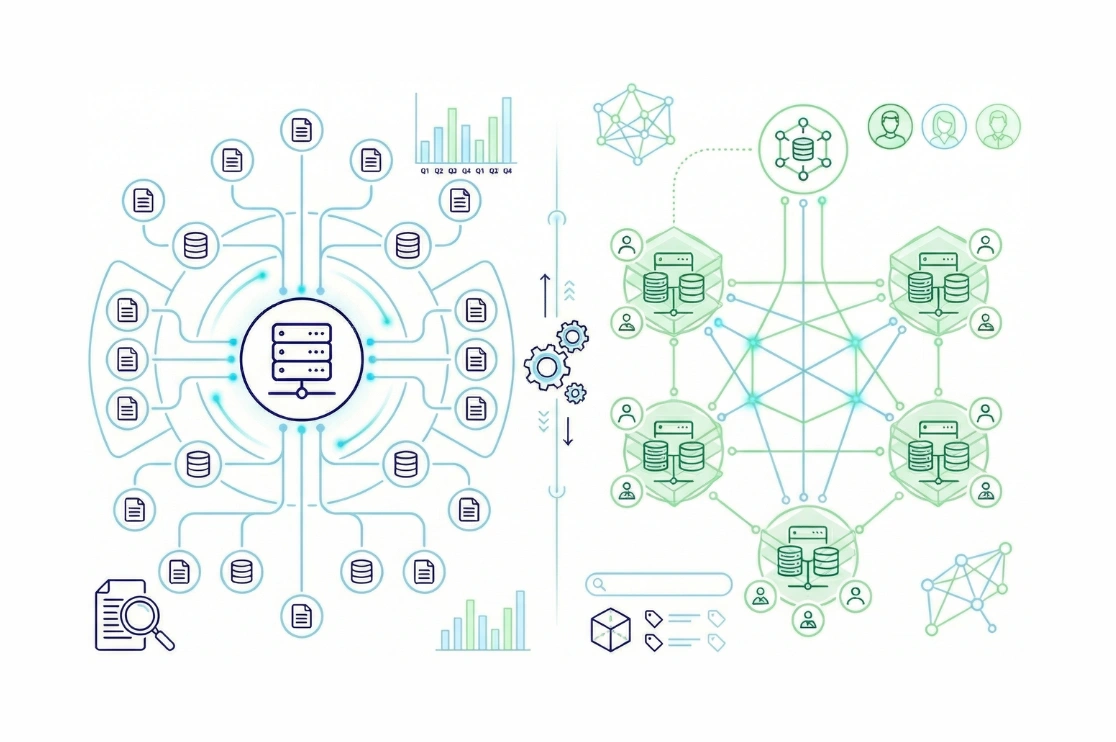 Centralized vs. Federated vs. Hybrid Data Governance: Which Model Fits Your Organization
 Data Governance Roles and Responsibilities in AEC Organizations