











Environmental, Social, and Governance reporting is no longer a voluntary corporate exercise. Enterprises across industries are moving toward a regulatory reality where ESG disclosures are becoming enforceable, auditable, and financially material. Organizations will not simply be encouraged to report sustainability metrics. They will be required to do so with accuracy, consistency, and transparency.
The shift toward mandatory ESG reporting is being driven by multiple forces. Regulatory frameworks such as CSRD, evolving climate disclosure rules, and expanding global compliance standards are pushing enterprises to treat ESG data with the same rigor as financial data.
Investors are demanding measurable sustainability performance. Boards are under pressure to demonstrate risk mitigation. Customers increasingly evaluate vendors based on sustainability commitments.
Table of Contents
- Introduction
- Microsoft Fabric’s Role in Real-Time ESG Data Pipelines
- Enterprise ESG Data Modernization Using Microsoft Fabric Platform
- Carbon Intelligence Models for Enterprise Decision-Making
- Microsoft Fabric Governance Framework for ESG Compliance Reporting
- ROI for Sustainability Programs Using Microsoft Fabric
- ESG Reporting Requirements in 2026: What Enterprises Must Prepare For
- Conclusion
- FAQs
For many enterprises, the challenge is not the willingness to report ESG metrics. The difficulty lies in managing fragmented data, inconsistent measurement methodologies, and disconnected analytics systems.
ESG data often resides across ERP systems, IoT platforms, supply chain systems, procurement tools, spreadsheets, and third-party providers. Without a structured analytics foundation, reporting becomes slow, unreliable, and expensive.
This is precisely where Microsoft Fabric consulting for ESG analytics and sustainability reporting becomes strategically important. Enterprises require a modern data architecture capable of centralizing sustainability information, enabling governance controls, and delivering decision-grade insights.
Microsoft Fabric’s Role in Real-Time ESG Data Pipelines
Enterprises pursuing sustainability intelligence quickly encounter a recurring problem. ESG data ecosystems are inherently complex. Metrics originate from operational systems, environmental sensors, financial applications, and external data providers. Traditional analytics stacks struggle to unify these data streams efficiently.
A unified ESG analytics platform with Microsoft Fabric fundamentally changes this dynamic. Microsoft Fabric enables enterprises to build integrated, scalable ESG pipelines without stitching together multiple disconnected tools. Instead of managing separate ingestion platforms, warehouses, BI tools, and governance layers, organizations operate within a consolidated analytics environment.
Through Microsoft Fabric implementation services for enterprise ESG data management, enterprises can centralize sustainability data flows across departments and regions. Fabric’s OneLake architecture creates a single logical data estate where ESG information becomes consistently accessible.
Real-time intelligence capabilities allow organizations to monitor emissions, energy consumption, waste metrics, and operational anomalies as events occur. In practice, this means emissions data can be validated within hours rather than weeks.
Enterprises can detect inefficiencies, identify compliance risks, and respond proactively rather than retroactively. Enterprises incorporating Microsoft Fabric have reported to reduced ESG reporting cycle by 42%.
From an executive perspective, this consolidation reduces architectural complexity, shortens reporting cycles, and minimizes integration overhead. Instead of spending resources reconciling inconsistent datasets, analytics teams can focus on insight generation and strategic modeling.
Enterprise ESG Data Modernization Using Microsoft Fabric Platform
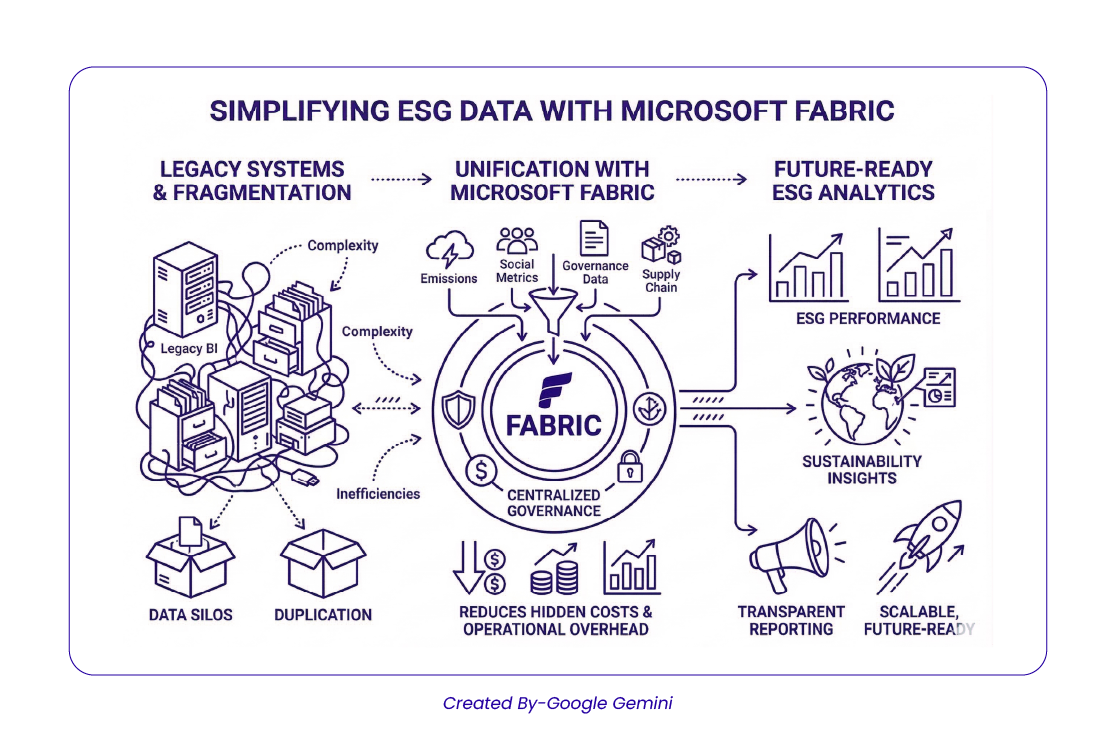
Many enterprises approach ESG reporting using legacy BI ecosystems that were never designed for sustainability analytics. These environments often involve multiple warehouses, overlapping dashboards, redundant ETL workflows, and escalating licensing costs.
Enterprise ESG data modernization using Microsoft Fabric platform offers a pragmatic pathway out of this fragmentation. Rather than layering new sustainability tools on top of existing complexity, enterprises can modernize their analytics foundation holistically.
Fabric consolidates ingestion, storage, analytics, AI, and visualization into a cohesive SaaS framework. This dramatically simplifies ESG analytics operations. Data silos shrink. Duplication decreases. Governance becomes centralized. Reporting workflows become repeatable.
The financial implications are equally significant. Fragmented BI environments frequently lead to hidden costs. These include infrastructure expenses, integration maintenance, manual reconciliation efforts, and duplicated analytics workloads.
A unified Fabric architecture directly supports BI cost optimization by reducing tool sprawl and operational inefficiencies.
Executives evaluating modernization initiatives often prioritize risk reduction, scalability, and cost predictability. Fabric aligns strongly with these decision drivers by providing a single analytics backbone capable of supporting both ESG intelligence and broader enterprise analytics needs.
Recommended Reading:
Carbon Intelligence Models for Enterprise Decision-Making
Carbon accounting is evolving beyond compliance reporting. Enterprises are now expected to understand emissions drivers, simulate reduction strategies, and evaluate financial trade-offs associated with sustainability initiatives.
Advanced carbon intelligence requires integrating Scope 1, Scope 2, and Scope 3 data across operational systems, supplier networks, logistics platforms, and financial applications. Without a scalable analytics platform, carbon measurement quickly becomes inconsistent and analytically shallow.
Microsoft Fabric enables enterprises to build scalable carbon intelligence models. Enterprises can correlate emissions data with operational activities, cost structures, and procurement decisions. This allows leadership teams to evaluate decarbonization strategies using quantifiable business metrics.
Predictive analytics capabilities further enhance decision quality. Enterprises can simulate future emissions trajectories, identify high-impact reduction opportunities, and assess ROI scenarios associated with sustainability investments.
For CFOs and strategy leaders, carbon intelligence becomes a financial planning tool rather than a reporting obligation. It supports capital allocation decisions, operational optimization, and risk forecasting.
Microsoft Fabric Governance Framework for ESG Compliance Reporting
Mandatory ESG disclosures introduce a new class of governance requirements. Sustainability metrics must be traceable, auditable, and defensible. Data lineage, access controls, classification policies, and quality standards become essential.
An effective Microsoft Fabric governance framework for ESG compliance reporting ensures enterprises maintain data credibility while enabling analytics agility. Governance is not merely a security exercise. It is a regulatory necessity.
ESG data governance Microsoft Fabric capabilities provide structured controls for managing sensitive sustainability information. Enterprises can implement role-based access, lineage tracking, sensitivity labeling, and centralized administration without constructing governance mechanisms from scratch.
This governance foundation directly supports regulatory defensibility. Organizations can demonstrate data provenance, verify calculation methodologies, and maintain transparency across reporting cycles.
Executives increasingly recognize that poor ESG governance introduces reputational, financial, and compliance risks. A structured Fabric governance strategy mitigates these exposures while enabling scalable analytics adoption.
Recommended Reading:
ROI for Sustainability Programs Using Microsoft Fabric
Sustainability initiatives are frequently evaluated through a cost lens rather than a value lens. However, modern ESG analytics platforms reveal measurable financial and operational benefits.
Microsoft Fabric for regulatory ESG reporting enhances reporting efficiency, reduces reconciliation effort, and shortens disclosure cycles. Automated pipelines replace manual data aggregation. Unified models eliminate inconsistencies. Analytics teams spend less time validating datasets.
Operational cost reductions often follow. Real-time insights help enterprises identify inefficiencies, optimize resource consumption, and reduce waste. Compliance costs decline as governance frameworks standardize reporting workflows.
From an executive standpoint, ROI emerges across multiple dimensions. These include productivity gains, cost consolidation, risk mitigation, and improved decision quality. Fabric transforms ESG analytics from a compliance expense into a strategic intelligence capability.
Organizations investing in Microsoft Fabric consulting and implementation services frequently observe accelerated analytics maturity alongside sustainability improvements.
ESG Reporting Requirements in 2026: What Enterprises Must Prepare For
In 2026, ESG reporting shifts from voluntary to mandatory, focusing on audit-ready data, complete scope 3 emissions monitoring, and following the ISSB/CSRD parameters.
Enterprises must focus on the digital data management, board-level climate risk governance for accomplishing stricter, standardized regulatory needs.
Here are the 5 key ESG reporting requirements.
-
Mandatory Standards (ISSB/CSRD)
-
California Climate Laws (SB 253/261)
-
Scope 3 Emission Tracking
-
Materiality Assessment
-
Public Accountability (ESOS Phase 4)
Conclusion
Enterprises are entering an era where ESG data is becoming mission critical. Regulatory mandates, investor expectations, and operational realities demand analytics platforms capable of managing sustainability intelligence at scale.
A sustainability data platform for enterprises built on Fabric provides the architectural stability, governance rigor, and analytical depth required for modern ESG strategies. However, successful adoption requires more than platform deployment.
Microsoft Fabric architecture consulting for sustainability intelligence ensures enterprises design scalable, compliant, and cost-efficient analytics environments. From modernization planning to governance frameworks and pipeline design, strategic consulting plays a pivotal role.
Organizations seeking to transform ESG reporting into decision-grade intelligence can benefit significantly from expert-led implementation and architectural guidance.
FAQs
What makes Microsoft Fabric suitable for ESG analytics?Microsoft Fabric provides a unified analytics environment that centralizes ESG data across systems. It simplifies ingestion, governance, analytics, and reporting within a single platform, reducing complexity and improving data consistency.
How does Fabric improve ESG data governance?Fabric integrates governance controls such as lineage tracking, role-based access, and sensitivity labeling. These capabilities enhance data credibility, regulatory defensibility, and compliance alignment.
Can Fabric help reduce BI and analytics costs?Yes. Fabric supports BI cost optimization by consolidating fragmented analytics tools into a unified platform. This reduces licensing redundancy, integration overhead, and operational inefficiencies.
How long does it take for implementing MS Fabric for enterprise ESG reporting?The time to implement MS Fabric for enterprise level ESG reporting differs due to various factors such as scope of ESG data sources, data quality, integrations with existing systems, governance requirements, dashboard complexity, compliance standards, and whether you are executing a full-scale rollout or starting with a pilot.
How does Microsoft Fabric ensure ESG data is audit-ready for CSRD and regulatory examination?To ensure this, Microsoft Fabric provides a structured, governed, and traceable data foundation throughout ingestion, storage, transformation, and reporting. CSRD requires companies to exhibit traceability, accuracy, and transparency.
Can Microsoft Fabric integrate with existing ERP, SAP, or Oracle systems for ESG reporting?Yes, Microsoft Fabric is designed to be integrated with enterprise systems such as Oracle, SAP, and other ERP systems. As a matter of fact, the integration of CSRD-grade ESG programs with ERP systems is mandate.

 Microsoft Fabric 2.0: The Future of Unified Analytics in a Multi-Agent AI World
  Why Traditional Data Migration Falls Short and How AI Is Changing the Approach
  How CFOs and CIOs Actually Evaluate Cloud Data Strategy: Cost, Risk, and ROI
  Databricks to Snowflake Migration Guide: A Strategic Blueprint for Modern Data Warehousing