











Short answer
AI risk is fundamentally different from traditional technology risk because the failure modes are probabilistic, emergent, and data-dependent rather than deterministic and code-level. Enterprise organizations building AI at scale need four things their standard IT risk framework typically does not provide: a risk taxonomy covering model, data, operational, and regulatory dimensions; an assessment process calibrated to AI-specific risk types; integration with the data governance program that manages the inputs AI systems depend on; and a governance operating model that can keep pace with AI deployment velocity. The NIST AI Risk Management Framework and ISO/IEC 42001 provide the established standards; the challenge is operationalizing them in a way that enables rather than throttles AI development.
Your organization has approved ten AI projects for 2026. The legal team has concerns about the EU AI Act. The compliance function is asking for risk assessments on the credit scoring model before it goes live. The data science team is frustrated because the review process takes longer than building the model. And no one is entirely sure who owns AI at risk: IT, legal, the Chief Risk Officer, or the new Chief AI Officer.
This is not a governance failure. It is the predictable result of applying risk management frameworks designed for deterministic software systems to AI systems that fail in fundamentally different ways. Traditional IT risk management assumes you can specify correct behavior exhaustively, test against it, and declare the system at low risk if tests pass. AI systems do not work this way. Their behavior emerges from training data, is probabilistic at inference, drifts as real-world data changes, and can fail in ways that were not present during testing but appear in production when the input distribution shifts.
Building an AI risk management function that works requires a different taxonomy, a different assessment process, and a different operating model. It also requires integration with the data governance program, because data quality and lineage are the foundation that AI reliability depends on.
Table of Contents:
| Dec 2027 | Deadline for providers of standalone high-risk AI systems (Annex III) to comply with the EU AI Act’s requirements, including risk management, data governance, technical documentation, transparency, and human oversight. Covered use cases include employment, education, credit scoring, critical infrastructure, law enforcement, and healthcare. Source: EU AI Act (Regulation (EU) 2024/1689), as amended by the Digital Omnibus implementation timeline. |
|---|
Why AI Risk Is Different from Traditional Technology Risk The specific failure modes of AI systems that standard IT risk frameworks are not designed to catch
Probabilistic outputs, not deterministic behavior
Traditional software has deterministic behavior given the same inputs; it produces the same outputs, and you can test exhaustively against a specification. AI systems produce probabilistic outputs: the same input can produce different outputs depending on model version, sampling parameters, and context. This makes traditional pass/fail testing insufficient. An AI system cannot be declared risk-free because all unit tests pass. The question is whether the distribution of outputs is acceptable across the full range of inputs the system will encounter in production.
Data dependency creates a new risk surface
Traditional software risk is primarily a code risk. AI model risk is inseparable from data risk. A model trained in biased, incomplete, or historically unrepresentative data will encode those characteristics in its outputs. A model whose training data does not cover a segment of the population it will score in production will perform poorly on that segment, often in ways that are invisible until the system has already caused harm. Data lineage, data quality, and data governance are not supporting functions for AI risk management. They are the primary control layer.
Emergent behavior and model drift
AI systems can exhibit emergent behavior: outputs or capabilities that were not present during testing and were not designed into the system. Large language models are the most prominent example, but classification and prediction models also degrade in unexpected ways when input distributions shift. A credit risk model trained on pre-pandemic economic conditions will drift in its predictions as the economic environment changes. A fraud detection model trained on historical fraud patterns will underperform when fraud tactics evolve. Model drift is not a failure. It is the expected behavior of models deployed in changing environments. Managing it requires ongoing monitoring, which standard IT risk frameworks do not include.
Explainability creates regulatory and legal risk
Traditional software decisions are auditable: you can trace the logic that produces any output. Many AI models, particularly deep learning models, do not provide a human-interpretable explanation for their decisions. This creates regulatory risk in contexts where explanations are legally required (credit decisions under GDPR, FCRA, and EU AI Act Article 13), operational risk when operators cannot understand why a model flagged or approved a case, and reputational risk when a model’s decisions are challenged and the organization cannot explain them.
Note: Many organizations apply their existing IT security or change management framework to AI systems and find it inadequate within the first production deployment. The inadequacy is not in the framework’s rigor. It is that the framework was designed for a different class of systems. AI risk management requires a purpose-built framework, not an adapted one.
Build a Strong Foundation for AI Risk Management
Evaluate your governance maturity to strengthen data quality, lineage, accountability, and compliance before expanding enterprise AI initiatives.
Data Governance Maturity Assessment
A structured diagnostic for CDOs, CIOs, and Chief Compliance Officers. 18 questions across six governance dimensions. Receive a scored maturity profile and prioritised recommendations.
Your Details
Your Assessment Results
Overall Governance Maturity Level
Receive Your Full Report
A BluEnt governance consultant will prepare a personalised report with specific recommendations for your highest-priority gaps. Book a 60-minute discovery call to discuss your findings.
The Enterprise AI Risk Landscape: A Taxonomy for Risk Leaders Six risk categories that define the enterprise AI risk landscape
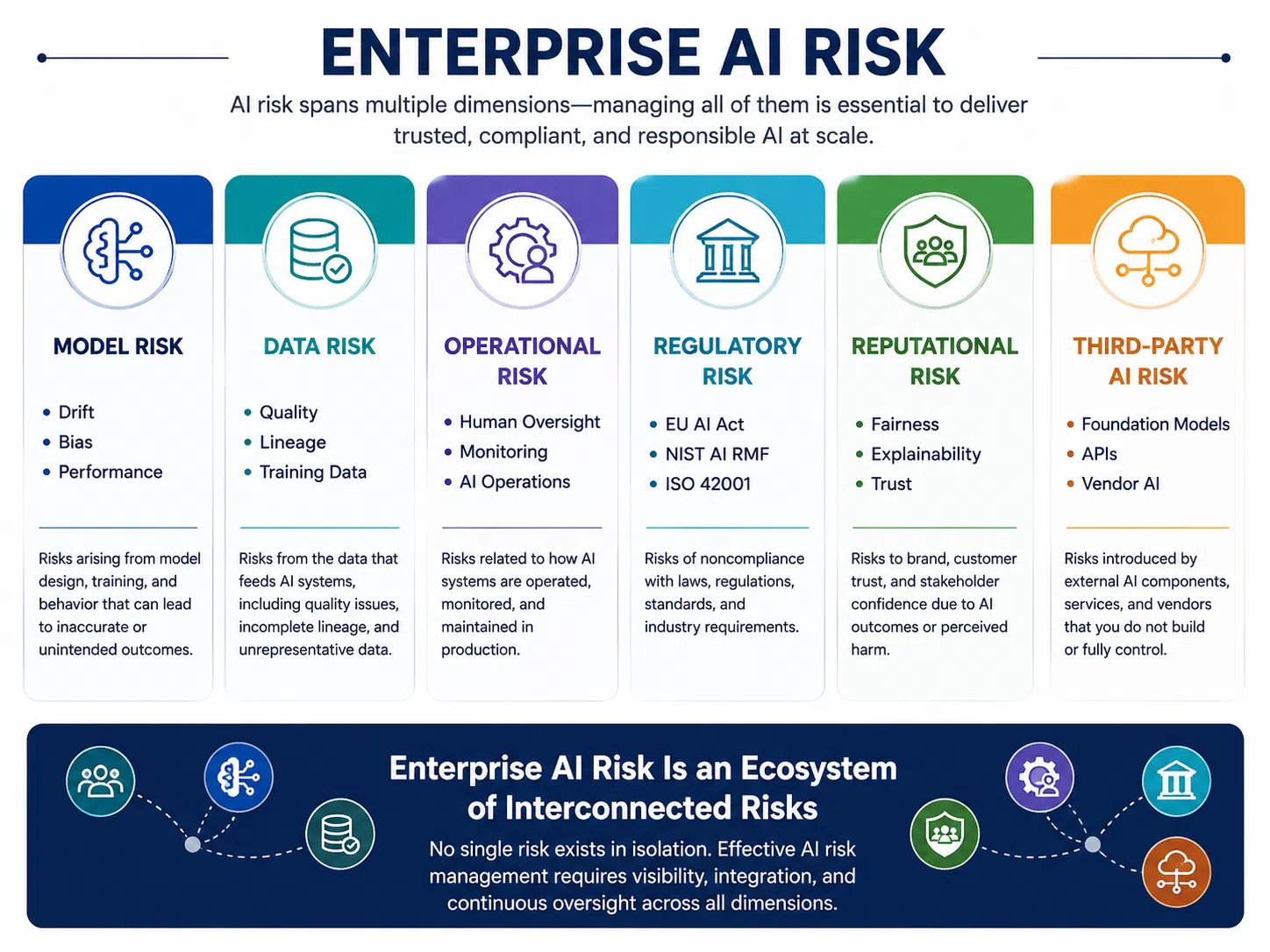
| Risk category | Examples | Governance layer | Primary mitigation |
|---|---|---|---|
| Model risk | Bias in outputs, performance degradation, model drift, overconfident predictions | Model development and validation | Model validation framework, ongoing performance monitoring, drift detection |
| Data risk | Training data quality, biased historical data, data lineage gaps, PII in training sets | Data governance program | Data quality management, lineage documentation, PII governance, data stewardship |
| Operational risk | Overreliance on AI decisions, inadequate human oversight, failure of monitoring systems | AI deployment and MLOps | Human-in-the-loop requirements, override mechanisms, MLOps monitoring |
| Regulatory and compliance risk | EU AI Act non-compliance, GDPR automated decision-making requirements, sector-specific rules | Legal and compliance function | Regulatory mapping, compliance assessment by use case, ongoing regulatory monitoring |
| Reputational and ethical risk | Discriminatory outcomes, unexplainable decisions affecting individuals, misuse of AI outputs | Ethics and responsible AI | Impact assessment, fairness testing, stakeholder review, explainability requirements |
| Third-party AI risk | Vendor model opacity, API dependency, pre-trained foundation model risks | Vendor and procurement governance | Third-party AI due diligence, contractual protections, model documentation requirements |
Data risk and model risk are tightly interdependent: most model risk originates in data quality and data representativeness issues that were not caught before training. This is why enterprise AI risk management programs that operate independently of the data governance program consistently find the same root causes in their model incidents.
Third-party AI risk is emerging as a significant and underaddressed category. Organizations using foundation models, AI APIs, or AI-embedded vendor software to inherit risk from models they did not train and cannot inspect. The EU AI Act creates explicit obligations for deployers of third-party high-risk AI systems, not just developers, making vendor AI due diligence a compliance requirement rather than a best practice.
From the field
In AI risk programs we have supported, the most common governance gap is the absence of a formal model inventory. Organizations frequently cannot enumerate all the AI models running in production, who trained them, what data they were trained on, when they were last validated, and which business decisions they inform. Model inventory is the foundational asset for AI risk management. Without it, risk assessment is necessarily incomplete, and regulatory compliance is difficult to demonstrate.
Build a Smarter AI Risk Management Strategy
Whether you’re establishing AI governance or strengthening enterprise risk controls, our experts can help you develop a practical framework that scales with AI adoption.
Regulatory and Standards Context NIST AI RMF 1.0, EU AI Act, ISO/IEC 42001, and sector-specific requirements
NIST AI Risk Management Framework 1.0
The National Institute of Standards and Technology published the AI Risk Management Framework (AI RMF 1.0) in January 2023. It is a voluntary framework structured around four core functions: Govern, Map, Measure, and Manage. The framework is designed to be technology-neutral and sector-agnostic, applicable to any organization developing or deploying AI systems regardless of industry or jurisdiction.
Govern establishes the policies, processes, and organizational accountability structures for AI risk management. Map identifies and categorizes AI systems and their associated risks. Measure assesses the magnitude and likelihood of identified risks. Manage implements risk responses and tracks their effectiveness. The AI RMF is not a compliance mandate for most US organizations, but it is increasingly cited as a reference standard in government procurement, financial services regulation, and international interoperability discussions.
| 4 functions | The NIST AI Risk Management Framework (AI RMF) 1.0 is organized around four core functions: Govern, Map, Measure, and Manage. Together, they provide a structured approach to managing AI risks throughout the AI system lifecycle, from design and development to deployment, operation, and retirement. Source: NIST AI Risk Management Framework (AI RMF) 1.0, National Institute of Standards and Technology, January 2023. |
|---|
EU AI Act
The EU AI Act (Regulation EU 2024/1689) entered into force in August 2024 and applies a risk-based regulatory framework to AI systems placed on the EU market or affecting EU persons. It establishes four risk tiers: unacceptable risk (prohibited), high risk (extensive compliance obligations), limited risk (transparency requirements), and minimal risk (no specific obligations).
High-risk AI systems include those used in hiring and recruitment, credit scoring and financial services, critical infrastructure management, education and vocational training, essential private and public services, law enforcement, border control, administration of justice, and healthcare. Organizations deploying high-risk AI systems must implement a risk management system, ensure data governance and training data quality, maintain technical documentation, provide transparency and explainability, enable human oversight, and achieve appropriate accuracy, robustness, and cybersecurity standards.
The Act’s compliance timeline is phased: provisions for prohibited AI practices applied from February 2025, obligations for general-purpose AI models from August 2025, and requirements for high-risk AI systems from August 2026. Organizations with operations or customers in the EU that have not yet conducted an AI Act applicability assessment should treat this as a near-term priority.
ISO/IEC 42001:2023
ISO/IEC 42001, published in December 2023, is the international standard for Artificial Intelligence Management Systems. It provides a framework for establishing, implementing, maintaining, and continuously improving an AI management system within an organization. It follows the same high-level structure as ISO 27001 (information security) and ISO 9001 (quality management), which means organizations with existing ISO management systems can integrate their AI management requirements into the same governance infrastructure.
ISO/IEC 42001 is certifiable, meaning organizations can achieve third-party certification demonstrating conformance. For organizations in regulated industries or those serving enterprise clients with vendor due diligence requirements, certification provides an independently verifiable signal of AI risk management maturity.
Sector-specific requirements
Beyond the general frameworks, regulated industries face AI-specific requirements from their sectoral regulators. In financial services, the Federal Reserve, OCC, and FDIC have issued interagency guidance on model risk management (SR 11-7) that predates modern AI but applies to machine learning models used in credit, fraud, and risk decisions. The EU’s financial regulators have issued additional guidance on AI in credit scoring and algorithmic trading. In healthcare, FDA guidance on AI/ML-based software as a medical device creates specific lifecycle management requirements. Organizations operating across multiple jurisdictions need a regulatory mapping that identifies which AI use cases to trigger which requirements.
Note: Regulatory compliance and risk management are not the same objective. Regulatory compliance is a binary threshold: you either meet the requirements, or you do not. Risk management is continuous: it identifies, assesses, and reduces risk across a spectrum. An AI risk management function designed only to achieve regulatory compliance will typically fall short of the risk management capability the organization actually needs. Build risk management first; compliance follows.
Recommended Reading:
Building an Enterprise AI Risk Management Function Four components required to build an AI risk function that enables deployment velocity
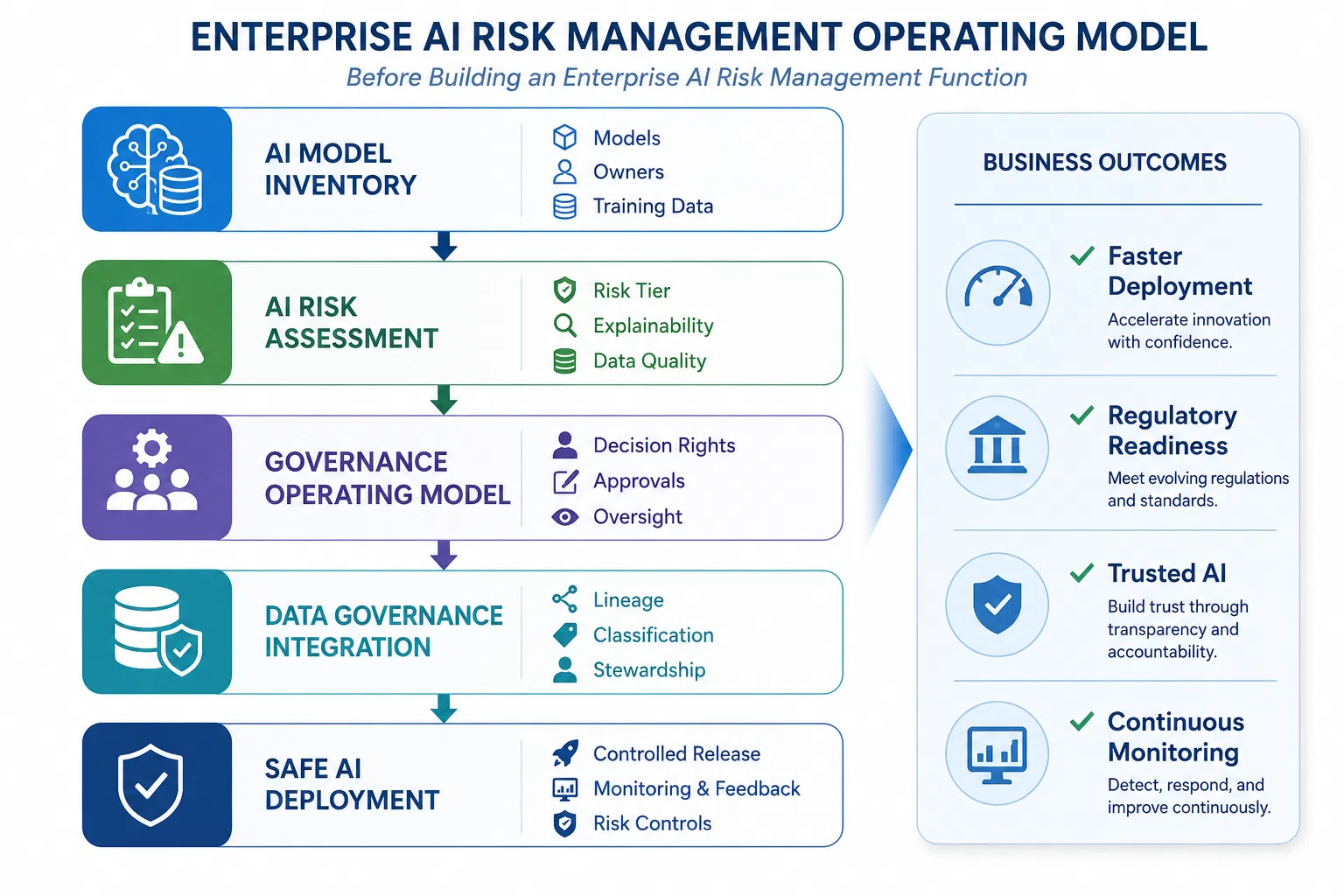
Build and maintain a model inventory
The model inventory is the foundational asset for AI risk management. It enumerates every AI model in use across the organization, with structured documentation for each: model purpose and business use case, owner and developer, training data sources and date range, validation status and last validation date, performance metrics and acceptable thresholds, the decisions it informs and their risk level, and the regulatory tier it falls into. Without a maintained model inventory, risk assessment is necessarily ad hoc and incomplete.
The inventory should include models in all stages: development, testing, staging, and production. It should also include third-party AI systems, AI-embedded vendor software, and foundation model APIs, not just internally developed models. Organizations frequently undercount their AI exposure because procurement of AI-embedded software is handled outside the model’s governance process.
Implement an AI risk assessment process calibrated to AI-specific risks
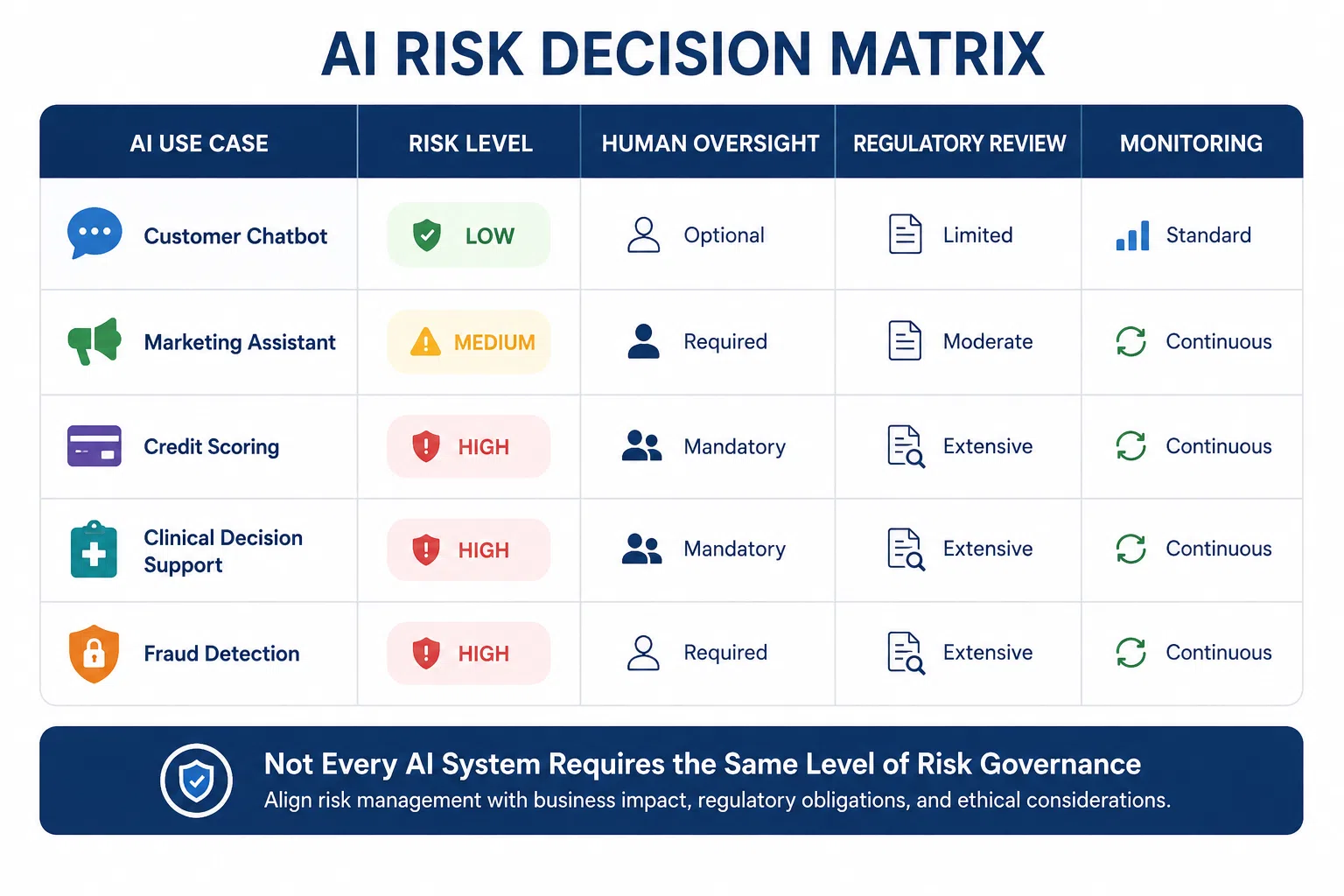
A fit-for-purpose AI risk assessment evaluates six dimensions: the risk tier of the use case (using the EU AI Act categories or NIST AI RMF categories as a baseline), the quality and representativeness of training data, the model’s explainability requirements given the decisions it informs, the human oversight mechanisms in place, the monitoring and drift detection capability, and the regulatory and compliance obligations that apply to the use case.
The assessment output should be a risk classification that determines the level of scrutiny and documentation required before deployment and the ongoing monitoring requirements of post-deployment. A customer service chatbot and a credit scoring model require fundamentally different assessments. A framework that applies the same process to both will either over-burden low-risk AI deployment or under-scrutinize high-risk AI deployment.
Establish a governance operating model that scales
An AI governance operating model defines who is responsible for AI risk management, what decisions require review and approval, and how the function scales as AI deployment accelerates. The three common models are: a centralized AI risk committee that reviews all significant AI deployments, a federated model where risk responsibility is embedded in each business unit with central oversight standards, and a center of excellence model that provides standards, tooling, and advisory support while business units own execution.
Centralized models provide strong oversight but become bottlenecks as deployment volume grows. Federated models scale better but require strong central standards and monitoring to maintain consistency. Most enterprise organizations with more than 20 active AI use cases find the federated model with central standards to be the most sustainable design. The governance operating model should be designed for the AI deployment volume the organization expects in two years, not the volume it has today.
Integrate AI risk management with the data governance program
AI model risk cannot be managed independently of data governance. Training data quality, lineage documentation, PII handling, bias assessment, and ongoing data quality monitoring are all data governance capabilities that AI risk management depends on. Organizations that run these separate programs find that AI risk reviews identify data governance gaps, and data governance programs identify AI use cases that were never submitted for risk review.
The integration points are specific: data stewards should be included in AI risk assessments for use cases in their data domain. The data catalog should record which data assets are used as training data for which models. Data quality SLAs for governed datasets should include the quality requirements of the AI models that depend on them. And when data quality incidents occur in governed datasets used by AI models, the AI risk function should be notified automatically through the incident management process.
Note: AI risk management that is not integrated with data governance will repeatedly find the same root causes: models trained on ungoverned data, training datasets without lineage documentation, PII in training sets that was not identified because no data classification process covered it. Building the integration between these two functions is the highest-leverage structural improvement most enterprise AI risk programs can make.
The bottom line
AI risk is not a new category of IT risk. It is a fundamentally different class of risk that requires a purpose-built management framework, integration with the data governance program, and an operating model that can scale with deployment velocity. Organizations that apply traditional IT risk management to AI systems will consistently find the framework inadequate, because the failure modes it was designed to catch are not the failure modes AI systems exhibit.
-
Build a model inventory first. Without it, risk assessment and regulatory compliance are incomplete by design.
-
The EU AI Act creates compliance deadlines that are already active for some provisions and immediate for others. An applicability assessment is a near-term necessity for organizations with EU market exposure.
-
Data governance and AI risk management are not separate programs. Training data quality, lineage, and PII governance are the primary control layer for model risk.
-
NIST AI RMF and ISO/IEC 42001 provide the established standards. The implementation challenge is operationalizing them at deployment velocity.
-
The governance operating model should be designed for two years of AI deployment growth, not current volume. Centralized review processes that work today become bottlenecks quickly.
If your AI risk management function is still being built, or if your existing framework was not designed with AI-specific failure modes in mind, the time to redesign it is before a high-risk deployment goes wrong rather than after.
Build an AI risk management function that enables faster, safer AI deployment
BluEnt’s data governance and AI strategy team works with enterprise organizations to design AI risk frameworks, conduct model inventory and portfolio risk assessments, prepare for EU AI Act compliance, and integrate AI risk management with existing data governance programs.
Common Questions What CROs, CDOs, and AI program leaders ask about enterprise AI risk management
What is the difference between AI risk management and AI governance?AI governance is the broader organizational capability: the policies, structures, roles, and processes that define how AI is developed, deployed, and overseen across the enterprise. AI risk management is a component of AI governance focused specifically on identifying, assessing, and mitigating the risks that AI systems introduce. AI governance without a risk management component lacks the systematic evaluation of failure modes. AI risk management without a governance structure lacks the accountability and enforcement mechanisms to ensure risk decisions are implemented. Mature AI programs need both.
Do we need to comply with the EU AI Act if we are not based in the EU?The EU AI Act applies to any AI system placed on the EU market or whose outputs affect people in the EU, regardless of where the developing or deploying organization is headquartered. A US-based financial institution that uses a credit scoring AI to assess EU-resident applicants is subject to the Act for that use case. A US SaaS company whose product includes AI-driven decision-making used by EU customers is subject to the Act for that product. Organizations should conduct an applicability assessment that maps their AI use cases against EU market exposure, not assume non-EU domicile means non-applicability.
What is the NIST AI Risk Management Framework and is it mandatory?The NIST AI Risk Management Framework (AI RMF 1.0) is a voluntary framework published by the National Institute of Standards and Technology in January 2023. It provides a structured approach to managing AI risks organized around four functions: Govern, Map, Measure, and Manage. It is not a regulatory mandate for most US private sector organizations, but it is increasingly referenced as a standard in government procurement requirements, financial services regulatory guidance, and international frameworks. Organizations seeking to demonstrate AI risk management maturity to regulators, clients, or boards often use the AI RMF as the reference framework for that demonstration.
How is AI model risk different from the model risk management frameworks financial services firms already have?Financial services model risk management (governed by SR 11-7 guidance) is well-established and applies to statistical models used in credit, market risk, and capital adequacy calculations. It covers model development, validation, documentation, and ongoing performance monitoring. AI models fall under this framework when used in regulated financial decisions. However, SR 11-7 was designed for traditional statistical models and does not fully address the AI-specific risks of explainability, emergent behavior, foundation model opacity, and data provenance. Financial services organizations typically need to extend their existing MRM framework with AI-specific annexes covering these dimensions rather than replacing the MRM framework.
What is a model inventory and why does it matter?A model inventory is a structured register of all AI and analytical models in use across the organization, with documentation for each model’s purpose, ownership, training data, validation status, performance metrics, and regulatory classification. It is the foundational tool for AI risk management because risk assessment, regulatory compliance, and ongoing monitoring are all impossible to systematize without knowing what models exist and what they do. Many organizations that believe they have a small AI footprint discover through inventory exercises that they have significantly more AI-driven decision-making in production than their governance process has captured, particularly through AI-embedded vendor software and shadow AI use cases built outside the formal development process.
When should we engage an AI risk consulting firm?External AI risk consulting adds the most value in three situations: when building or redesigning the AI risk management function from scratch, including framework design, operating model, and integration with existing governance programs; when preparing for a specific regulatory requirement such as EU AI Act compliance or a financial services model risk review; and when conducting a cross-portfolio AI risk assessment that requires independence from the teams who built the models being assessed. Internal teams typically have the domain knowledge but benefit from external perspectives on framework design, regulatory interpretation, and assessment methodology. A good AI risk consulting engagement transfers the framework and methodology to the internal team rather than creating ongoing dependency.

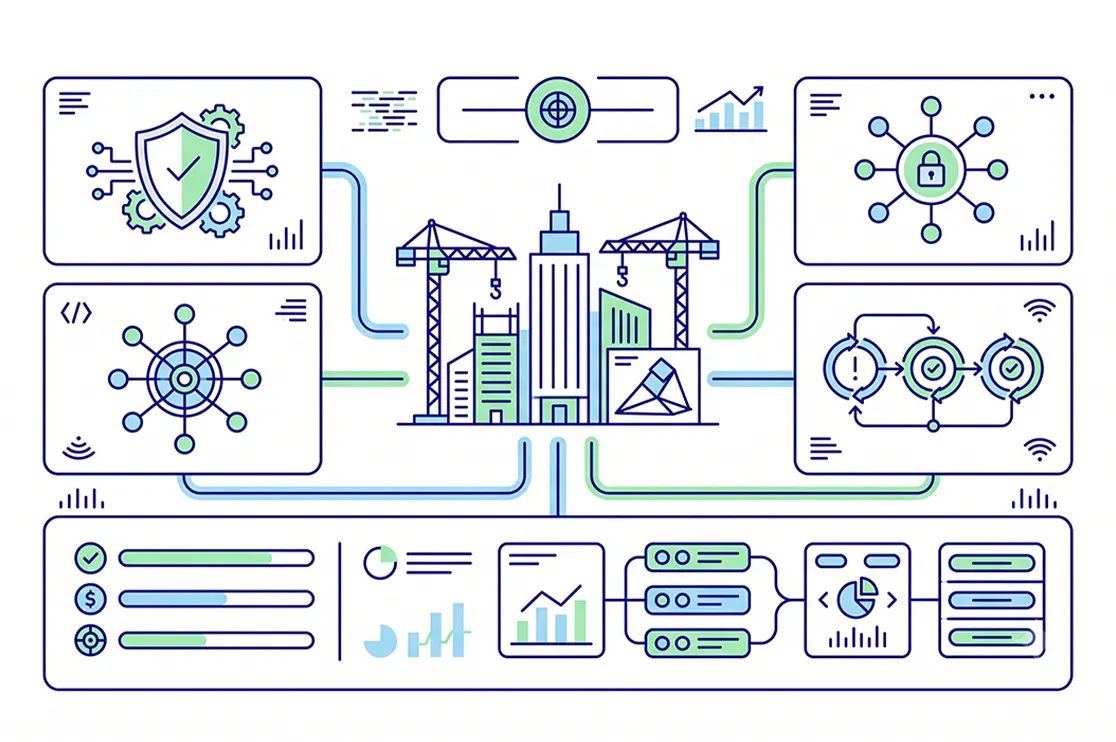 Governing AI Tools in AEC: Copilot, Digital Twins, and Generative Design
  Data Governance for AI and Advanced Analytics: Building the Foundation That Works
 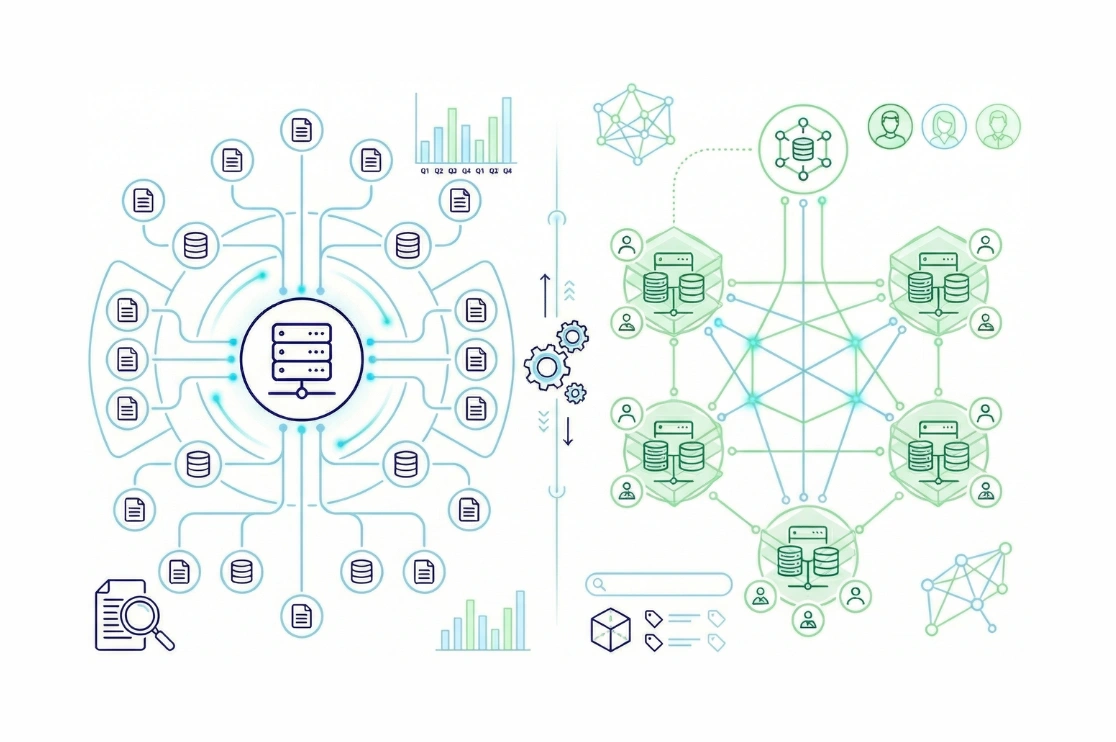 Centralized vs. Federated vs. Hybrid Data Governance: Which Model Fits Your Organization
 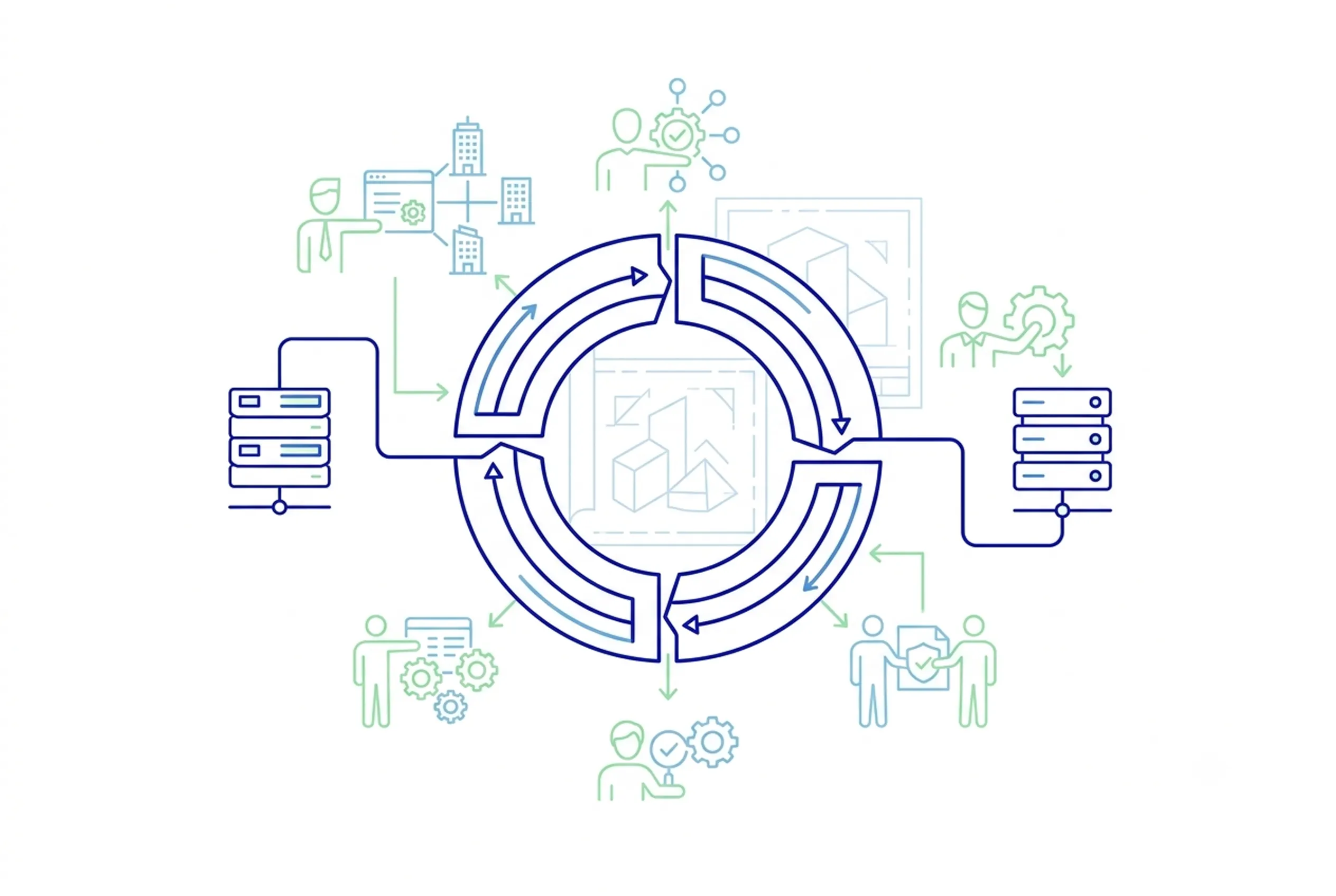 Data Governance Roles and Responsibilities in AEC Organizations