











Short answer
Most organizations treat data governance as a defensive function: audit readiness, regulatory compliance, risk reduction. Mature organizations treat it as an offensive capability: faster analytics delivery, more reliable AI, trusted data products, and self-service access that accelerates decisions across the business. The difference is not technology. It is governance program design, executive sponsorship, and whether the program is measured against compliance checkboxes or business outcomes. Organizations that make this shift consistently report measurable improvements in analytics ROI, AI deployment rates, and time-to-insight.
Your governance program has been running for 18 months. The policies are documented. The data catalog is populated. The audit findings are clean. And yet the business still does not trust the data; the AI projects are stalling because model training data is unreliable, and leadership still builds their own spreadsheets rather than using the shared dashboards your team maintains.
This is the compliance-first governance trap. The program is technically successful by the metrics it was designed against, and invisible to everyone it should be serving. The organizations pulling ahead on data-driven decisions are not running better compliance programs. They have redesigned governance as an enabling capability, measured against business outcomes rather than audit checklists, and owned by business leaders rather than risk and IT teams.
Gartner has identified poor data quality as the leading cause of failed analytics and AI initiatives, estimating it costs organizations an average of $12.9 million per year in rework, delayed decisions, and incorrect outputs. The organizations that reduce that cost most significantly are not those that invested most in data technology. They are those that established governance as a business capability first.
Table of Contents:
High-quality, well-governed data is consistently identified as a foundational requirement for successful AI initiatives. Industry research from Gartner, McKinsey, IBM, and MIT Sloan emphasizes that organizations with strong data governance, metadata management, and data quality practices are better positioned to scale AI and generate measurable business value.
The Compliance-First Trap Why audit-readiness governance fails to create business value and loses organizational support
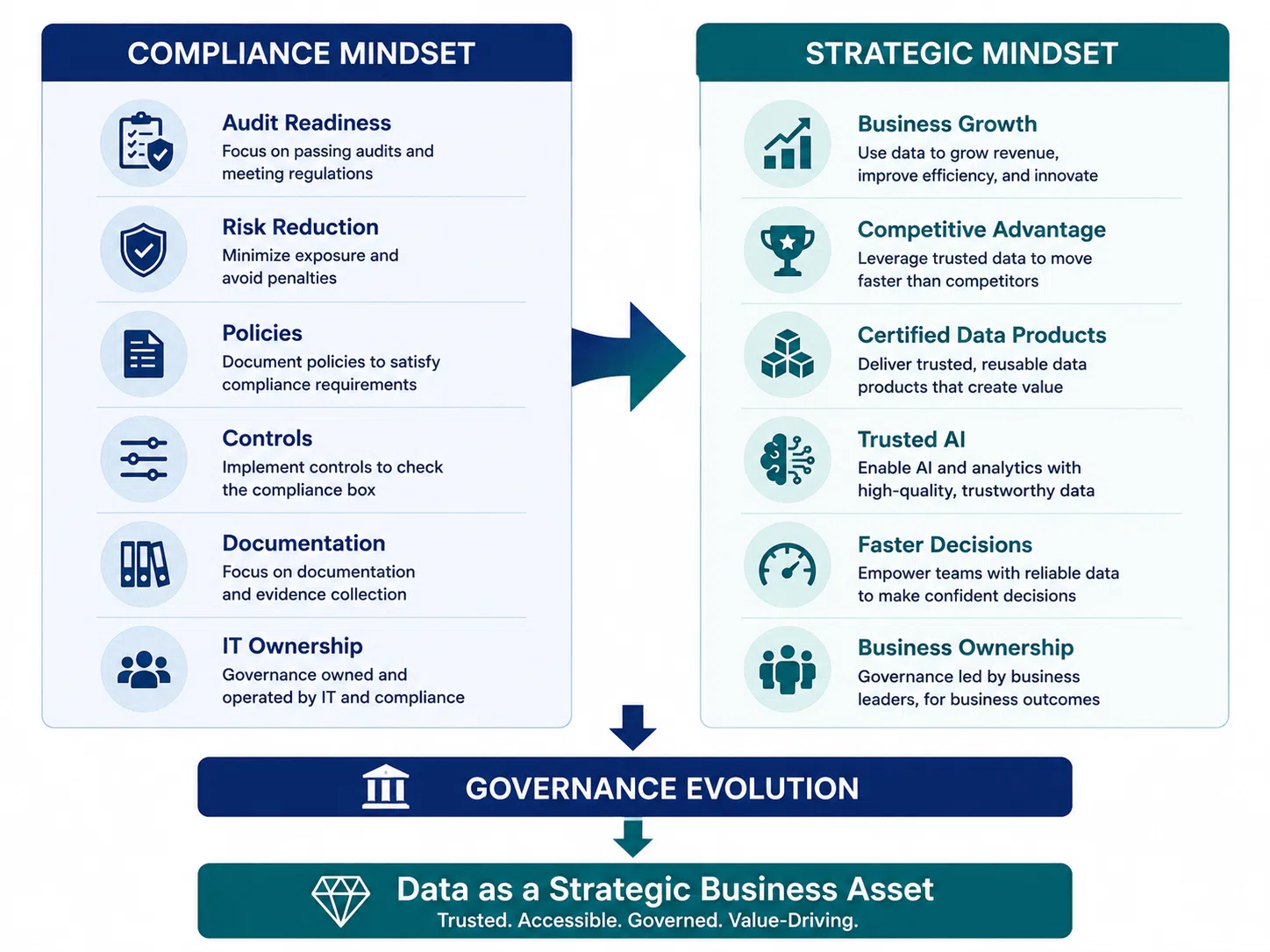
Compliance-first governance is built to satisfy external requirements: CCPA, GDPR, HIPAA, SOX, Basel III, and sector-specific mandates. It produces data classification schemes, access control documentation, retention policies, and breach of response procedures. These are necessary. They are not sufficient to create business value, and they are not what the business asked for.
The organizational signal that a program is compliance-first is its sponsorship: typically, a Chief Compliance Officer or a Chief Risk Officer. The business units view it as an overhead imposed by legal and IT. Data stewards spend their time filling in catalog fields rather than resolving data quality issues that affect business decisions. The program delivers what was asked of it, and the business continues building shadow analytics in spreadsheets.
A governance program that runs for 18 months and still has no visible presence in the day-to-day work of business analysts has not failed technically. It has failed to connect its outcomes to the problems business stakeholders actually face. Control and documentation matters. They matter most when they make it faster and easier for business teams to find trusted data and answer new questions, not slower.
Three signals that your governance program is in the compliance-first trap:
Business units are building their own data extracts and spreadsheet models to answer questions the governed data environment should be answering. This means data stewardship is producing clean, documented data that is not trusted or used by the people it was designed to serve.
AI and analytics projects are citing data quality as the primary blocker. If governance has been running for more than 12 months and the AI team is still unable to find reliable training data in the governed catalog, the program has not addressed the data domains that matter most to the business.
Governance ROI is measured in audit findings closed and compliance tickets resolved, not in analytics delivery time, self-service adoption, or business decision quality. Compliance metrics confirm that the program exists. They do not confirm that it creates value.
Note: A data governance program that satisfies auditors but is invisible to the business has solved the wrong problem. Audit readiness and business enablement are both required outcomes. Programs designed exclusively around the first will not achieve the second.
Turn Data Governance into a Competitive Advantage
Evaluate your current governance capabilities and uncover opportunities to improve decision-making, compliance, and AI readiness.
Data Governance Maturity Assessment
A structured diagnostic for CDOs, CIOs, and Chief Compliance Officers. 18 questions across six governance dimensions. Receive a scored maturity profile and prioritised recommendations.
Your Details
Your Assessment Results
Overall Governance Maturity Level
Receive Your Full Report
A BluEnt governance consultant will prepare a personalised report with specific recommendations for your highest-priority gaps. Book a 60-minute discovery call to discuss your findings.
What Competitive Advantage Through Data Governance Looks Like Five specific advantages mature governance delivers that compliance-first programs cannot
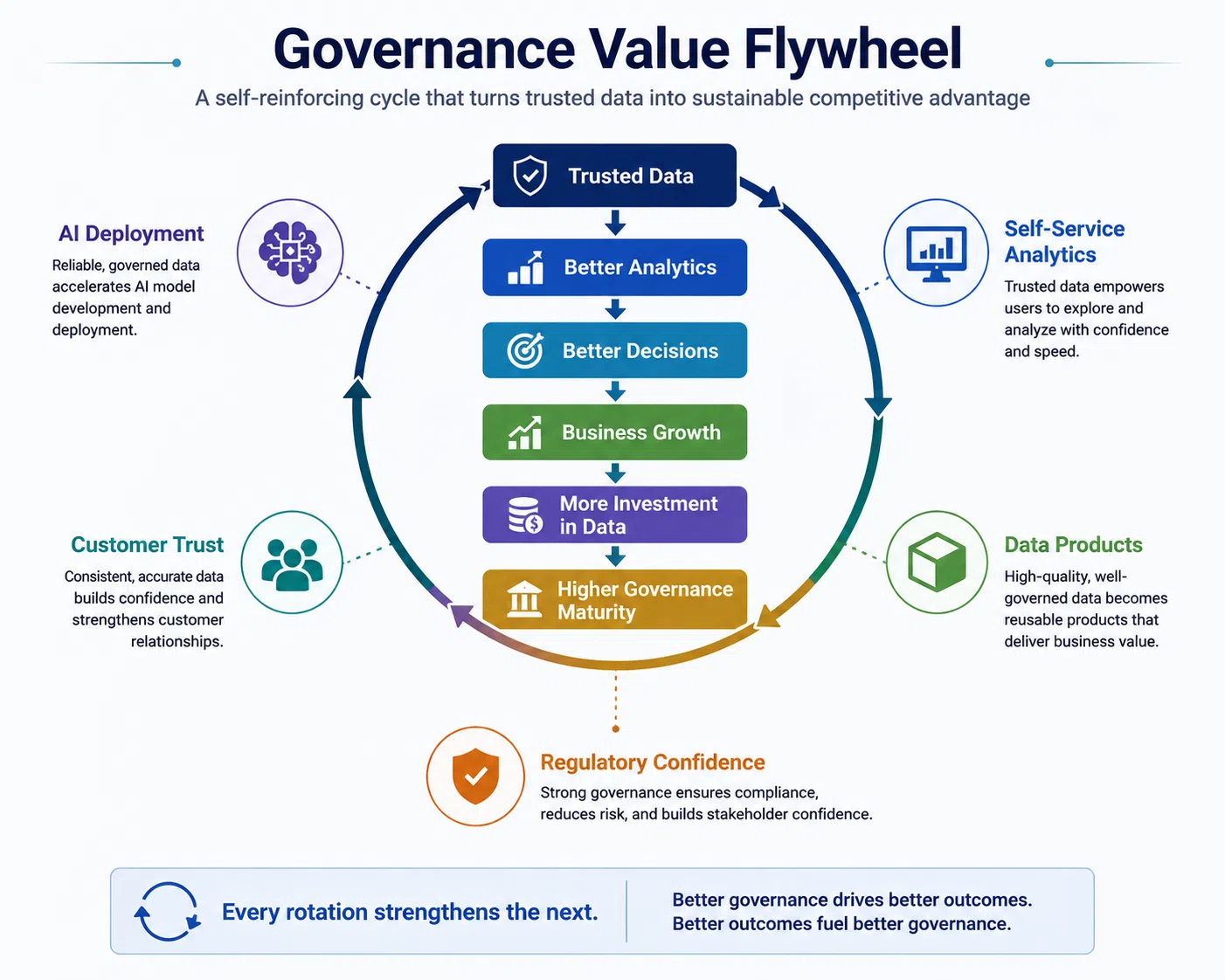
AI that gets deployed rather than validated indefinitely
The most common reason enterprise AI projects fail to reach production is not model quality. It is data quality. When training data is ungoverned, models inherit the inconsistencies, missing values, and definitional conflicts present in the source data.
Validation cycles then extend indefinitely because the team cannot establish a trusted baseline for what the model should predict. The problem is not the model. It is the absence of a governed data standard that the validation can be measured against.
Organizations with mature data governance resolve this by ensuring data domains used for AI training are governed to a defined quality standard before model development begins. The model team receives clean, well-documented, lineage-traced data. Validation becomes model performance, not data remediation, and time from development to production deployment drops materially.
Self-service analytics that business teams actually use
Self-service analytics fail when business users cannot trust the data they find. If two reports on the same metric produce different numbers, analysts stop using the self-service environment and return to building their own extracts.
The BI investment delivers no value because the foundation is untrusted. Strategic data governance solves this by establishing certified data products: governed, documented datasets with clear ownership, defined quality SLAs, and business-validated definitions.
Analysts know which datasets are certified, what they mean, and what data quality to expect. Self-service adoption improves because the data is trustworthy enough to stake a decision on.
Faster time-to-insight on new analytics questions
In organizations without mature governance, answering a new business question typically requires a data engineering project: find the relevant data, understand its provenance, assess its quality, resolve definitional conflicts, and build a pipeline. This process takes weeks.
With a maintained data catalog, documented lineage, and certified data domains, the same question can often be answered from existing governed assets in hours. The catalog tells analysts which datasets exist and what quality standards they meet. The answer is built on a foundation that is already trusted. Time-to-insight compresses from weeks to days or hours.
Regulatory compliance as a customer trust signal
For organizations in financial services, healthcare, and regulated data industries, demonstrating strong data governance to enterprise clients is becoming a competitive differentiator in procurement. Enterprise buyers increasingly include data governance maturity assessments in vendor due diligence.
The ability to show documented data lineage, access controls, retention policies, and audit trails is shifting from a compliance baseline to a commercial differentiator. Organizations that have invested in governance can demonstrate these capabilities concretely in the sales process.
The ability to launch data products
Data products are governed, packaged datasets or data services made available to internal teams or external customers as standalone value-creating assets. Examples include a customer insights of API sold to partners, a real-time inventory feed provided to retail distributors, or a risk scoring model licensed to financial intermediaries.
Organizations cannot launch data products without the governance infrastructure to ensure the data is accurate, auditable, and legally compliant to share. For organizations in data-rich industries, data products represent a direct revenue opportunity that governance unlocks. The governance program is the enabler, not the cost center.
From the field
In many organizations that have positioned governance strategically, the CDO has direct access to the CEO and a mandate measured in business outcomes rather than technical deliverables. Data quality SLAs are tied to business process SLAs rather than system uptime metrics. When a data quality failure causes a forecast to be wrong, the business owner of that data domain is accountable. That accountability model tends to produce governed data that the business trusts, because someone whose performance depends on it has a stake in its quality.
Turn Data Governance into a Competitive Advantage
Discover how a tailored data governance strategy can improve data quality, strengthen compliance, and enable confident, data-driven decisions across your organization.
The Data Governance Maturity Journey Four stages from reactive firefighting to strategic data asset
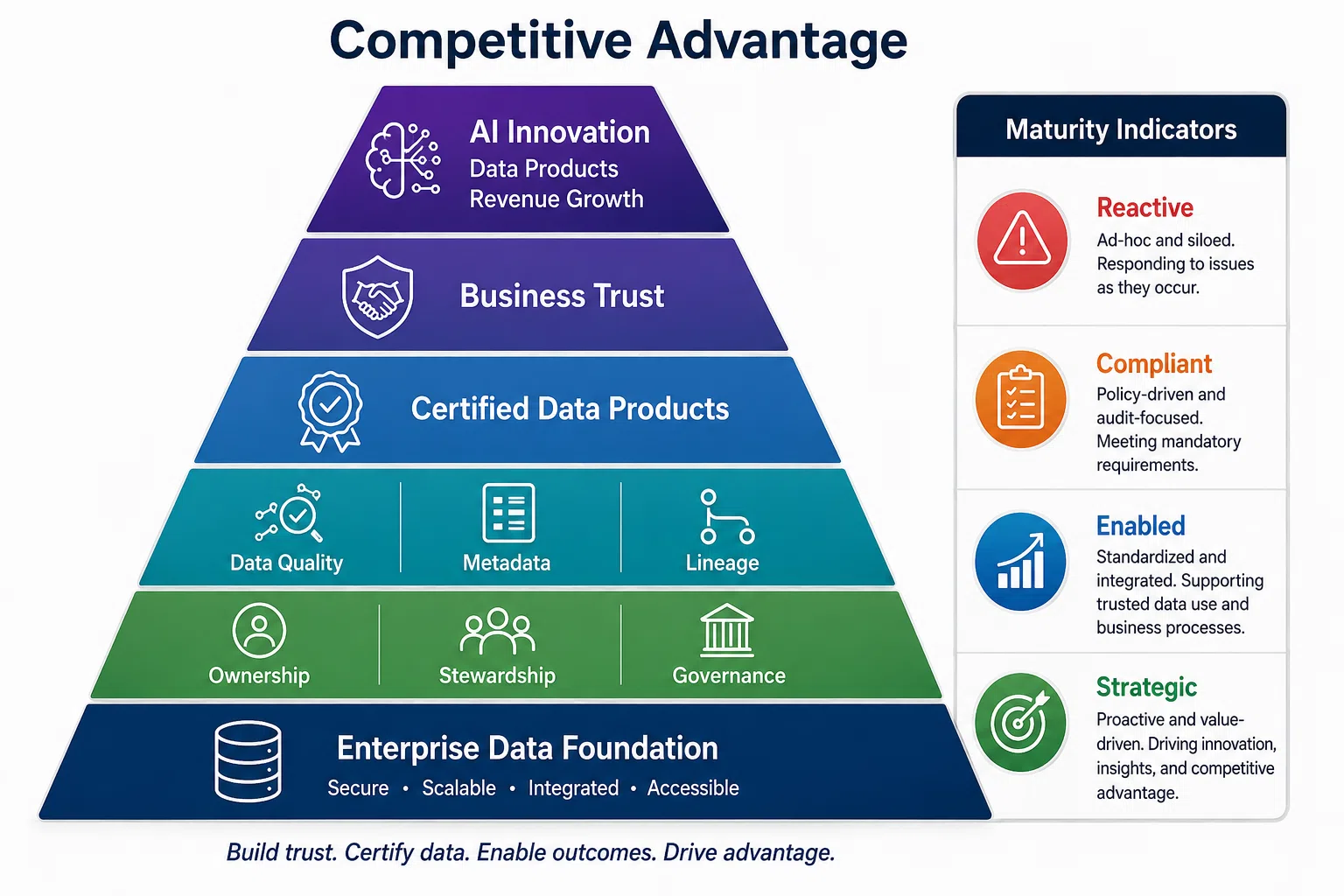
| Stage | Stage Name | Characteristics | Governance Focus | Business Value |
|---|---|---|---|---|
| 1 | Reactive | Data problems are discovered in production. No defined ownership. Quality is fixed on demand. | Incident response, ad hoc data fixes, no formal standards | Risk mitigation only. High cost of firefighting. |
| 2 | Compliant | Policies documented. Catalogs exist. Audit findings addressed. Business is largely unaware. | Compliance, access control, retention, audit readiness | Regulatory risk is reduced. Limited analytics value. |
| 3 | Enabled | Certified data products exist. Self-service analytics are adopted. Quality SLAs met consistently. | Data quality management, certified domains, stewardship active | Faster analytics delivery. AI projects are reaching production. |
| 4 | Strategic | Data as a product. Governance embedded in pipelines. Data monetization or external data products active. | Data products, automated governance, continuous quality monitoring | Measurable revenue contribution. Competitive differentiation. |
Most organizations with established governance programs sit at Stage 2 (Compliant). The gap between Stage 2 and Stage 3 is the most consequential transition: it is where governance shifts from serving auditors to serving the business. Most organizations that make this transition do so through a deliberate governance strategy to redesign, not through incremental improvement of the compliance program.
| ~87% | Organizations say trusted, high-quality data plays a critical role in responding to changing business conditions and market disruptions. Many are increasing investments in data governance, data quality automation, and data skills to improve business resilience. Source: Experian Global Data Management Research, 2023. |
|---|
Recommended Reading:
How to Shift from Defensive to Strategic Governance Five changes required to move a governance program from compliance cost to business capability
Change who sponsors and owns the program
Compliance-first governance programs tend to be sponsored by Chief Compliance Officers or Chief Risk Officers. Strategic governance programs are more often sponsored by the CDO, CEO, or a cross-functional data leadership committee that includes the CFO, CMO, and business unit leaders. The sponsorship structure shapes whose problem of governance is designed to solve.
In many organizations that have made governance strategic, the CDO reports directly to the CEO rather than the CIO. This positions data strategy within the business strategy structure rather than the technology cost structure. Where this structure exists, governance programs tend to be measured against business outcomes rather than technical deliverables.
Measure governance against business outcomes, not compliance metrics
Replace or supplement compliance KPIs with business impact KPIs: time-to-insight for new analytics questions, self-service adoption rates in the BI environment, AI model deployment rate versus validation cycle time, revenue attributed to data product launches, and data-related rework cost per quarter compared to prior periods.
These metrics tell leadership whether governance is delivering business value. They also redirect the governance team’s focus. Instead of closing audit findings, the team is improving the metrics the business cares about. The work may be similar. The direction it is aimed at changes.
Build and certify data products rather than governing raw data
A data product is a governed, packaged, business-validated dataset maintained to a defined quality standard and made available through a discoverable interface. Rather than governing raw tables, strategic governance programs identify the 15 to 20 datasets the business uses most frequently and govern those to a certified standard: documented definitions, validated quality, maintained lineage, and clear ownership.
Certified data products change business relationships with governance. Instead of a compliance function that restricts access, governance becomes the team that maintains the assets the business depends on. Business teams assess fit in minutes rather than starting a data discovery project from scratch.
Embed governance into pipelines, not into approval processes
Governance that operates as a review and approval gate slows data teams down and accumulates a backlog. Governance embedded into the data pipeline happens automatically, at the speed of the pipeline. Data quality checks run on every load. Lineage is generated by the orchestration layer. New datasets are registered in the catalog through an automated step in the ingestion process.
The engineering investment to automate governance into pipelines pays back quickly. Manual governance at scale requires growing the governance team proportionally with data volume. Automated governance scales with the platform.
Build data literacy alongside governance maturity
Self-service analytics and data product adoption require business users who understand what governed data means, how to find it, and how to use it responsibly. Data literacy programs teach business users to navigate the data catalog, interpret quality scores, understand lineage, and recognize when data is and is not fit for a given use case.
Governance without literacy produces certified data products that sit unused because business teams do not know they exist or cannot evaluate them. Literacy without governance produces confident data users working on unvalidated assets. Both investments are needed, and they reinforce each other.
Note: The shift from compliance governance to strategic governance is a program to redesign, not an incremental improvement. It requires new sponsorship, new metrics, a different relationship with business stakeholders, and a different design for how governance is operationalized in data pipelines. Organizations that try to layer strategic value on top of a compliance-only architecture typically find the two goals in conflict.
The bottom line
The organizations winning data in 2026 are not running better compliance programs. They redesigned their governance programs as business capabilities, measured them against business outcomes, and embedded them in the pipelines and products the business depends on every day. The compliance outcomes followed, because data governed by a quality standard is compliant with data by design.
-
Compliance governance and strategic governance are not competing priorities. Strategic governance includes compliance and adds business value on top of it.
-
The transition requires new sponsorship, new metrics, and a different design for how governance operates on your data platform.
-
Certified data products are the primary mechanism through which governance shifts from invisible cost to visible business assets.
-
Organizations at Stage 2 have the most impactful transition ahead. Stage 3 is where analytics and AI ROI begin to compound.
If your governance program is technically sound but struggling to demonstrate business value, the most efficient next step is a strategy assessment that identifies the highest-leverage changes and sequences them against your current program and platform investment.
Elevate your governance program from compliance to competitive advantage
BluEnt’s data governance strategy team works with CDOs and data leaders to redesign governance programs for business impact: certified data products, automated governance in pipelines, business outcome KPIs, and the sponsorship and change management required to make the shift stick.
Common Questions What CDOs and data leaders ask about elevating governance to a strategic function
What is the difference between compliance governance and strategic data governance?Compliance governance is designed to satisfy regulatory requirements and audit standards: GDPR readiness, HIPAA data handling, SOX controls, and access documentation. It is necessary but does not create business value beyond risk reduction on its own. Strategic data governance is designed to make data trustworthy enough for the business to use it to make decisions, deploy AI, and launch data products. It includes compliance as a baseline and adds ownership structures, quality management, certified data products, and automated lineage that accelerate analytics and AI outcomes.
How do we measure the ROI of data governance?ROI from compliance governance is measured in audit findings closed and regulatory risk reduced. ROI from strategic governance is measured in reduction in data-related rework cost, improvement in analytics delivery time, self-service BI adoption rates, AI project deployment rate versus validation cycle time, and revenue from data product launches. Forrester research on enterprise data governance programs consistently identifies cost savings in data management overhead and reduction in data incident remediation as the most consistently quantified value drivers within the first 12 to 24 months of mature governance deployment.
How long does it take to move from compliance-focused to strategic governance?Moving from Stage 2 (Compliant) to Stage 3 (Enabled) typically takes 9 to 18 months for organizations with an existing governance foundation. The work involves redesigning program sponsorship, building the first set of certified data products for the most business-critical domains, implementing automated data quality monitoring, and establishing the business outcome metrics the program is measured against. Moving to Stage 4 (Strategic) is a longer journey of 2 to 4 years and typically involves launching internal or external data products.
Does a CDO need to be in place before governance can become strategic?A CDO or equivalent executive sponsor with business-facing authority significantly accelerates the shift. However, the transition can begin without a CDO if a cross-functional data governance steering committee with genuine business leadership sponsorship is in place. What the transition is unlikely to succeed without is some form of business unit accountability for data outcomes. Governance owned exclusively by IT or the compliance function tends to remain compliance-oriented, because those functions’ success metrics are compliance-oriented.
What is a data product in the context of data governance?A data product is a governed, packaged dataset maintained to a defined quality standard and made available as a reliable, discoverable asset for internal or external consumers. Unlike a raw database table or pipeline output, a data product has a named owner, documented business definitions, quality SLAs, maintained lineage, and a clear description of what business questions it is designed to answer. Certified data products are the primary mechanism through which strategic governance delivers self-service analytics value.
How does data governance enable AI programs?AI programs require training data that is accurate, complete, consistently defined, and traceable to its source. Governance provides each of these: data quality management ensures accuracy and completeness, standardized business definitions ensure consistent labeling, and data lineage provides the audit trail that model validation and regulatory compliance require. Organizations with mature governance tend to deploy AI models to production faster because the data validation work has been done at the governance layer, rather than within each individual AI project team.

 Governing AI Tools in AEC: Copilot, Digital Twins, and Generative Design
  Data Governance for AI and Advanced Analytics: Building the Foundation That Works
  Centralized vs. Federated vs. Hybrid Data Governance: Which Model Fits Your Organization
  Data Governance Roles and Responsibilities in AEC Organizations