











What Is the Real Cost of Poor Data Governance?
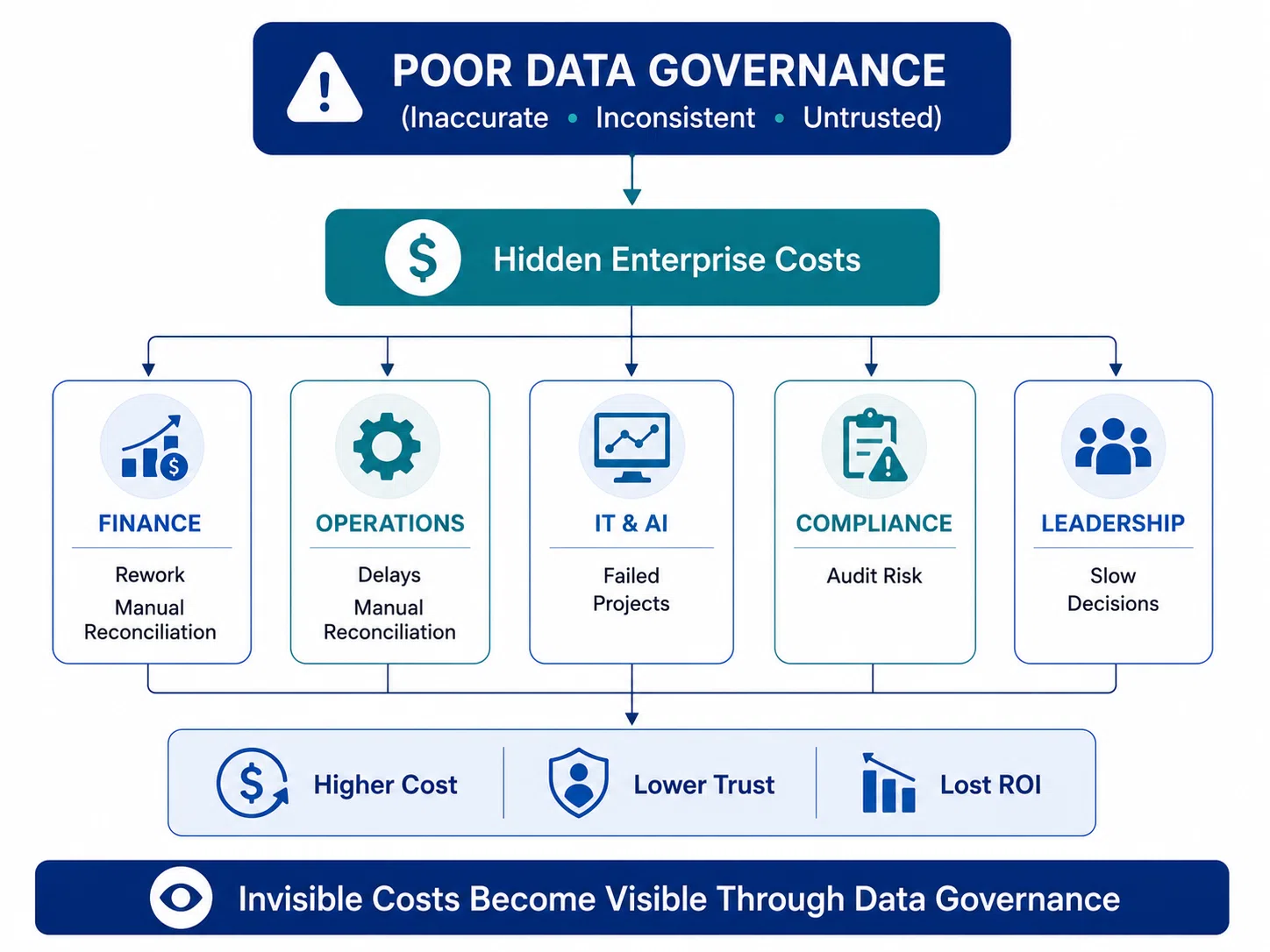
The cost of poor data governance is the total financial, operational, and strategic impact of making decisions on inaccurate, incomplete, inconsistent, or inaccessible data. It includes direct costs, rework, reconciliation, compliance fines, and indirect costs, delayed decisions, failed technology initiatives, and erosion of organizational trust in data. Gartner estimates that poor data quality alone costs organizations an average of $12.9 million annually, but that figure covers only the measurable surface of a much larger hidden expense.
The CFO asks why quarterly close takes 12 days when it used to take 5. The answer is buried in three manual reconciliation steps that exist because nobody trusts the numbers without verification. That is not an accounting problem.
It is a data governance problem, and it has been costing the organization 7 days every quarter for three years without appearing on a single budget line.
Poor data governance costs. It just rarely appears where anyone is looking for it. It shows up as overtime in the finance team, as rework in operations, as delayed decisions in the boardroom, and as failed AI deployments in the technology roadmap.
When no one adds those costs together, organizations consistently underinvest in governance, because the price of not governing is invisible until it becomes a crisis.
Table of Contents:
- What Is the Real Cost of Poor Data Governance?
- Seven Hidden Cost Categories
- How Costs Accumulate Invisibly
- Calculating Your Data Governance Cost Exposure
- BluEnt in Practice: Quantifying Governance ROI Before Investing
- How to Start: Building the Business Case for Governance Investment
- Frequently Asked Questions
What Is the Real Cost of Poor Data Governance?
The $12.9 million figure from Gartner is widely cited, and widely misunderstood. It measures what organizations can attribute directly to data quality failures: reprocessing costs, customer service escalations, and regulatory remediation. It does not measure decision latency, technology ROI drag, or the talent cost of analysts spending most of their time wrangling data rather than generating insight.
The true data governance of ROI calculation starts by making the full cost of inaction visible. That requires looking across seven distinct cost categories that typically sit in different budgets, under different team names, with no shared owner and no shared accounting.
Seven Hidden Cost Categories
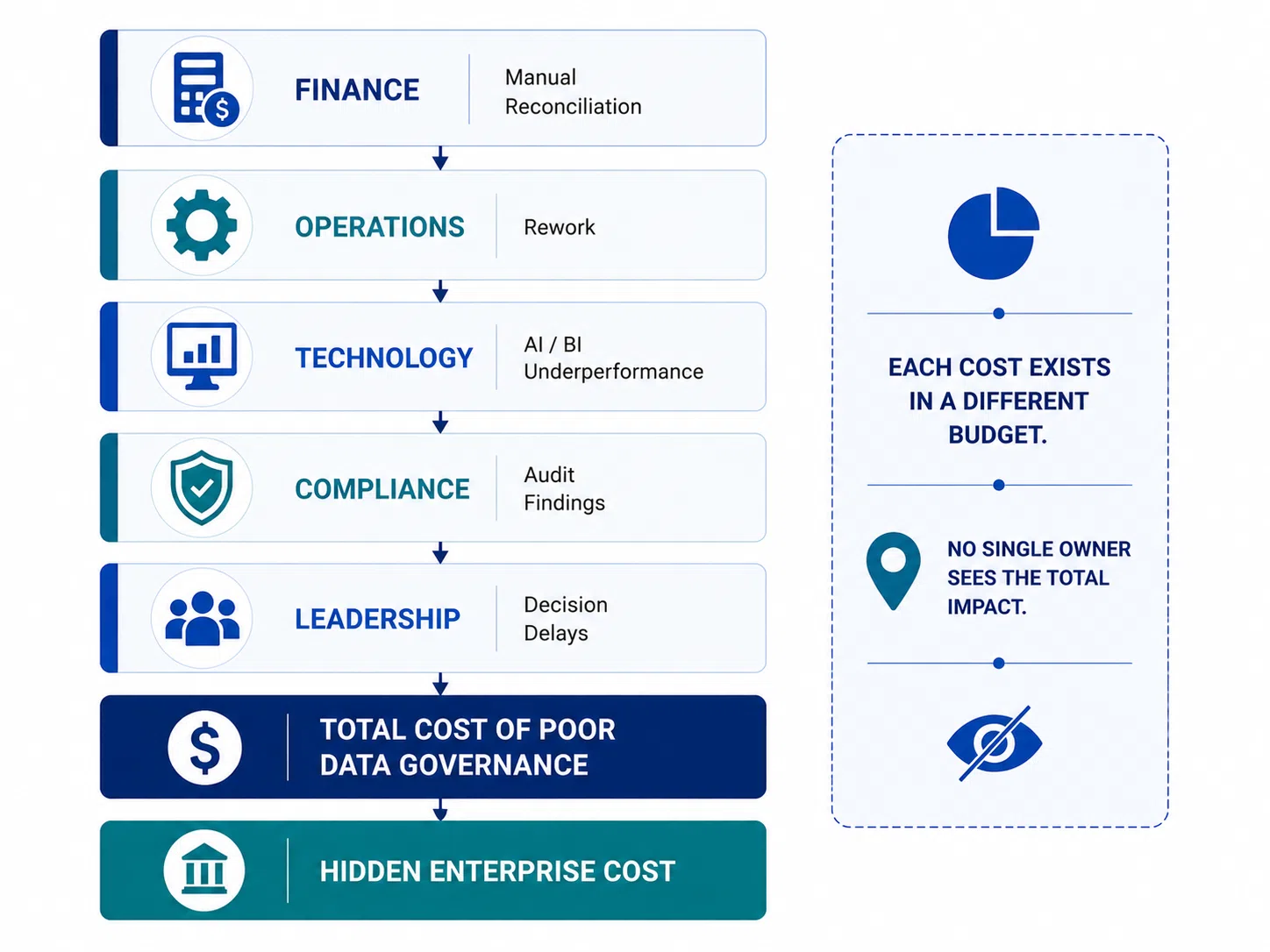
The hidden cost of data governance failures is distributed across the organization. Each of the following categories represents a real financial impact, but because they appear in different team budgets and different reporting lines, no single leader ever sees the full picture.
Manual Reconciliation and Data Wrangling
Finance teams and analysts spend significant time reconciling reports from systems that should agree but do not. Every hour spent manually verifying or cross-checking data is a governance failure that has been converted into labor cost.
Example: A retail enterprise requiring finance to reconcile three separate data sources for monthly revenue reporting, adding 6 hours per analyst per close cycle, is spending over $50,000 annually on reconciliation work that governed data would eliminate.
Decision Latency
Executives waiting for data to be validated before acting are bearing a cost that rarely appears in any budget. Every delayed strategic decision has a business value attached, and governance failures are the reason the delay exists.
Example: A product launch decision delayed by 3 weeks while the team waits for clean data from three competing systems is not a project management failure. It is an ungoverned data quality cost with a measurable time-to-market consequence.
Rework and Error Correction
Errors that propagate downstream before they are caught require correction at every point of consumption. A data quality problem in a source system that feeds five downstream reports creates five correction cycles.
Example: An incorrect customer segmentation attribute flowing from a CRM into a marketing automation platform and two analytics dashboards required three teams to reprocess campaigns, at a combined labor and media cost of over $80,000.
Compliance and Regulatory Exposure
Ungoverned sensitive data creates audit findings, potential fines under GDPR, SOC 2, HIPAA, CCPA, and breach costs that are disproportionate to the governance of investment that would have prevented them.
Example: A financial services firm with inconsistent data access controls across business units faced two audit findings in a single year, each requiring remediation projects estimated at $150,000 in combined legal, IT, and compliance effort.
Technology Initiative Failures
BI tools, AI deployments, and data platforms consistently underperform when the underlying data is ungoverned. The technology cost is visible; the root cause, data quality and governance gaps, is often not diagnosed until after significant investment has been made.
Example: A $400,000 data warehouse modernization project that delivered 60% of its projected analytics value because source data quality issues invalidated key reporting pipelines represents a $160,000 governance failure, not a technology failure.
Talent Cost
IBM research found that data professionals spend up to 80% of their time finding, cleaning, and organizing data rather than performing analysis. In most organizations, this is the single largest hidden cost of poor data governance.
Example: A team of 10 data analysts at a fully loaded cost of $120,000 per year generates $1.2 million in annual labor cost. If 80% of that time is spent on wrangling rather than analysis, $960,000 is being consumed by a governance failure rather than by insight generation.
Reputation and Trust Erosion
When stakeholders stop trusting reports, every number gets questioned. Governance-eroded trust creates a hidden tax on every data interaction, more verification cycles, more manual checks, and more decisions made on instinct rather than data.
Example: An executive team that routes around the analytics dashboard because ‘the numbers are never right’ is bearing a governance cost in every strategy meeting, every planning cycle, and every budget discussion where data should be driving the conversation but is not.
The cost of poor governance is distributed across your organization in ways most finance teams never add up.
BluEnt’s Data Governance Maturity Assessment maps your governance gaps – including their cost implications – across 18 dimensions in 15 minutes. No sales call required.
Data Governance Maturity Assessment
A structured diagnostic for CDOs, CIOs, and Chief Compliance Officers. 18 questions across six governance dimensions. Receive a scored maturity profile and prioritised recommendations.
Your Details
Your Assessment Results
Overall Governance Maturity Level
Receive Your Full Report
A BluEnt governance consultant will prepare a personalised report with specific recommendations for your highest-priority gaps. Book a 60-minute discovery call to discuss your findings.
How Costs Accumulate Invisibly
The reason organizations underinvest in data governance is structural: the costs of poor governance are distributed across teams while the investment in governance is concentrated as a visible line item.
Costs are distributed; nobody sees the full picture
Finance sees the reconciliation hours. Operations see the rework cycles. Technology sees the BI tool that is underperforming. Each team experiences one slice of the total governance failure cost, and none has the full picture. There is no budget line called ‘cost of poor data governance’ anywhere on the organizational P&L.
Governance investment is visible; governance failure is not
When a CDO proposes a data governance program, the investment number is on a slide. The distributed cost of not governing is not on any slide, because it has never been calculated. That asymmetry produces the chronic underinvestment pattern that characterizes most enterprise governance programs.
The ‘we get by’ rationalization
Organizations with long-standing governance gaps have normalized the friction. Teams have built workarounds, manual processes, and verification rituals that absorb the governance failure cost without labeling it as such. ‘We have always done the extra reconciliation step’ is a governance cost that has been reclassified as standard operating procedure.
IBM research found data professionals spend up to 80% of their time finding, cleaning, and organizing data rather than performing analysis. In a team of 10 data analysts at an average fully loaded cost of $120,000 per year, that is $960,000 annually spent on data wrangling rather than insight generation. That is not a staffing problem. It is a data governance cost that appears on the payroll line rather than the governance budget.
Calculating Your Data Governance Cost Exposure
Building a business case for data governance investment requires converting distributed governance failure costs into a single number. The following four-step framework is how BluEnt’s consultants approach the data governance ROI calculation with enterprise clients.
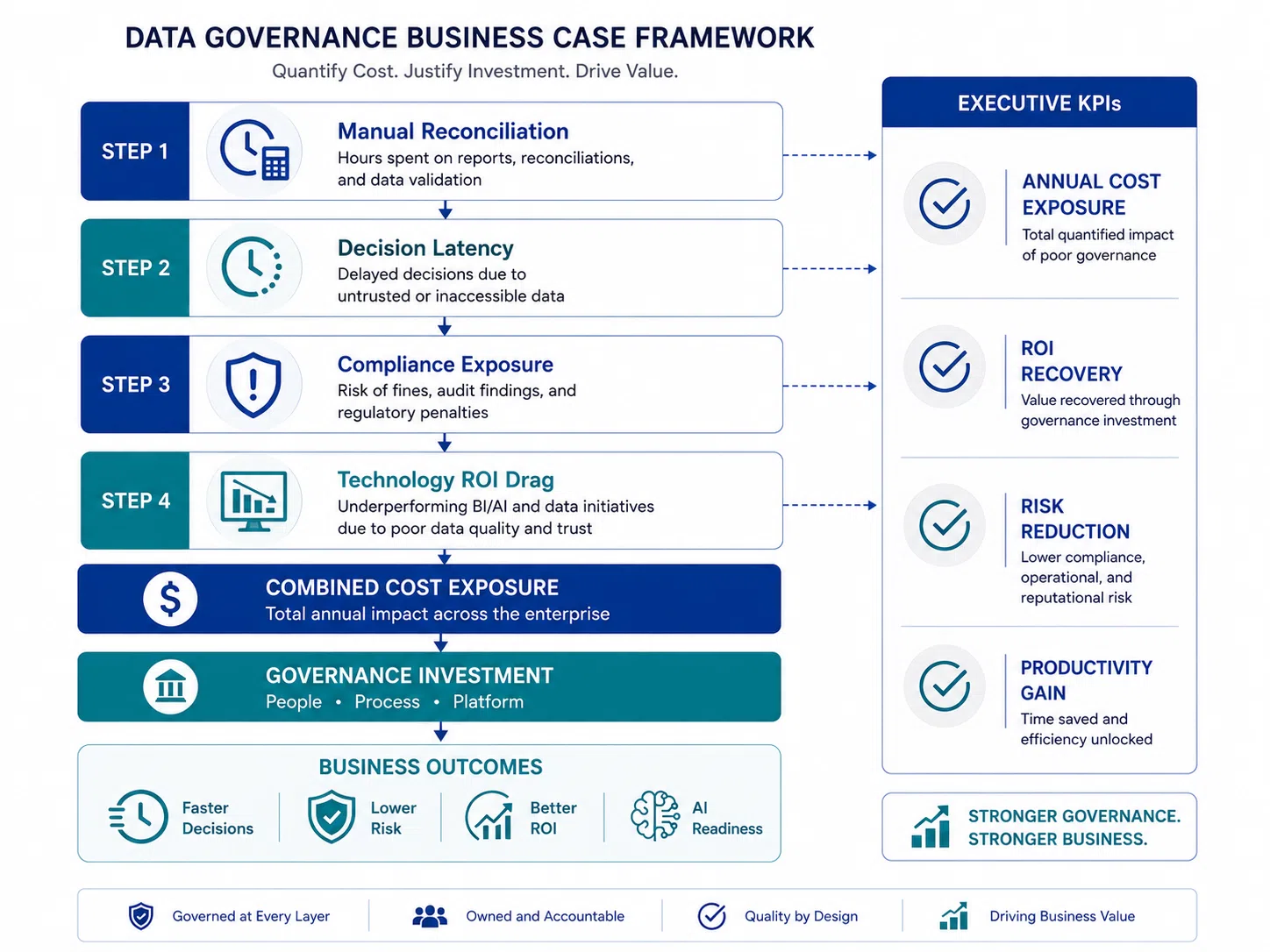
Count Manual Reconciliation Hours Finance, operations, and data teams, monthly
Ask finance, operations, and data engineering how many hours per month are spent on manual data reconciliation, verification, and correction work. Include the extra steps that exist because systems disagree, because data quality cannot be assumed, or because downstream consumers require validation before using a dataset. Multiply by fully loaded labor cost. This is your baseline governance failure cost.
Estimate Decision Latency Cost Delayed decisions and their business value
Identify decisions in the last two quarters that were delayed because the underlying data was unavailable, unvalidated, or disputed. Estimate the business value of each delayed decision and the cost of the delay, delayed time-to-market, missed pricing windows, and deferred budget approvals. This number is often the most significant category in the calculation and the most consistently overlooked.
Audit Compliance Exposure Potential fine values under applicable regulations
Review your current governance gaps against applicable regulatory frameworks, GDPR, CCPA, SOC 2, HIPAA, or industry-specific standards. Identify the top three gaps with the highest potential fine values or audit remediation costs. This number is probabilistic, but it belongs in the business case. Governance programs that prevent one material audit finding often pay for themselves in a single year.
Assess Technology ROI Drag Which investments are underperforming because of data quality?
Identify technology investments, BI platforms, AI tools, ERP systems, data warehouses, that are delivering less than their projected value. For each, estimate the percentage of underperformance attributable to data quality and governance gaps rather than technology limitations. This is the governance failure cost embedded in your technology budget. It is almost always larger than the governance program of investment being considered.
Ready to calculate what poor data governance is actually costing your organization?
BluEnt’s data governance consultants have built ROI models for enterprise governance programs across multiple industries. Build a governance investment case that pays for itself.
BluEnt in Practice: Quantifying Governance ROI Before Investing
When BluEnt began working with a US-based enterprise on its data governance program, the engagement was preceded by a structured pre-engagement assessment designed to quantify the cost of the current governance gap before a program of investment was proposed.
The client had 58 terabytes of data in Egnyte with no classification, no catalog, and no consistent access controls. The initial instinct from the technology team was that this was a file storage problem. The assessment reframed from it as a cost-of-poor-data-governance problem with three specific cost categories.
The pre-engagement assessment identified over 40 hours per month of manual data reconciliation across finance and operations teams, at a fully loaded cost exceeding $80,000 annually. It also identified a Microsoft Copilot deployment worth $200,000 in annual licensing that had been blocked for 6 months because ungoverned data made deployment unsafe. And it documented two audit findings from the prior year related to data access controls, each requiring a remediation project.
The cost of the governance program was justified against the reconciliation hours alone, before accounting for the AI deployment unblocking or the compliance risk reduction. When the full cost of inaction was assembled as a single number, the governance investment was not a budget question. It was an obvious economic decision.
Note: Client details shared with permission. Engagement delivered by BluEnt’s data governance practice, US.
How to Start: Building the Business Case for Governance Investment
The data governance business case does not require a comprehensive audit. It requires four focused conversations that together produce a number the CFO and CDO can act on.
Interview Three Operational Teams About Manual Data Work Finance, operations, and analytics
Ask each team to walk through their data preparation process for their highest-frequency reporting cycle. Count the verification steps, the reconciliation checks, and the manual corrections that would not exist if data quality were assumed. Translate those hours into annual labor costs. This is your starting number.
Calculate the Annual Cost of Manual Reconciliation Fully loaded labor cost across those three teams
Sum the reconciliation hours across all three teams and multiply by fully loaded hourly cost. Present this as the annual baseline governance failure cost, before any other category is added. For most enterprises, this number alone exceeds the cost of the governance program under consideration.
Identify One Compliance Exposure and Its Potential Fine Value GDPR, CCPA, SOC 2, or applicable frameworks
Select the single most material compliance gap in your current data environment and document its potential fine value or remediation cost under the applicable regulatory framework. This does not require a full compliance audit; one well-documented exposure converts the governance investment from discretionary to risk mitigation.
Connect One Stalled Technology Investment to Its Governance Prerequisite BI, AI, or platform investments underperforming due to data quality
Identify one technology investment that is underperforming because data quality or governance gaps are blocking its value of delivery. Document the gap between actual and projected ROI. Present that gap as a governance failure cost. Then present the governance program as the prerequisite for recovering that investment value. Together, these four numbers form the cost of not governing, and that is the only business case a CFO needs to see.
Book a strategy session with BluEnt’s data governance team to scope a program sized to your actual cost exposure.
BluEnt’s data governance consultants build the cost-of-inaction case before scoping the program, so you invest at the right level for your organization.
Frequently Asked Questions
What is the average cost of poor data quality for enterprises?Gartner estimates that poor data quality costs organizations an average of $12.9 million annually. However, that figure captures only directly attributable to quality failures, reprocessing, error correction, and compliance with remediation. When decision latency, technology ROI drag, and the talent cost of data wrangling are included; the total cost of poor data governance for large enterprises frequently exceeds $30 to $50 million annually. The gap between the published figure and the actual organizational cost is the hidden portion, distributed across team budgets, and never aggregated.
How do you measure the ROI of a data governance program?Data governance ROI is calculated by comparing the annual cost of the governance program against the sum of four cost categories it reduces: manual reconciliation labor, decision latency costs, compliance exposure reduction, and technology investment ROI recovery. Most enterprises find that reconciliation of labor reduction alone provides a payback period of under 18 months. When AI deployment unblocking and compliance risk reduction are added, the ROI case strengthens further. The governance ROI calculation should be built before the program is scoped, not after it is implemented.
What are the most expensive consequences of ungoverned data?The three most financially material consequences of ungoverned data are: technology investment failures (BI, AI, and platform deployments that underdeliver because data quality undermines their outputs), compliance exposure (regulatory fines and audit remediation costs that are disproportionate to the governance investment required to prevent them), and talent cost (data professionals spending the majority of their time on wrangling rather than analysis). Decision latency is the most strategically costly but the hardest to quantify, delayed strategic decisions have compounding consequences that rarely get attributed to data governance.
How does poor data governance affect AI initiatives?AI initiatives are particularly vulnerable to poor data governance because AI outputs are only as reliable as the data they process. Ungoverned data creates three specific AI failure modes: model outputs that cannot be trusted because training data quality is unknown; deployment risks when AI systems have access to sensitive data that lacks classification and access controls; and compliance barriers when regulatory requirements for explainability and data lineage cannot be met. Microsoft Copilot, enterprise AI assistants, and predictive analytics platforms all require a governed data foundation to deliver ROI. Without it, the AI licensing cost becomes a governance failure cost.
What is data reconciliation and why does it cost so much?Data reconciliation is the process of manually verifying and aligning data from multiple sources that should agree but do not. It exists in organizations where data quality cannot be assumed, where different systems report different numbers for the same metric, where data moves between systems without validation, or where there is no authoritative source of record for key business data. The cost is high because it is performed repeatedly by skilled and expensive people, on a recurring cycle. Finance close reconciliation, operations reporting verification, and analytics QA processes are the three most common manifestations. Each represents a governance failure that has been normalized as standard process.
How do you build a business case for data governance investment?An effective data governance business case is built on four numbers: the annual cost of manual reconciliation across finance, operations, and analytics teams; the cost of decision latency from the last two to four quarters; the potential fine value of the top compliance gap; and the ROI gap in a stalled technology investment with a data quality root cause. Present these four numbers as the annual cost of not governing. Present the governance program investment against that number. The business case is not about governance theory; it is about making the distributed cost of inaction visible as a single, defensible number.

 Governing AI Tools in AEC: Copilot, Digital Twins, and Generative Design
  Data Governance for AI and Advanced Analytics: Building the Foundation That Works
  Centralized vs. Federated vs. Hybrid Data Governance: Which Model Fits Your Organization
  Data Governance Roles and Responsibilities in AEC Organizations