











In the United States, data governance is no longer just a compliance activity. In the US, data governance has become much more than a compliance activity. Trusted data is now a strategic imperative of enterprise leadership in a market environment where regulation is becoming more intense, cybersecurity risks are growing stronger, and AI and cloud solutions are being adopted more quickly.
Whenever we have to deal with a large organization, the scarcity of data is not usually the greatest challenge. The problem is that there is no evident ownership, set standards and stable governance of business functions. In the absence of a comprehensive enterprise data governance framework, companies cannot have confidence in their analytics, develop AI projects, and act promptly in response to market dynamics.
For CIOs, CDOs, and enterprise leaders, data is now enabling the making of risk-free decisions and balancing security, compliance, and innovation. An effective governance model offers the basis to reliable analytics, regulatory disclosure, and sustainable digital transformation.
Table of Contents:
- Introduction
- Why Data Governance Has Become a Board-Level Priority in the USA
- Signs Your Organization Needs a Data Governance Framework
- Enterprise Data Governance Framework: Building a Practical Model for US Enterprises
- Data Governance Strategy and Maturity Model for Long-Term Success
- Why US Enterprises Choose BluEnt
- Conclusion
- FAQs
A practical governance framework ensures that enterprise data remains accessible, secure, and reliable across business functions. When governance is implemented effectively, organizations gain greater visibility into their data assets, reduce operational risk, and enable faster, more confident decision-making.
The global data governance market size is projected to grow from $5.38 billion in 2026 to $24.07 billion by 2034. More importantly, it allows the leadership to make quicker and more assured decisions within a competitive market.
Why Data Governance Has Become a Board-Level Priority in the USA
In many organizations, governance only becomes a priority after a major reporting error, regulatory audit, or failed analytics initiative. By that stage, remediation costs are significantly higher and executive confidence in data has already declined.
In today’s digital economy, boards and executive leaders expect data initiatives to deliver measurable business outcomes, not just technology upgrades.But, the existence of fragmented data environments and inconsistent controls tends to cause uncertainty. Leaders are often questioning the accuracy of reports, which makes the strategy slower and risky.
A strong data governance strategy helps organizations:
-
Enhance audit-readiness and regulatory compliance.
-
Strengthen data privacy and cybersecurity programs
-
Increase trust in analytics and AI
-
Lessen operational inefficiencies.
-
Improve customer experience and personalization
-
Speed up the decision-making process.
Governance is currently regarded as a business facilitator. The earlier an organization invests in it, the more resilient it becomes, the more agile it is, and the more competitive it is in the long run.
Signs Your Organization Needs an Enterprise Data Governance Framework
Early warning signs of governance gaps often appear long before major failures occur. As an organization grows, unusual reporting, vague data ownership, and increasing compliance implications often become apparent in the data environment.
Conflicting Reports and Slow Decisions
The discrepancy among various groups in producing varying figures within the same business indicators leads to reduced trust in information among the leaders. Executives do not concentrate on strategy and use time to align reports and authenticate data sources.
Increasing Regulatory Pressure
U.S. organizations face strict regulatory expectations related to transparency, privacy, and data accountability. Without clear governance controls, audits become slower and compliance risks increase.
Lack of Clear Data Ownership
In case of confusion over ownership, there is less accountability. This is usually a sign of poor or incomplete data governance implementation.
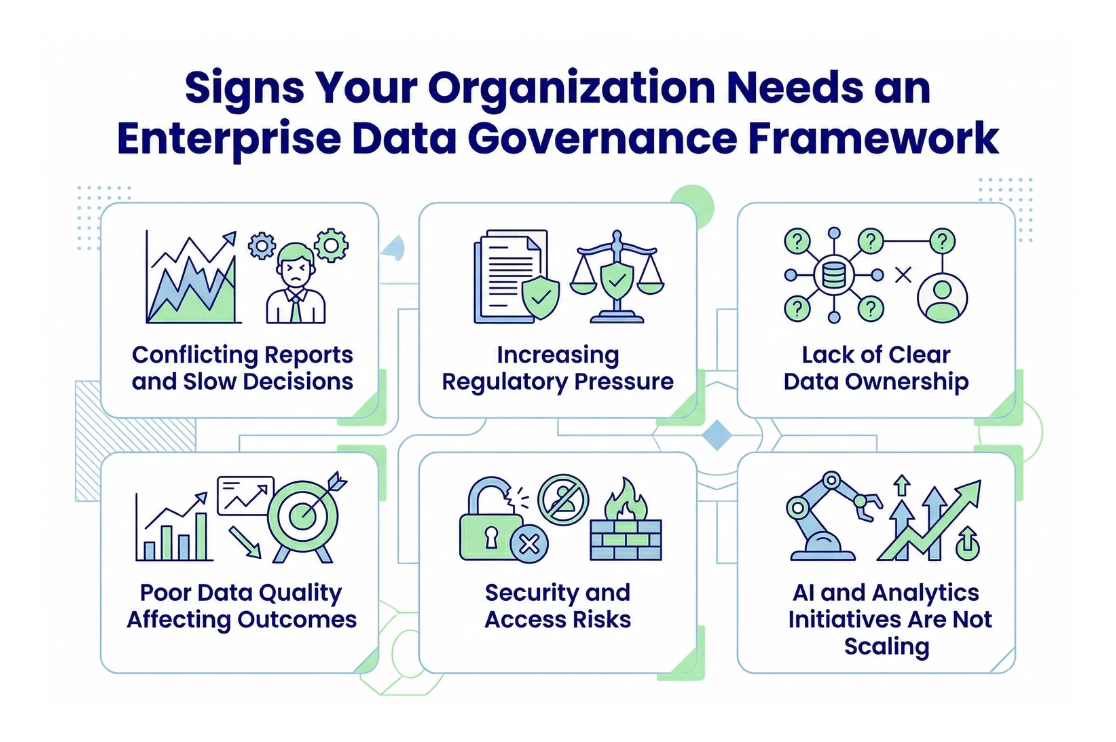
Poor Data Quality Affecting Outcomes
Any errors in customer and financial details add to the cost and reduce trust. According to the PwC’s Tech Strategy and AI survey, 97% of CIOs identify cybersecurity breaches and data privacy issues as their top concerns. Reliable data management & data quality initiatives boost reliability.
Security and Access Risks
Excess or unmonitored access enhances cyber threats. Governance supported by RBAC & data lineage ensures secure usage.
AI and Analytics Initiatives Are Not Scaling
Numerous organizations are effective in their AI pilot launches but fail to scale it to the enterprise. The most prevalent obstacle is a shortage of trusted and controlled data.
Enterprise Data Governance Framework: Building a Practical Model for US Enterprises
Most of the governance programs have failed due to their high level of complexity or lack of alignment to business objectives. An effective enterprise data governance model is pragmatic, has accountability, and deliverables. Governance must allow quicker decisions and more dependable insights as opposed to building more bureaucracy.
Align Governance with Business Priorities
Strategic goals that should be served by governance include growth, cost optimization, risk reduction and customer experience. CIOs and CDOs should be in close contact with the business leaders to find the major decisions that require trusted data.
Leading enterprises typically start governance initiatives by identifying the business decisions that depend on trusted data—such as regulatory reporting, customer analytics, or financial forecasting.
For example, enhancing accuracy of custom data management & data quality data will enhance cross-selling prospects and cut down on wastage in marketing. Controlling financial and operation information enhances compliance and reporting. The relationship between governance and quantifiable business worth enhances the executive support.
Establish a Clear Governance Operating Model
A structured operating model ensures accountability and alignment. This has governance councils, domain ownership and defined escalation procedures.
Key components include:
-
Enterprise governance council
-
Domain-level ownership
-
Data stewards for key domains
-
Cross-functional collaboration
This is the foundation of the successful data governance & stewardship services and it can help to speed up the resolution of issues.
Focus on High-Impact Data Domains
Trying to govern any enterprise data simultaneously usually becomes a burden and a drag. Rather, companies usually start with big-impact areas like customer, financial and compliance data.
A phased adoption offers fast payoffs and quantifiable ROI. Successful start off gives an impression of trust to the stakeholders and drives adoption.
Define Ownership and Accountability
Good governance is founded on transparent ownership. Data owners have the responsibility of quality and compliance and stewards of day to day operations.
The stewardship organizations maximize the business cooperation, reduce errors, and increase business trust. The governance is incorporated into the day-to-day activities.
Business leaders are involved in mature programs of governance and are data owners so that the governance policies are always in line with the operation priorities.
Implement Data Quality and Continuous Monitoring
The governance should be quantifiable. Dashboard and automated monitoring are used to identify the problems in time and avoid business disruption.
Focus areas include:
-
Standard definitions and metadata
-
Validation rules and thresholds
-
Continuous monitoring
-
Root cause analysis
Strong data management & data quality programs help save money and enhance the productivity.
Strengthen Security, Privacy, and Access Controls
Protecting data is one of the major concerns of the US organizations. The governance should provide secure and compliant access within the enterprise.
Some of the key practices are role-based access, classification, masking and audit trails. Governance supported by RBAC & data lineage enhances the level of transparency and minimize the risk exposure.
Leverage Automation and Modern Platforms
The governance through manuals cannot be scaled. Automation and sophisticated platforms used aid in offering consistent governance between the cloud and hybrid environment and promote efficiency and agility.
Build a Data-Driven Culture
Cultural change is needed to achieve success in governance. Responsibility, cooperation, and data literacy should also be encouraged in companies. Adoption is improved through the identification of stewardship.
Measure and Communicate Value
The support of governance initiatives by the executive is long-term when the effect of the action is quantifiable. The tangible value is in such metrics as faster reporting cycles and higher data quality scores and a lower compliance risk.
Data Governance Strategy and Maturity Model for Long-Term Success
An organized data governance maturity model assists organizations to determine where they are and where they need to be in order to improve their capability. Instead of trying a radical change on a grand scale, developed governance programs are developed in stages.
Organizations typically move through stages such as:
-
Initial: Limited governance policies and fragmented ownership.
-
Developing: Defined standards and emerging stewardship roles
-
Managed: Formal governance councils and quality monitoring.
-
Optimized: Governance embedded across enterprise processes and analytics platforms.
In the progression of organizations through these stages, governance is less reactive (as in compliance) and more proactive (as in value creation) to support trusted analytics, scalable adoption of AI, and enhanced operational performance.
Recommended Reading:
Why US Enterprises Choose BluEnt
Most organizations have made substantial investments in the latest data platforms and are unable to develop the governance frameworks to maximize those investments. BluEnt helps enterprises design practical governance frameworks that align business priorities, technology platforms, and regulatory requirements.
Our approach focuses on measurable outcomes such as improved data quality, faster reporting cycles, stronger compliance readiness, and greater confidence in analytics and AI initiatives.
The governance strategy, implementation, stewardship, data quality, secure access, and AI readiness have the support of BluEnt. The strategy enhances compliance, decision making and innovation, as well as minimizing risk.
Conclusion
For U.S. enterprises, building a practical enterprise data governance framework is essential for data risk management, improving compliance, and unlocking the full value of enterprise data. As organizations expand their use of AI, analytics, and cloud platforms, trusted data will increasingly define competitive advantage.
Companies that are more practical and business oriented are more successful in realizing quicker outcomes, greater strength and measurable ROI. They leave behind disjointed environments to trusted and scalable data ecosystems.
In the modern controlled and competitive environment, quality information is a competitive advantage that leads to innovation, growth, and success over time. The leaders who invest in governance today will be in a better position to face future challenges and opportunities.
Organizations that treat governance as a strategic capability rather than a compliance obligation are better positioned to accelerate innovation, strengthen resilience, and deliver measurable business outcomes.
FAQs
What is an Enterprise Data Governance Framework?It formulates policies, ownership, and controls in order to have secure reliable and compliant data across US enterprises.
Why is data governance important in the USA?It facilitates compliance, enhances cybersecurity, and helps to make trusted decision-making and innovation.
How long does governance implementation take?In the US, most businesses can achieve quantifiable results within three to six months through the use of phased approaches.
What is a data governance maturity model?It assesses the governance capabilities and gives a roadmap of constant improvement and scalability.
How does governance improve data quality and security?It creates accountability, monitoring and authorization to enhance accuracy, trust and protection.

 Governing AI Tools in AEC: Copilot, Digital Twins, and Generative Design
  Data Governance for AI and Advanced Analytics: Building the Foundation That Works
  Centralized vs. Federated vs. Hybrid Data Governance: Which Model Fits Your Organization
  Data Governance Roles and Responsibilities in AEC Organizations