











Short answer
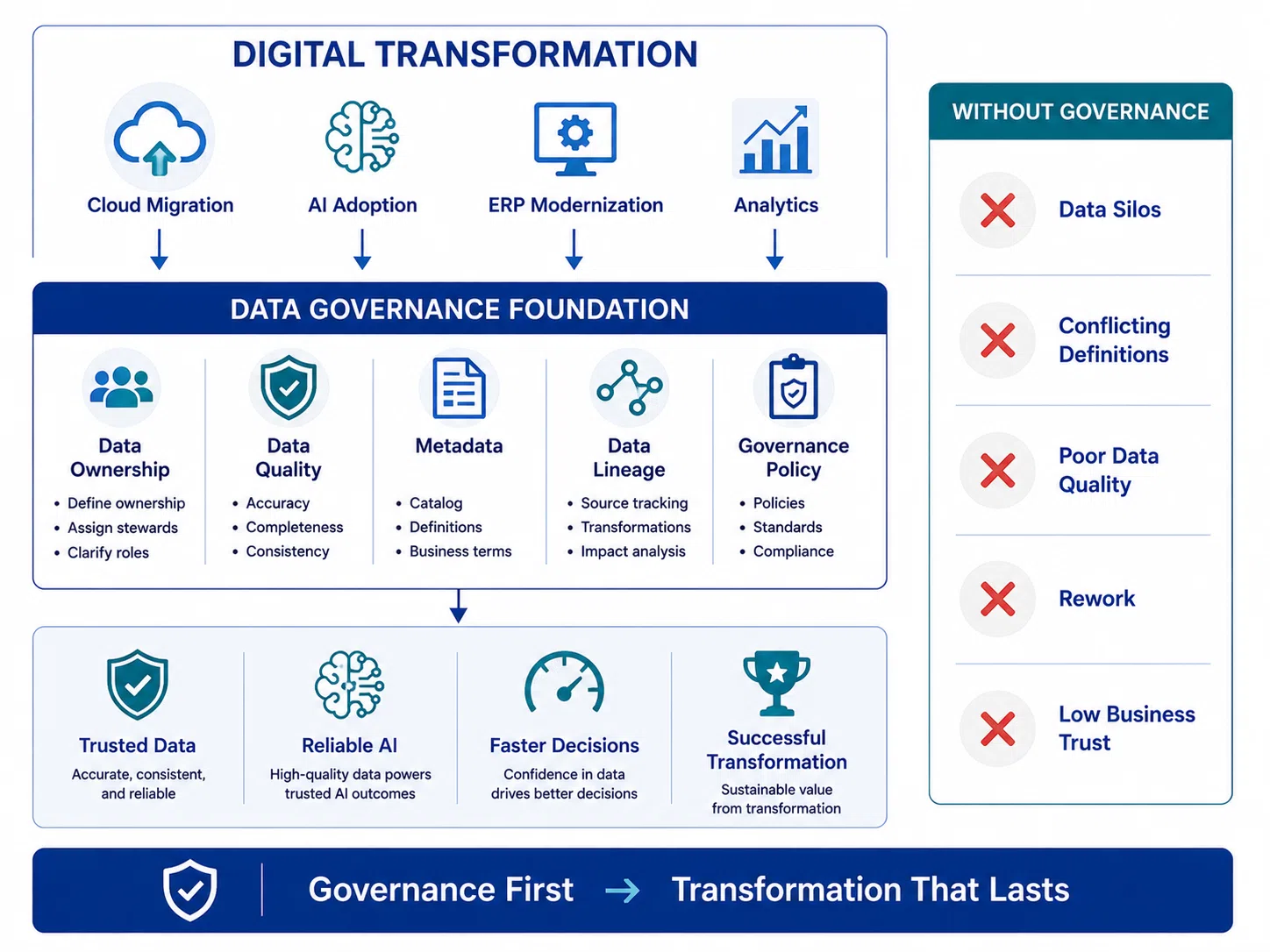
Data governance for digital transformation is the framework of policies, ownership structures, and quality standards that ensures data is accurate and trustworthy before, during, and after transformation programs. Without it, organizations that move processes to the cloud, deploy AI, or modernize systems simply carry their data problems into new environments. With it, transformation outcomes are reliable, auditable, and scalable. The framework covers data ownership, quality management, metadata, lineage, and policy, and it must be established before transformation processes go live, not after.
Most digital transformation programs begin with a technology decision: move to the cloud, adopt a modern data platform, deploy AI, or replace a legacy system. The data strategy comes second, or not at all. By the time the new platform is live, the team discovers that the quality, consistency, and ownership problems that existed in the old system have migrated cleanly into the new one.
Data governance for digital transformation is the practice of establishing data ownership, quality standards, and usage policies before transformation processes go live. Organizations that do this first reduce transformation failure rates, cut the cost of rework, and build the kind of data trust that makes AI and analytics outputs reliable enough to act on. Those that skip it spend the first 12 months post-launch fixing the data rather than using it.
Table of Contents:
| $12.9M | Average annual cost of poor data quality per organization. Poor data quality increases operational costs, delays analytics initiatives, and reduces confidence in business decision-making. Source: Gartner, Data Quality: Why It Matters and How to Achieve It |
|---|
Why Digital Transformation Fails Without Data Governance The patterns that cause transformation programs to stall when data is not governed
The most common pattern is this: an organization invests in a cloud data platform, completes the migration on time, and then discovers that data from five different source systems uses five different definitions for the same business concept. Revenue. Customer. Active account. The new platform is live, but analysts cannot agree on the numbers it produces, and leadership loses confidence in the outputs within weeks of launch.
The most common pattern is this: an organization invests in a cloud data platform, completes the migration on time, and then discovers that data from five different source systems uses five different definitions for the same business concept. Revenue. Customer. Active account. The new platform is live, but analysts cannot agree on the numbers it produces, and leadership loses confidence in the outputs within weeks of launch.
| 73% | Organizations identify improving data quality, governance, and accessibility as a strategic priority for enabling AI and digital transformation initiatives. Source: MIT Sloan Data and AI Leadership Executive Survey (2024). |
|---|
From the field
The most common entry point for our data governance consulting engagements is an organization six to twelve months into a transformation program that has stalled. The new platform is live, the investment has been made, and the team is discovering that every report produces a different number depending on which system it came from. Governance that should have been established before the migration now has to be retrofitted, which costs two to three times as much as doing it upfront.
Three specific failure patterns appear consistently:
Undefined data ownership means that when data quality problems surface, no one has the authority or accountability to fix them. Issues get escalated, discussed, and deferred. The new platform runs on dirty data indefinitely.
Inconsistent business definitions mean that the same metric calculated by two different teams produces two different numbers. The BI dashboard becomes a source of debate rather than a source of decisions. Trust collapses.
Missing data lineage means that when a compliance audit or a business question requires tracing data back to its source, the team cannot reliably explain where a number came from or what transformations it passed through. For regulated industries, this is a compliance of exposure. For all industries, it erodes confidence in analytics outputs.
Note: Cloud migration does not fix data quality problems. It moves them. A data governance framework must be established before migration, not after. Retrofitting governance onto a live platform typically costs 2 to 3 times more than building it upfront.
Assess Your Data Governance Maturity
Complete a quick assessment to identify governance gaps, evaluate your current maturity level, and receive practical recommendations for improving data quality, compliance, and governance.
Data Governance Maturity Assessment
A structured diagnostic for CDOs, CIOs, and Chief Compliance Officers. 18 questions across six governance dimensions. Receive a scored maturity profile and prioritised recommendations.
Your Details
Your Assessment Results
Overall Governance Maturity Level
Receive Your Full Report
A BluEnt governance consultant will prepare a personalised report with specific recommendations for your highest-priority gaps. Book a 60-minute discovery call to discuss your findings.
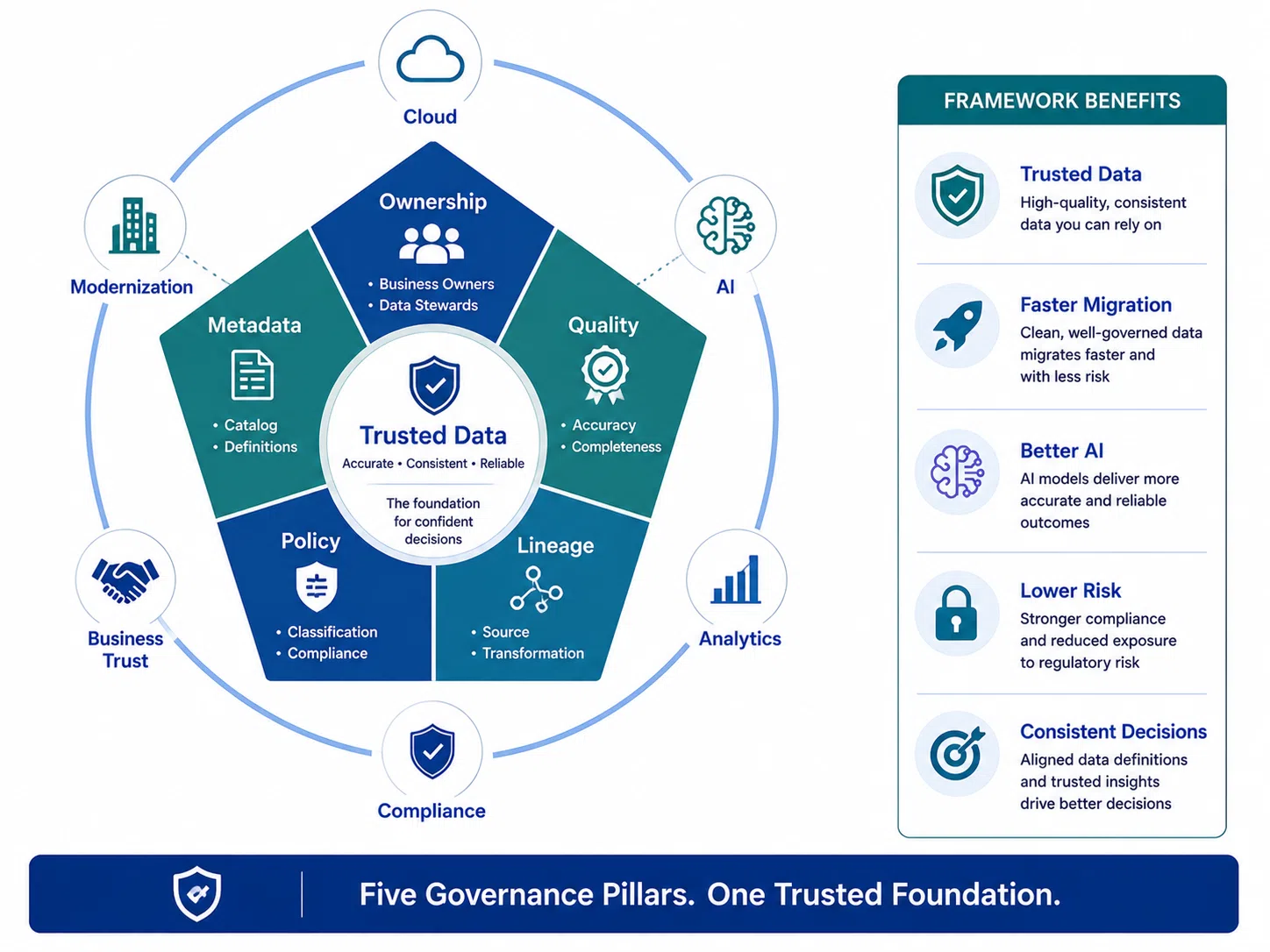
The Core Pillars of a Data Governance Framework Ownership, quality, metadata, lineage, policy: what each pillar does and why it matters
Data ownership and stewardship
Every data domain requires a named business owner accountable for its quality and definition, and a data steward responsible for day-to-day quality management. Without this, governance policies have no one to enforce them. The most technically sophisticated data platform cannot compensate for absent accountability.
In a transformation context, ownership must be established before new systems go live. The question is not “who manages this data in the new platform” but “who is responsible for what this data means and whether it is correct across all systems that use it.”
Data quality management
Data quality management defines the standards that data must meet to be used in transformation processes: completeness, accuracy, consistency, timeliness, and validity. It also establishes the monitoring and remediation workflows that detect and fix quality failures before they reach downstream applications.
For AI and analytics to use cases, data quality is not a nice-to-have. A model trained in in inaccurate or inconsistently defined data produces inaccurate outputs. The quality of the governance determines the reliability of the AI.
Metadata management and data catalog
Metadata management ensures that every data asset in the organization is described, classified, and searchable. A data catalog gives analysts and data engineers a single place to find what data exists, what it means, who owns it, and how it has been used. This reduces the time analysts spend searching for trusted data from hours to minutes.
For digital transformation programs that introduce new data sources from SaaS applications, cloud platforms, and IoT systems, a maintained catalog is the only way to prevent data proliferation from creating invisible silos in the new environment.
Data lineage and traceability
Data lineage tracks the origin, movement, and transformation of data from source to consumption. For regulated industries, lineage is a compliance requirement: auditors need to trace a reported figure back to its source system and through every transformation step. For AI programs, lineage is what allows teams to audit model inputs and explain outputs.
Organizations that establish lineage during transformation programs, rather than after, build it into their pipelines from the start. Retrofitting lineage onto complex pipelines that were built without it is one of the most expensive data engineering tasks an organization can face.
Governance policy and compliance framework
Governance policy defines how data is to be accessed, used, shared, and retained across the organization. It covers data classification (public, internal, confidential, restricted); access control tied to data sensitivity, retention schedules, and regulatory compliance requirements including GDPR, HIPAA, CCPA, and sector-specific mandates.
For transformation programs that involve moving data to cloud environments or sharing data across new systems, policy must precede access. Establishing access controls after a cloud migration has already created broad permissions is significantly harder than designing them upfront.
Build Governance on a Strong Foundation
Discover the essential governance pillars that improve data quality, accountability, metadata, lineage, and regulatory compliance.
Building a Data Governance Framework for Digital Transformation A five-phase approach from current-state assessment to embedded governance
Phase 1: Assess the current data state
Before defining governance policies, map what data exists, where it lives, how it is used, and what quality problems are already present. This includes a data inventory across source systems, an assessment of existing data definitions and their consistency, and stakeholder interviews to identify where data trust has broken down.
The output of the assessment is a prioritized view of which data domains carry the most risk to transformation of success and should be governed first. Starting with the highest-risk domains, rather than trying to govern everything at once, is what separates programs that gain traction from programs that stall under their own scope.
From the field
Data governance programs that start with a single critical domain and prove value there are significantly more likely to expand successfully than programs that open with an enterprise-wide framework. Start with the data that matters most to the transformation. Customer master data, financial data, and product data are the most common starting points because errors in these domains have the highest downstream cost.
Phase 2: Define data domains and ownership
Map the organization’s data into logical domains (customer, product, financial, operational, HR) and assign a business data owner to each. Document the canonical definition for each key data concept within each domain. These definitions become the reference point that resolves conflicts when different systems produce different numbers.
This phase requires business leadership involvement, not just IT. Data ownership is a business accountability. IT manages the systems; business stakeholders own the meaning and quality of the data those systems produce.
Phase 3: Establish data quality standards
For each data domain, define the quality dimensions that matter: completeness (no required fields missing), accuracy (data matches the real-world entity it represents), consistency (the same concept has the same value across systems), timeliness (data is current enough for its use case), and validity (data conforms to defined format and range rules).
Implement automated data quality monitoring that measures against these standards continuously and alerts data stewards when thresholds are breached. Manual quality checks at migration or report generation do not scale. Continuous monitoring embedded in pipelines.
Phase 4: Implement governance tooling
Select and deploy the tools required to operationalize the framework: a data catalog for metadata management and discovery, a data quality platform for monitoring and remediation, a lineage tool to track data movement and transformation, and an access management layer aligned to data classification policies.
Tool selection should follow governance design, not precede it. Many organizations invest in governance tooling before they have defined ownership, policies, or quality standards, and then discover the tools have nothing meaningful to enforce. The framework design comes first.
Phase 5: Embed governance in transformation workflows
Governance that operates as a separate oversight process, parallel to transformation of delivery, rarely survives the first major project pressure. Effective governance is embedded into the delivery workflow: data quality checks run as part of every pipeline, lineage is generated automatically by the orchestration layer, and new data assets are registered in the catalog as part of the development process.
The goal is to make governance the path of least resistance, not an additional step. When developers have to manually register data assets and run separate quality checks, those steps get skipped under deadline pressure. When they are automated into the build process, they happen consistently.
Recommended Reading:
Barriers Organizations Hit and How to Overcome Them The four objections that stall governance programs and the evidence-based responses
“We do not have time to govern data during a transformation program.”
This is the most common objection and the most expensive mistake. Governance that is deferred to after go-live means transformation teams are building a foundation of unresolved data quality issues. The rework required to fix data problems in a live system typically takes longer than establishing governance during the build phase would have.
The framing of using data governance is not an additional workstream. It is part of the transformation that makes the rest of it work. Defer it and you are not saving time. You are moving the time cost to the most expensive phase of the program.
“We do not know where to start.”
Start with the data that is most critical to the transformation use case and most likely to create problems if it is wrong. For a customer data platform project, start with customer master data. For a financial reporting modernization, start with the chart of accounts and revenue definitions. Narrow scope, visible impact, and quick wins to build the organizational support governance programs need to expand.
“IT owns data governance.”
IT manages the systems and platforms that store and process data. IT does not determine what customer revenue means or who is accountable when the definition is inconsistent across business units. Data governance that is treated as an IT function produces technically compliant policies that no business stakeholder enforces. Governance requires joint ownership: IT provides the infrastructure; business owners provide accountability and definitions.
“Our data is already in the cloud. We are fine.”
Cloud migration moves data. It does not clean it, define it, or assign accountability for it. The cloud provides better infrastructure for governance tooling (automated quality monitoring, centralized catalog, fine-grained access control), but the governance itself has to be designed and implemented. Organizations that treat cloud adoption as a data quality solution typically discover within six to twelve months that the same problems exist at higher volume and faster propagation rate.
Note: Governance is not a gate or a bureaucracy. It is the set of decisions about data ownership, quality, and meaning that allows transformation programs to produce reliable outcomes. The question is not whether to govern data, but when. Governing it upfront costs less than governing it after go-live.
The bottom line
Digital transformation is not primarily a technology problem. It is a data problem that technology makes it more visible. Organizations that treat data governance as the foundation of transformation, rather than a compliance task that follows it, consistently produce better outcomes: faster time-to-value on new platforms, more reliable AI and analytics outputs, and lower rework costs when data quality issues surface.
-
Establish data ownership before migration, not after
-
Start with the data domains most critical to your transformation use case
-
Automate quality monitoring and lineage generation in pipelines from day one
-
Treat governance as a business program with executive sponsorship, not an IT compliance task
-
If in-house governance capability is limited, a specialist data governance consulting engagement provides faster time-to-framework than building from scratch
If your organization is mid-transformation and discovering that data quality and ownership gaps are the bottleneck, the most efficient path is a structured governance assessment that identifies the highest-risk domains and defines an implementation roadmap aligned to your transformation timeline.
Build the data governance foundation your transformation needs
BluEnt’s data governance consulting team designs and implements data governance frameworks for enterprise organizations undergoing cloud migration, AI adoption, and platform modernization. We cover data ownership design, quality management, metadata cataloging, lineage, and policy, aligned to your transformation program timeline.
BluEnt provides data governance consulting, data quality management, and data strategy services for enterprise organizations across the US, UK, Canada, and Australia.
Common Questions What data and transformation leaders ask most about data governance programs
What is data governance for digital transformation?Data governance for digital transformation is the framework of policies, ownership structures, and quality standards that ensures data is accurate, trustworthy, and consistently defined before transformation programs go live. It covers data ownership assignment, data quality management, metadata and catalog management, data lineage, and access and compliance policy. Without it, transformation programs built on new technology inherit the data quality and consistency problems of the systems they replaced.
Why do digital transformation programs fail because of data?Most digital transformation failures trace back to three data problems: inconsistent data definitions across systems (two departments calculate the same metric differently), absent data ownership (no one is accountable for data quality), and missing data lineage (the organization cannot trace where a number came from or how it was transformed). These are governance failures, not technology failures. New platforms do not resolve them without a deliberate governance program.
When should data governance be implemented relative to a transformation program?Data governance should be implemented before transformation processes go live, and ideally before migration begins. The current state assessment and ownership design should happen during the discovery and design phase of the transformation program. Quality standards and lineage tooling should be established before data is loaded into the new environment. Governance that is established after go-live is more expensive to retrofit and requires significantly more organizational change management.
What is the difference between data governance and data management?Data governance defines the policies, ownership structures, and standards for how data should be managed. Data management is the operational execution of those policies: the processes and tools that maintain data quality, track lineage, manage metadata, and control access. Governance without management produces policies that are never enforced. Management without governance produces technical controls that are not aligned to business intent. Both are required and they are different functions.
How long does it take to implement a data governance framework?A focused initial governance framework covering one or two critical data domains can be designed and operationalized in 8 to 16 weeks. Enterprise-wide governance programs that span multiple domains and integrate with complex platform environments typically take 6 to 18 months for initial deployment, with ongoing maturity development beyond that. Starting with a narrowly scoped, high-impact pilot is both faster to deliver and more likely to build the organizational support needed for broader expansion.
Do we need a Chief Data Officer to implement data governance?A CDO or equivalent executive sponsor accelerates governance programs significantly by providing the cross-functional authority needed to resolve data ownership disputes and enforce data quality standards. However, a CDO is not a prerequisite. Many organizations run effective governance programs led by a Director of Data or a data governance steering committee, provided they have genuine executive sponsorship. What governance programs cannot survive without is business leadership involvement. IT-only governance programs rarely achieve sustained adoption.

 Governing AI Tools in AEC: Copilot, Digital Twins, and Generative Design
  Data Governance for AI and Advanced Analytics: Building the Foundation That Works
  Centralized vs. Federated vs. Hybrid Data Governance: Which Model Fits Your Organization
  Data Governance Roles and Responsibilities in AEC Organizations