











Most enterprises today are not struggling with a lack of data. They are struggling with a lack of trust in their data. In our work with global organizations, we frequently see leadership teams hesitate on strategic initiatives because they are unsure whether the underlying data is accurate, complete, and consistent across functions.
This gap between data availability and decision confidence is why data governance for modern enterprises has moved from being an IT-led initiative to a board-level priority. As organizations accelerate AI, automation, and digital transformation, the ability to trust data has become a competitive differentiator.
At the same time, regulatory expectations around transparency, traceability, and accountability are increasing. Poor data decisions can now lead to financial loss, compliance exposure, and reputational damage.
The global data governance market size was estimated at USD 3.35 billion in 2023 and is projected to reach USD 12.66 billion by 2030. As a result, governance is no longer about control—it is about enabling growth, resilience, and trusted innovation.
Table of Contents:
What is Data Governance?
The simplest question is: what is data governance? It is a set of policies, processes, ownership models, and technologies that make the data accurate, secure, compliant and usable throughout the enterprise. However, to contemporary leaders, it is not just control. It is about confidence in decision-making.
Effective enterprise data governance helps organizations:
-
Establish ownership and responsibility of data.
-
Secure valuable and controlled data.
-
Minimize operations and compliance risks.
For CXOs, governance is less about policies and more about enabling faster, confident decision-making. It brings clarity on ownership, improves visibility into critical data, and ensures consistency across business functions. When implemented effectively, enterprise data governance becomes the foundation for trusted analytics, AI readiness, and regulatory confidence.
Why Data Governance Matters Now
In many organizations, governance only becomes a priority after a regulatory audit, delayed reporting cycle, or a failed AI initiative. By that stage, remediation costs are significantly higher and business trust has already eroded. Proactive governance helps enterprises avoid reactive investments and build a sustainable data foundation.
Enterprises have never been under more pressure than before. AI, automation, cloud migration and digital transformation all rely on reliable data. Meanwhile, regulators expect transparency, traceability and accountability.
For CXOs, the impact shows up in:
-
Missed revenue opportunities
-
Rising compliance costs
-
Increased operational inefficiencies
-
Poor customer experiences
-
Higher cybersecurity risks
Organizations that invest in data management, data quality management, and governance see measurable benefits:
-
Faster time to insights
-
Lower risk exposure
-
Better ROI from analytics and AI
Today, governance is closely linked with strategic priorities such as AI adoption, ESG reporting, cloud transformation, and customer-centric growth. Organizations that treat governance as a growth enabler rather than a compliance exercise are seeing faster innovation and stronger business outcomes.
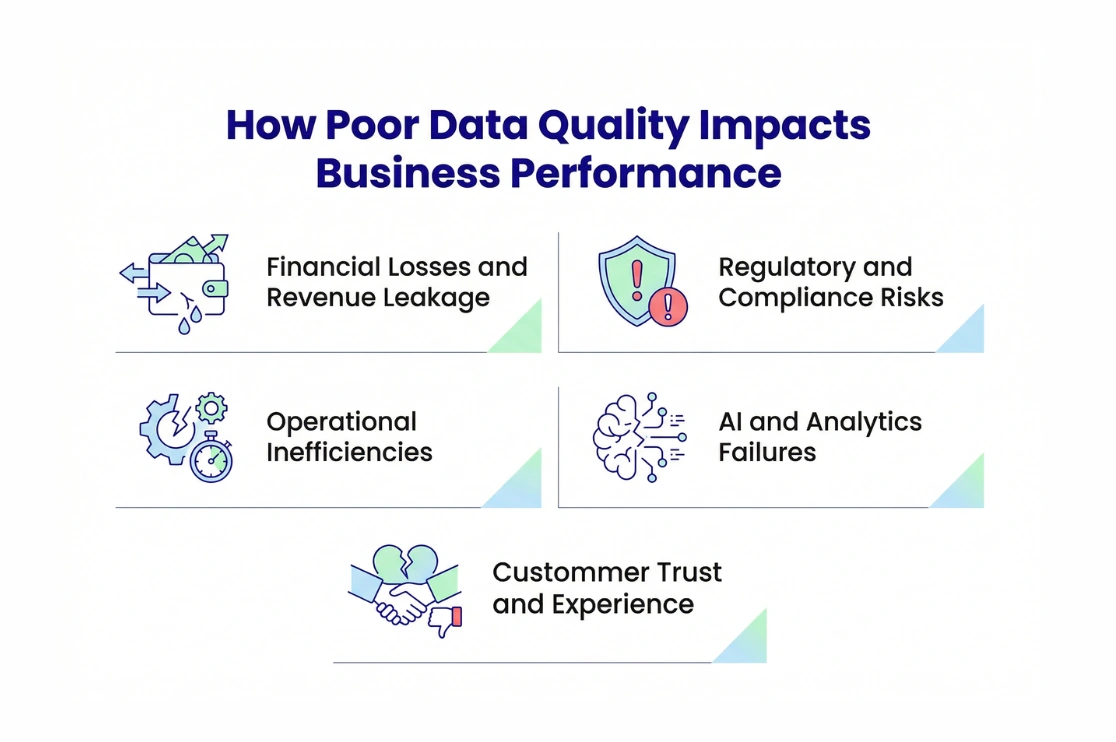
The Business Impact of Poor Data Quality
The cost of poor data is taken lightly by many leaders. Nevertheless, poor data quality risks have direct effects on revenue, risk, and performance.
Financial Losses and Revenue Leakage
We often see revenue leakage due to fragmented customer, product, and pricing data across sales, marketing, and finance systems. This results in weak insights and a loss of cross-sell or pricing.
Regulatory and Compliance Risks
The reporting errors, audit failure and penalties could be the result of the data quality issues in the regulated sectors. Most organizations cannot easily establish the lineage of critical elements of data utilized in regulatory reporting and this adds more complexity to audit as well as exposing risk.
Operational Inefficiencies
Teams frequently spend more time reconciling data than acting on insights, slowing decision cycles and reducing productivity.
AI and Analytics Failures
A significant percentage of AI and analytics programs do not succeed due not to technology but to the fact that the data underpinning them is of low quality, lacking governance, and trust. This brings about data-driven decision risks, which lead to inaccurate predictions and subsequent poor business outcomes.
Customer Trust and Experience
The presence of poor data will lead to inconsistency in interaction with customers, delay in service and low loyalty. This directly affects the brand reputation and retention.
The business impact of bad data is not only just technical but it is also strategic. Leaders must treat data quality as a board-level priority.
Data Governance Maturity Assessment
A structured diagnostic for CDOs, CIOs, and Chief Compliance Officers. 18 questions across six governance dimensions. Receive a scored maturity profile and prioritised recommendations.
Your Details
Your Assessment Results
Overall Governance Maturity Level
Receive Your Full Report
A BluEnt governance consultant will prepare a personalised report with specific recommendations for your highest-priority gaps. Book a 60-minute discovery call to discuss your findings.
Common Reasons Data Governance For Modern Enterprises Programs Fail
Despite strong intent, many governance initiatives struggle. In fact, many enterprises experience data governance failures because governance is treated as a technology project instead of a strategic business transformation. Knowledge of these data governance challenges can assist leaders to avoid costly mistakes.
Treating Governance as an IT Initiative
Many programs fail because they are driven only by IT. Governance should be a business initiative that is executive sponsored. One of the most common mistakes we see is limited business engagement. Without clear alignment to business priorities, governance becomes a documentation exercise rather than a value driver.
Lack of Clear Data Ownership
Powerful data governance & stewardship services assist in establishing the ownership, accountability, and workflows across functions.
Overly Complex Frameworks
Some organizations develop complex policies that are difficult to adopt. Governance must facilitate agility, rather than cause friction.Another frequent challenge is over-engineering frameworks before identifying high-impact data domains. This delays adoption and reduces executive sponsorship.
Poor Change Management
A clear understanding of why data governance initiatives fail enables organizations to design more practical, scalable, and business-aligned governance programs.
No Measurable Business Outcomes
When governance initiatives are not linked to business KPIs such as revenue growth, cost reduction, and risk mitigation, they often lose executive support. This increases governance program risks and reduces long-term value from data investments. The data governance implementation challenges can be avoided through an outcome-driven approach.
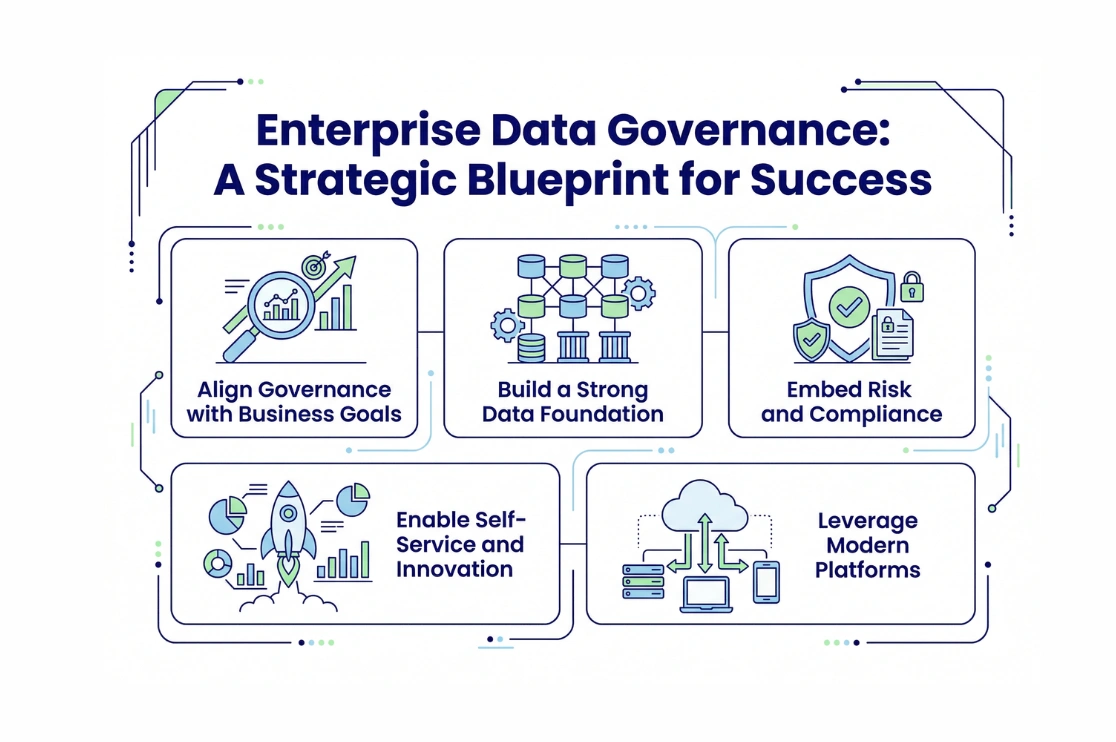
A Strategic Approach to Enterprise Data Governance
Organizations need to transcend policies and tools in order to develop a sustainable model of governance. Emphasis should be on results.
A modern approach includes:
Align Governance with Business Goals
Begin with strategic priorities, e.g. customer growth, regulatory preparedness and operational efficiency. Leading organizations focus first on high-value domains such as customer, finance, and risk, rather than attempting enterprise-wide governance from the start.
Build a Strong Data Foundation
This includes the delivery of the potent data management & data quality solutions to provide reliable data in systems.
Embed Risk and Compliance
The data risk management needs to be linked with governance in order to safeguard sensitive data and provide regulatory alignment. Modern governance must extend to AI and model risk, ensuring transparency, explainability, and ethical data usage.
Enable Self-Service and Innovation
The governance should also allow the teams to access trusted data, and not restrict access.
Leverage Modern Platforms
Automation, scalability and real-time governance are supported by cloud and data platforms.
In order to speed up this process, many enterprises prefer to schedule an enterprise data governance discussion with experienced partners.
Key Services that Enable Data Management & Governance Success
Successful governance programs require more than frameworks. They demand operating model design, change management, stewardship enablement, and measurable KPIs that align with business outcomes.
Data Governance & Stewardship Services
These services define policies, ownership models as well as governance workflows. They facilitate the alignment of IT, business and compliance teams.
Data Management & Data Quality
These comprise data profiling, cleansing, monitoring and quality controls. It enhances reliability and decision confidence.
Data Risk Management
An efficient framework secures sensitive information, regulative adherence, and lessens cyber and operational threats. Many organizations also leverage governance maturity assessments and industry accelerators to accelerate adoption and demonstrate early value.
Why CXOs Must Act Now
The future of enterprise competitiveness is based on trusted data. Governance is no longer optional. It is a strategic facilitator of AI, digital transformation and risk management.
Organizations that delay risk:
-
Slower innovation
-
Higher regulatory exposure
-
Poor ROI from analytics
-
Increased operational inefficiencies
In case your organization is considering taking the next steps, it is worth booking a data governance strategy session as a way to outline a proper roadmap based on business priorities.
Why BluEnt
BluEnt takes a practitioner-led approach to data governance, focusing on measurable business outcomes rather than documentation-driven frameworks. We assist CIOs and CDOs to create scalable, performance-oriented data governance for modern enterprises that enhances decision confidence, risk reduction, and accelerates AI readiness. Our programs are designed to improve decision confidence, accelerate regulatory readiness, and enable trusted AI at scale.
Key strengths:
-
Industry-aligned governance models tailored to your business goals.
-
Validated data quality and risk management systems.
-
Faster adoption with strong change management and stewardship.
-
Scalable governance that supports AI, analytics, and compliance.
Our differentiator lies in combining governance strategy, operating model design, and change management to drive adoption across business functions.
Conclusion
Data governance is no longer a back-office capability. It is a strategic enabler of growth, resilience, and innovation. As enterprises scale AI, analytics, and digital transformation, trusted data will define competitive advantage.
Modern enterprises need to embrace a business-based governance model, which is strategic in nature; that is, it entails a combination of quality, risk and ownership. Today, leaders who are focused on governance will open the door to quicker insights, lower risk, and deliver quantifiable value.
FAQs
How should enterprises prioritize data governance initiatives across business domains?High-impact domains should be considered by the companies like customer, finance, and risk, and governance should be aligned with strategic objectives, the level of regulatory exposure, and quantifiable business value to provide an early success.
What operating model works best for global organizations?The federated operating model is the most suitable with centralized standards but domain ownership to achieve scalability, local responsibility, and uniform governance between regions and business departments.
How does governance support AI and advanced analytics?Governance assures quality of data, lineage and accountability which are important to trustworthy models, regulatory openness, ethical AI and expedited implementation of sophisticated analytics throughout the enterprise.
What is the typical ROI from enterprise governance programs?The ROI usually involves accelerated life cycle of reporting, reduced compliance expenses, greater confidence in decisions, minimized operational risk and greater value of analytical, AI and digital transformation investments.
How long does it take to implement a scalable governance framework?The majority of businesses will achieve the first results in 6-12 months due to the concentration on the priority areas, whereas the complete maturity can take 2-3 years based on the complexity, scale, and preparation of the organization.

 Governing AI Tools in AEC: Copilot, Digital Twins, and Generative Design
 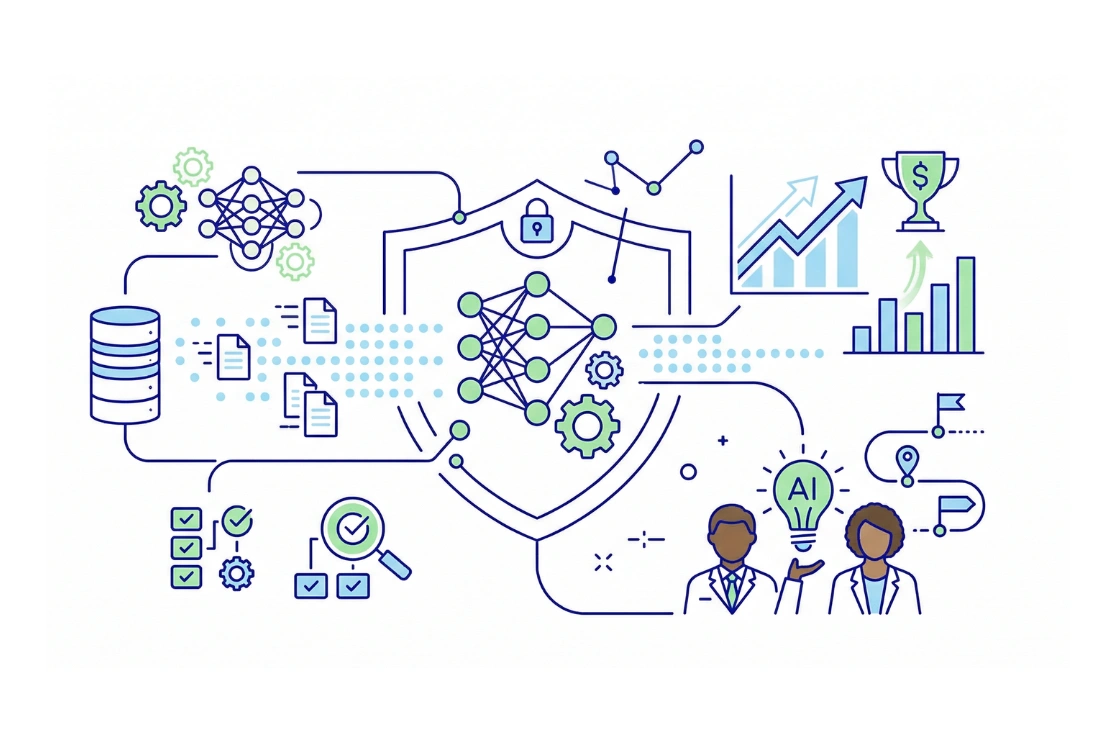 Data Governance for AI and Advanced Analytics: Building the Foundation That Works
 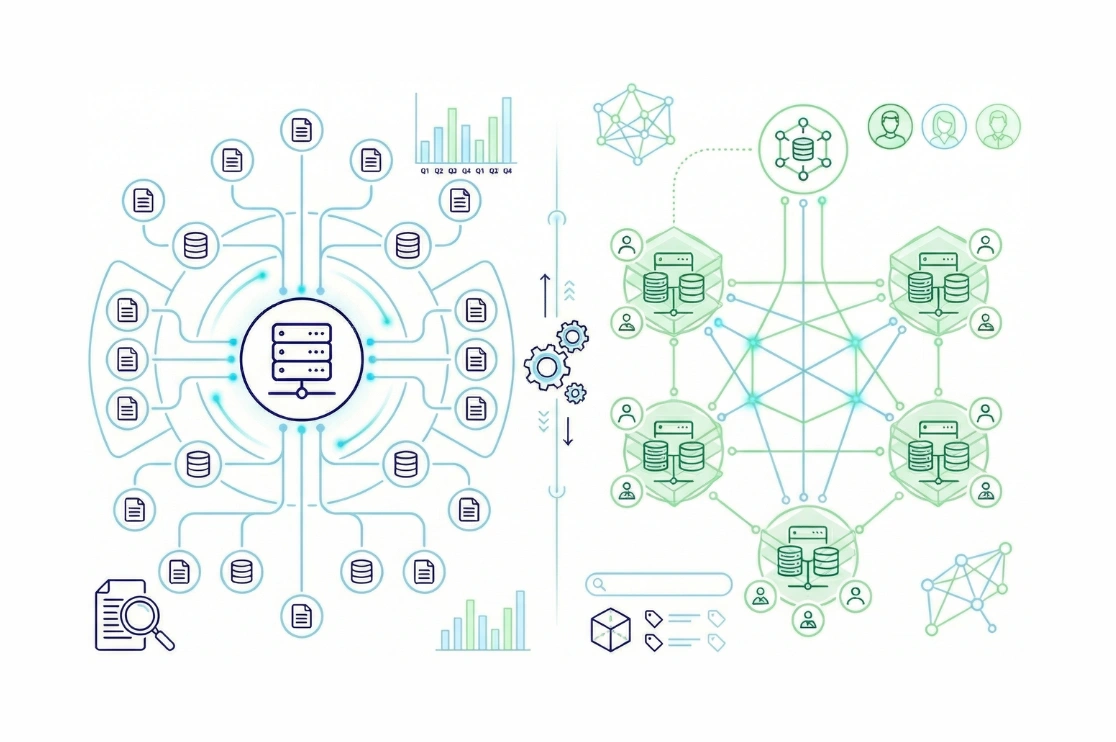 Centralized vs. Federated vs. Hybrid Data Governance: Which Model Fits Your Organization
 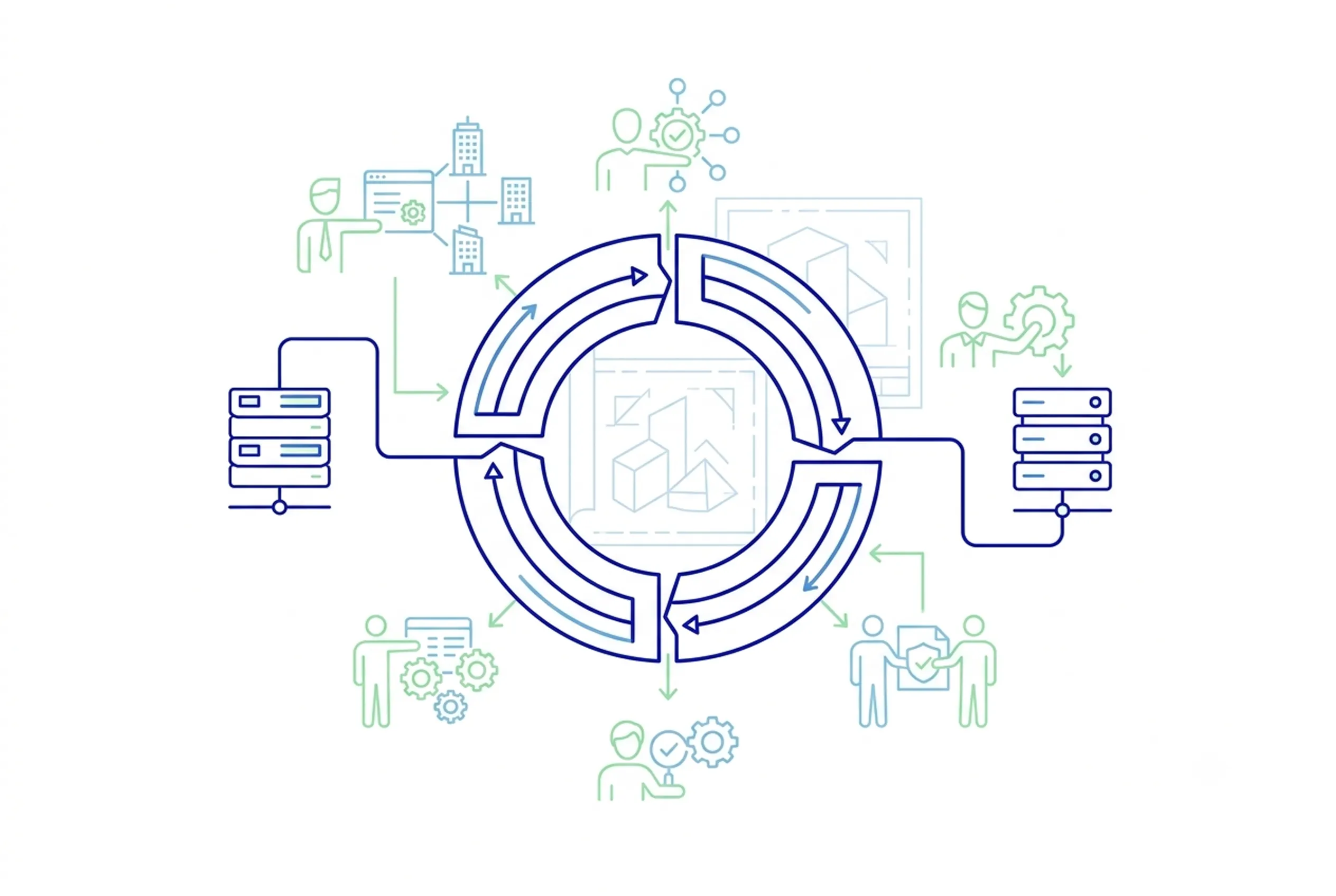 Data Governance Roles and Responsibilities in AEC Organizations