











Across U.S. enterprises, the pressure to ensure that data is secure, compliant, and reliable has never been higher. However, technology alone cannot solve governance challenges. In practice, the success of data governance depends far more on clearly defined roles, ownership, and accountability than on tools or platforms.
In our experience working with enterprise data leaders, the most common governance failures occur when responsibilities are unclear. Without defined data governance roles and responsibilities, even the most advanced data platforms struggle to deliver business value. Reports become inconsistent, compliance risks increase, and trust in enterprise data declines.
For CIOs, CDOs, and data leaders, establishing a clear data ownership model is critical to improving data quality, strengthening security, and enabling scalable AI and analytics initiatives.
Table of Contents:
- Why Data Ownership Has Become a Strategic Priority in the USA
- Common Challenges in Defining Data Governance Structure
- Data Governance Roles and Responsibilities for US Enterprises
- Chief Data Officer: Strategic Leadership
- Data Governance Manager: Execution and Coordination
- Data Owners: Accountability and Decision-Making
- Data Stewards: Quality and Policy Enforcement
- Data Custodians: Security and Infrastructure
- Building a Scalable Data Ownership Model
- Why US Enterprises Choose BluEnt
- Conclusion
- FAQs
When governance roles are clearly defined, organizations gain greater confidence in their data, reduce operational risks, and accelerate digital transformation initiatives. Clear accountability enables faster decision-making and creates a strong foundation for innovation and long-term resilience.
Why Data Ownership Has Become a Strategic Priority in the USA
In many organizations, governance issues emerge when leadership teams receive conflicting reports or when regulatory audits reveal gaps in data accountability. Technology limitations bring about these challenges. Instead, they often stem from unclear ownership and poorly defined governance responsibilities.
Clouds, artificial intelligence, and sophisticated analytics are being heavily invested in by the US enterprises. Nonetheless, most projects are not successful because of poor accountability and governance.
The data governance market size stood at USD 4.60 billion in 2026 and is projected to reach USD 9.68 billion by 2031. The quality issues, compliance risk, and security controls shall be the same in situations where the data belongs to nobody, compliance risk is higher, and security controls are lower.
A good data ownership model assists organizations:
-
Enhance audit preparedness and regulatory compliance.
-
Enhance cybersecurity and privacy.
-
Improve the quality and reliability of data.
-
Foster AI and advanced analytics
-
Minimize business inefficiencies.
-
Enhance business and IT cooperation.
For many organizations in the USA, defining ownership is no longer optional. Risk management and maximization of data-driven value are a strategic need.
Common Challenges in Defining Data Governance Structure
A lot of organizations are not able to achieve a clear data governance structure. Roles overlap, responsibilities are unclear, and governance becomes ineffective.
Lack of operationalization of governance is well-known among many enterprises since business and technology teams lack clear definitions of their roles. Governance initiatives in the absence of organised accountability tend to lose momentum.
Confusion Between Business and IT Ownership
In most companies, business units consider IT to be the owner of the data whereas IT teams think that the business ought to establish ownership. Such malevolence results in lack of accountability and inconsistency in decision making.
Lack of Executive Sponsorship
Without strong leadership, the governance initiatives lose momentum and cannot scale up the enterprise.
Resistance to Change
Defining governance roles requires cultural change. Business teams may view governance as additional work rather than a mechanism to improve decision-making and reduce risk.
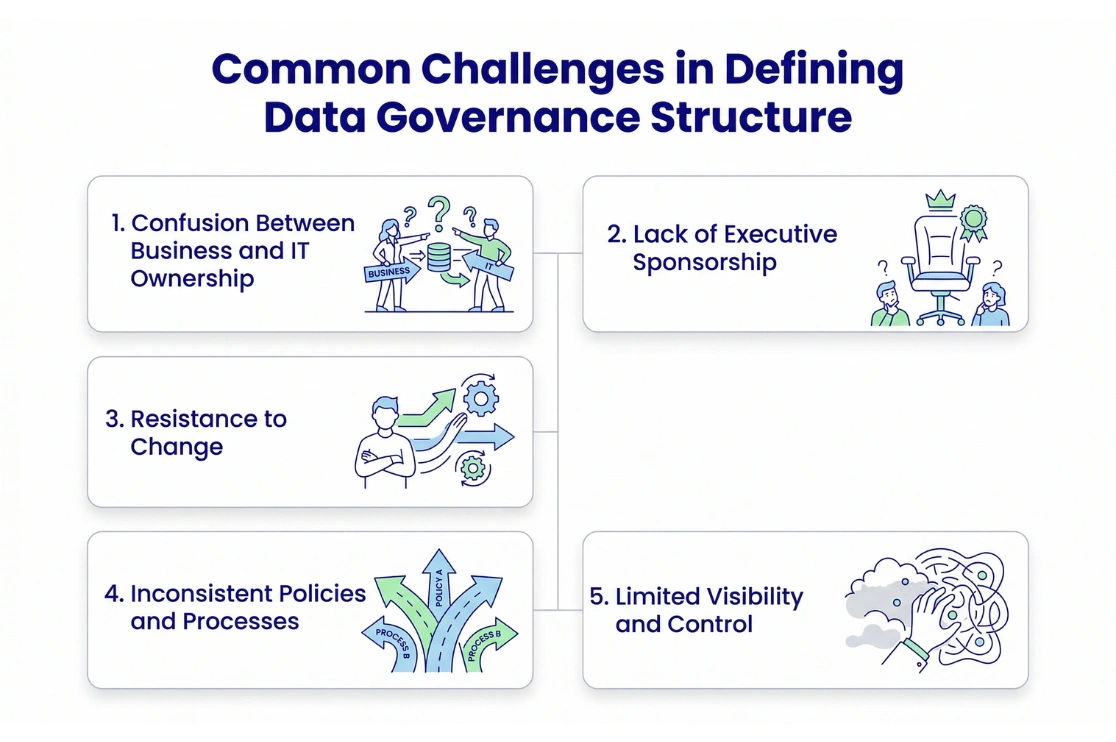
Inconsistent Policies and Processes
Various business divisions tend to develop their rules, which results in fragmentation and risk.
Limited Visibility and Control
Organizations lack defined roles and therefore they find it difficult to control access, quality and compliance. This augments operational and security risks.
Recommended Reading:
Data Governance Roles and Responsibilities for US Enterprises
A successful governance program requires a clear data accountability framework that defines how responsibilities are distributed across leadership, business teams, and IT. Well-structured roles ensure that governance policies are consistently implemented and aligned with enterprise priorities.
About 60% of corporate leaders have prioritized data governance; it remains a focus for chief development officers (CDOs) and is ahead of AI by 80% for data platforms and security practitioners. This will provide corporate teamwork, responsibility and alignment between business and IT.
In mature governance programs, there is an explicit accountability on the strategic, operational and technical levels. This will ensure policies that are instituted at the executive level are well practiced in business sectors and the technology platforms.
Chief Data Officer: Strategic Leadership
Enterprise data governance is a strategic leadership role held by the Chief Data Officer (CDO). This role will ensure that the governance projects comply with the business interests, regulatory enforcements as well as long term data strategy.
Key responsibilities include:
-
Defining enterprise data strategy
-
Ensuring regulatory compliance
-
Aligning data initiatives with business priorities
-
Promoting a data-driven culture
High-quality leadership in CDO assists organizations in establishing a scalable and sustainable enterprise data governance framework.
Data Governance Manager: Execution and Coordination
The data governance manager makes the strategy into action. This position will be applied to make sure that governance processes are put in place, checked and refined.
Key responsibilities include:
-
Managing governance programs
-
Coordinating across business and IT
-
Monitoring compliance and quality
-
Supporting policy implementation
-
Driving continuous improvement
This is a key role to effective data governance & stewardship services and operational governance.
Data Owners: Accountability and Decision-Making
The Data Owners are charged with the responsibility of guaranteeing the quality, security of data, as well as its utilization within their domain. They ensure that information is consistent with business objectives and required standards.
Key responsibilities include:
-
Defining data standards
-
Approving access and usage
-
Managing risks
Transparency would increase accountability and increase confidence within the organization.
Data Stewards: Quality and Policy Enforcement
Data Stewards are key operational figures of governance by doing the check-up that makes governance standards to be applied the same to datasets and business processes. Their functions are to pay attention to quality, address data challenges, and metadata maintenance.
Key responsibilities include:
-
Monitoring data quality
-
Enforcing policies
-
Managing metadata
-
Supporting business users
-
Driving issue resolution
A well-organized data stewardship framework enhances consistency, reliability, and collaboration.
Data Custodians: Security and Infrastructure
The Data Custodians tend to be members of the IT or data platform team and are engaged in the operation of the technical environment, where the data is stored and manipulated. They are to control security controls, architecture and mechanisms of data access.
Key responsibilities include:
-
Implementing security controls
-
Managing infrastructure
-
Ensuring backup and recovery
-
Supporting compliance and audits
-
Enabling secure data access
Custodians and business data owners should work together effectively to guarantee that security and access controls could support the need of compliance and operative requirements.
Identity & access control services and RBAC & data lineage governance are solutions to enhance visibility and risk management.
Data Governance Maturity Assessment
A structured diagnostic for CDOs, CIOs, and Chief Compliance Officers. 18 questions across six governance dimensions. Receive a scored maturity profile and prioritised recommendations.
Your Details
Your Assessment Results
Overall Governance Maturity Level
Receive Your Full Report
A BluEnt governance consultant will prepare a personalised report with specific recommendations for your highest-priority gaps. Book a 60-minute discovery call to discuss your findings.
Building a Scalable Data Ownership Model
In order to attain long term success, US organizations need to develop a scalable governance structure that is in line with the business priorities.
Step 1: Align Ownership with Business Outcomes
Strategic goals that should be associated with ownership are customer experience, compliance, and innovation. This will guarantee value in governance. Top enterprises normally initiate with high-worth information fields like customer, fiscal, and regulatory information and then elaborate governance throughout the enterprise.
Step 2: Create a Clear Data Governance Structure
Form governance councils, domain ownership and escalation to increase cooperation and accountability.
Step 3: Define Policies and Standards
Policies being standardized create homogeneity that brings about uniformity to the enterprise and also minimizes risks.
Step 4: Leverage Automation and Technology
The modern platforms make automated monitoring, lineage tracking and policy enforcement possible.
Step 5: Build a Culture of Accountability
Governance can be inculcated in the day to day operations through training and communication. The adoption of the same is increased through recognition and incentives.
Step 6: Measure and Communicate Value
Measures of the quality of data quality, report velocity, and compliance preparedness can be monitored to provide an objective picture of the real value of governance initiatives to the executive.
Recommended Reading:
Why Do US Enterprises Choose BluEnt?
Most businesses also invest in the modern data platforms and fail to develop the governance systems needed to utilize data. BluEnt assists US organizations to design and execute governance structures that provide quantifiable results. It pays attention to scalable, practical, and business solutions.
BluEnt supports:
-
Structures of ownership and accountability of data.
-
Stewardship programs
-
Secure access and identity management
-
Artificial intelligence and digital technology preparedness.
We base our strategy on providing tangible results like better quality of data and compliance willingness, shorter reporting periods and increased trust in enterprise analytics and AI projects.
Conclusion
Through clearly defined data governance roles and responsibilities, it is evident that we need to create trusted enterprise data environments. With the increased AI, analytics, and cloud usage by organizations, firm ownership, and responsibility are essential in ensuring both data quality and compliance and operational efficiency.
A structured ownership model will help in boosting interactions, compliance, and decision-making. It also makes data initiatives provide measurable business outcomes. Those organizations that are strategic and business oriented in their approach to governing the business develop resilience and competitive edge.
Organizations that establish structured governance roles are better positioned to improve collaboration across business and technology teams while unlocking the full value of their data assets.
FAQs
What roles are essential in a data governance framework?The main roles are the Chief Data Officer, data governance managers, data owners, data stewards, and data custodians. All the roles are relevant to governance strategy, operation implementation and technical management.
Why is data ownership critical for enterprise governance?Clarity allows responsibility for data quality, compliance, and security. In the absence of ownership, the policies of governance will be hard to implement.
How do data stewards support governance initiatives?Data stewards observe data quality, support metadata, impose governance policies as well as orchestrating the resolution of issues among business units.
How should organizations structure data governance roles?Most of the businesses are stratified in nature, having the executive governance, domain-level ownership, stewardship and technical custodian.
How do governance roles support AI and analytics initiatives?AI and analytics rely on the quality of data. The governance functions are used to assure policy implementation, data quality, and accountability of enterprise systems.

 Governing AI Tools in AEC: Copilot, Digital Twins, and Generative Design
  Data Governance for AI and Advanced Analytics: Building the Foundation That Works
  Centralized vs. Federated vs. Hybrid Data Governance: Which Model Fits Your Organization
  Data Governance Roles and Responsibilities in AEC Organizations