











What Is Master Data Management?
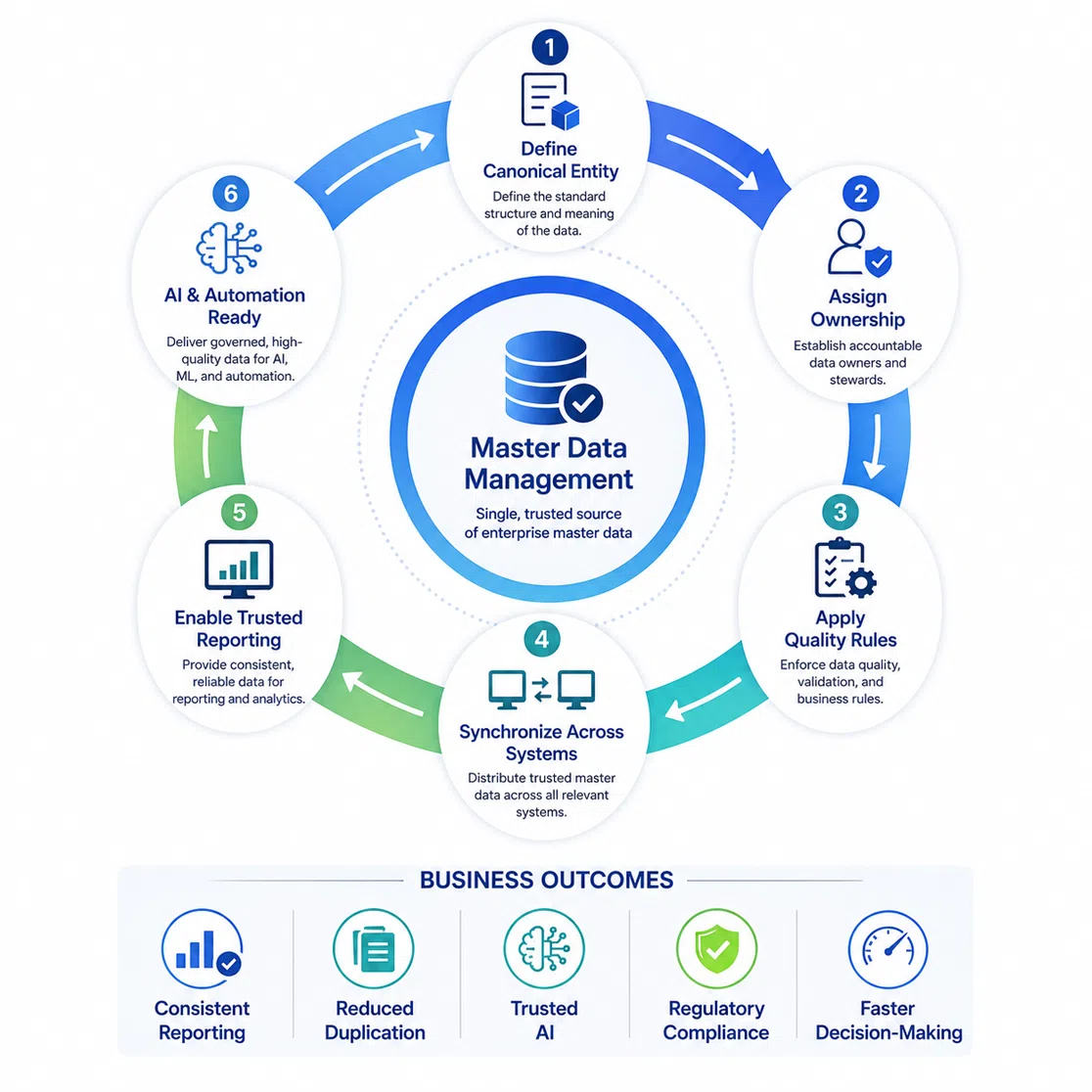
Master data management (MDM) is the process of creating and maintaining a single, consistent, and authoritative version of an organization’s most critical shared data entities, customers, products, suppliers, employees, locations, and financial hierarchies. MDM ensures that these core entities are defined consistently across all enterprise systems, so that the same customer, product, or cost center means the same thing in every platform that uses it. In the context of data governance, MDM provides the canonical data foundation that governance policies are built to protect.
Your CRM says you have 4,200 active customers. Your ERP says 3,800. Your billing system says 4,050.
Each system is confident. None of them agree. And somewhere in that gap, a sales team is working from the wrong list; a finance team is reconciling manually every quarter, and an executive dashboard is showing a number that nobody fully trusts.
This is not a technology failure. It is a master data problem, and it compounds every time you add a new system, acquire a company, or try to use AI tools that surface data across your environment.
Master data management (MDM) is the discipline that creates a single, authoritative version of your most critical data entities. When MDM is connected to a governance framework, it becomes the operational foundation that makes governance policies enforceable, reporting trustworthiness, and AI deployments safe.
Table of Contents:
- What Is Master Data Management?
- Why MDM and Governance Cannot Work Without Each Other
- The Six Master Data Domains That Drive Enterprise Performance
- Four Ways MDM Enables Data Governance at Scale
- BluEnt in Practice: MDM as the Foundation for AI-Ready Data
- How to Start: A 4-Step MDM Governance Foundation
- Frequently Asked Questions
What Is Master Data Management?
MDM is not the same as a data warehouse, a CRM, or a data catalog. Those systems store or describe data. MDM governs the identity and definition of the entities that data describes.
Without MDM, governance policies apply to inconsistent underlying data. You can mandate data quality standards all you want, but if ‘customer’ means something different in five systems, quality enforcement has nothing consistent to measure against.
Gartner research estimates that poor data quality costs organizations an average of $12.9 million per year. In enterprises with fragmented master data across multiple systems, the true cost, in manual reconciliation, delayed reporting, and bad decisions, is consistently higher than the technology budget allocated to fix it.
Why MDM and Governance Cannot Work Without Each Other
MDM programs that exist without governance frameworks tend to create a new silo: a master data hub that individual business units ignore because it conflicts with their local definitions, or because there is no enforcement mechanism to require its use.
Governance programs that exist without MDM tend to produce policy documents that cannot be operationalized, because there is no consistent master data foundation to apply those policies to.
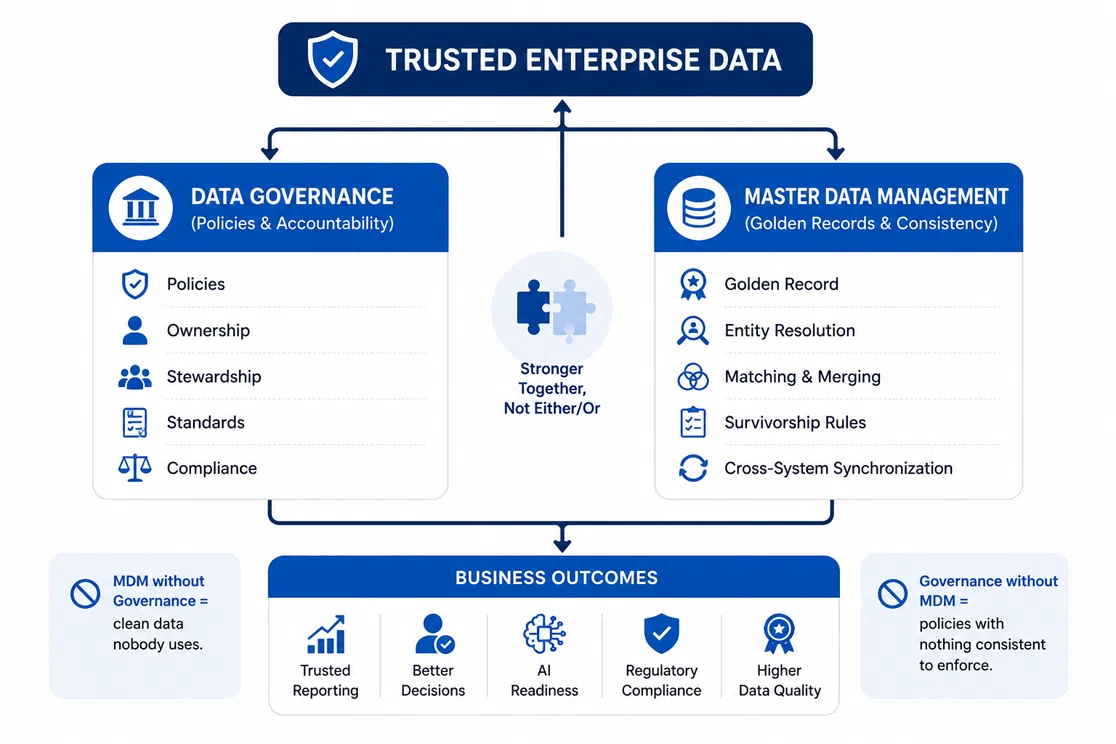
MDM without governance: clean data nobody uses
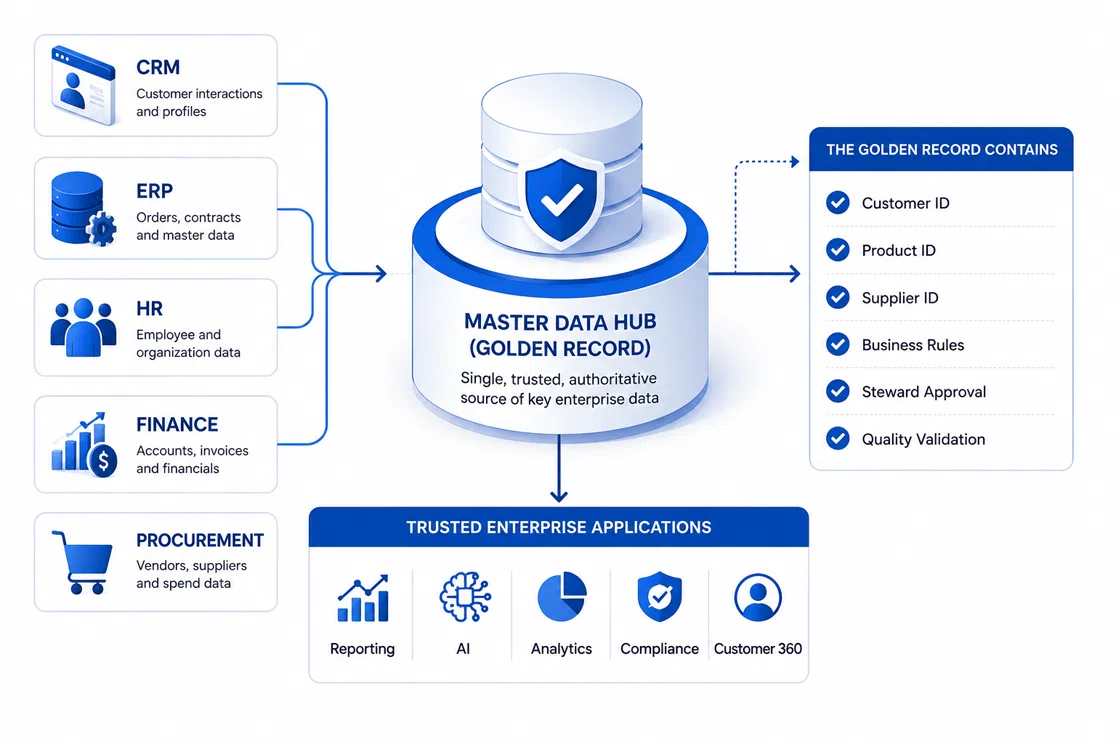
Building a golden record for your customer entity is technically achievable. Platforms like Informatica MDM, Reltio, and Profisee can match, merge, and deduplicate customer records into a single authoritative source.
But if no governance structure defines who is responsible for maintaining that golden record, what quality standards it must meet, and how systems are required to consume it, the MDM hub becomes another data store that teams route around when it is inconvenient.
Governance without MDM: policy with nothing to enforce
A governance policy that says ‘customer data must be complete and accurate’ is meaningless without a defined canonical customer entity. Complete against which definition? Accurate compared to which system?
MDM provides the reference point that governance policies need to be operationalized. It defines what the authoritative version of a data entity looks like, which makes it possible to measure quality, assign ownership, and enforce standards consistently.
MDM success depends on knowing which master data domains are already broken.
BluEnt’s Data Governance Maturity Assessment includes a dedicated MDM readiness dimension. 18 questions. 15 minutes. No sales call required.
Data Governance Maturity Assessment
A structured diagnostic for CDOs, CIOs, and Chief Compliance Officers. 18 questions across six governance dimensions. Receive a scored maturity profile and prioritised recommendations.
Your Details
Your Assessment Results
Overall Governance Maturity Level
Receive Your Full Report
A BluEnt governance consultant will prepare a personalised report with specific recommendations for your highest-priority gaps. Book a 60-minute discovery call to discuss your findings.
The Six Master Data Domains That Drive Enterprise Performance
Not all data is master data. Master data describes the core entities that appear across multiple systems and business processes. Here are the six domains that most enterprises need to govern as a priority.
| Domain | Why It Matters |
|---|---|
| Customer | The most critical domain for most enterprises. Customer master data governs how individuals and organizations are identified, segmented, and served across sales, marketing, service, and finance systems. Duplicate, incomplete, or inconsistent customer records are the most common source of enterprise data quality failures. |
| Product | Product master data governs how products and services are defined, categorized, and described across procurement, inventory, sales, and finance systems. Inconsistent product data drives supply chain errors, incorrect pricing, and revenue recognition problems. |
| Supplier | Supplier master data governs vendor identity, classification, payment terms, and compliance status. Fragmented supplier data increases procurement risk, enables duplicate payments, and makes spend analytics unreliable. |
| Employee | Employee master data governs workforce identity, organizational structure, roles, and cost center assignments. It is the foundation for accurate HR analytics, access governance, and organizational reporting. |
| Location | Location of master data governs physical addresses, organizational sites, and geographic hierarchies. Inconsistent location data affects logistics accuracy, regulatory compliance, and geographic reporting. |
| Financial | Financial hierarchy master data governs cost centers, legal entities, chart of accounts structures, and intercompany relationships. It is the foundation for consolidated reporting and audit-ready financial governance. |
Four Ways MDM Enables Data Governance at Scale
MDM translates governance from policy into practice. Here is specifically how.
Provides a Consistent Reference Point for Ownership Assignment
Governance requires data ownership. But ownership of what, exactly? Without MDM, ownership debates stall at ‘which system is authoritative’ rather than advancing to ‘who is accountable for this data entity.
MDM defines the canonical entity. Governance assigns an owner to it. That owner’s accountability extends to every system that consumes the master’s record, which is how governance policies become enforceable across platform boundaries.
Makes Data Quality Standards Measurable
Quality standards need a reference to measure against. MDM provides the defined data model, which fields are required, what values are valid, which relationships must be populated, that quality rules are written to enforce.
Tools like Informatica Data Quality, Collibra DQ, and Microsoft Purview Data Quality apply quality rules to master data entities and produce measurable compliance scores. Without MDM, quality measurement becomes a per-system exercise that produces incompatible results.
Enables Reliable Cross-System Reporting and Analytics
Dashboards and analytics that aggregate data across systems are only as reliable as the consistency of the underlying entity definitions. When a customer in the CRM is the same entity as a customer in the ERP, because MDM has created a shared golden record, cross-system reporting produces trustworthy results.
When they are not, every cross-system report requires manual reconciliation. That reconciliation cost, measured in analyst hours and delayed decisions, is the hidden price of ungoverned master data.
Provides Safe Foundations for AI and Automation
AI tools that surface, summarize, or act on enterprise data; Microsoft Copilot, Salesforce Einstein, enterprise LLMs, operate on whatever data they can access. If master data is inconsistent, AI surfaces inconsistent results. If customer definitions vary by system, AI recommendations built on customer data are built on a fractured foundation.
MDM governed data is AI-ready data. Consistent entity definitions, enforced quality standards, and clear ownership mean AI outputs are built on information the organization can trust.
Your enterprise MDM program is only as strong as the governance framework behind it.
BluEnt’s MDM consulting team designs and implements master data governance programs across complex, multi-system enterprise environments. Request a proposal tailored to your data domains and technology stack.
BluEnt in Practice: MDM as the Foundation for AI-Ready Data
A US-based enterprise engaged BluEnt to prepare its data environment for Microsoft Copilot deployment. The immediate challenge was a 58-terabyte Egnyte environment with no classification or governance structure. The deeper challenge emerged quickly: the organization had no consistent master data definitions across its enterprise platforms.
Cost centers were coded differently in Egnyte, the ERP, and the project management system. Organizational units had no canonical hierarchy. The same vendors appeared under different names across procurement and finance. Any AI tool operating in this environment would surface conflicting results, because the underlying data described the same entities incompatible ways.
BluEnt’s governance framework included a master data alignment workstream as a foundational element. Canonical definitions were established for the client’s highest-priority data domains: cost centers, organizational units, and project codes. Mapping tables were built to reconcile legacy representations across systems, and ownership was assigned to a named data steward in each domain.
The result was not a full MDM platform deployment; that was a downstream workstream in the roadmap. It was a governed master data foundation that made AI deployment safe, reporting consistent, and governance policies enforceable across platform boundaries from day one.
Client details are shared with permission. Engagement delivered by BluEnt’s data governance practice, US.
How to Start: A 4-Step MDM Governance Foundation
A successful MDM governance program does not require a full platform of deployment on day one. It requires a disciplined approach to the highest-priority domain, governed from the start.
Identify Your Highest-Pain Master Data Domain
Choose the domain where master data fragmentation is causing the most visible business pain: the customer entity that does not reconcile across systems, the product catalog that cannot support accurate inventory, the financial hierarchy that makes consolidation a manual exercise every quarter.
This is your proof-of-value domain. Govern it well before expanding.
Define the Golden Record Before Selecting a Platform
The golden record definition, which attributes are canonical, what values are valid, which relationships are required, is a governance decision, not a technology decision. Define it with the business owners of the domain before evaluating MDM platforms like Informatica MDM, Reltio, Profisee, or SAP Master Data Governance.
Organizations that select MDM platforms before defining their golden record end up configuring the platform to match the mess rather than the desired state.
Assign a Master Data Owner with Enforcement Authority
The master data owner for each domain needs the authority to reject non-compliant data submissions, mandate source system corrections, and enforce quality standards across every system that consumes the master’s record. Authority without enforcement is the governance of theater.
Measure Duplication, Completeness, and Consistency from Week One
Establish baseline metrics before the program starts: how many duplicate records exist in the priority domain, what percentage of required fields are populated, and how many systems are using inconsistent values for the same entity. Track these metrics monthly.
Improvement in these three metrics is the business case for expanding MDM governance to additional domains. Without measurement, MDM programs lose executive support before they deliver results.
Build an MDM governance program your enterprise will actually use.
BluEnt’s master data management consulting team designs domain-by-domain MDM programs built around governance from the start, not retrofitted after deployment. Book a strategy session to scope your MDM governance requirements.
Frequently Asked Questions
What is the difference between MDM and data governance?Data governance is the framework of policies, ownership structures, and accountability that determines how all data in an organization is managed and used. MDM is a specific discipline within that framework that focuses on creating and maintaining consistent, authoritative definitions of core shared data entities, customers, products, suppliers, locations, and financial hierarchies. MDM provides the canonical data foundation that data governance policies are designed to protect and enforce.
What MDM platforms do enterprise organizations use?The leading enterprise MDM platforms include Informatica MDM, Reltio (cloud-native, strong for customer and party data), Profisee (Microsoft-aligned, mid-market to enterprise), Stibo Systems (product and supplier MDM), SAP Master Data Governance (strong for SAP-centric organizations), and Semarchy xDM. Microsoft Purview provides data catalog and lineage capabilities that complement MDM platforms without replacing them. Platform selection should follow golden record definition, not precede it.
How long does an MDM implementation take?A focused MDM implementation for a single priority domain, customer or product, typically takes 3 to 6 months from golden record definition to initial production deployment. Enterprise-wide MDM programs covering multiple domains typically run 12 to 24 months. The most common delay is not technology deployment; it is governance decisions: who owns the golden record, how conflicts between source systems are resolved, and what quality standards the master record must meet.
Can MDM work without a dedicated MDM platform?Yes, particularly in the early stages of a program. A governed master data approach can be implemented using a data catalog (Collibri, Microsoft Purview) to define canonical entities, a data quality tool to measure and enforce standards, and clear ownership and stewardship assignments. A dedicated MDM platform becomes necessary when the matching, merging, and survivorship logic required to maintain the golden record exceeds what catalog and quality tools can manage, typically when source system volumes or data quality complexity reach enterprise scale.
What is a golden record in MDM?A golden record is the single authoritative representation of a master data entity, a customer, product, supplier, or location, that serves as the trusted source for all systems that need to reference that entity. The golden record is constructed by matching and merging records from multiple source systems, applying defined survivorship rules to determine which source provides the authoritative value for each attribute, and validating the result against quality standards. Every system that consumes master data should reference the golden record rather than maintaining its own local copy.
How does MDM support AI and advanced analytics readiness?AI tools that access enterprise data, Microsoft Copilot, business intelligence platforms, machine learning models, produce outputs that are only as reliable as the consistency of the data they operate on. When customer, product, and financial entities are governed as master data with consistent definitions and enforced quality standards, AI tools surface results that business users can trust. When master data is fragmented across systems with inconsistent definitions, AI amplifies the inconsistency rather than resolving it. MDM governance is a prerequisite for reliable AI deployment, not a parallel initiative.

 Governing AI Tools in AEC: Copilot, Digital Twins, and Generative Design
  Data Governance for AI and Advanced Analytics: Building the Foundation That Works
  Centralized vs. Federated vs. Hybrid Data Governance: Which Model Fits Your Organization
  Data Governance Roles and Responsibilities in AEC Organizations